Ipamorelin is not an approved drug, and the FDA closed the compounding-pharmacy channel in 2023. Where to buy ipamorelin for research in 2026 means one channel: a research-supply vendor. This guide covers the chemistry trap that makes cheap ipamorelin not really ipamorelin, the identity-verification requirements specific to this pentapeptide, and the $50–$150 pricing range for research-grade material.
Ipamorelin is a synthetic 5-amino-acid peptide built by Novo Nordisk in the late 1990s. It is available as a research reference compound. It is not FDA-approved for any indication. A Phase III trial for postoperative ileus failed, and clinical development stopped. Research-grade pricing runs $50–$100 per 5 mg vial. The identity-verification challenge: the compound’s pharmacological value depends on two unnatural amino acids called Aib and D-2-Nal that are not detectable by label inspection alone — only a proper CoA confirms their presence.
“
Despite ipamorelin’s frequent appearance in grey-market protocols, robust human clinical evidence for performance, body composition, or musculoskeletal recovery is essentially absent.
— Sports Medicine, 2026 review
The 60-second answer: Source from a research-supply vendor that ships lyophilized (freeze-dried) powder with a third-party CoA. The CoA must show HPLC purity ≥98%, mass-spec at [M+H]+ 712.4, and explicit Aib + D-amino acid confirmation. Research-grade pricing runs $50–$150 per vial. Ipamorelin is frequently co-sourced with CJC-1295 for studies examining dual GH-axis stimulation.
Sourcing channels and their regulatory status
Ipamorelin sits in a regulatory dead zone. It’s not a scheduled drug. It’s not approved. It’s not compounding-eligible. Three channels have been used historically:
- Prescription: Not available. No FDA approval means no physician can write a prescription for ipamorelin.
- Compounding pharmacy: Closed since 2023. The FDA added ipamorelin to the 503A ineligibility list. The 503A channel permits pharmacists to compound custom medications for individual patients; ipamorelin is no longer eligible.
- Research-supply vendor: The current legal channel. Vendors sell ipamorelin as a reference compound for laboratory use, labeled Research Use Only (21 CFR § 809.10(b)(9)).
The research-supply channel is the focus of this guide, as it is the only lawful route for obtaining ipamorelin in a laboratory context.
Research-supply channel limitations: No FDA-regulated batch testing — identity and purity rely entirely on the vendor’s third-party CoA. Ipamorelin has not been evaluated in a randomized controlled human trial for any body-composition, performance, or recovery endpoint. Research use is strictly in-vitro, ex-vivo, or preclinical unless conducted under an approved IND.
What the compound is
Ipamorelin is a five-amino-acid peptide. The sequence reads Aib-His-D-2-Nal-D-Phe-Lys-NH2. Five residues sounds simple. Only one of them is normal.
Here’s the chemistry that matters. Aib is α-aminoisobutyric acid, an unnatural amino acid not found in any standard protein. D-2-Nal is D-2-naphthylalanine, another unnatural one with a bulky side chain. Three of the five residues (D-2-Nal, D-Phe, D-Lys) are mirror-image “D” versions of natural amino acids. These aren’t decoration. They’re the reason ipamorelin works differently than older peptides like GHRP-6.
Ipamorelin activates the ghrelin receptor (GHS-R1a) on pituitary cells. That triggers growth hormone release. So do GHRP-2 and GHRP-6. The difference is selectivity.
Studies have reported that ipamorelin stimulates GH release with minimal cortisol, prolactin, or appetite spillover. GHRP-6 has been shown to reliably elevate cortisol and prolactin and to stimulate appetite. The Aib and D-2-Nal residues are understood to underlie the more selective profile (Rahman et al., 2026).
The four checks that matter for ipamorelin specifically
The standard eight vendor criteria still apply. Four are sharper here. Three of them are variations on the same theme: ipamorelin’s selling point is selectivity, and selectivity depends on chemistry the CoA must verify.
1. Aib confirmed on the CoA
The Aib residue at position 1 is structurally specific. It’s not a natural amino acid. A CoA that lists only “5-amino-acid pentapeptide” without naming Aib is incomplete.
Check the math. A peptide with alanine swapped for Aib would weigh 14 Da lighter, and the [M+H]+ mass-spec peak would land at roughly 698.4 instead of 712.4. The identity report should show the full sequence with Aib notation, and the mass-spec trace should match 711.9 g/mol within about 0.5 Da.
2. D-amino acid stereochemistry confirmed
Three residues are D-isomers, not the natural L-form. A peptide made with the wrong stereochemistry would weigh exactly the same. Mass-spec alone can’t catch it.
A compliant CoA should show explicit D-/L- notation in the chemical name, plus either chiral HPLC or amino-acid analysis after hydrolysis. Without stereochemistry verification, a pentapeptide may confirm the correct mass but not confirm ipamorelin’s identity.
3. Pricing that reflects the unnatural amino acids
The pharmacological value of ipamorelin versus older GHRPs lies in its selectivity profile. GHRP-6 costs less to synthesize because it uses only standard amino acids. Ipamorelin priced at GHRP-6 levels warrants scrutiny of the synthesis economics.
The unnatural amino acid building blocks cost meaningfully more than standard L-amino acids. Below-floor pricing can indicate skipped purification or residue substitution — resulting in a pentapeptide that matches the label by name but diverges from the authentic structure at the receptor level.
4. Lyophilized vials, not pre-mixed kits
Lyophilized (freeze-dried) powder is the standard delivery form for research-grade peptides. Reconstitution is performed in the laboratory prior to use in assays.
Some vendors sell pre-mixed CJC-1295 + ipamorelin liquid kits. The liquid format is less stable than lyophilized powder and, more critically, a single blend CoA does not individually confirm each peptide’s identity. Separate lyophilized vials with individual CoAs are the appropriate standard for research-grade sourcing.
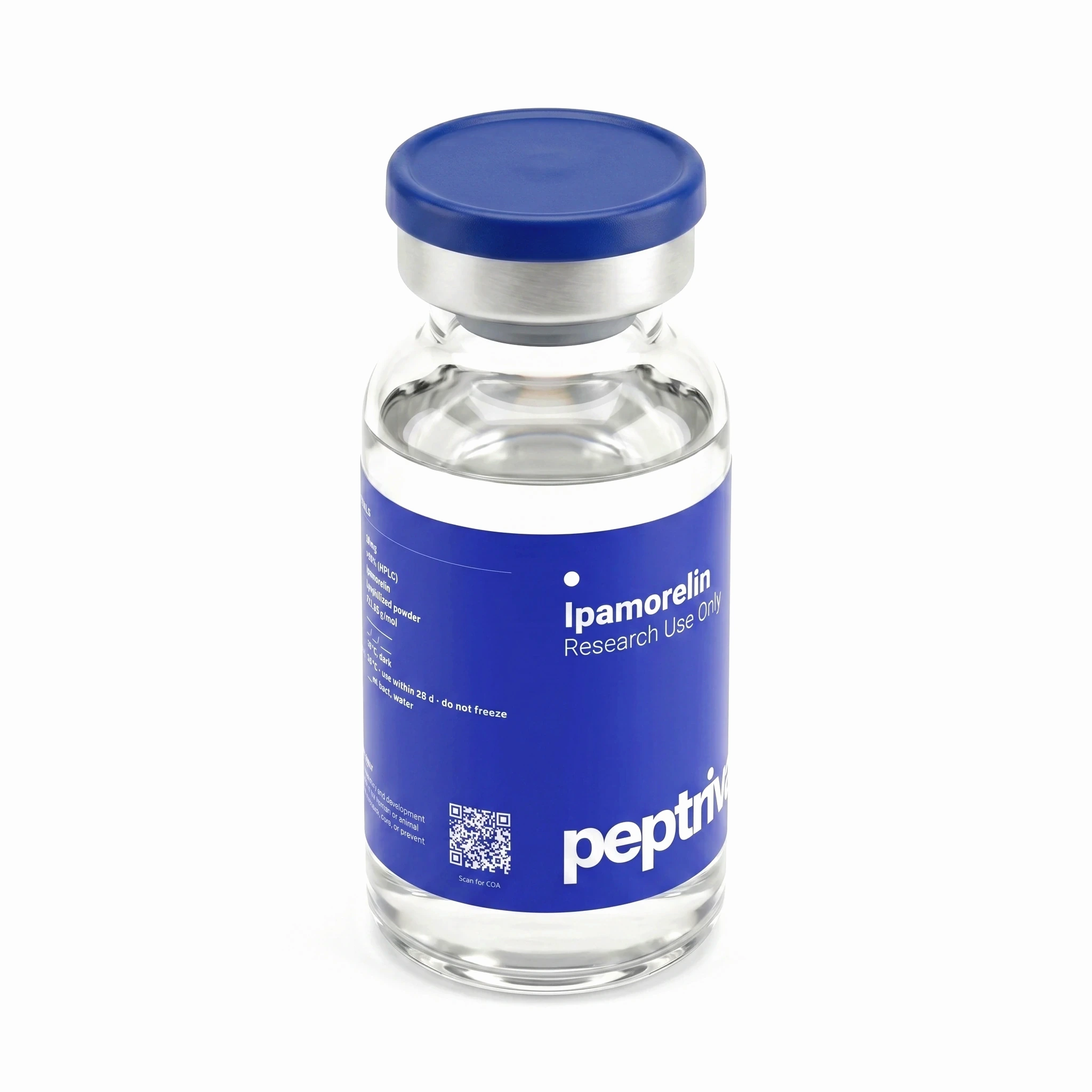
Ipamorelin
The standard pentapeptide (Aib-His-D-2-Nal-D-Phe-Lys-NH2) cited across the 2026 orthopaedics review and the 2024 cisplatin cachexia model. CAS 170851-70-4, observed mass [M+H]+ 712.4, ≥98% HPLC purity, ISO 17025 third-party CoA on every lot with explicit Aib and D-amino acid confirmation.
2026 pricing benchmarks
Ipamorelin sits in a strange pricing zone. By length (5 residues) it should be cheap. By complexity (two unnatural amino acids, three D-isomers) it costs meaningfully more per mg than a standard 5-mer. Here’s the 2026 retail map:
- 5 mg vial: $50–$100 ($10–$20/mg). The most common size.
- 10 mg vial: $80–$150 ($8–$15/mg). Better per-mg value.
- CJC-1295 + ipamorelin bundle: $90–$150. Stack discount. Verify both individual CoAs ship.
- Multi-vial discounts: 10–25% off for 3-pack or 6-pack purchases.
Below $40 per 5 mg vial, the synthesis economics warrant scrutiny. The unnatural amino acid building blocks are not cheap; material priced below that floor may reflect shortcut purification or residue substitution. Above $30 per mg, pricing reflects retail markup rather than additional synthesis quality.
The CJC-1295 / ipamorelin co-investigation context
Ipamorelin is frequently co-sourced with CJC-1295. The two compounds have been studied together in preclinical models because they activate complementary receptor systems on pituitary cells.
Ipamorelin is a GHS-R1a (ghrelin receptor) agonist. CJC-1295 is a GHRH-receptor agonist. Both receptor systems converge on growth hormone release through different intracellular pathways.
Preclinical models have reported that combining the two produces a larger and more pulsatile GH response than either compound alone. A 2026 sports-medicine review reported improved muscle tension in mice in a study investigating the combination. Controlled human trial data for this pairing is absent (Mayfield et al., 2026).
For CoA verification purposes, sourcing both compounds from the same vendor facilitates matching lot dates and a unified identity-verification workflow. See CJC-1295 vs ipamorelin and the stack research article.
The legal picture
Ipamorelin is not FDA-approved for anything. Its biggest human trial was a Phase III study for postoperative ileus. It failed. Helsinn Therapeutics dropped clinical development. Zero randomized human trials have tested ipamorelin for muscle gain, fat loss, anti-aging, or recovery (Mendias & Awan, 2026).
The 2023 FDA action put ipamorelin on the 503A ineligibility list. The compounding-pharmacy door closed. Research-grade sales operate under Research Use Only labeling (21 CFR § 809.10(b)(9)). See peptides and the 2023 503A categorization.
Ipamorelin is also banned by WADA under category S2. Anti-doping labs have validated mass-spec detection. Any athlete subject to WADA testing should assume it’s detectable. See the 2026 WADA peptide list.
Red flags specific to ipamorelin
- CoA missing Aib or D-amino acid notation. The sequence Aib-His-D-2-Nal-D-Phe-Lys-NH2 must appear explicitly. “5-amino-acid pentapeptide” without residue identity is incomplete.
- Mass-spec not matching 712.4 [M+H]+. Alanine instead of Aib = 14 Da lighter. Wrong mass means wrong molecule.
- Pricing at GHRP-6 levels. GHRP-6 uses only standard amino acids and synthesizes cheap. Ipamorelin at the same price is either subsidized or substituted.
- Pre-mixed CJC + ipamorelin kits without separate CoAs. A blend CoA doesn’t prove each peptide’s identity. Demand both individual reports.
- “Modified” or “Enhanced” ipamorelin variants. The standard pentapeptide is the molecule with the published pharmacology. Branded variants are marketing.
- Clinical claims on the product page. “Builds lean muscle.” “Reverses aging.” That’s an unapproved drug claim, and the FDA acts on these.
- Missing CAS number. CAS 170851-70-4 is the unique chemical identifier. Its absence is a red flag.
- No third-party ISO 17025 lab verification. Internal QC isn’t enough. Stereochemistry verification needs a real outside lab.
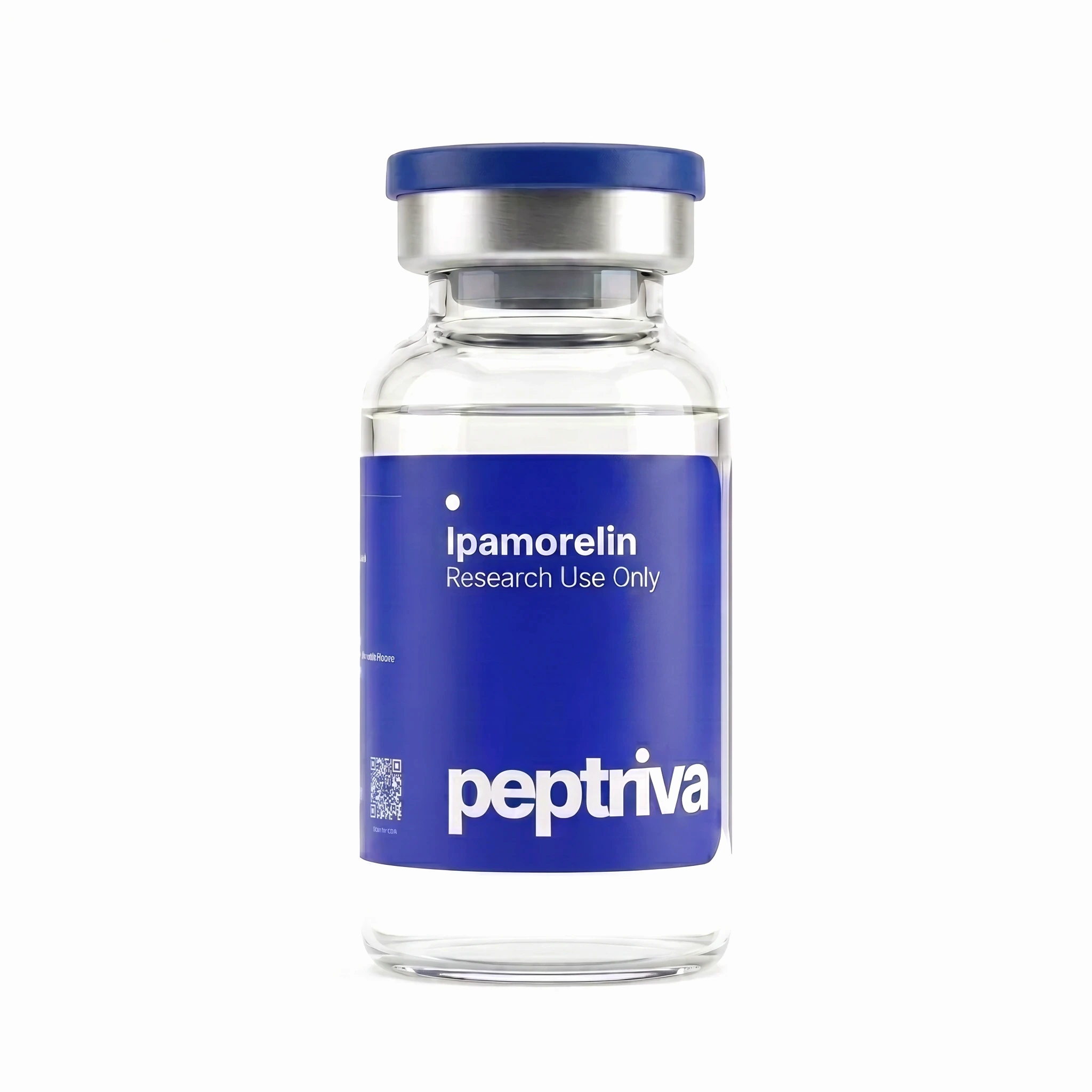
Ipamorelin
Selective GHS-R1a agonist, sequence Aib-His-D-2-Nal-D-Phe-Lys-NH2, CAS 170851-70-4. The same reference compound used across the cited preclinical studies. COA with HPLC trace, mass-spec at [M+H]+ 712.4, and explicit Aib + D-amino acid identity ships with every order.
Frequently asked questions
Is ipamorelin legal to acquire for research?
Ipamorelin is legal to acquire as a research reference compound from vendors that supply it under Research Use Only labeling. It is not available by prescription and is not compounding-eligible under 21 CFR § 503A. Selling ipamorelin for human consumption is illegal; acquiring it as labeled research material from a compliant vendor is lawful.
How much does ipamorelin cost?
Research-grade pricing in 2026 runs $50–$100 per 5 mg vial or $80–$150 per 10 mg vial. CJC-1295 + ipamorelin kits run $90–$150 per pair. Below those benchmarks, the synthesis economics suggest skipped purification or substituted amino acids — the unnatural building blocks are not cheap to source or incorporate.
Why is ipamorelin co-investigated with CJC-1295?
Ipamorelin (GHS-R1a agonist) and CJC-1295 (GHRH-receptor agonist) activate complementary receptor pathways on the same pituitary cells. Preclinical models have shown that the combination produces a larger and more pulsatile GH response than either compound alone. Controlled human trial evidence for the pairing is absent. See CJC-1295 vs ipamorelin.
How is ipamorelin different from GHRP-2 and GHRP-6?
All three are GHS-R1a agonists with comparable GH-stimulating potency in preclinical assays. The pharmacological distinction is selectivity. Studies have reported that ipamorelin produces minimal cortisol, prolactin, and appetite off-target effects at GH-stimulating concentrations. GHRP-6 has been shown to elevate cortisol and prolactin reliably and to stimulate appetite via direct ghrelin-mimetic activity. GHRP-2 sits between the two in selectivity profile.
What should an ipamorelin Certificate of Analysis show?
The full sequence Aib-His-D-2-Nal-D-Phe-Lys-NH2 spelled out. CAS 170851-70-4. HPLC purity ≥98% with a chromatogram. Mass-spec at [M+H]+ 712.4. Water content 2–8% via Karl Fischer titration (a chemistry test that measures trace water). An ISO 17025-accredited lab on the report. For ipamorelin specifically, also look for chiral HPLC or amino-acid analysis to confirm the D-amino acids. See reading a CoA for the full framework.
Is ipamorelin banned by WADA?
Yes. Category S2, banned in and out of competition. Detection methods are validated and in active use. If you’re tested, assume it’ll show up. See the 2026 WADA peptide list.
What to know now
- No prescription channel exists. Research-supply vendors are the only legal option.
- CAS 170851-70-4, MW 711.9, [M+H]+ 712.4. The identity parameters a compliant CoA must confirm.
- Aib and D-amino acid notation on the CoA, or it’s not ipamorelin. Cheap synthesis swaps these out.
- $50–$150 per vial. More expensive than GHRP-6 per mg, for chemistry reasons.
- CJC-1295 + ipamorelin is the most commonly co-investigated pairing. Same vendor, same lot, same lab for identity verification.
- Phase III ileus trial failed; clinical development stopped. Zero human RCT evidence for performance or body composition.
- WADA S2 banned. Validated mass-spec detection in use.
What we’re watching
The central open question is whether a controlled human trial of ipamorelin will be initiated. The Phase III ileus failure is two decades old, and no subsequent IND-supported human study has been published. Interest in selective ghrelin-receptor agonism for oncology-related cachexia and post-surgical recovery has continued in the broader literature. Anamorelin, a structurally related GHS-R1a agonist, received regulatory approval in Japan for cancer-related anorexia-cachexia. Until controlled human data for ipamorelin accumulates, its clinical effect size remains genuinely unknown. Regulatory activity around the 503A status may also shift the sourcing landscape.
References
- Rahman, O. F., Lee, S. J., & Seeds, W. A. (2026). Therapeutic peptides in orthopaedics: Applications, challenges, and future directions. JAAOS: Global Research and Reviews, 10(1). https://doi.org/10.5435/JAAOSGlobal-D-25-00236
- Mendias, C. L., & Awan, T. M. (2026). Safety and efficacy of approved and unapproved peptide therapies for musculoskeletal injuries and athletic performance. Sports Medicine. https://doi.org/10.1007/s40279-026-02437-0
- Mayfield, C. K., Bolia, I. K., Feingold, C. L., et al. (2026). Injectable peptide therapy: A primer for orthopaedic and sports medicine physicians. The American Journal of Sports Medicine, 54(1), 223–229. https://doi.org/10.1177/03635465251357593
- Lu, Z., Ngan, M. P., Liu, J. Y. H., et al. (2024). The growth hormone secretagogue receptor 1a agonists, anamorelin and ipamorelin, inhibit cisplatin-induced weight loss in ferrets: Anamorelin also exhibits anti-emetic effects via a central mechanism. Physiology & Behavior, 284, 114644. https://doi.org/10.1016/j.physbeh.2024.114644
- Sinha, D. K., et al. (2020). Beyond the androgen receptor: The role of growth hormone secretagogues. Translational Andrology and Urology, 9(Suppl 2), S149–S159. https://doi.org/10.21037/tau.2019.11.30
- U.S. Food and Drug Administration. (2023). Section 503A of the Federal Food, Drug, and Cosmetic Act. https://www.fda.gov/drugs/human-drug-compounding/section-503a-federal-food-drug-and-cosmetic-act
- International Organization for Standardization. (2017). ISO/IEC 17025:2017 — General requirements for the competence of testing and calibration laboratories. https://www.iso.org/standard/66912.html
- World Anti-Doping Agency. (2026). The World Anti-Doping Code International Standard: Prohibited List. https://www.wada-ama.org/en/prohibited-list