Across the growth-hormone-releasing-peptide literature, ipamorelin appears repeatedly as the reference compound of choice. Not because it is the most potent GHRP, nor the longest-acting. Because it is the cleanest. When it triggers a GH spike, it does so without the cortisol, prolactin, and appetite side effects documented with older GHRPs. That selectivity profile is what has made it a standard pharmacological tool in GH-axis research.
Ipamorelin is a synthetic 5-amino-acid pentapeptide. It binds the ghrelin cell-surface target (GHS-R1a) on pituitary somatotrophs, triggering GH release. Its defining feature is selectivity: GH stimulation with minimal effect on cortisol, prolactin, ACTH, or aldosterone. The most rigorous trial on record, a Phase III postoperative ileus study, failed its primary endpoint and ended clinical development. Zero randomized controlled trials have tested it for muscle gain, fat loss, anti-aging, or recovery indications. It is WADA-prohibited (S2) and FDA placed it on the 503A pharmacy compounding-ineligible list.
The ipamorelin story is the GH-axis-peptide story in miniature. A real molecule with a real mechanism. Developed by a serious pharma company. Worked exactly as designed in early pharmacology studies. It then failed its one major clinical test for an unrelated indication. From there, it drifted into research-supply channels. Today it's one of the two most-discussed GH-axis peptides in grey-market protocols.
This guide covers what ipamorelin is, why its cleanness matters for research design, where it fits in the broader GHRP family, what the published literature does and doesn't support, and how its regulatory status shapes the research-supply landscape.
What is ipamorelin?
Ipamorelin is a synthetic pentapeptide developed by Novo Nordisk in the late 1990s. The sequence is Aib-His-D-2-Nal-D-Phe-Lys-NH₂. 5 amino acids total, 2 of them non-natural. Those non-natural residues give ipamorelin its stability in blood and its cleaner cell-surface targeting compared to natural ghrelin or older GHRPs.
The molecular target is GHS-R1a — the cell-surface receptor endogenous ghrelin binds. Ghrelin is the endogenous “hunger hormone,” produced predominantly in the stomach. GHS-R1a is expressed on GH-producing somatotrophs in the anterior pituitary, on arcuate-nucleus neurons in the hypothalamus, and on various peripheral tissues. Activating it drives GH release, appetite, and energy-balance signaling.
Where ipamorelin differs from the older agents (GHRP-2, GHRP-6, hexarelin) is in what it doesn't activate. Older GHRPs, particularly GHRP-6, produce notable elevations in cortisol, prolactin, and ACTH alongside GH release. Those collateral effects come from incomplete cell-surface selectivity. Ipamorelin's clinical-pharmacology showed minimal effects on those side axes at GH-stimulating doses. That's the defining attribute we keep coming back to.
The defining feature that drove ipamorelin's development was selectivity: it stimulates GH release with minimal effect on cortisol, prolactin, ACTH, or aldosterone, in contrast to older GHRPs that produce notable collateral hormonal effects.
— from a 2026 review of growth hormone secretagogues in orthopaedic practice
A 2026 review by Rahman and colleagues in the Journal of the AAOS Global Research and Reviews groups ipamorelin with CJC-1295, tesamorelin, sermorelin, and AOD-9604 as growth hormone secretagogues acting on the GH/IGF-1 axis. (Strictly, ipamorelin's target is different from the GHRH target the rest of the group binds. We're listing it that way because that's how clinicians categorize it.)
Why ipamorelin's selectivity matters in research.
Ipamorelin became a standard pharmacological tool because of the cleanness of the readout, not the marketing. Characterizing GH-axis dynamics requires a stimulus that hits one target and one downstream pathway. Older GHRPs that also elevate cortisol introduce confounders. Cortisol blocks GH's anabolic effects. Prolactin has separate metabolic actions. ACTH alters glucocorticoid signaling.
Ipamorelin isolates the GH-axis effect from that noise. In rodent studies, cleaner mechanistic questions become tractable: are effects mediated specifically by GH release, or by the broader stress-axis activation that GHRP-6 produces? A 2020 rat study found ipamorelin reduced colonic and somatic pain in non-inflammatory models. Effects were blocked by a ghrelin-pathway blocker — demonstrating the specificity that distinguishes it from older GHRPs (Mohammadi et al., 2020).
This selectivity also explains why ipamorelin appears in the CJC-1295 combination studies rather than GHRP-2 or GHRP-6. Combining a GHRH analog (CJC-1295) with a ghrelin-pathway agent for synergistic GH release requires that the ghrelin-side agonist not simultaneously spike cortisol, which would attenuate the downstream anabolic signal.
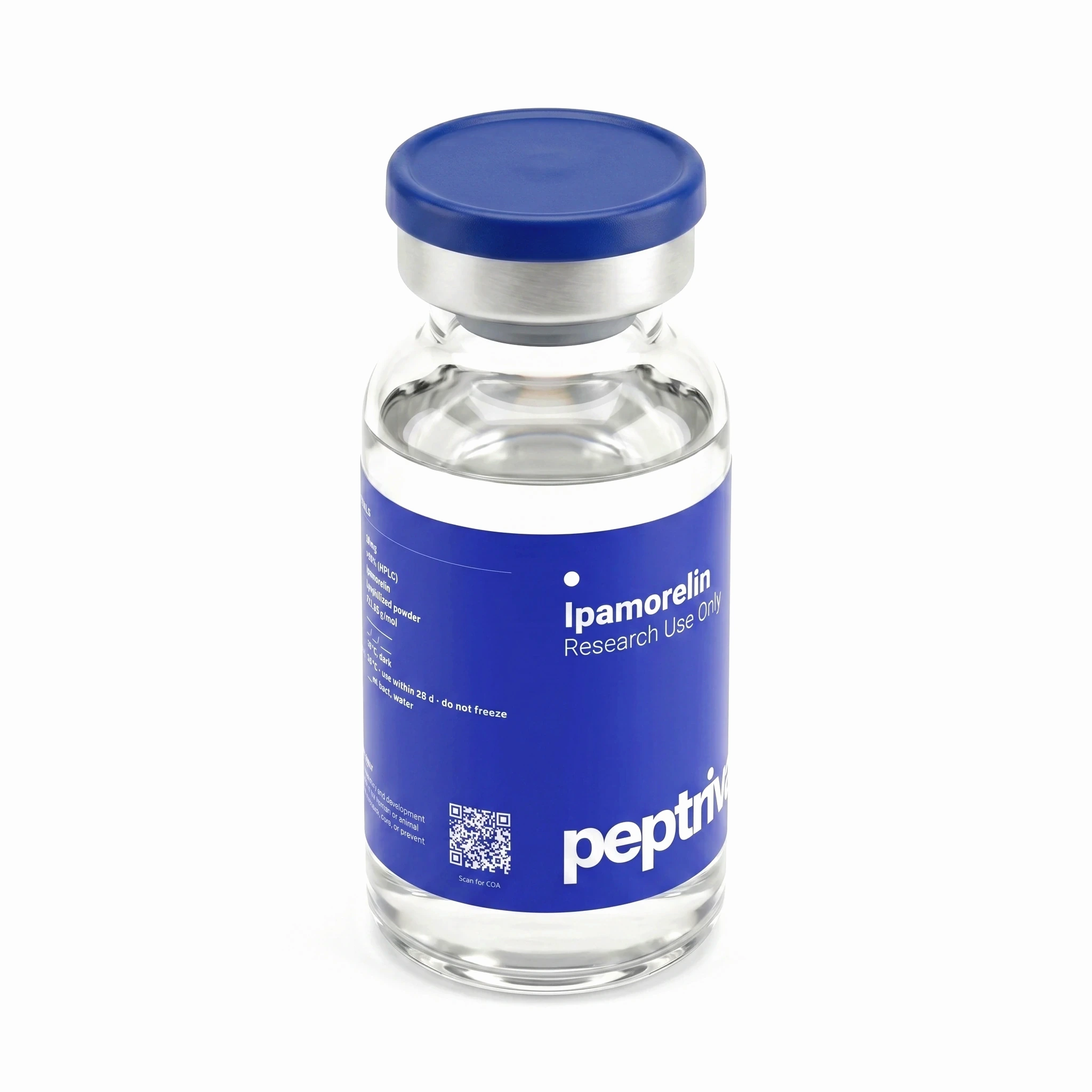
Ipamorelin
The same compound cited across the preclinical pain, cachexia, and GH-pathway studies in this guide. Lab-verified identity and purity, third-party COA per lot.
Preclinical findings: what the rodent work actually shows.
Ipamorelin's preclinical literature in the 2020s falls into three buckets: cachexia (wasting), pain, and reproductive-axis effects. There's very little new work on the “muscle gain” or “body composition” endpoints that drive the grey-market use.
Cachexia. A 2024 study in ferrets found ipamorelin (1–3 mg/kg, intraperitoneal) blocked cisplatin-induced weight loss during the delayed phase of chemo-induced nausea. Importantly, ipamorelin did not stop the vomiting itself. The weight-protective effect comes from a different mechanism. It's probably appetite stimulation and metabolic preservation via ghrelin signaling (Lu et al., 2024).
Visceral and somatic pain. The 2020 Mohammadi et al. rat study showed ipamorelin reduced colonic and somatic pain in non-inflammatory models. Effects were blocked by a ghrelin-pathway blocker. That's mechanistically interesting because it identifies a peripheral ghrelin mechanism for pain relief. It's distinct from the central GH-release pathway. It opens up applications outside the classical “GH stimulation” story.
Reproductive axis. A 2024 study in tilapia (a fish species used in reproductive endocrinology) found ipamorelin acetate increased spermatogenesis and elevated luteinizing hormone and 11-ketotestosterone (Gouda & Ganesh, 2024). Several inferential steps removed from human reproductive biology, but it suggests the ghrelin system has reproductive effects worth investigating in mammalian models.
What the preclinical literature doesn't robustly demonstrate is muscle growth, fat loss, or anti-aging effects in healthy animals. A 2026 sports-medicine review in the American Journal of Sports Medicine notes ipamorelin + CJC-1295 significantly improved muscle tetanic tension in mice with glucocorticoid-induced muscle loss (Mayfield et al., 2026). That's a cachexia model. Not healthy animals doing training.
The Phase III ileus trial: the one major human readout.
This is the most important real-world data point in ipamorelin's clinical history. It's also the one most often skipped in grey-market discussions. Novo Nordisk pushed ipamorelin into Phase III trials for postoperative ileus, the bowel-stopping condition that often follows abdominal surgery. The theory was that ghrelin-pathway activation would restart gastrointestinal motility.
The trial failed. Ipamorelin did not meet its primary endpoint. Clinical development was discontinued. The molecule was shelved as a therapeutic. We'd say this is the single most informative real-world data point on file. 1 Phase III trial, primary endpoint missed, program shut down. When tested rigorously against a controlled endpoint, the measurable effect wasn't large enough to support an approval.
This doesn't mean ipamorelin does nothing in humans. It plausibly does cause GH release. The cell-surface pharmacology is well-established. But it means that the threshold for clinical efficacy on a real endpoint, when actually measured, wasn't cleared. That's a different kind of evidence than “mechanism is plausible.”
Where this falls short. The ileus failure indicates ipamorelin's effects in humans may be more modest or context-dependent than the mechanism suggests. That is why the compound is treated as investigational in clinical literature. The ghrelin-pathway molecule that did clear a Phase III hurdle was anamorelin, approved in Japan for cancer cachexia — a different endpoint with a much larger evidence base. No Phase III data supports ipamorelin for muscle, fat, or recovery indications.
Where the human efficacy data stops.
Outside the failed ileus trial, the human evidence base for ipamorelin is essentially absent. No published randomized controlled trials have tested ipamorelin for the indications most frequently cited in grey-market discussions:
- Muscle gain or lean body mass in healthy adults or athletes
- Fat loss or body recomposition in any population
- Anti-aging or longevity endpoints
- Recovery from athletic training or injury
- Sleep quality, libido, or cognition
A 2026 sports-medicine review by Mendias and Awan in Sports Medicine concludes that despite ipamorelin's frequent appearance in grey-market protocols, robust human clinical evidence for performance, body composition, or musculoskeletal recovery is essentially absent. The same review groups ipamorelin among unapproved peptides where human safety data is scarce. The potential for serious harm exists.
The honest reading: ipamorelin's case in 2026 rests on 3 pillars. First, clinical-pharmacology data showing it causes GH release (true, but biomarker-level). Second, cell-surface-specific preclinical experiments (informative for mechanism, not for clinical effect). Third, inference from the broader GH-axis literature (which itself is mostly about tesamorelin in HIV lipodystrophy, a very different patient population).
The CJC-1295 + ipamorelin pairing.
In 2026, ipamorelin is almost always reported alongside CJC-1295 no DAC in the literature and in grey-market discussions. The pairing has a coherent mechanistic basis: GHRH-pathway activation (CJC-1295) plus ghrelin-pathway activation (ipamorelin) produces a larger GH pulse than either alone. The two pathways activate complementary signaling cascades inside the GH-producing cells.
What is notable about the pairing is that it represents a mechanism-based combination, not an outcomes-based one. The administration patterns documented in grey-market literature are drawn from clinical-pharmacology studies that established the synergistic GH-release effect — not from controlled human trials measuring downstream tissue benefit. The implicit assumption that “more GH means more downstream benefit” is not formally validated.
This is relevant because GH-axis biology has well-documented feedback dynamics. Sustained or repeated synergistic pulses can drive tolerance buildup, liver resistance to GH signaling, and adaptive changes that dampen the response. Whether the combination's acute effect translates to durable benefit, or whether a transient biomarker elevation simply fades, is untested in controlled human studies.
Risks, side effects, and the unknowns.
The adverse-event profile documented in the GHRP literature for ipamorelin is consistent with the broader class, with the caveat that cleaner cell-surface targeting is expected to reduce the cortisol and prolactin elevations observed with older GHRPs. Risks noted in the published literature include:
- GH-axis side effects when GH is elevated supraphysiologically: edema (fluid retention), joint stiffness, paresthesias (tingling), insulin resistance, theoretical IGF-1-mediated oncogenic concerns.
- Tolerance buildup. Continuous ghrelin-pathway activation may cause cell-surface downregulation. Grey-market literature describes pulsatile administration patterns on this basis, though no controlled human evidence supports a specific schedule.
- Cross-reactivity caveat. A 2021 method paper noted some compounds (cannabidiol and carboxy-THC) act as allosteric ghrelin-pathway ligands and may interact with ipamorelin effects in unexpected ways (Danila et al., 2021).
- Long-term safety: no long-term human safety data exist for ipamorelin in healthy, non-clinical populations. The Phase III postoperative ileus trial population represents the largest controlled exposure on record, and that was a short-duration acute hospital indication.
- Pharmacy compounding restrictions. FDA placed ipamorelin among substances ineligible for 503A pharmacy compounding in recent years, restricting legal clinical access.
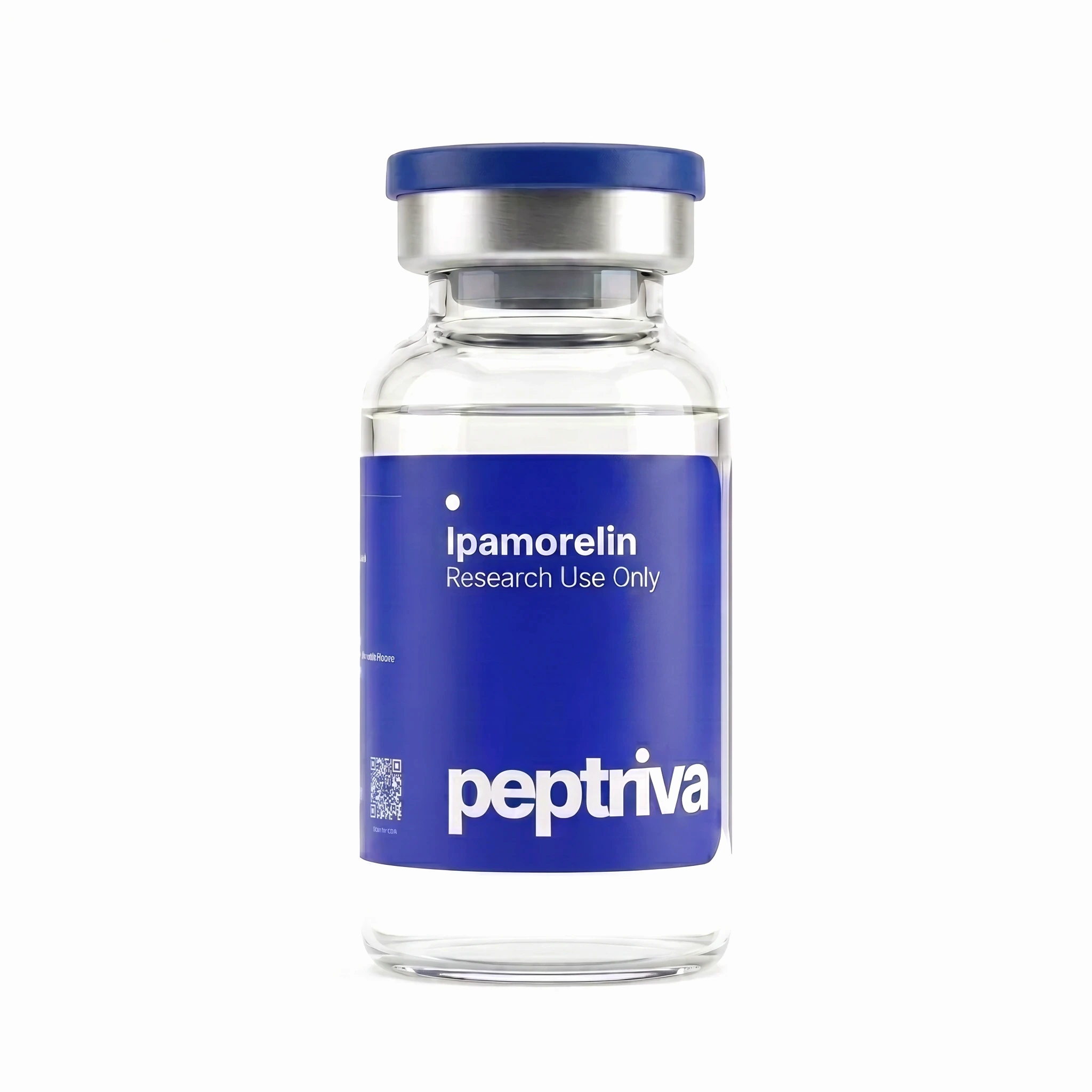
Ipamorelin
5-amino-acid pentapeptide ghrelin-receptor agonist (Aib-His-D-2-Nal-D-Phe-Lys-NH₂). The same reference compound used across the cited preclinical studies. COA available with each lot.
Regulatory status.
Ipamorelin isn't approved by FDA, EMA, or any major regulatory body for any indication. Clinical development was discontinued after the Phase III ileus failure. It's on the WADA Prohibited List under category S2. Reliably detectable in athlete samples by validated LC-MS/MS methods. Major sports leagues prohibit its use.
The FDA's decision to place ipamorelin among substances ineligible for 503A pharmacy compounding is what pushed it out of legitimate clinical channels and into research-supply-only distribution. Like CJC-1295, ipamorelin is now used predominantly as a research tool in in-vitro and animal studies of GH-axis pharmacology. Grey-market human use happens in parallel, outside the regulated supply chain.
What to know now
- Mechanism: 5-amino-acid pentapeptide (Aib-His-D-2-Nal-D-Phe-Lys-NH₂) that selectively binds the ghrelin cell-surface target to stimulate endogenous GH release.
- Selectivity profile: the cleanest of the GHRP family. Minimal cortisol, prolactin, ACTH, or aldosterone elevation at GH-stimulating doses, unlike GHRP-6 or hexarelin.
- Clinical development: halted after a Phase III postoperative ileus trial failed its primary endpoint. The most informative real-world data point in the ipamorelin file.
- Human RCT data for performance/body composition: zero. No randomized trials for muscle gain, fat loss, anti-aging, recovery, sleep, libido, or cognition.
- Preclinical signal: chemotherapy cachexia, visceral pain models, reproductive-axis effects in fish models. Mechanistically interesting, several inferential steps from human efficacy.
- FDA status: not approved. Placed among substances ineligible for 503A pharmacy compounding.
- WADA status: Prohibited under S2. Reliably detectable by accredited labs.
- Pairing: commonly stacked with CJC-1295 no DAC for supra-additive GH-release effect. A mechanism-based, not outcomes-based, protocol.
What we're watching
Three things to track over the next 18 months. First, whether any ghrelin-pathway molecule (ipamorelin, anamorelin, relamorelin, or a newer one) enters Phase III trials for indications beyond cachexia. That would be the most direct test of whether the broader GH-axis-stimulation thesis translates to clinical benefit in healthier populations. Second, whether independent labs replicate the CJC-1295 + ipamorelin synergy data in non-rodent models. That's the experimental gap between mechanism and translational signal. Third, whether the FDA's 503A compounding policy for ipamorelin changes in either direction. Status moves are meaningful signals about regulator confidence.
References
- Lu, Z., Ngan, M. P., Liu, J. Y. H., et al. (2024). The growth hormone secretagogue receptor 1a agonists, anamorelin and ipamorelin, inhibit cisplatin-induced weight loss in ferrets. Physiology & Behavior, 284, 114644. https://doi.org/10.1016/j.physbeh.2024.114644
- Mohammadi, E. N., Louwies, T., Pietra, C., Northrup, S. R., & Greenwood-Van Meerveld, B. (2020). Attenuation of visceral and somatic nociception by ghrelin mimetics. Journal of Experimental Pharmacology, 12, 267–274. https://doi.org/10.2147/JEP.S249747
- Sinha, D. K., Balasubramanian, A., Tatem, A. J., et al. (2020). Beyond the androgen receptor: the role of growth hormone secretagogues in the modern management of body composition in hypogonadal males. Translational Andrology and Urology, 9(Suppl 2), S149–S159. https://doi.org/10.21037/tau.2019.11.30
- Gouda, M., & Ganesh, C. B. (2024). The influence of ghrelin agonist ipamorelin acetate on the hypothalamic-pituitary-testicular axis in a cichlid fish. Animal Reproduction Science, 268, 107550. https://doi.org/10.1016/j.anireprosci.2024.107550
- Rahman, O. F., Lee, S. J., & Seeds, W. A. (2026). Therapeutic peptides in orthopaedics: Applications, challenges, and future directions. Journal of the American Academy of Orthopaedic Surgeons Global Research & Reviews, 10(1). https://doi.org/10.5435/JAAOSGlobal-D-25-00236
- Mendias, C. L., & Awan, T. M. (2026). Safety and efficacy of approved and unapproved peptide therapies for musculoskeletal injuries and athletic performance. Sports Medicine. https://doi.org/10.1007/s40279-026-02437-0
- Mayfield, C. K., Bolia, I. K., Feingold, C. L., et al. (2026). Injectable peptide therapy: A primer for orthopaedic and sports medicine physicians. American Journal of Sports Medicine, 54(1), 223–229. https://doi.org/10.1177/03635465251357593
- Mavrych, V., Shypilova, I., & Bolgova, O. (2026). Therapeutic peptides in gerontology: mechanisms and applications for healthy aging. Frontiers in Aging, 7, 1790247. https://doi.org/10.3389/fragi.2026.1790247