The Certificate of Analysis (CoA) is the lab report a peptide supplier ships with every lot to prove what’s in the vial. Knowing how to read one is the single most useful skill for any research-peptide purchase. You can spot a sketchy supplier in about 90 seconds.
A CoA is a one- or two-page document from the testing lab. It documents identity, purity, and physical properties of a specific batch of material. The four core sections every CoA should contain are HPLC purity (with a chromatogram trace), mass-spec identity confirmation, water content (measured by Karl Fischer titration), and physical description. A reputable supplier provides a third-party CoA, tested by an ISO 17025-accredited lab independent of the manufacturer. Purity below 95% is unusable for serious research. 98% is the working standard. 99% is achievable and increasingly the norm for established peptides.
A real CoA looks boring. One or two pages, supplier logo at the top, a few tables of analytical numbers, a couple of graphs, and a signature line. The reason we care so much about a boring document: two vials of “BPC-157” from two different suppliers can be radically different in identity, purity, and contamination. The CoA is the only window into which one you got. We’ll walk through what each section means, what good values look like, and which red flags to actually pay attention to.
Section one: identity and lot information
The top of every CoA documents the basics. Product name (e.g., BPC-157), CAS number (137525-51-0 for BPC-157 — this is the unique chemical identifier and never changes), molecular formula, molecular weight, lot number, manufacture date, and expiration / retest date. The lot number is the key — it ties the CoA to a specific batch of material. If a supplier sends you a CoA that doesn’t list a lot number, or whose lot number doesn’t match the label on your vial, that’s a red flag worth a follow-up email.
The CAS number is worth checking against a public database (PubChem, ChemSpider). If the CAS number on the CoA doesn’t match the molecule it claims to be, the supplier has either made an error or shipped the wrong material. Either is a reason to pause.
Section two: HPLC purity
This is the line most people skip and most analysts go to first. High-Performance Liquid Chromatography (HPLC) separates a peptide from any impurities by passing the sample through a column under high pressure and detecting what comes out at the other end as a function of time. Every distinct compound in the sample shows up as a peak on the chromatogram. The peptide’s purity is the area of its peak divided by the total area of all peaks — expressed as a percentage.
A CoA should report a numerical purity value (e.g., “99.2%”) and should ideally include a chromatogram image. The chromatogram should show one dominant peak with minimal smaller peaks around it. If you see multiple peaks of similar size, the sample is impure. If the dominant peak has a long tail or splits, the column or method may be poor — or the molecule may be partially degraded.
- < 90% pure: not usable for any serious research. Walk away.
- 90–95% pure: below industry standard. Acceptable for some screening applications but not for any quantitative work.
- 95–98% pure: the legacy minimum for “research grade.” Acceptable but no longer best in class.
- ≥ 98% pure: the current working standard for established research peptides.
- ≥ 99% pure: achievable for most catalog peptides and increasingly the norm at reputable suppliers.
Purity below 98% in 2026 should prompt the question: why? Either the synthesis is difficult (some peptides genuinely are), the supplier is using a cheaper crude prep, or the analytical method isn’t catching impurities you’d want to know about.
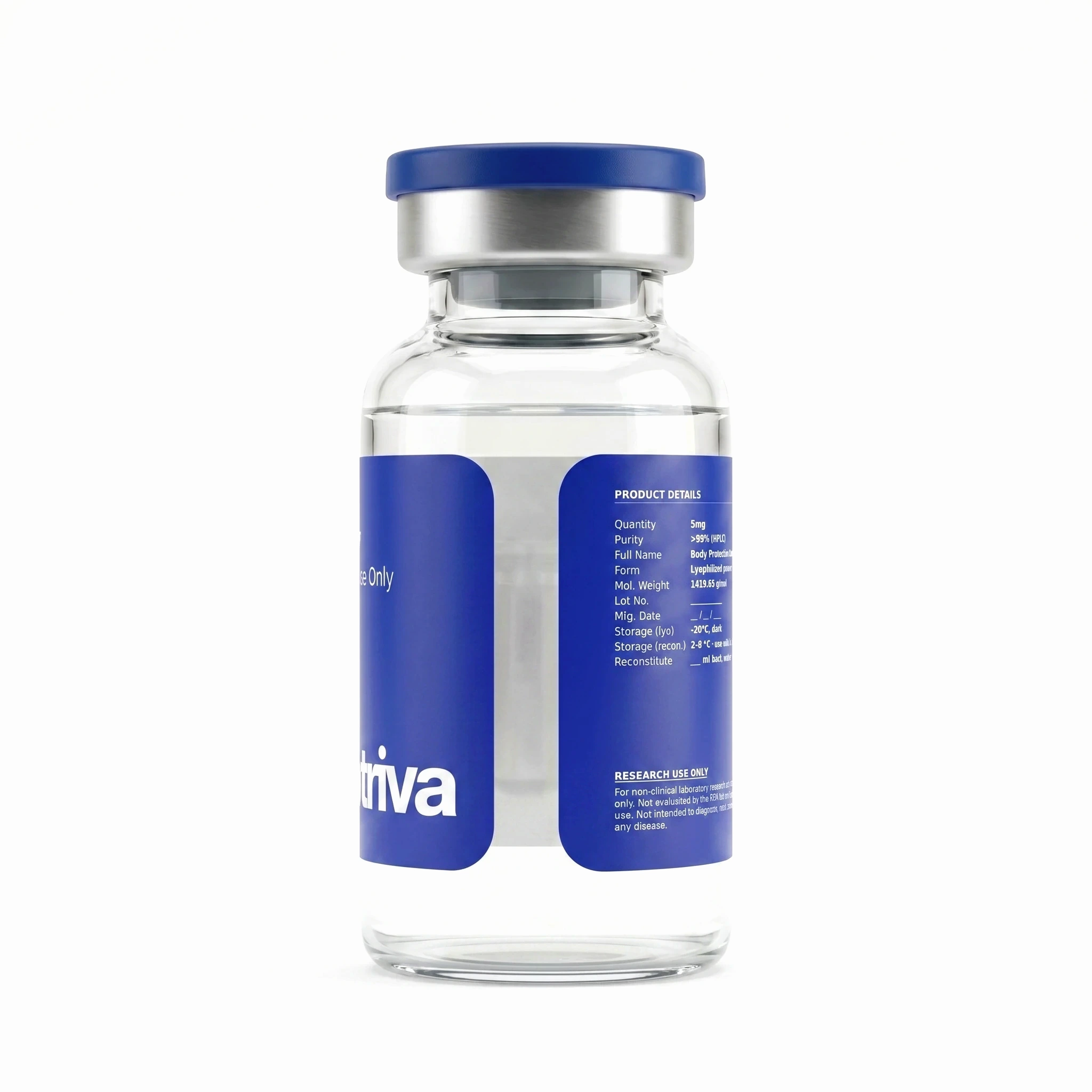
BPC-157
Every lot ships with the same kind of CoA this article walks through — HPLC trace, mass-spec identity, water content, and third-party ISO 17025 testing. Identity and purity verified.
Section three: mass spectrometry
HPLC purity tells you how much of one substance is in the sample. Mass spectrometry tells you which substance it is. The CoA should report an observed mass and a theoretical (calculated) mass for the peptide. For BPC-157 with a theoretical mass of 1419.6 g/mol, the observed mass on a good run will be within roughly 0.5 Da of that value — typically reported as something like “[M+H]+ observed: 1420.6, theoretical: 1420.6.”
The technique used is usually MALDI-TOF or ESI-MS — both produce a spectrum showing the ionised molecule’s mass-to-charge ratio. A clean spectrum with a single dominant peak at the expected mass is what you want. A spectrum showing multiple peaks or a mass that doesn’t match the claimed identity is a problem. The observed-vs-theoretical match is the most direct evidence that the vial contains the molecule the label claims.
Some CoAs report “identity confirmed by mass spec” without showing the actual spectrum. That’s acceptable from a well-established lab but a level less transparent than reproducing the spectrum image. The most rigorous CoAs include both.
The combination of HPLC purity and mass-spectrometry identity is the analytical floor for any peptide intended for research use. A CoA that omits either should not be considered evidence of quality.
— United States Pharmacopeia, General Chapter <1503> Quality Attributes of Therapeutic Peptides
Section four: water content and physical description
Lyophilized peptides are not dry powders — they always contain some residual water that the freeze-drying didn’t fully remove. Karl Fischer titration is the standard analytical method for measuring this. Most well-prepared peptides come in at 2–8% residual water. Above 10% is unusual and may suggest poor lyophilisation. The water-content line matters because the mass of peptide you actually receive equals the gross mass minus water and counterion content — a vial labelled “10 mg” with 8% water and 6% counterion contains roughly 8.6 mg of actual peptide.
The physical description line is simpler. For most peptides it reads “white to off-white lyophilized powder.” Some are colored by their structure — GHK-Cu is a blue powder because of the copper coordination, NAD+ is pale yellow. Colour outside the expected description is a signal that something is wrong with the sample.
Section five: counterion, endotoxin, and elemental impurities
The more thorough CoAs include three additional lines worth understanding.
Counterion content. Most peptides are synthesised as trifluoroacetate (TFA) salts — the TFA comes from the deprotection step in SPPS and binds to basic side chains. Some suppliers convert peptides to acetate salts before lyophilisation; some leave them as TFA. The CoA should specify which counterion is present and report its content. A typical TFA salt is around 5–15% TFA by mass. This matters for accurate dosing calculations, especially in long peptides with many basic residues.
Endotoxin (bacterial endotoxin testing, BET / LAL). Not every CoA includes this, but rigorous ones do. Endotoxin is a fragment of bacterial cell wall that can produce strong biological effects at low concentrations. For research use, endotoxin levels under 1 EU/mg are generally considered acceptable. Endotoxin testing requires equipment most peptide-synthesis labs don’t have in-house, so it’s typically subcontracted — which is why it shows up less consistently than HPLC.
Elemental impurities. ICP-MS analysis for trace heavy metals (lead, arsenic, mercury, cadmium) is standard for pharmaceutical peptides but uncommon for research-grade ones. Its presence on a CoA is a positive signal about supplier rigour, not a baseline expectation.
Red flags to actually pay attention to
- No CoA, or only a CoA from the supplier’s own internal lab without third-party verification. The whole point of a CoA is independent corroboration. Internal-only documents are a starting point, not an endpoint.
- Lot number on the CoA doesn’t match the vial label. Either an error or a generic CoA recycled across batches. Both are problems.
- Purity number reported without a chromatogram image. Anyone can type 99.5% into a PDF. A real CoA shows the trace.
- No mass-spec line. Without it, you have purity but no identity confirmation. That’s a critical gap.
- Manufacturing date older than 12 months and no retest date. Lyophilized peptides are typically stable at −20 °C for 2–3 years, but a retest date demonstrates the supplier has checked recently rather than relying on initial release data.
- HPLC purity reported in a single decimal place (e.g., “99%” flat). Real HPLC traces give two-decimal precision (e.g., “99.18%”). A round number suggests rounding, which suggests the report wasn’t generated from an actual chromatogram on this lot.
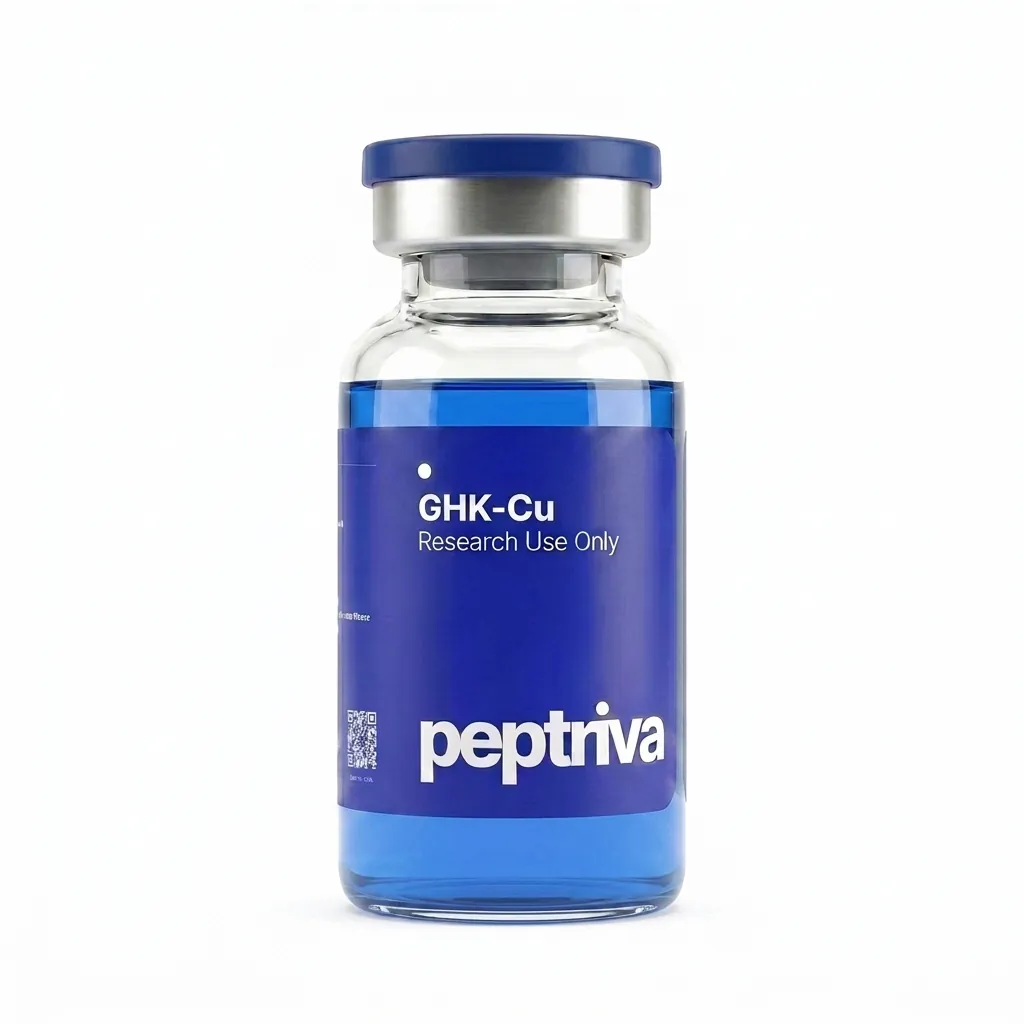
GHK-Cu
Copper-binding tripeptide · Gly-His-Lys, blue lyophilized powder. Lot-specific CoA from an ISO 17025 accredited third-party lab ships with every order — HPLC trace, mass-spec identity, and water content all documented.
A worked example: BPC-157 lot CoA
A reputable CoA for a 10 mg vial of BPC-157 should read approximately like this:
- Product: BPC-157 · CAS: 137525-51-0 · Molecular formula: C62H98N16O22 · Theoretical MW: 1419.6 g/mol
- Lot: [unique identifier] · Manufactured: [date] · Retest by: [date + 24 months typical]
- Appearance: White lyophilized powder
- HPLC purity: 99.18% (chromatogram attached, single dominant peak)
- Mass spec identity: [M+H]+ observed 1420.6, theoretical 1420.6 — identity confirmed
- Water content (Karl Fischer): 4.7%
- Counterion: Trifluoroacetate, 8.2% by mass
- Endotoxin (LAL): < 0.5 EU/mg
Any vial whose CoA reads roughly like that, from a third-party ISO 17025 accredited lab, is what “research grade” should mean in practice. Anything substantially less rigorous deserves more scrutiny — or a different supplier.
The thirty-second CoA check: open the PDF, find the lot number, check it matches your vial, find the HPLC purity number, check it’s above 98%, find the mass-spec line, check the observed mass matches the theoretical. Four checks. If all four pass, the vial is what the label claims. If any fails, ask for clarification before using the material.
What to know now
- A CoA documents: identity (CAS, lot, manufacture date), HPLC purity (with chromatogram), mass-spec identity confirmation, water content, and ideally counterion + endotoxin testing.
- Purity floors: <95% unusable; 95–98% acceptable for screening; ≥98% is the working standard; ≥99% achievable for established peptides.
- Identity: HPLC purity alone is insufficient. Mass spec is the only direct confirmation that the vial contains the claimed molecule.
- Third-party testing: a CoA from an independent ISO 17025 accredited lab is the gold standard. Internal-only CoAs are weaker evidence.
- Lot-specific: each batch should have its own CoA with its own data. Recycled or batch-generic CoAs are a red flag.
- The four-check screen: lot match, HPLC ≥98%, mass-spec match, recent retest date. Thirty seconds. Catches most problems.
What we’re watching
One development worth tracking: the gradual adoption of ICH Q3A/B impurity reporting conventions in research-peptide CoAs. Pharmaceutical-grade peptides require characterised identification of every impurity above 0.1% by mass; research-grade CoAs typically don’t go that deep. As cGMP-style transparency seeps into the research-peptide market, expect to see impurity profiling become part of the CoA standard. That’s a positive development for researchers who care about reproducibility.
References
- United States Pharmacopeia. (2022). General Chapter <1503>: Quality attributes of therapeutic peptides. USP-NF. USP-NF
- European Pharmacopoeia. (2023). Monograph 2.2.29: Liquid chromatography. Ph. Eur. 11.0. https://doi.org/10.1007/978-3-211-89836-9_515
- International Council for Harmonisation. (2022). ICH guideline Q3A(R2): Impurities in new drug substances. ICH Q3A
- Verlander, M. (2007). Industrial applications of solid-phase peptide synthesis — a status report. International Journal of Peptide Research and Therapeutics, 13(1–2), 75–82. https://doi.org/10.1007/s10989-006-9075-7