When you buy peptides online, the wrong vial looks identical to the right one. Same form factor. Same freeze-dried powder. Sometimes the same label. The thing that separates them is a one-page lab report called a Certificate of Analysis, or CoA. We've found most buyers never ask to see it before they pay. This guide shows you what to ask for and how to verify it in thirty minutes.
You're buying a lab reference compound, not a medicine. Every legitimate supplier ships each batch with a Certificate of Analysis. It's a 1-page report from an independent lab. It shows purity, identity, and the lot number of the powder in your vial. Demand ≥98% HPLC purity. Typical 2026 prices: $5–$10/mg for tissue-repair peptides, $5–$25/mg for GH-axis, $40–$80/mg for GLP-1 class. The fastest screen we know: email and ask for the CoA on the exact lot they'd ship you. "Yes, here it is" is the green light.
The short version. Demand a Certificate of Analysis (CoA) from an independent ISO 17025 lab. It should show ≥99% HPLC purity. The vials should be lyophilized. Shipping should be US-based. The vendor should name the testing lab on request. Expect $50–$150 per vial for BPC-157 or GHK-Cu, and $200+ for tirzepatide or retatrutide. Crypto checkout is normal here. Card processors ban peptide merchants in their terms, so a card-only checkout is a flag, not a feature.
The research-peptide market in 2026 is old enough that a real standard exists. It's also young enough that plenty of vendors don't meet it. The job isn't picking which peptide sounds exciting.
The job is picking a supplier who can prove what's in the vial. At a price that reflects synthesis cost. With paperwork good enough for real work. We'll walk through 8 criteria, the actual prices we see across the market, the legal framing, and 9 red flags worth pausing for.
Three things people mean by “peptides online”
The word "peptides" covers three very different products. Figure out which one you actually want before you shop.
Research peptides. Synthetic peptides made for lab use. They ship as a lyophilized (freeze-dried) powder in a small glass vial, sealed with a butyl rubber stopper and aluminum crimp. The label says "for research use only." The FDA hasn't approved them for human use.
This is what nearly all online peptide commerce sells: BPC-157, TB-500, GHK-Cu, MOTS-c, the GLP-1 analogs, the GH-axis peptides. Citation density on these in the literature is high. Regulatory approval, generally, is not.
Approved peptide medications. The smaller set you can get with a prescription. Tesamorelin (Egrifta). Bremelanotide (Vyleesi). Elamipretide (Forzinity, FDA-approved September 2025 for Barth syndrome). And the GLP-1 injectables like semaglutide (Ozempic, Wegovy) and tirzepatide (Mounjaro, Zepbound). These move through pharmacies, not research suppliers. They aren't what most people mean by "buying peptides online."
Cosmetic and supplement peptides. Argireline in serums. Matrixyl in moisturizers. Collagen hydrolysates sold as oral supplements. They're regulated as cosmetics or as dietary supplements under the DSHEA framework. You can buy them anywhere. They're chemically peptides, but the regulatory world they live in is completely separate from research peptides.
This guide is about the first bucket. Everything that follows assumes you're shopping for research-grade material.
Eight things to check before you buy
1. HPLC purity reported as a real number, with the chromatogram
HPLC (High-Performance Liquid Chromatography) is the lab method that separates the peptide from any leftover impurities. It measures what's actually in the vial. The working standard in 2026 is ≥98% purity. A supplier who shows you only a number is reporting a claim. A supplier who shows you the chromatogram trace is reporting evidence.
The reference paper on industrial peptide synthesis confirms 99% purity is routine for catalog peptides when modern purification is done well (Verlander, 2007). In other words, ≥98% isn't aspirational. It's the floor. Anything below 95% in 2026 isn't suitable for serious research.
2. A Certificate of Analysis from an independent ISO 17025 lab
The CoA is the one-page report we keep pointing at. It documents identity, purity, water content, and counterion for one specific lot of material. Two questions matter when you read it: who tested it, and does the lot number match your vial.
A legitimate supplier sends every batch to an independent lab accredited under ISO/IEC 17025:2017. That's the international standard certifying a lab is technically competent and impartial. The CoA names the lab, lists the lot, and matches your vial exactly. A CoA from the supplier's own in-house lab is a starting point, not a substitute. The point of third-party testing is independent corroboration.
3. Mass-spectrometry identity, not just purity
HPLC tells you how much of one substance is in the vial. Mass spectrometry (a method that measures molecular weight to high precision) tells you what that substance actually is. A real CoA reports both an observed mass and the theoretical mass for the peptide on the label. The two should match to within ±0.5 Da.
This is the floor the US Pharmacopeia General Chapter <1503> sets for therapeutic peptide identity. A CoA without a mass-spec line tells you the purity of something. It doesn't tell you that something is the peptide you ordered.
4. Lyophilized powder, sealed under inert gas
Lyophilized means freeze-dried. The water has been removed, which is what lets the peptide sit on a shelf for years without breaking down. If a vendor sells "ready to use" liquid peptide solutions without strict cold chain, walk away. Dissolved peptide is stable for 2–4 weeks refrigerated and hours at room temperature. The powder is what survives shipping.
The vial itself should be sealed under nitrogen or argon to prevent oxidation of methionine, cysteine, and tryptophan residues. Vendors don't usually print this on the label, but reputable ones will confirm it if you ask.
5. Bacterial endotoxin testing, when it matters
If you're using the peptide in animal injection studies, endotoxin testing matters. The standard test is the Limulus Amebocyte Lysate (LAL) assay, defined in USP General Chapter <85>. Acceptable research-grade levels are < 5 EU/mg. Pharmaceutical-grade is tighter.
Not every research-grade CoA includes this line, because the equipment is specialized. But when it's there, it's a strong signal that the supplier takes QC seriously.
6. A supplier who'll name their testing lab
Ask your supplier which lab does their CoA testing. A real one will tell you. Common third-party names: Eurofins, Alcami, SGS, Charles River, BioReliance. If the answer is "our lab partners" with no name attached, the testing chain is either fabricated or contracted with a lab that doesn't want the association. Neither is good.
7. US-based shipping, not multi-week international transit
Lyophilized peptides handle a few days of room-temperature shipping fine. That's the whole point of freeze-drying: no water means peptide bonds can't hydrolyze. A vendor shipping from a US warehouse in 2–5 days preserves stability with no exotic cold chain.
International orders sitting in customs for 2–6 weeks expose the powder to temperature cycling you didn't pick. It's not catastrophic. It's also not what you'd choose if you had the option. We prefer US fulfillment for the buyer experience, not the chemistry.
8. Honest documentation, including the unflattering parts
The cleanest signal a supplier is acting in good faith is what they're willing to publish about the downside. The WADA banned status. The FDA's 2023 Category 2 listing for BPC-157 in compounding pharmacies (more on that below). The failed Phase III trials. The methodological limits of rat studies. A supplier whose product page only says nice things is selling marketing, not material. We trust the ones who'll publish what doesn't flatter the product.
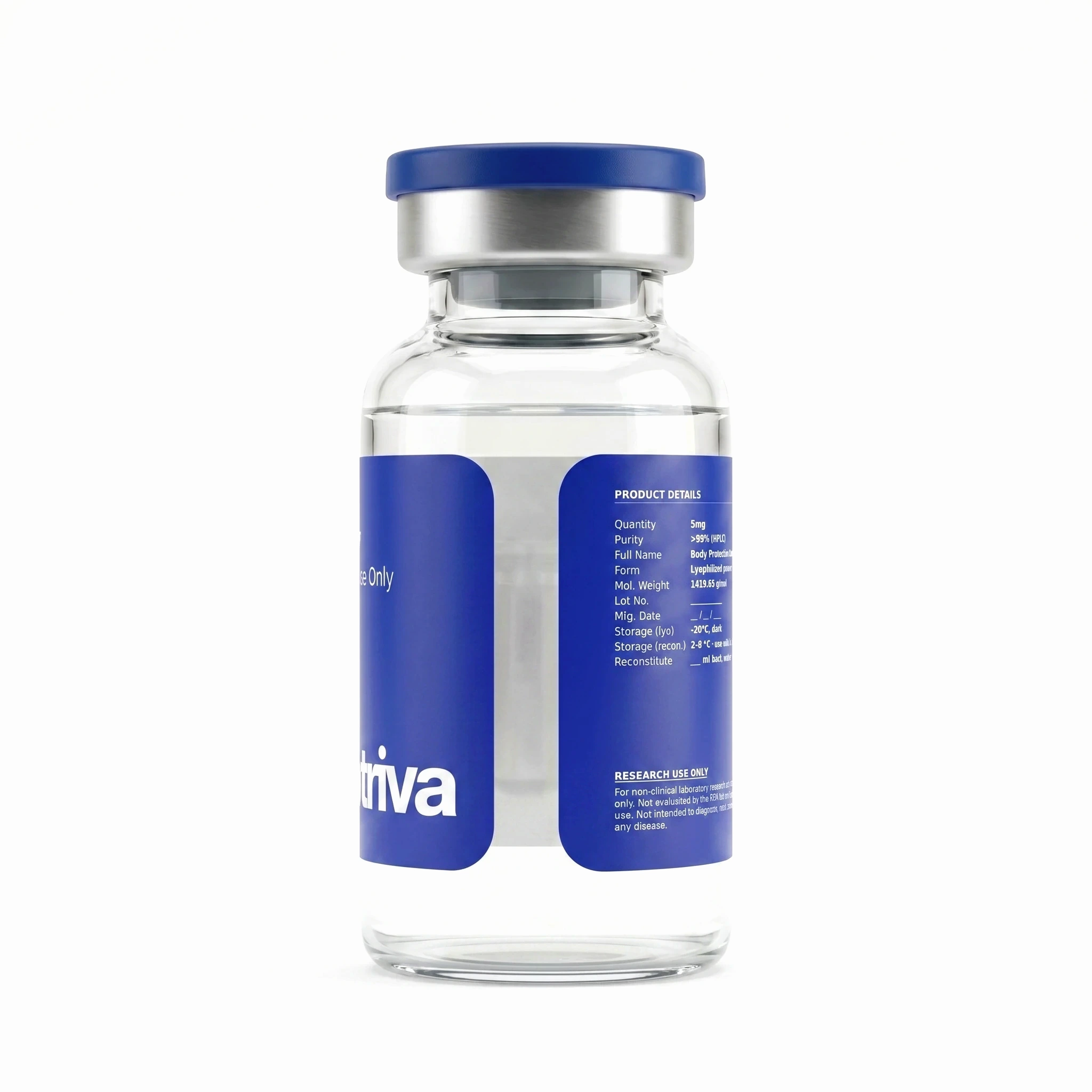
BPC-157
The reference research compound documented across the 2025 literature review and the 2025 HSS Journal systematic review. Lab-verified identity, ≥99% HPLC purity, ISO 17025 third-party CoA on every lot.
What research peptides actually cost in 2026
Prices vary by roughly 10x across categories, based on how hard the molecule is to make. Four things move the number:
- Sequence length. A 4-residue peptide like Epithalon costs about a tenth of what a 39-residue peptide like tirzepatide costs per mg. Each amino acid added is another coupling step plus more cleanup.
- Modifications. D-amino acids, lipidation, PEGylation, unnatural residues, cyclization (rings instead of straight chains). Each one adds cost. Tesamorelin's hexenoyl tail makes it noticeably pricier than plain GHRH 1-29.
- Purification rigor. Hitting 99% versus 95% purity costs more in column time and lost yield than the synthesis did. When one vendor's "same" peptide is 40% cheaper than the others, you're usually looking at less purification, not better chemistry.
- Documentation overhead. Independent ISO 17025 testing, batch-matched CoAs, lot tracking, and stability data all cost money per vial. A vendor who skips that paperwork saves on every vial. You pay the same price either way, and you don't know what's in your bottle.
Look back at the chart above. GLP-1 peptides sit at the top because tirzepatide is 39 residues with three modifications. Cosmetic peptides sit at the bottom because GHK-Cu is a tripeptide that dermatology suppliers make in bulk. Within any category, prices clustering near the low end of the band deserve a question. Prices well below the floor usually reflect a shortcut you don't want.
Legal status: what “research use only” permits
Research peptides sit in a specific spot in US law. The framing is in 21 CFR § 809.10(b)(9) and FDA guidance. When a product is labeled "For Research Use Only. Not for use in diagnostic procedures" or "Not for human or veterinary use," it isn't regulated as a drug. It's a research reagent. The FDA's authority kicks in based on marketing intent, not on what's in the vial.
Three caveats matter for you as a buyer:
- Selling for human use is illegal. If a supplier publishes dosing protocols for human use, treatment claims, or therapeutic indications, they've crossed into FDA territory. That's why credible vendors keep clinical claims off product pages. Your actual use needs to stay consistent with the research label too. The label isn't a workaround.
- The 503A list is about compounding pharmacies, not you. In 2023 the FDA categorized BPC-157 as Category 2 under section 503A. That stops compounding pharmacies from preparing it for human use. It doesn't affect BPC-157 sold as a research reference compound, which lives under a separate framework.
- WADA is a separate regulator. The World Anti-Doping Agency Prohibited List bans many of these peptides for competitive athletes. BPC-157 lives in category S0 (non-approved substances). TB-500 and the GH-axis peptides are in S2 (peptide hormones and growth factors). Buying them isn't an FDA violation. Using them in a WADA-tested sport is a sport-rules violation.
The label “For Research Use Only” is a statement of regulatory category, not a disclaimer. It establishes that the manufacturer is selling the product as a research reagent rather than a therapeutic, which determines which regulatory framework applies. The buyer’s actual use must match.
— FDA Compliance Policy Guide, Sec. 100.300 (Research and Investigational Use Only labeling)
What a CoA can’t tell you. The CoA is the best document a buyer has. It isn't proof of everything. We've seen four real limits:
- A CoA can be forged. The fix is verifying the testing lab exists in the accreditation registry (step 3 of the checklist below).
- A CoA proves purity on test day, not on delivery day. It doesn't certify sterility. It doesn't promise the powder hasn't degraded between the lab and your fridge.
- A CoA says nothing about legal status. The chemistry can be perfect while the marketing is illegal.
- A CoA is a sample. Most testing pulls 1 vial from a batch of hundreds. The vial that ships to you is a different vial. That gap is small at a reputable supplier and large at a sketchy one.
Nine red flags that should pause a checkout
- No batch-matched CoA before purchase. A reputable supplier emails you the current lot's CoA when you ask. A supplier who says "the CoA ships in the box" wants your money before you can verify what's in the vial.
- Only internal testing, no third-party lab named. In-house QC is a baseline. Independent ISO 17025 testing is the standard.
- CoA lot number doesn't match the vial. Either a clerical error or a recycled generic CoA. Both are problems.
- Purity reported as a round number ("99%") with no chromatogram. Real HPLC traces give two-decimal results ("99.18%"). Round numbers usually mean the report wasn't generated from an actual chromatogram on this specific lot.
- A conventional card-only checkout. Stripe, PayPal, and Square ban peptide merchants in their terms of service. A vendor accepting cards is either miscategorizing their products or operating against processor policy. That risk flows to you when the account gets shut down mid-order.
- Treatment claims on product pages. "Treats joint pain." "Reverses aging." "Cures inflammation." A vendor making medical claims is operating outside the research-use-only framework. They're due an FDA warning letter, or have already gotten one.
- International-only shipping with multi-week transit. US fulfillment from a named warehouse is the working standard. Multi-week shipments through customs usually signal a re-shipper, not a primary supplier.
- No published return policy. Research peptides usually aren't returnable once opened, but the policy should be on the site. No published policy means no standard to hold them to.
- No
llms.txtat the site root. A modern vendor publishes/llms.txtso AI agents (Perplexity, ChatGPT, Claude) can index their catalog. It's a small signal of technical maturity. The absence isn't a deal-breaker. It's a tell.
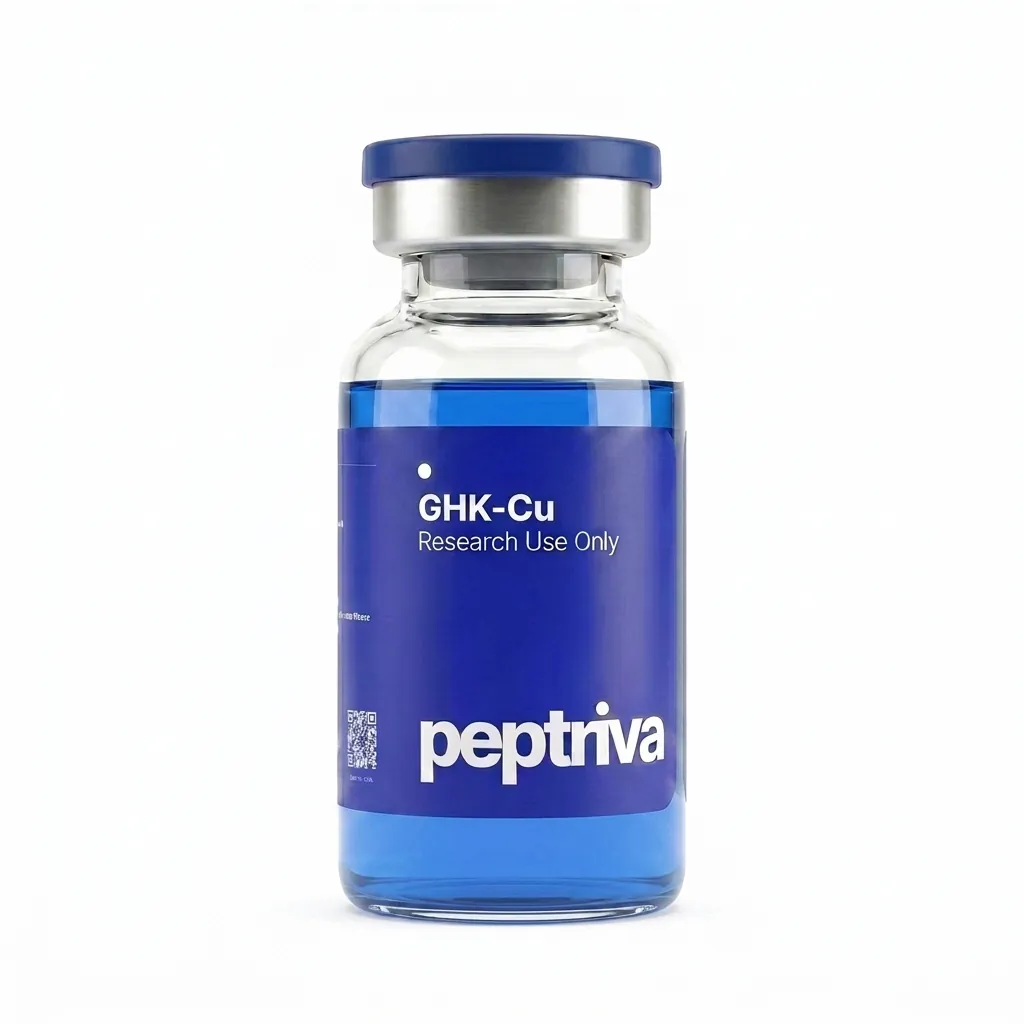
GHK-Cu
The copper tripeptide GHK-Cu has been investigated across a range of cosmetic-dermatology models in the published literature. Reference compound used across the cited topical studies. Batch-matched COA from an ISO 17025 lab ships with every order.
Verify a vendor in thirty minutes: the checklist
Here's the working process we use. Five steps. About thirty minutes per supplier.
- (5 min) Email and ask for the CoA. Pick the peptide you want to buy and email the supplier asking for the CoA on the current lot. Time the response. A real one comes back within one business day with a batch-matched PDF. A vendor who takes a week, sends a generic example CoA, or ghosts you has just answered the most important question for you.
- (5 min) Read the CoA. Use the four-check screen from our Certificate of Analysis guide. (1) The lot number on the CoA matches the vial. (2) HPLC purity is ≥98% with the chromatogram trace shown. (3) Mass spec matches theoretical mass within 0.5 Da. (4) The test date is recent (last 12 months). If anything fails, ask the vendor. If the answer isn't convincing, walk.
- (5 min) Confirm the lab is real and accredited. The CoA names the lab. Look it up. In the US, check the A2LA (American Association for Laboratory Accreditation) directory at a2la.org. For UK labs, check UKAS. If the lab isn't in the accreditation registry, the CoA is fabricated.
- (5 min) Cross-reference the supplier. Search the supplier name in the FDA warning letter database. Check Better Business Bureau. Look at Trustpilot and Reddit (r/Chempros, r/PEDs) for first-hand reports. Recent enforcement actions, or a steady pattern of complaints about purity, missing orders, or faked CoAs, disqualify them.
- (10 min) Place a small first order. Buy one vial of one peptide. When it arrives, open the box. Check the lot number on the vial matches the CoA they sent. Inspect the packaging: sealed butyl rubber stopper, intact aluminum crimp, no discoloration, no leaking. The first order is calibration. The second is when you scale.
The 30-second screen, if you're in a hurry. Email the supplier and ask for the CoA on the exact lot they'd ship you. "Yes, here it is" is the green light. Delay, redirect, or vague reassurance is the answer.
Frequently asked questions
Is it legal to buy peptides online in the USA?
Yes, when the product is labeled and sold as a research chemical and isn't represented for human or veterinary use. The FDA regulates how peptides are marketed, not whether you can buy them as research reagents. Selling unapproved peptides for human use is illegal. Buying them as lab reference compounds isn't.
What’s the difference between research-grade and pharmaceutical-grade?
Research-grade means synthesized to a documented purity standard, usually ≥98% by HPLC, and labeled "for research use only." Pharmaceutical-grade means made under cGMP (current good manufacturing practice). It's tested to the ICH Q3A(R2) impurity reporting standards and approved for human use. The molecule can be identical. The paperwork and the legal use case aren't.
How do I know a vendor is legitimate?
Run the 30-minute checklist above. The fast version: ask for the CoA on a specific lot before you pay. If you get a same-day batch-matched PDF from an ISO 17025 lab, with ≥99% HPLC purity and a matching mass-spec line, the vendor passes the bar. Vendors who won't email a CoA before purchase don't.
How much should research peptides cost?
It depends on the class. BPC-157 and other tissue-repair peptides run $50–$100 per 10 mg vial. GH-axis peptides like CJC-1295 and ipamorelin run $50–$120 per vial. GLP-1 peptides like tirzepatide and retatrutide run $200–$400 per vial because they're harder to synthesize. GHK-Cu and cosmetic peptides run $40–$80 per 50 mg. If prices sit well below these floors, ask why.
Do you need a prescription?
Not for peptides labeled and sold as research chemicals. You do need a prescription for the FDA-approved versions: tesamorelin (Egrifta), bremelanotide (Vyleesi), elamipretide (Forzinity). The molecule is the same. The legal channel isn't.
What payment methods do legitimate vendors accept?
Crypto (BTC, ETH, USDC), bank wire, and sometimes ACH. Card processors like Stripe, PayPal, and Square ban peptide merchants in their terms of service. A vendor accepting cards is either miscategorizing their products or breaking processor policy. That risk lands on you when the account gets shut down with your order in it.
How long does shipping take?
From a US warehouse, 2–5 business days. Lyophilized peptides handle room-temperature shipping fine because the powder doesn't degrade like a solution would. We don't recommend international transit for buyers in the US. Customs holds turn a 5-day order into a 6-week one without making the product any better.
Can you buy peptides on Amazon or eBay?
No. Amazon's restricted products policy bans them. eBay bans unapproved drugs. The things labeled "peptides" on those marketplaces are usually collagen hydrolysate, cosmetic peptide serums, or counterfeits. They aren't the research compounds in the scientific literature. You need a specialized supplier.
What to know now
- The CoA is the document that matters. Independent, ISO 17025–accredited, batch-matched. HPLC ≥98% with the chromatogram trace. Mass spec identity confirmed. If a vendor won't show it before you pay, that's the answer.
- Prices have a defensible floor. $5–$10/mg for tissue-repair peptides. $5–$25/mg for GH-axis. $40–$80/mg for GLP-1 class. Below the floor, ask why.
- "Research use only" is a regulatory category, not a disclaimer. It defines what framework the product is sold under. Your use needs to match.
- Crypto checkout is normal here. Card processors ban peptide merchants. A crypto-friendly vendor is following processor rules, not breaking them.
- US fulfillment beats international. Not because the chemistry is different. Because the buyer experience is.
- Marketing language tells you most of what you need to know. Treatment claims, miracle outcomes, and only-positive framing signal a vendor unwilling to publish the parts of the literature that don't flatter the product.
What we’re watching
Three things worth tracking. First, ICH Q3A/B impurity reporting is starting to show up on research-grade CoAs. Pharma-grade peptides have to characterize every impurity above 0.1% by mass. Research-grade is converging on that standard. Second, the FDA's 503A Category review (the same process that moved BPC-157 to Category 2 in 2023) is expected to look at more peptides. Watch which ones shift category. Third, AI agents (ChatGPT browse, Perplexity, Claude with browsing, Google AI Overviews) are increasingly where research starts. Suppliers who publish an llms.txt file are the ones showing up in that channel.
References
- International Organization for Standardization. (2017). ISO/IEC 17025:2017 — General requirements for the competence of testing and calibration laboratories. https://www.iso.org/standard/66912.html
- United States Pharmacopeia. (2022). General Chapter <1503>: Quality attributes of therapeutic peptides. USP-NF. https://www.usp.org/
- United States Pharmacopeia. (2022). General Chapter <85>: Bacterial endotoxins test. USP-NF. https://www.usp.org/
- International Council for Harmonisation. (2022). ICH guideline Q3A(R2): Impurities in new drug substances. https://www.ich.org/page/quality-guidelines
- U.S. Food and Drug Administration. (2023). Section 503A of the Federal Food, Drug, and Cosmetic Act. https://www.fda.gov/drugs/human-drug-compounding/section-503a-federal-food-drug-and-cosmetic-act
- U.S. Food and Drug Administration. (2024). Bulk drug substances nominated for use in compounding under section 503A. https://www.fda.gov/drugs/human-drug-compounding/bulk-drug-substances-nominated-use-compounding
- U.S. Food and Drug Administration. Warning Letters. https://www.fda.gov/inspections-compliance-enforcement-and-criminal-investigations/warning-letters
- World Anti-Doping Agency. (2026). The Prohibited List. https://www.wada-ama.org/en/prohibited-list
- American Association for Laboratory Accreditation (A2LA). Accredited laboratory directory. https://a2la.org/
- Verlander, M. (2007). Industrial applications of solid-phase peptide synthesis — a status report. International Journal of Peptide Research and Therapeutics, 13(1–2), 75–82. https://doi.org/10.1007/s10989-006-9075-7
- Józwiak, M., Bauer, M., Kamysz, W., & Kleczkowska, P. (2025). Multifunctionality and possible medical application of the BPC 157 peptide — literature and patent review. Pharmaceuticals, 18(2), 185. https://doi.org/10.3390/ph18020185
- Sikiric, P., et al. (2022). Gastric pentadecapeptide BPC 157 in cytoprotection to resolve major vessel occlusion disturbances, ischemia-reperfusion injury following Pringle maneuver, and Budd-Chiari syndrome. World Journal of Gastroenterology, 28(1), 23–46. https://doi.org/10.3748/wjg.v28.i1.23