The glow peptide blend is three research compounds in one vial: BPC-157, TB-500, and GHK-Cu. Each has its own literature. The combination has none.
“Glow” is the aesthetics market’s name for the BPC-157 + TB-500 + GHK-Cu stack. The per-compound biology is real. But the strongest human dataset in the whole stack is a 17-patient retrospective case series, and controlled trials on the three compounds combined number zero. Anyone selling the blend as a proven protocol is ahead of the data.
This article is a per-constituent evidence review, because the blend itself has never been tested as a unit — no trial, no case series, no published pharmacokinetics. What exists is per-ingredient literature and a stacking rationale downstream of it. If you’re deciding where to source the blend, our GLOW Blend sourcing guide covers CoA verification, ratio checks, and pricing.
What is the glow peptide blend?
A glow peptide blend is a pre-mixed co-formulation of three compounds that grew popular separately before the market packaged them together:
- BPC-157 — a synthetic 15-amino-acid peptide from a protective sequence in human gastric juice; the recovery community’s favorite. Full monograph: BPC-157 complete guide.
- TB-500 — the research-market name for thymosin beta-4 or its active fragment, an endogenous actin-binding peptide central to cell migration. Full monograph: TB-500 complete guide.
- GHK-Cu — the copper(II) complex of an endogenous tripeptide discovered in 1973 — the most established dermal peptide, and what puts “glow” in the name. Full monograph: GHK-Cu complete guide.
Peptriva’s GLOW Blend follows the common market ratio: 10 mg BPC-157 + 10 mg TB-500 + 50 mg GHK-Cu — 70 mg total in one lyophilized vial. The logic of the trio is division of labor: repair signaling, cell migration, skin remodeling. Whether the combination does anything a single constituent doesn’t is an unanswered experimental question.
How the glow blend works — one mechanism per constituent
BPC-157: angiogenesis and growth-factor signaling
BPC-157’s proposed mechanism is multifactorial rather than receptor-specific. The most cited pathway is VEGFR2 activation with downstream nitric-oxide synthesis through Akt-eNOS, which a 2025 review proposes underlies its reparative effects in poorly vascularized tissue like tendon (McGuire et al., 2025). Reviews also describe ERK1/2 activation and fibroblast stimulation. No validated human receptor target exists — nearly all mechanistic data are rodent and in vitro.
TB-500: G-actin sequestration and cell migration
Thymosin beta-4 is the best-characterized molecule in the vial. It binds monomeric G-actin in a 1:1 ratio, regulating the actin dynamics a cell uses to move into a wound — with documented downstream effects across skin trauma, corneal repair, hair-follicle regeneration, and bone formation (Ying et al., 2023). One market caveat: “TB-500” may mean full-length Tβ4 or just its active fragment, and suppliers don’t always declare which.
GHK-Cu: copper delivery and matrix remodeling
GHK is endogenous to human plasma, and its levels fall with age — from roughly 200 ng/mL at age 20 to about 80 ng/mL by age 60 (Dou et al., 2020). The histidine residue chelates copper(II) tightly, and the complex modulates collagen synthesis, glycosaminoglycan production, and angiogenesis at injury sites. In vitro work shows roughly 49% elastase inhibition — the mechanistic basis cited in the photoaging literature (Dymek et al., 2023).
The stacking rationale — and its limit
Three mechanisms, three non-overlapping targets — growth-factor signaling, cytoskeletal migration, matrix remodeling. That non-redundancy is the entire theoretical case for the blend. It has also never been tested: no study has measured whether the three compounds together outperform any one alone, on any endpoint, in any species.
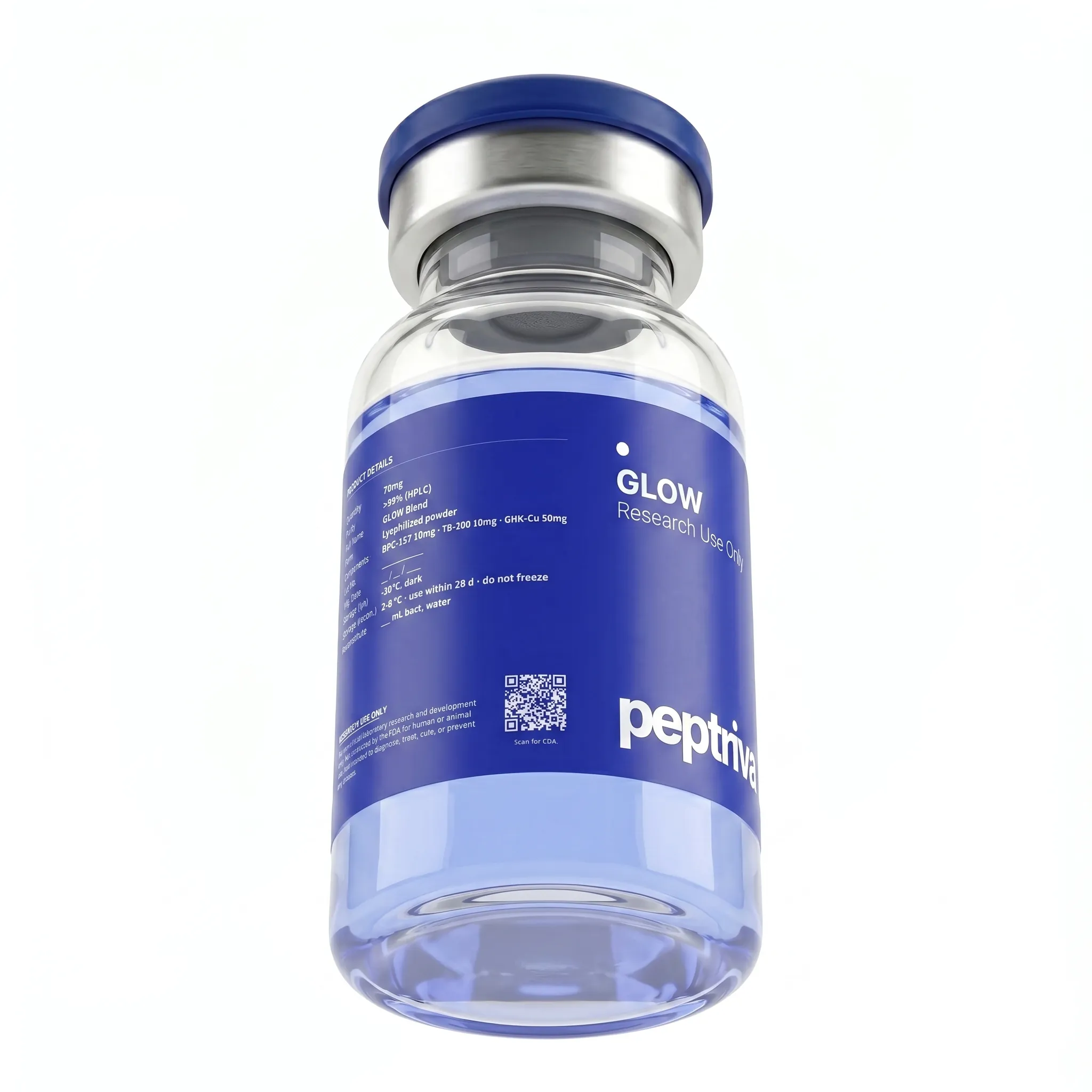
GLOW Blend
The same three compounds reviewed across the studies cited in this guide, with per-component mass-spec identity and lab-verified purity.
How the blend is used in research settings
Reconstituted solution
The blend is supplied as a single lyophilized cake at a fixed ratio — the format’s defining property: convenient if 10/10/50 is what a study design calls for, limiting if it isn’t.
Topical formulations (GHK-Cu only)
The well-supported route for GHK-Cu is topical, and that evidence does not transfer to the injectable format. Even topically, GHK-Cu penetrates the stratum corneum poorly and needs formulation help (Dymek et al., 2023). Our cosmetic skin-peptides overview maps that landscape.
Research evidence, constituent by constituent
BPC-157 has the largest preclinical footprint: a 2025 systematic review counted 36 studies — 35 preclinical, 1 clinical — with consistently positive outcomes in rodent injury models (Vasireddi et al., 2025). The human side is a 17-patient retrospective knee series: 14 of 16 reachable patients (87.5%) reported subjective relief — no controls, no validated outcomes (Lee & Padgett, 2021). Notably, four of those patients received BPC-157 with TB-500 — the closest thing to combination data anywhere, and far too weak to conclude anything. Most of the preclinical corpus also comes from a single research group in Zagreb.
Despite robust preclinical findings, human data are extremely limited, no large-scale randomized trials exist, and BPC-157 should be considered investigational pending well-designed clinical trials.
— Summarizing the conclusions of McGuire et al., Current Reviews in Musculoskeletal Medicine, 2025
TB-500 / thymosin beta-4 splits into two stories. Full-length Tβ4 is a legitimate research molecule with human trials underway in ophthalmology. But the TB-500 sold for recovery has zero published human studies for orthopedic, athletic, or aesthetic indications — a distinction a 2026 sports-medicine review draws explicitly (Mendias & Awan, 2026).
GHK-Cu is the best-evidenced constituent — for one route. Topically, it has decades of cosmetic history and replicated wound-healing findings across independent groups (Lee et al., 2023). Injectable GHK-Cu in humans: no PubMed-indexed RCTs, 2020–2026. The blend inherits the injectable evidence tier, not the topical one.
The blend’s evidence, in one paragraph
Rank the vial’s contents by human evidence: topical GHK-Cu (real, but a different route), then BPC-157 (uncontrolled series and tiny pilots), then TB-500 (nothing). The evidence for the combination is four uncontrolled knee patients from 2021 who got two of the three compounds. Complementary mechanisms on paper; on evidence, a hypothesis in a vial.
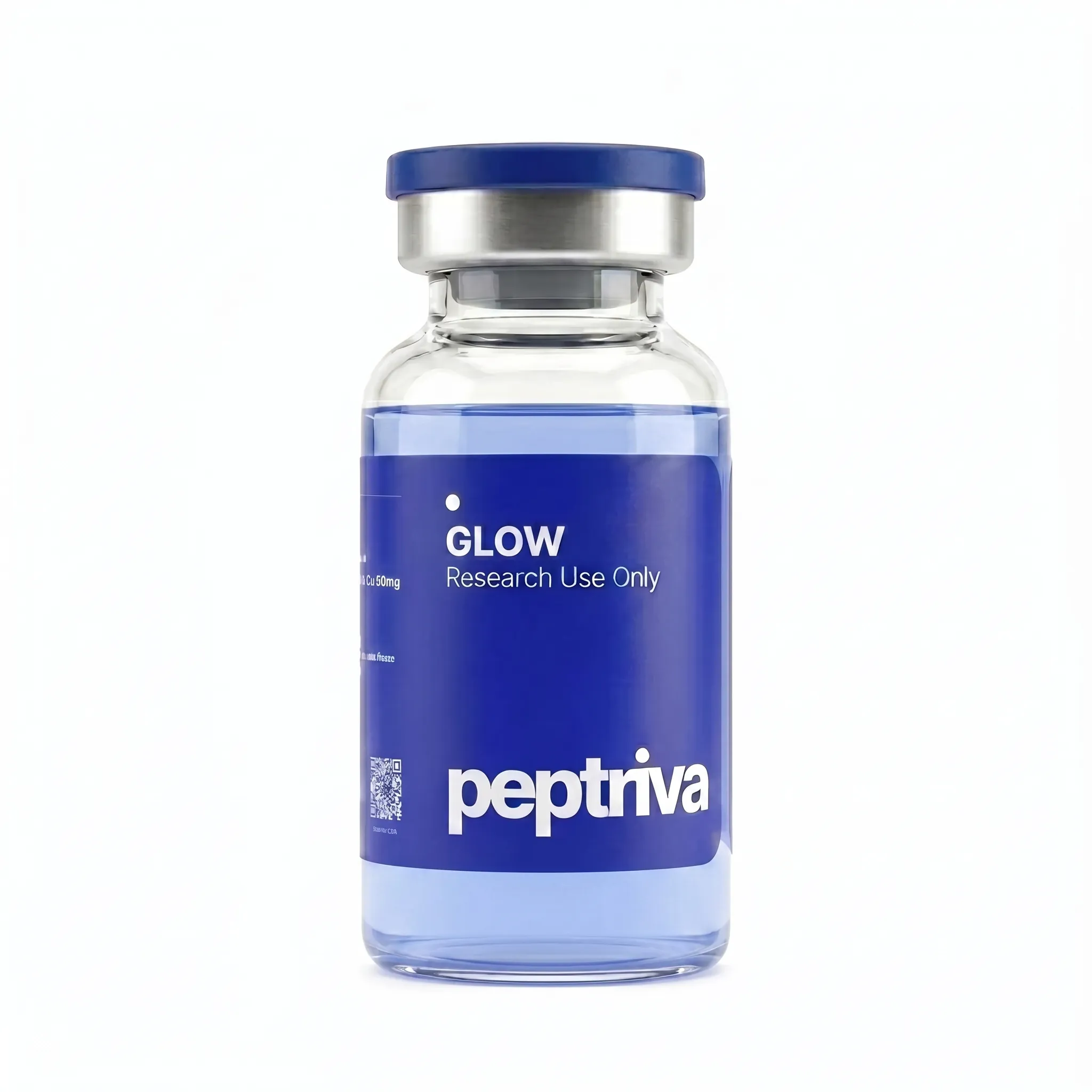
GLOW Blend
BPC-157 + TB-500 + GHK-Cu, 70 mg total (10/10/50) in one sterile lyophilized vial, with per-component identity testing. COA available with each lot.
Side effects & safety data
The core problem is absence of data, not documented harm: total published human exposure to BPC-157 is fewer than 50 people; TB-500 and injectable GHK-Cu have none for these indications.
- Commonly reported (anecdotal, unverified): injection-site redness or irritation; transient fatigue or lightheadedness.
- Less commonly reported: headache, nausea, dizziness in community reports — none systematically collected.
- Theoretical / serious: all three constituents promote angiogenesis, an unresolved concern for undetected vascularized tumors; GHK-Cu adds systemic copper redox chemistry with no injectable safety dataset. The 2025 systematic review also flags unregulated manufacturing and contamination as harm sources independent of the molecules (Vasireddi et al., 2025).
TB-500 and GHK-Cu sit among the unapproved peptide therapies for which rigorous human safety data are scarce and serious harm cannot be excluded.
— Paraphrasing the safety assessment of Mendias & Awan, Sports Medicine, 2026
Legal status & FDA position
None of the three constituents is FDA-approved as a drug, and the combination has no separate regulatory identity. BPC-157 sits on FDA’s Category 2 list for 503A compounding (flagged for safety risks). GHK-Cu’s cosmetic history (“copper tripeptide-1”) covers topical products only. The blend is sold legally in the US strictly as research-use-only reference material, not for human or veterinary use; our guide to US peptide legality covers the framework.
Sports & WADA status
For tested athletes, the blend is a two-count violation in one vial. BPC-157 joined the WADA Prohibited List under S0, effective January 2022 (Józwiak et al., 2025); thymosin beta-4/TB-500 falls under S2. GHK-Cu is not explicitly listed — academic, when the co-formulation contains two prohibited compounds. Current list: wada-ama.org.
Frequently asked questions
What is the glow peptide blend, exactly?
A pre-mixed research formulation of BPC-157 (10 mg), TB-500 (10 mg), and GHK-Cu (50 mg) in one 70 mg lyophilized vial. The name comes from the aesthetics market: GHK-Cu is the classic “skin glow” copper peptide.
Does the glow blend actually work for skin?
Unknown. Topical GHK-Cu has replicated skin-remodeling evidence; injectable GHK-Cu — the format in this blend — has zero human RCTs, and the combination has never been studied for anything.
Is the blend better than buying the three peptides separately?
More convenient, not more evidenced. A pre-mix guarantees the ratio and removes steps; it also locks in 10/10/50 and rules out single-variable work.
What’s the difference between GLOW and the Wolverine blend?
Wolverine is the two-compound recovery pairing (BPC-157 + TB-500). GLOW adds 50 mg GHK-Cu, aiming the stack at the skin/aesthetics research axis.
Is the glow peptide blend legal?
Legal in the US as research-use-only material; none of the constituents is a controlled substance. Selling for human consumption is illegal, and tested athletes should treat it as prohibited — it contains two WADA-listed compounds.
Why is the vial faintly blue?
Copper — GHK-Cu’s copper(II) complex tints solutions blue. Blue dye reproduces the color for pennies, so treat the tint as a consistency check and rely on the CoA. Our sourcing guide details what to check.
What to know now
- Identity: glow peptide blend = BPC-157 + TB-500 + GHK-Cu, typically 10/10/50 mg in one 70 mg vial.
- Mechanisms: three non-overlapping pathways — VEGFR2/growth-factor signaling, G-actin sequestration, copper-mediated matrix remodeling.
- Best-evidenced constituent: GHK-Cu — but topically, a route this blend doesn’t use. BPC-157 has 35 preclinical studies and one weak human series; TB-500 has nothing.
- Combination evidence: zero studies of the three compounds together, in any species.
- Handling: oxidation-prone TB-500 shares a solution with redox-active copper. Cold, dark, gentle, short in-use window.
- Status: not FDA-approved; RUO material only. Contains two WADA-prohibited compounds (BPC-157 S0, Tβ4 S2).
What we're watching
Three things would change this article. First: any controlled study of the three-compound combination against its constituents — nobody has run the obvious factorial experiment. Second: an injectable GHK-Cu human safety dataset. Third: regulatory movement on BPC-157. Until then, the honest label for the glow stack is: three real molecules, one untested combination.
References
- Vasireddi, N., Hahamyan, H., Salata, M. J., et al. (2025). Emerging use of BPC-157 in orthopaedic sports medicine: A systematic review. HSS Journal, 21(4). https://doi.org/10.1177/15563316251355551
- McGuire, F. P., Martinez, R., Lenz, A., Skinner, L., & Cushman, D. M. (2025). Regeneration or risk? A narrative review of BPC-157 for musculoskeletal healing. Current Reviews in Musculoskeletal Medicine, 18(12), 611–619. https://doi.org/10.1007/s12178-025-09990-7
- Józwiak, M., Bauer, M., Kamysz, W., & Kleczkowska, P. (2025). Multifunctionality and possible medical application of the BPC 157 peptide — literature and patent review. Pharmaceuticals, 18(2), 185. https://doi.org/10.3390/ph18020185
- Lee, E., & Padgett, B. (2021). Intra-articular injection of BPC 157 for multiple types of knee pain. Alternative Therapies in Health and Medicine, 27(4), 8–13. PMID 34324435
- Ying, Y., Lin, C., Tao, N., et al. (2023). Thymosin β4 and actin: Binding modes, biological functions and clinical applications. Current Protein & Peptide Science, 24(1), 78–88. https://doi.org/10.2174/1389203724666221201093500
- Mendias, C. L., & Awan, T. M. (2026). Safety and efficacy of approved and unapproved peptide therapies for musculoskeletal injuries and athletic performance. Sports Medicine. https://doi.org/10.1007/s40279-026-02437-0
- Dou, Y., Lee, A., Zhu, L., Morton, J., & Ladiges, W. (2020). The potential of GHK as an anti-aging peptide. Aging Pathobiology and Therapeutics, 2(1), 58–61. https://doi.org/10.31491/apt.2020.03.014
- Dymek, M., Olechowska, K., Hąc-Wydro, K., & Sikora, E. (2023). Liposomes as carriers of GHK-Cu tripeptide for cosmetic application. Pharmaceutics, 15(10), 2485. https://doi.org/10.3390/pharmaceutics15102485
- Lee, S., Lee, S. M., Lee, S. H., et al. (2023). In situ photo-crosslinkable hyaluronic acid-based hydrogel embedded with GHK peptide nanofibers for bioactive wound healing. Acta Biomaterialia, 172, 159–174. https://doi.org/10.1016/j.actbio.2023.10.011