GHK-Cu is a copper-binding tripeptide endogenous to human plasma. The topical literature spans approximately 30 controlled studies. The injectable literature has essentially zero human RCTs, despite confident commercial marketing.
GHK-Cu is a three-amino-acid peptide bound to one copper ion. Circulating plasma levels average approximately 200 ng/mL at age 20, declining to roughly 80 ng/mL by age 60. Topical formulations have been investigated in ~30 controlled studies. Injectable use has zero published RCTs. Both routes are examined below with reference to the primary literature.
Most peptides in the research catalog earn their place from the lab outward. GHK-Cu is different — it was identified inside human blood first, and entered cosmetic research before most of the synthetic peptide field existed. Its life as a cosmetic ingredient predates retinol's commercial adoption. The core biology is well-established. What remains contested is the range of indications the human evidence actually supports.
One number anchors the field: endogenous GHK levels decline approximately ~60% between age 20 and 60. That age-associated decline is the biological rationale the copper-peptide literature has built from.
How was GHK-Cu discovered?
The story starts in 1973 at UC San Francisco. A postdoctoral researcher named Loren Pickart was screening human plasma for something that could rejuvenate aged rat liver cells. He found it. The active fraction was a tiny copper-binding peptide of three amino acids: glycine, histidine, and lysine. He named it GHK.
The discovery landed in Nature. Pickart spent the next 50 years characterizing the molecule, and his name still dominates the literature today.
The single most important property of GHK is its grip on copper. The histidine ring and two backbone nitrogens form a near-perfect pocket for a copper ion. The resulting complex, GHK-Cu, is the bioactive form. Inject the bare peptide and your body assembles the copper chelate anyway. There's no functional difference.
The famous deep blue color you see in solution is the copper itself. It's the same physics behind blue copper proteins like azurin. The blue isn't a dye or a marketing choice. It's the molecule.
What does GHK-Cu do in dermal tissue?
We'd describe the story as unusually multi-pronged for such a small peptide. A 2020 review by Dou and colleagues at the University of Washington sorts the established pathways into roughly four buckets.
Collagen-cell stimulation. Dermal fibroblasts are the primary collagen-synthesizing cells. Studies have found that GHK-Cu stimulates fibroblast production of collagen and glycosaminoglycans in vitro. Copper itself is a required cofactor for the enzyme that cross-links nascent collagen. The mechanism is biologically well-characterised.
Blood-vessel growth and wound repair. A 2023 paper by Lee and colleagues showed that a GHK-loaded gel sped up wound healing by sprouting new capillaries and recruiting collagen cells to the site. This arm of the story replicates across independent labs.
Anti-inflammatory signalling. A 2025 colitis study by Mao and colleagues found that GHK-Cu turns up a longevity-associated gene (SIRT1) and turns down an inflammation signal (STAT3). We'll come back to that second one in the cancer section, because the pathway has dual roles.
Elastase inhibition. A 2023 paper by Dymek and colleagues reported roughly 49% inhibition of human leukocyte elastase by GHK-Cu in test tubes. Elastase is the enzyme that breaks down the elastic fibers in photoaged skin. Blocking it is a plausible piece of the anti-aging story.
GHK forms an exceptionally stable complex with Cu(II), and the resulting chelate is the typical bioactive form. Endogenous GHK is a naturally occurring component of human serum, with circulating levels averaging 200 ng/mL at age 20 and declining to approximately 80 ng/mL by age 60.
— Dou et al., Aging Pathobiology & Therapeutics, 2020
Our honest gloss: GHK-Cu has real, replicated, multi-pathway activity in skin cells and wound models. The story is broader than a single binding site. Scientists haven't pinned down a dedicated "GHK-Cu docking station" the way some peptides have one well-known target. The signalling combines copper delivery, direct gene-expression effects, and matrix-protein binding.
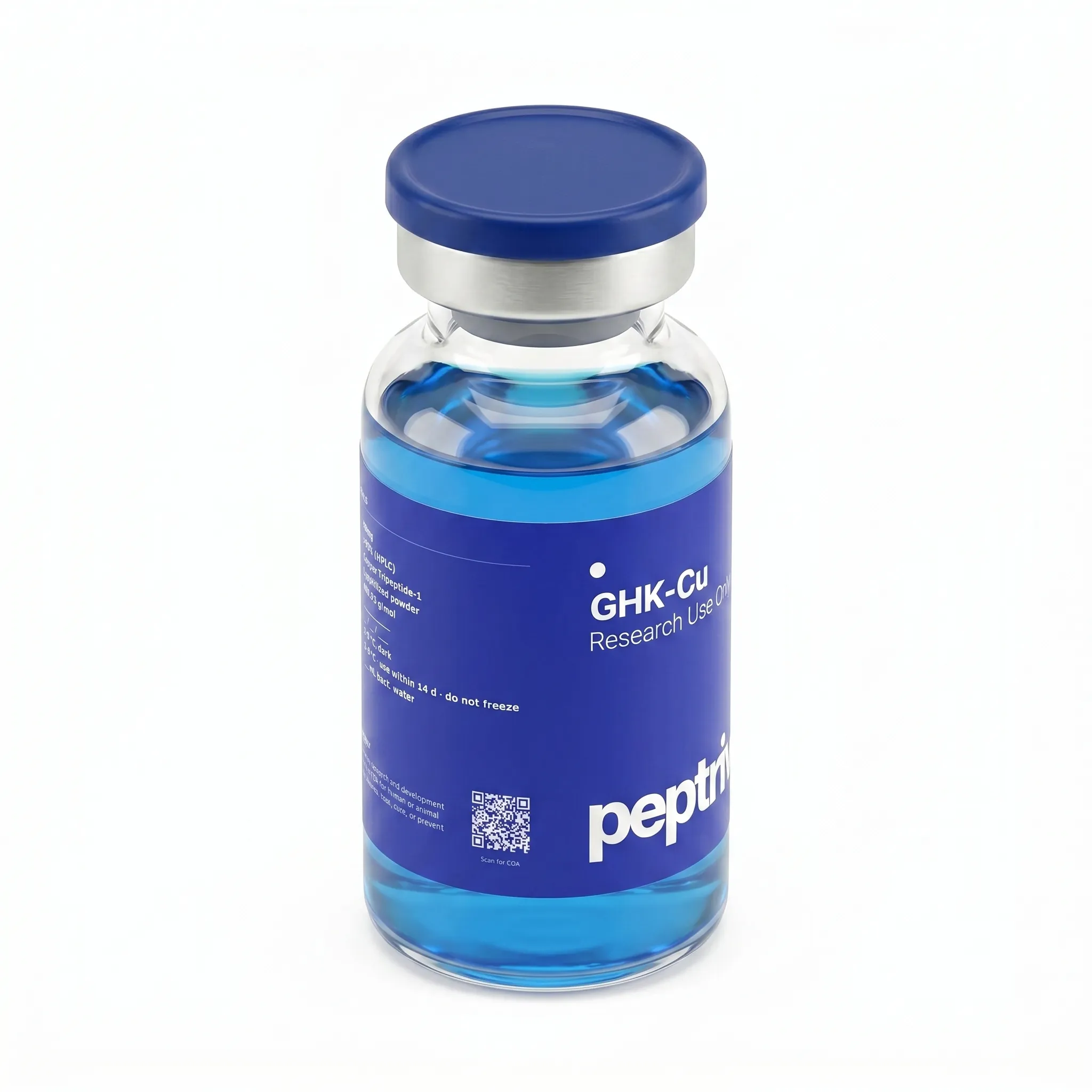
GHK-Cu
The same endogenous copper tripeptide cited across the cosmetic-dermatology and wound-healing studies in this review. Lab-verified identity and purity.
What does the topical evidence show?
This is where GHK-Cu has its strongest human evidence base among cosmetic-dermatology peptides. Topical copper peptide formulations have been commercially available since the 1990s under names including "tripeptide-1 copper" and the original Skin Biology product lines.
The body of work is small controlled studies and mechanistic lab work, not pharma-style Phase III trials. We think it still matters. The findings are consistent, replicated by independent groups, and biologically coherent.
A widely-cited 2002 study by Leyden and colleagues tested a 12-week facial cream. It produced measurable improvements in fine lines, wrinkle depth, and skin firmness versus placebo. Histology showed increased dermal density. The Pickart group's 2018 review aggregates roughly two dozen further topical studies. All point in the same direction: small but real improvements in skin roughness, fine-line counts, and dermal collagen.
One notable limitation: bare GHK-Cu has poor skin penetration. The molecule is hydrophilic and ionic, so it does not cross the outer skin barrier efficiently. Modern formulations use liposomes, hyaluronic-acid conjugates, or microemulsions to improve dermal delivery. The 2023 Dymek paper makes this case in detail, arguing that the delivery system is as consequential as the active peptide itself.
The topical evidence summary, in one sentence: across ~30 published studies spanning 1990–2025, topical GHK-Cu shows consistent, replicated, modest improvements in skin elasticity, dermal collagen density, fine-line depth, and wound-healing endpoints. The supporting lab biology is well-characterised too: collagen-cell stimulation, ~49% elastase inhibition, and new-capillary growth driven by VEGF.
Topical vs injectable: how do the evidence bases compare?
The topical route has the deepest human evidence base. Topical copper-peptide formulations have been the subject of approximately 30 controlled studies; the injectable route has no published human RCTs. A 2026 Sports Medicine review by Mendias and Awan groups GHK-Cu with grey-market peptides where rigorous human safety data is scarce.
As of mid-2026, we count zero PubMed-indexed RCTs of injectable GHK-Cu in humans for anti-aging, inflammatory bowel disease, lung disease, or any systemic indication. The colitis, silicosis, and wound-healing signals are all rodent-only.
What does the hair-follicle research show?
A handful of in vitro and small-animal papers have investigated GHK-Cu's effect on hair follicle cells, reporting stimulation of follicular keratinocyte proliferation and modest follicle enlargement in preclinical models.
Human data are limited. Available evidence consists largely of small open-label work in hair-transplant cohorts rather than blinded RCTs. Hair-follicle research on GHK-Cu should be characterised as preliminary and not yet established in controlled human trials.
What does the literature say about GHK-Cu and oncology-related pathways?
This question arises because of the dual-role longevity-gene and inflammation-signal pathway discussed above.
Both proteins have dual roles in cancer biology. The inflammation signal is a well-known cancer-driver when chronically activated. The longevity gene is more context-dependent: tumor-suppressive in some settings, tumor-promoting in others.
GHK-Cu modulates both. In Pickart's 2015 microarray work, GHK-Cu treatment of cultured cells shifted the expression of roughly 30% of measured genes, including genes implicated in DNA repair and tumor suppression. That work is interesting, but it's in vitro, from a single research group, and hasn't been replicated at scale.
Where this falls short: no human trials of GHK-Cu for cancer prevention or treatment have been published, and the in-vitro gene-expression data cannot be assumed to translate in either direction. Cancer-protective marketing claims are not supported by current human evidence. Topical use over intact skin carries a different risk profile, and decades of cosmetic-grade use have not flagged a cancer signal in epidemiological surveillance.
Is GHK-Cu approved for anything?
Topically, yes, as a cosmetic ingredient. GHK-Cu has been in cosmetic formulations under names like "tripeptide-1 copper" for decades under FDA cosmetic regulations and the EU Cosmetic Regulation.
That's a genuinely different regulatory pathway from a drug approval. Topical cosmetics don't need Phase III efficacy trials. They need safety substantiation. The legal framing matches the evidence. GHK-Cu is established as a topical cosmetic ingredient, not as a therapeutic drug.
Systemically: no. There is no FDA, EMA, or PMDA approval of GHK-Cu as a drug for any indication. WADA doesn't list it on the Prohibited List as of 2026, but that status can change.
Key methodological and practical considerations for researchers and clinicians reviewing the GHK-Cu literature:
- RCT availability by route: the topical literature includes several small controlled trials; the injectable systemic literature has no published human RCTs as of mid-2026.
- Delivery system: bare GHK-Cu exhibits poor penetration through intact skin due to its hydrophilic, ionic character. Published formulation work has focused on liposomal, hyaluronic-acid-conjugated, and microemulsion carriers to improve dermal delivery.
- Certificate of Analysis: cosmetic-grade and research-grade copper peptide are characterised to different purity and endotoxin standards and are not interchangeable.
- Copper-modulating co-treatments: chelation regimens such as penicillamine (used in Wilson's disease) interact with copper homeostasis; the interaction profile of GHK-Cu with such agents is under-studied in the published literature.
- Comparative evidence base: published effect-size data for photoaging show larger responses for tretinoin and vitamin C than for topical GHK-Cu; copper peptide represents one intervention among several investigated in the dermatology literature.
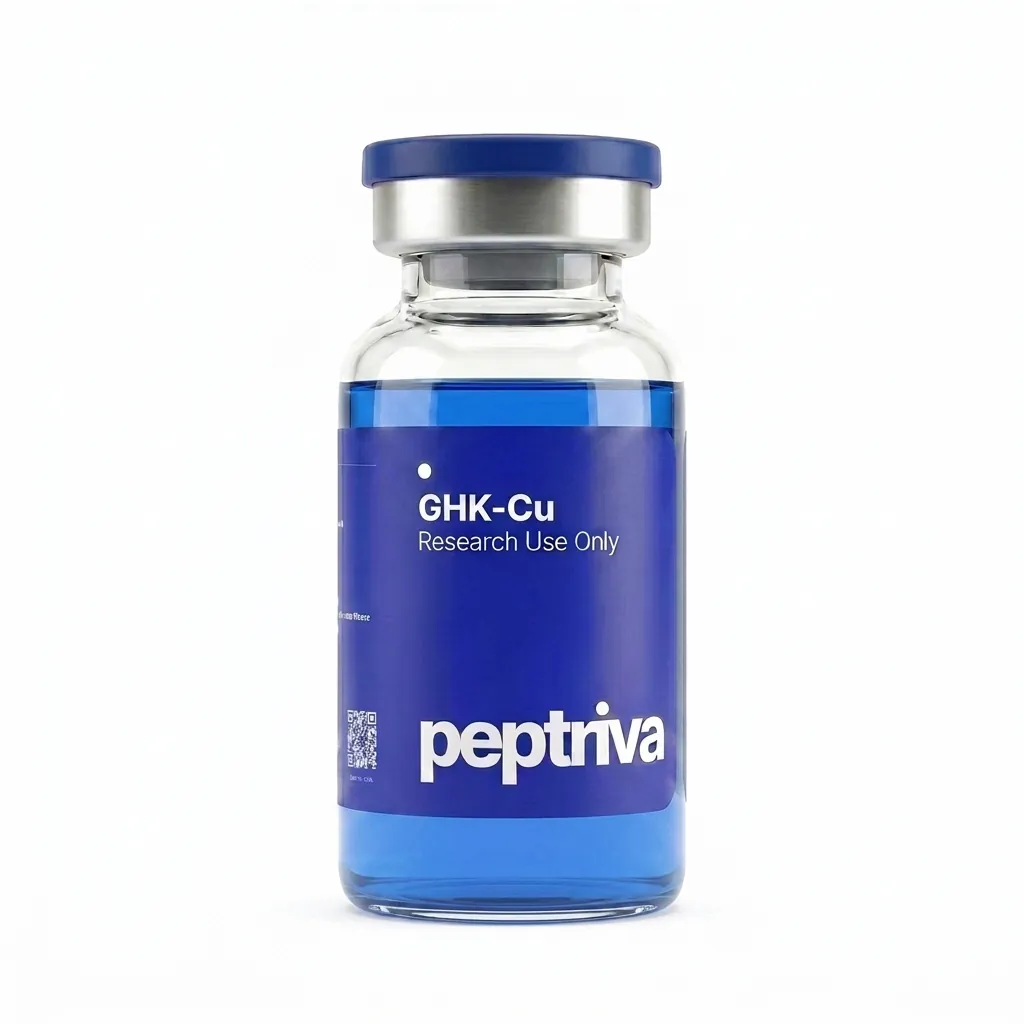
GHK-Cu
Glycyl-L-Histidyl-L-Lysine·Cu²⁺ copper chelate · the same reference compound used across the cited cosmetic-dermatology and wound-healing studies. COA available with each lot.
Cosmetic-grade vs research-grade: what's the difference?
This matters more than most marketing suggests. A cosmetic-grade ingredient sold to a skincare formulator meets purity and identity standards for topical use on intact skin. It isn't characterized to the endotoxin and purity standards required for pharmaceutical injection.
Research-grade GHK-Cu is supplied as a lyophilized vial, typically characterised at ≥98% or ≥99% purity by HPLC with a third-party Certificate of Analysis. The solid is a deep blue powder that reconstitutes to a clear blue solution.
For laboratory or preclinical research, research-grade material is the appropriate specification. For cosmetic formulation work, cosmetic-grade is the appropriate specification. The two grades are not interchangeable in either direction, and research-grade vials are not formulated or characterised for injectable self-administration.
What to know now
- Endogenous molecule: GHK is naturally in human plasma. Levels fall from ~200 ng/mL at age 20 to ~80 ng/mL by age 60.
- Bioactive form: the copper chelate. The deep blue color is the copper itself, not a dye.
- Topical evidence: ~30 published studies across 1990–2025 show consistent, modest improvements in skin elasticity, collagen density, and wound healing.
- Mechanism: multi-pathway. Collagen-cell stimulation, new-capillary growth, longevity-gene-and-inflammation-signal anti-inflammatory effects, ~49% elastase inhibition in vitro.
- Injectable evidence: zero published human RCTs for any systemic indication. The preclinical signals are rodent-only.
- Cancer signal: the dual-role oncology-pathway biology is real. No human cancer data are available in either direction; all findings are in vitro or rodent-model.
- Regulatory status: approved as a cosmetic ingredient (FDA, EU). Not approved as a drug. Not on the WADA Prohibited List in 2026.
What we're watching
Three things to track. First, whether the longevity-gene colitis signal from the 2025 Mao paper replicates outside the original Chinese group. Second, whether the lung-fibrosis binding target from the 2024 silicosis paper extends to other fibrotic lung diseases. That's a more concrete molecular target than our field has usually offered. Third, whether new liposomal cosmetic formulations push topical efficacy into the range of prescription dermatology agents.
References
- Dou, Y., Lee, A., Zhu, L., Morton, J., & Ladiges, W. (2020). The potential of GHK as an anti-aging peptide. Aging Pathobiology & Therapeutics, 2(1), 58–61. https://doi.org/10.31491/apt.2020.03.014
- Mao, S., Huang, J., Li, J., et al. (2025). Exploring the beneficial effects of GHK-Cu on an experimental model of colitis and the underlying mechanisms. Frontiers in Pharmacology, 16, 1551843. https://doi.org/10.3389/fphar.2025.1551843
- Bian, Y., Deng, M., Liu, J., et al. (2024). The glycyl-l-histidyl-l-lysine-Cu tripeptide complex attenuates lung inflammation and fibrosis in silicosis by targeting peroxiredoxin 6. Redox Biology, 75, 103237. https://doi.org/10.1016/j.redox.2024.103237
- Lee, S., Lee, S. M., Lee, S. H., et al. (2023). In situ photo-crosslinkable hyaluronic acid-based hydrogel embedded with GHK peptide nanofibers for bioactive wound healing. Acta Biomaterialia, 172, 159–174. https://doi.org/10.1016/j.actbio.2023.10.011
- Chen, H., Yang, P., Xue, P., et al. (2025). Food-derived tripeptide-copper self-healing hydrogel for infected wound healing. Biomaterials Research, 29, 0139. https://doi.org/10.34133/bmr.0139
- Dymek, M., Olechowska, K., Hąc-Wydro, K., & Sikora, E. (2023). Liposomes as carriers of GHK-Cu tripeptide for cosmetic application. Pharmaceutics, 15(10), 2485. https://doi.org/10.3390/pharmaceutics15102485
- Ogórek, K., Nowak, K., Wadych, E., Ruzik, L., Timerbaev, A. R., & Matczuk, M. (2025). Are we ready to measure skin permeation of modern antiaging GHK-Cu tripeptide encapsulated in liposomes? Molecules, 30(1), 136. https://doi.org/10.3390/molecules30010136
- Mendias, C. L., & Awan, T. M. (2026). Safety and efficacy of approved and unapproved peptide therapies for musculoskeletal injuries and athletic performance. Sports Medicine. https://doi.org/10.1007/s40279-026-02437-0