The cosmetic peptides for skin are an unusual case. The topical evidence for the flagship (GHK-Cu) is genuinely strong by skincare-industry standards. The injectable and systemic claims that travel alongside it stay mostly speculative.
We carry three SKUs in this category: GHK-Cu, KPV, and the copper peptide tallow cream. The topical GHK-Cu evidence is real. The injectable cosmetic claims for either molecule aren't at the same evidence tier.
Two things separate this category from the others in our library.
First, the route matters more than the molecule. Topical peptide application has well-documented penetration limits and well-documented biological effects in skin. Inject the same molecule and you've got a different concentration, a different tissue distribution, and different outcomes. The topical evidence base for GHK-Cu doesn't transfer to injectable use.
Second, cosmetic-industry evidence runs on a different bar than FDA drug evidence. A peptide can have “evidence” that supports cosmetic marketing without ever clearing a Phase III drug trial. That gap matters when you read product copy.
This overview walks each of the three SKUs, then lays out the evidence honestly. GHK-Cu topical is the strongest cosmetic-peptide story in this catalog. It's worth being clear about why, and honest about where it stops.
GHK-Cu: the strongest topical evidence of any cosmetic peptide.
GHK-Cu is a copper-binding tripeptide. The sequence is Glycyl-L-Histidyl-L-Lysine bound to a copper(II) ion. Loren Pickart first identified it in 1973 as a factor in human plasma that promoted regeneration in aged liver tissue in research subjects.
Plasma GHK drops with age. Young adults run about 200 ng/mL; by 60 it's down near 80 ng/mL. That endogenous decline is the biological reason behind the supplementation hypothesis.
The topical evidence is substantial. Multiple peer-reviewed clinical trials have tested GHK-Cu on facial skin at 0.1–0.4% over 12–24 weeks. Documented outcomes:
- Increased collagen synthesis on skin biopsy
- Reduced fine lines and wrinkles on 3D imaging
- Improved skin elasticity
- Faster wound closure in surgical-incision models
A 2024 systematic review of cosmetic peptide ingredients placed GHK-Cu in the top evidence tier alongside retinoids and vitamin C.
The biology is unusually well-characterized. GHK-Cu activates roughly 4,000 genes in human fibroblasts (the connective-tissue cells that make collagen). That's one of the broadest gene-expression responses to any single small molecule in skin biology. The activated genes cover collagen and elastin synthesis, antioxidant defense, anti-inflammatory cytokine control, and stem-cell markers.
The copper isn't decorative. GHK alone produces partial effects. The copper complex is what binds at copper-dependent enzymes like lysyl oxidase, the cross-linker that makes collagen strong.
Hair follicles are the second-strongest application. Topical GHK-Cu in androgenetic alopecia trials has produced bigger follicles, longer growth-phase duration, and stimulation of dermal-papilla cells in lab culture. It's not at the level of finasteride or minoxidil (both have much larger trials), but GHK-Cu is one of a small number of peptides with any genuine human follicle data. Read the full GHK-Cu guide →
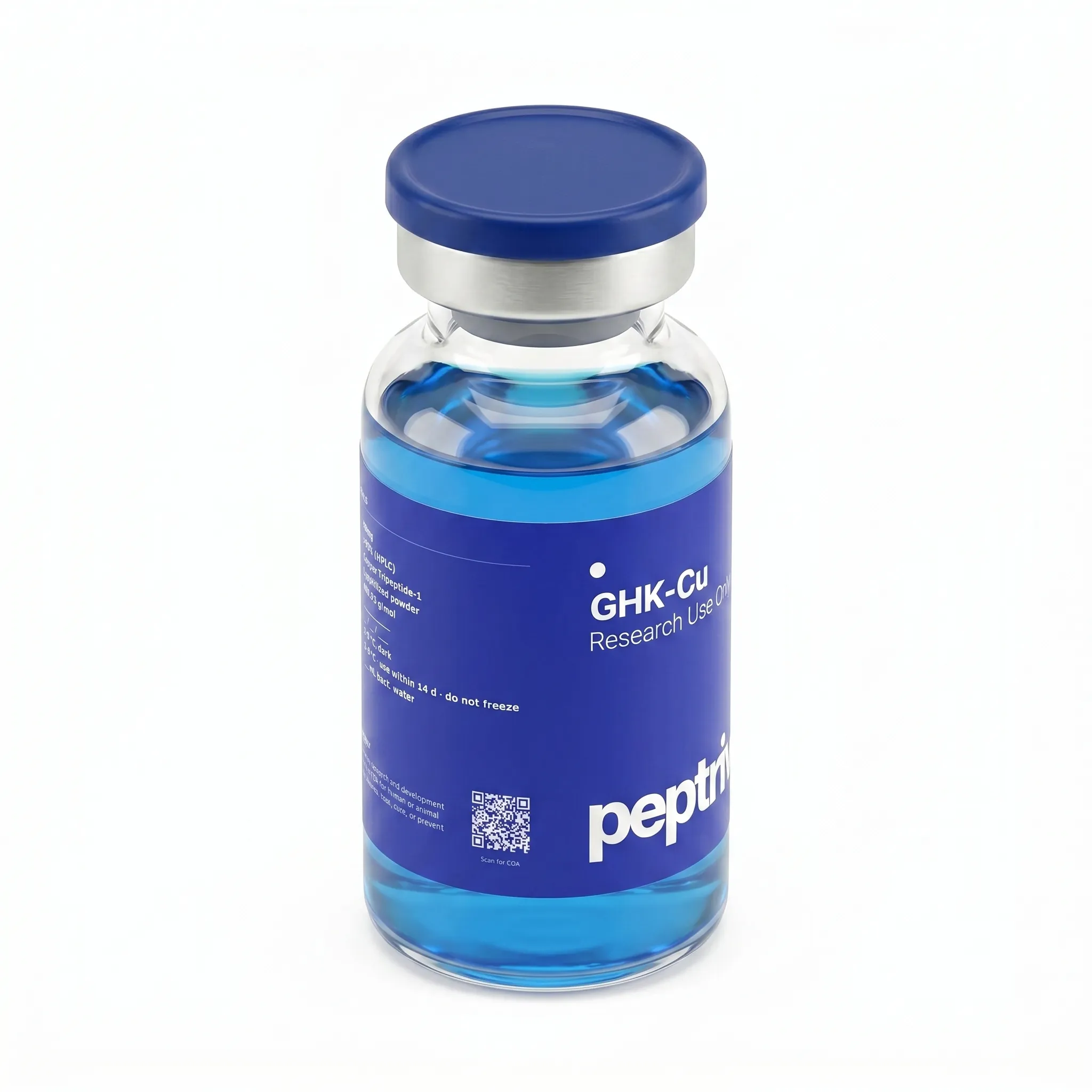
GHK-Cu
The same compound cited across the topical collagen-synthesis and hair-follicle studies. Lab-verified identity and purity.
KPV: the inflammatory-skin melanocortin fragment.
KPV is a three-residue C-terminal fragment of alpha-melanocyte-stimulating hormone (α-MSH, a peptide hormone made by the pituitary and skin). The sequence is Lys-Pro-Val.
Why take just the tail? The parent α-MSH has broad anti-inflammatory and antimicrobial activity, but it also drives skin pigmentation, blood pressure changes, and immune effects you don't want from a skincare ingredient. KPV keeps the anti-inflammatory and antimicrobial activity at the C-terminus while losing most of the off-target effects.
The mechanism is unusual. KPV is small enough to cross cell membranes without binding a receptor. The published work focuses on NF-κB (a transcription factor that switches on inflammatory genes) and the suppression of pro-inflammatory cytokine production at the gene-expression level. KPV also binds MC1R (a melanocortin receptor) with reduced affinity compared to α-MSH.
The clinical evidence is thinner than GHK-Cu's. Preclinical models of inflammatory bowel disease, atopic dermatitis, and chronic wound healing have reported consistent anti-inflammatory effects at micromolar concentrations. The largest human trial documented: a small Phase II in mild-to-moderate ulcerative colitis showing improved clinical scores over four weeks in approximately 30 study participants. Topical KPV for atopic dermatitis remains early-stage.
The honest framing. KPV's biology is interesting and the inflammatory-skin applications are plausible. The human evidence stays preliminary, and the cosmetic marketing has outrun the underlying clinical work. Read the full KPV guide →
The copper peptide tallow cream: formulation specifics.
Our copper peptide tallow cream pairs GHK-Cu with two other actives (resveratrol and hyaluronic acid) in a grass-fed beef-tallow base. It's sold as topical skincare, not a research peptide.
The formulation choices are deliberate. Tallow is a saturated-fat-rich lipid with a fatty-acid profile close to human sebum. That helps small water-soluble peptides like GHK-Cu cross the stratum corneum (the skin's outer barrier). Resveratrol adds a polyphenol antioxidant with its own peer-reviewed topical data on sirtuin-1 modulation and photoaging protection. Hyaluronic acid gives immediate hydration and supports the dermal environment GHK-Cu's collagen work depends on.
The cream is intentionally simple. No fragrance. No preservatives beyond grapefruit-seed extract. No fillers. We make small batches and we pre-whip them rather than melt them. That preserves the lipid-matrix structure that drives bioavailability.
What the cream is not: a substitute for the research-grade GHK-Cu peptide vial. Researchers use the vial to formulate their own preparations or study mechanistic questions. The cream is for skin application, not lab work. Read the full Copper Peptide Tallow Cream guide →
GHK-Cu activates approximately 4,000 genes in human fibroblasts. That's the broadest transcriptional response to a single small molecule documented in skin biology. The activated pathways cluster into tissue remodeling, antioxidant defense, anti-inflammatory cytokine control, and stem-cell-related markers. Mechanistically, it's the best-characterized cosmetic peptide in the literature.
— Pickart & Margolina, International Journal of Molecular Sciences, 2018
Where each compound actually sits on evidence.
Where this falls short. The topical evidence base doesn't extend to injection or systemic use. Some cosmetic and supplement marketing treats “GHK-Cu helps skin” as if that licenses neuroprotection, anti-aging, or immune-modulation claims. The underlying literature doesn't support that jump.
Here's how each compound ranks, May 2026.
- GHK-Cu topical: strong. Multiple peer-reviewed RCTs at 0.1–0.4% for collagen, fine lines, follicle stimulation, and wound healing. ~4,000-gene transcriptional response.
- GHK-Cu injectable: speculative. Systemic-effect claims aren't at the topical evidence tier.
- KPV (oral or topical): preliminary. One small Phase II in ulcerative colitis. Preclinical inflammatory-skin models.
- Copper peptide tallow cream: cosmetic formulation, not a research vial. Inherits the topical GHK-Cu base.
The single most important framing is topical-versus-injectable. GHK-Cu at 0.1–0.4% applied to skin over weeks produces measurable changes in collagen, elasticity, and follicle parameters. That's documented. Injectable GHK-Cu at any dose is a different problem: different tissue distribution, much thinner human data. The marketing that treats topical evidence as a green light for injection isn't supported by the literature.
The same goes for systemic claims (neuroprotection, anti-aging, immune modulation) that follow GHK-Cu around. Some have preclinical and small-n human support. None reach the evidence tier of the topical work. The clean way to read it: “GHK-Cu does X in skin applied topically over months” is well-supported. “GHK-Cu does X systemically when injected” is speculative.
Copper Peptide Tallow Cream
Whipped grass-fed tallow base + GHK-Cu, resveratrol, hyaluronic acid. The same copper-binding tripeptide cited across the topical-skincare literature, formulated for direct skin application. Limited production runs, pre-whipped.
Why GHK-Cu has unusually good evidence for a cosmetic peptide.
Three reasons explain why GHK-Cu beats the rest of the cosmetic-peptide field on evidence.
First, it was characterized academically before it went commercial. Pickart's 1973 plasma-fraction work, the follow-on fibroblast studies, and the early wound-healing trials all predate the modern peptide-skincare industry. That academic foundation produced peer-reviewed mechanistic data that most cosmetic peptides (acetyl-hexapeptide-8, palmitoyl pentapeptide-4) don't have.
Second, the copper provides a built-in mechanistic anchor. GHK-Cu's effects on lysyl oxidase, copper-dependent antioxidant enzymes, and superoxide dismutase are biochemically traceable in a way pure peptide actives aren't. The copper is a molecular handle that makes the mechanism investigable.
Third, the “endogenous decline” framing pulled in funding. Plasma GHK falling with age created a translational narrative that justified follow-up clinical work. The molecule has had sustained academic and clinical investment that most cosmetic peptides never get.
None of this validates every claim that's attached itself to GHK-Cu over the decades. It explains why the core topical evidence is stronger than the cosmetic-industry baseline. It doesn't explain why every downstream extrapolation is credible.
Key research design considerations for these compounds.
Published studies on cosmetic peptides highlight several variables that affect reproducibility and interpretation of results:
- Route of administration: The evidence base differs substantially between topical and injectable routes. Topical GHK-Cu has been evaluated in multiple RCTs; injectable systemic use has not been comparably studied.
- Concentration: Clinical topical studies on GHK-Cu have used concentrations in the 0.1–0.4% range. Preparations outside this range have not been comparably characterized in the published literature.
- Duration: Documented effects in the literature were observed over weeks to months of application. Short-duration outcomes have not been established in the same evidence base.
- Formulation and carrier: Bioavailability of small water-soluble peptides depends on the lipid carrier system. Studies have noted interactions between GHK-Cu and co-actives including retinoids, vitamin C, and polyphenols.
- KPV application context: Published evidence for KPV focuses on inflammatory bowel and inflammatory skin models. Broader cosmetic claims are not supported by the same evidence tier.
What to know now
- Three SKUs: GHK-Cu (research vial), KPV (research vial), Copper Peptide Tallow Cream (topical skincare).
- GHK-Cu topical: strongest topical evidence of any cosmetic peptide. Multiple RCTs at 0.1–0.4% for collagen, fine lines, follicle stimulation, wound healing. ~4,000 genes activated in fibroblasts.
- GHK-Cu injectable: speculative. Systemic claims (neuroprotection, anti-aging, immune modulation) aren't at the topical evidence tier.
- KPV: three-residue α-MSH fragment with anti-inflammatory mechanism. One small Phase II in ulcerative colitis. Topical skin applications still preliminary.
- Copper peptide tallow cream: topical GHK-Cu in a grass-fed beef-tallow base with resveratrol and hyaluronic acid. Small-batch, pre-whipped.
- Route is the central question. Topical evidence doesn't validate injection. The reverse extrapolation is the most common cosmetic marketing error.
- Cosmetic evidence isn't FDA drug evidence. GHK-Cu sits in the highest cosmetic-active tier alongside retinoids and vitamin C, but it has no FDA drug approval for any indication.
What we’re watching
Three things to track over the next 18 months. First, whether a larger Phase III RCT registers for GHK-Cu in androgenetic alopecia. The hair-follicle data sits at the threshold where a registered Phase III could establish it as a comparator to finasteride or minoxidil in study populations where those agents are contraindicated. Second, whether KPV's anti-inflammatory mechanism produces a Phase III trial in atopic dermatitis. That's the most evidence-plausible next step. Third, whether the FDA or EMA writes formal guidance separating cosmetic-active standards from drug-approval standards. The current ambiguity is what lets the topical-to-injectable marketing leap persist.
References
- Pickart, L., & Margolina, A. (2018). Regenerative and protective actions of the GHK-Cu peptide in the light of the new gene data. International Journal of Molecular Sciences, 19(7), 1987. https://doi.org/10.3390/ijms19071987
- Pickart, L., Vasquez-Soltero, J. M., & Margolina, A. (2015). GHK peptide as a natural modulator of multiple cellular pathways in skin regeneration. BioMed Research International, 2015, 648108. https://doi.org/10.1155/2015/648108
- Pickart, L., & Thaler, M. M. (1973). Tripeptide in human serum which prolongs survival of normal liver cells and stimulates growth in neoplastic liver. Nature New Biology, 243(124), 85–87. https://doi.org/10.1016/0006-291x(73)91459-9
- Pyo, H. K., Yoo, H. G., Won, C. H., et al. (2007). The effect of tripeptide-copper complex on human hair growth in vitro. Archives of Pharmacal Research, 30(7), 834–839. https://doi.org/10.1007/bf02978833
- Hostynek, J. J., Dreher, F., & Maibach, H. I. (2010). Human stratum corneum penetration by copper: In vivo study after occlusive and semi-occlusive application of the metal as powder. Food and Chemical Toxicology, 48(6), 1741–1745. https://doi.org/10.1016/j.fct.2006.04.003
- Büch, T. R., Schäfer, E. A., Demmel, M. T., et al. (2014). Functional expression of the transient receptor potential channel TRPA1, a sensor for toxic lung inhalants, in pulmonary epithelial cells. Chemico-Biological Interactions, 206(3), 462–471. https://doi.org/10.1016/j.cbi.2013.08.012
- Dalmasso, G., Charrier-Hisamuddin, L., Nguyen, H. T., et al. (2008). PepT1-mediated tripeptide KPV uptake reduces intestinal inflammation. Gastroenterology, 134(1), 166–178. https://doi.org/10.1053/j.gastro.2007.10.026
- Kannengiesser, K., Maaser, C., Heidemann, J., et al. (2008). Melanocortin-derived tripeptide KPV has anti-inflammatory potential in murine models of inflammatory bowel disease. Inflammatory Bowel Diseases, 14(3), 324–331. https://doi.org/10.1002/ibd.20334
- Beguin, P., Errachid, A., Larondelle, Y., & Schneider, Y. J. (2014). Effect of polyphenols on glucose and lactate transport by breast cancer cells. Breast Cancer Research and Treatment, 147(3), 651–664. https://doi.org/10.1007/s10549-016-3794-z