The GLOW Blend packs three well-known research compounds — BPC-157, TB-500, and the copper tripeptide GHK-Cu — into one lyophilized vial. That makes where to buy GLOW Blend three sourcing problems stacked on top of each other, plus a fourth that belongs to blends alone: is the ratio in the vial the ratio on the label? Add the copper wrinkle — GHK-Cu’s blue color can be faked with dye for pennies — and this becomes one of the most documentation-dependent purchases in the research-peptide market.
Get new research first
Research updatesOne short email when new peptide research drops or a new ISO 17025-verified batch lands — written from primary sources, no filler.
You’re on the list — check your inbox for a confirmation.
Could not save your email. Try again in a moment.
The GLOW Blend is a fixed-ratio pre-mix: 10 mg BPC-157 + 10 mg TB-500 + 50 mg GHK-Cu in a 70 mg lyophilized cake. A credible Certificate of Analysis therefore carries three separate mass-spec identity confirmations (BPC-157 near 1419.5, the TB-500 fragment near 889.0, GHK-Cu consistent with 401.9 g/mol), per-component HPLC purity ≥98%, a weight-percent composition assay, and elemental copper quantitation — copper is roughly 16% of the GHK-Cu mass. Market pricing for ISO 17025-verified tri-blends of this composition runs about $110-$200 per vial in 2026. The blue tint of the reconstituted solution comes from the copper complex — and is the single easiest attribute for a counterfeiter to fake with dye.
- CoA. Certificate of Analysis. A one-page lab report showing a specific lot's identity, purity, and contaminant results. For a blend, it must cover each component separately.
- ISO/IEC 17025. The international quality standard for testing labs. A 17025-accredited lab has been audited by a third party for technical competence.
- Chelate. A metal ion gripped by a molecule at multiple points. GHK-Cu is a copper(II) chelate — the peptide GHK holding one copper ion — which is why copper content is part of its identity.
- ICP-MS. Inductively coupled plasma mass spectrometry. The standard method for measuring elemental metal content — here, whether the vial actually contains the copper the GHK-Cu label implies.
- HPLC. High-performance liquid chromatography. The standard purity test for peptides. For a blend, the method must resolve three different peptides, not report one merged number.
- Lyophilized. Freeze-dried into a stable powder. The GLOW cake is white to pale blue; full color develops on reconstitution.
Quick answer. An ISO 17025-verified 70 mg tri-blend (10/10/50) should cost roughly $110-$200 in 2026, ship as a lyophilized cake, and come with a third-party CoA that identifies all three compounds by mass spectrometry, reports purity per component, verifies the weight ratio, and quantifies elemental copper. A vendor selling “glow” on branding, before-and-after imagery, or the blue color alone — without that document — is selling a story, not a reference material.
What you're actually buying
A blend vial is not a new molecule. It is three separate syntheses combined into one fill, and each component keeps its own identity, its own CAS number, and its own evidence base.
BPC-157 is a synthetic 15-amino-acid peptide (sequence Gly-Glu-Pro-Pro-Pro-Gly-Lys-Pro-Ala-Asp-Asp-Ala-Gly-Leu-Val, CAS 137525-51-0) derived from a partial sequence of a protein found in human gastric juice. Its proposed mechanism runs through VEGFR2 activation and nitric-oxide signaling in the Akt-eNOS pathway (McGuire et al., 2025). A 2025 systematic review identified 36 studies of BPC-157 for orthopaedic indications — 35 preclinical, one clinical (Vasireddi et al., 2025).
TB-500 is a marketing name, and that matters at the point of sale. It is sometimes used for full-length thymosin β4 (a 43-residue endogenous peptide) and sometimes for a short synthetic fragment carrying the LKKTETQ actin-binding sequence. The 2026 Sports Medicine review explicitly distinguishes the two (Mendias & Awan, 2026), and a 2026 American Journal of Sports Medicine primer treats them as related but distinct entities (Mayfield et al., 2026). The parent molecule’s biology — 1:1 G-actin sequestration regulating cell motility — is genuinely well characterized (Ying et al., 2023). Which molecule is in a given “TB-500” vial is exactly what the CoA’s mass-spec line exists to answer.
GHK-Cu is the copper(II) chelate of glycyl-L-histidyl-L-lysine, a tripeptide naturally present in human plasma — circulating levels average 200 ng/mL at age 20 and decline to roughly 80 ng/mL by age 60 (Dou et al., 2020). The histidine residue grips Cu(II) with exceptionally high affinity; the chelate (CAS 89030-95-5, 401.9 g/mol) is the typical bioactive form, and the copper is why authentic solutions carry a faint blue tint. GHK-Cu is the most extensively used cosmetic peptide in commercial skincare, with decades of topical formulation history — and essentially no controlled human data for injectable use.
TB-4 and TB-500 are related but distinct entities, and buyers of TB-500 from research-chemical suppliers cannot generally verify which form they are receiving without independent testing. For a blend, that ambiguity is one of three identity questions in the same vial.
— Our reading of the 2026 sports-medicine reviews (Mendias & Awan; Mayfield et al.)
The honest framing for the combination itself: the three compounds target complementary repair and remodeling biology, but no controlled human trial has studied the trio together. The closest published data point is a 2021 retrospective knee-pain case series in which just 4 participants received a two-compound BPC-157 + TB-500 co-injection — uncontrolled, telephone-recall follow-up, no isolated efficacy data (Lee & Padgett, 2021). A pre-mix buys convenience and a fixed ratio. It does not buy combined evidence.
The places people buy it
Three-compound aesthetic blends are sold through three channels with very different documentation standards.
1. Research-supply vendors (the only channel with verifiable material)
This is where legitimate GLOW-type blends live: lyophilized single-vial pre-mixes labeled for laboratory research use only. The format is legal in the U.S. under research-use-only framing. The vendor bar is higher than for a single peptide, because the CoA has to do three times the identity work — and add composition and copper assays on top. A blend vendor whose posted CoA looks identical to a single-compound CoA hasn't tested a blend; they've tested (at most) one ingredient.
2. Compounding pharmacies (effectively closed for this blend)
A 503A compounding pharmacy can in principle prepare peptides under prescription for an individual patient. In practice this channel is shut for the GLOW trio: in 2023 the FDA placed BPC-157 on its Category 2 list for 503A compounding — flagged for safety risks — which pushed most U.S. compounders away from it. No thymosin-β4 product is FDA-approved, and injectable GHK-Cu has no approved-drug pathway either. A pharmacy-branded “glow injection” containing these compounds deserves more scrutiny, not less.
3. The aesthetics gray market (where the “glow” branding lives)
The word “glow” is doing marketing work, and it points at a real phenomenon: this blend is sold hard through skincare-adjacent social commerce — influencer storefronts, med-spa back channels, DM sellers — on before-and-after imagery and cosmetic promises. That market inherits GHK-Cu’s decades of topical cosmetic credibility and quietly transfers it to an injectable format the published literature does not cover. It is also where documentation is thinnest and where the blue-dye counterfeit problem (next section) concentrates. Buy on documents, not on aesthetics-market momentum.
The GLOW-Blend-specific checks
The standard eight criteria for any peptide vendor apply. Four are sharper for a three-compound copper blend.
1. Three compounds, three identity checks
One mass-spec line cannot identify three molecules. A credible blend CoA reports a separate identity confirmation for each component: BPC-157 at its expected mass near 1419.5, the TB-500 heptapeptide fragment near 889.0 (or full-length Tβ4 near ~4,963 if that is what the vendor claims to ship — they must say which), and GHK-Cu consistent with its 401.9 g/mol copper complex. Each line should carry the matching CAS number: 137525-51-0, 885340-08-9, and 89030-95-5 respectively. A blend CoA showing one merged “identity: pass” has verified nothing.
2. Ratio verification — the check unique to blends
The label says 10/10/50. The cake is a uniform powder; nothing about its appearance tells you the split. The verifiable evidence is a weight-percent composition assay: for a 10/10/50 fill, roughly 71% GHK-Cu, 15% BPC-157, and 14% TB-500 by mass, each within a stated tolerance. This matters because the economics invite skew — GHK-Cu is by far the cheapest of the three per milligram, so an unscrupulous filler can hit the labeled 70 mg total while shorting the two expensive components. Purity numbers alone cannot catch that; only a composition assay can.
3. Copper quantitation — and why the blue tint proves nothing
GHK-Cu is a copper chelate, so elemental copper is part of its identity. Copper is roughly 16% of the GHK-Cu mass (63.5 of 401.9 g/mol) — a 50 mg GHK-Cu component implies about 8 mg of elemental copper in the vial. An honest blend CoA quantifies that copper by ICP-MS or an equivalent elemental method, and its heavy-metals panel explicitly excludes copper as the active rather than reporting a meaningless “metals: none detected.”
The flip side is the counterfeit vector. Buyers have learned “real GHK-Cu is blue,” and dye sellers exploit exactly that heuristic — a trace of blue colorant reproduces the look of a copper-peptide solution at essentially zero cost. Color is chemistry’s cheapest attribute to fake. Analytical chemists treat GHK-Cu quantitation as a genuine measurement problem in its own right, not a visual checkbox (Ogórek et al., 2025). If the copper number isn’t on the CoA, the blue in the vial is an assertion, not evidence.
4. Co-formulation stability — a copper complex sharing a vial with two peptides
A blend inherits the shortest stability profile of its components, and this one combines two fragilities: TB-500 is oxidation-sensitive, and the GHK-Cu copper complex is light-sensitive — while copper(II) is itself redox-active chemistry sitting in the same solution as the oxidation-prone peptide. Ask the vendor two questions a single-compound seller never faces: is the stated shelf life supported by stability data on the mixed cake (not the individual ingredients), and what is the in-use window for the reconstituted solution stored cold and dark? A vendor who has actually characterized their blend answers both without hesitation.
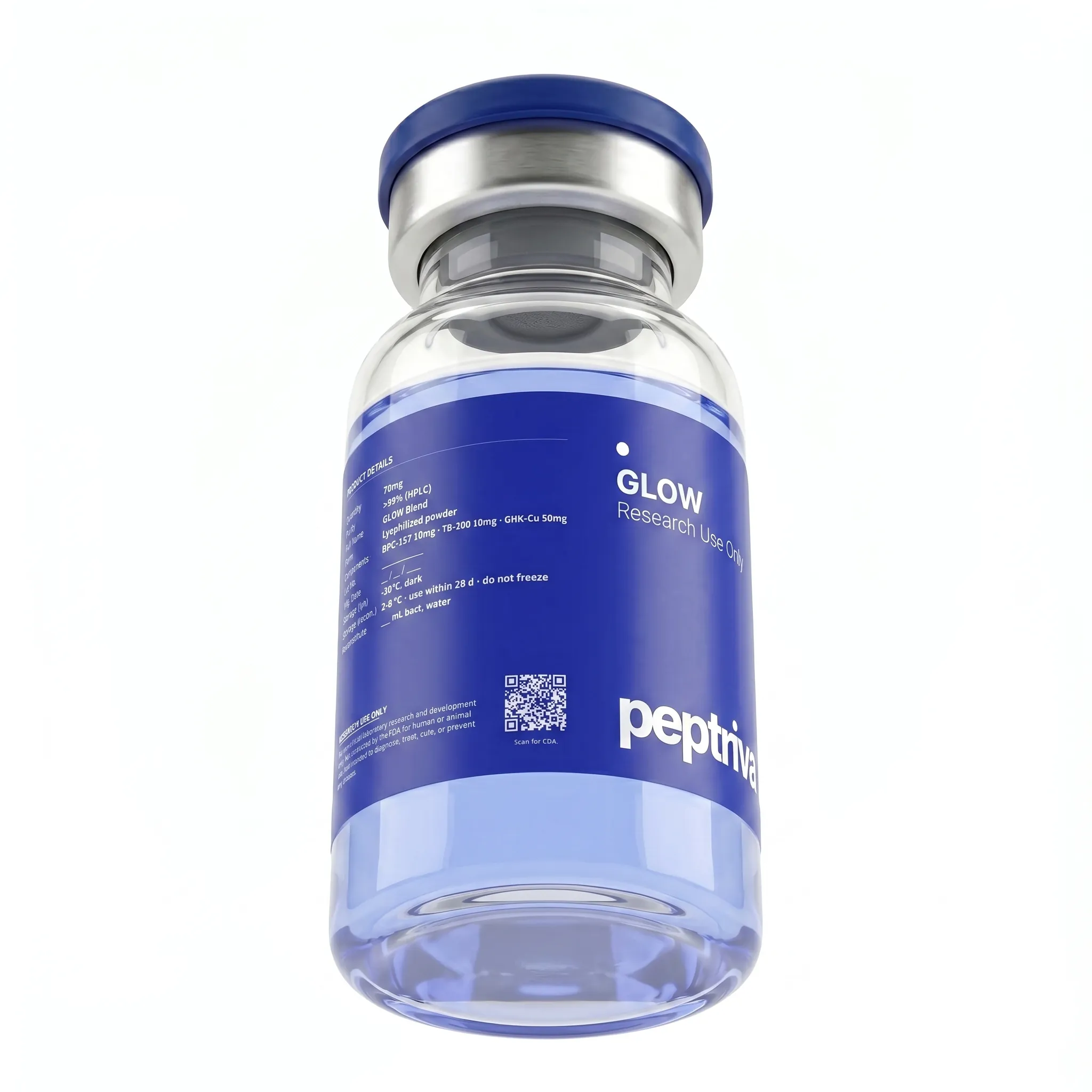
GLOW Blend
The same three compounds covered by the reviews cited in this guide — the pentadecapeptide BPC-157 (CAS 137525-51-0), the TB-500 fragment declared by form, and the copper tripeptide GHK-Cu (CAS 89030-95-5) — identified separately by mass spec, with per-component ≥98% HPLC purity, composition assay, and an ISO 17025 third-party CoA on every lot.
2026 pricing benchmarks
Blend pricing should track component synthesis cost. The three ingredients price very differently per milligram — GHK-Cu is a short, cheap tripeptide; BPC-157 and TB-500 are longer syntheses — so the bulk of a 10/10/50 vial’s mass is its cheapest ingredient. Benchmarks for ISO 17025-verified material in 2026:
- Components bought separately: BPC-157 10 mg runs $80-$150; TB-500 10 mg runs $90-$180; GHK-Cu 50 mg runs $40-$80. Sum: roughly $210-$410 across three vials.
- 70 mg tri-blend vial (10/10/50): $110-$200. The discount versus separates reflects one vial, one fill, one QC pass — partly offset by the extra blend assays.
- Multi-vial discounts: 10-20% off on 3-packs at most vendors.
Pricing meaningfully below $80 per tri-blend vial deserves suspicion, not celebration. The synthesis floor for the two long peptides plus per-component testing doesn’t leave room for a bargain there; the plausible explanations are a skewed ratio (mostly cheap GHK-Cu), skipped purification, or skipped testing. Above roughly $250 you’re paying aesthetics-market markup — the “glow” premium — rather than chemistry.
Legal status: FDA, WADA, and the cosmetic asterisk
- United States (FDA): None of the three components is approved as an injectable drug for any indication, and the combination has no separate regulatory status. The blend is legal to buy and sell as research reference material labeled for laboratory use only; selling it for human consumption is illegal. BPC-157 sits on FDA’s Category 2 list for 503A compounding (flagged for safety risks).
- The cosmetic asterisk: GHK-Cu is a legitimate, long-standing topical cosmetic ingredient (“copper tripeptide-1”) under cosmetic regulations. That status covers creams and serums — it does not transfer one inch toward injectable material, however often aesthetics marketing implies otherwise.
- WADA: TB-500/Tβ4 is prohibited under S2 (peptide hormones, growth factors and related substances). BPC-157 was added under S0 (non-approved substances) effective January 2022, per a 2025 review (Józwiak et al., 2025). GHK-Cu is not explicitly listed — irrelevant in practice, since the blend contains two prohibited components. (WADA Prohibited List for current status.)
- Major sports leagues: BPC-157 and TB-500 are generally prohibited; standard anti-doping panels include Tβ4 detection.
Where this falls short. The blend’s evidence is inherited, not combined. BPC-157’s literature is overwhelmingly preclinical and concentrated in a single research group; published human exposures across all its pilot studies total fewer than 50. TB-500 has zero published human trials for the recovery uses it’s marketed for. GHK-Cu’s strong evidence is topical-cosmetic; its injectable human RCT count is zero. And the three-compound combination itself has never been studied in a controlled human trial. A 2026 review groups these compounds among grey-market peptides where rigorous human safety data are scarce (Mendias & Awan, 2026).
Red flags specific to the GLOW Blend
- A single-compound CoA presented for a three-compound product. One mass-spec identity, one purity number, no composition assay — the document doesn't match the product. Most common failure in this category.
- Blue color offered as proof of GHK-Cu. “You can see the copper” is not an assay. Dye reproduces the tint; only mass-spec identity plus elemental copper quantitation (ICP-MS or equivalent) proves the chelate.
- No declared TB-500 form. Fragment or full-length Tβ4 — different molecules, different masses. A vendor who can't say which is in the vial hasn't verified it.
- No composition assay. Without weight-percent numbers per component, a 70 mg cake could be mostly cheap GHK-Cu with token amounts of the expensive peptides — and pass every purity test.
- Aesthetic outcome claims. “Glow from within,” skin-rejuvenation promises, before-and-after photos. Cosmetic claims for an injectable research compound are both scientifically unsupported (no injectable RCTs) and a marker that the vendor is selling to consumers, not researchers.
- Cosmetic-grade GHK-Cu in an injectable-format product. Cosmetic-ingredient supply chains are not held to injectable-material standards for sterility and endotoxin. The CoA should show endotoxin (LAL) and bioburden results on the finished blend.
- Heavy-metals line that ignores the active. A blend CoA must handle copper explicitly — quantified as the active, excluded from the contaminant panel. A generic “heavy metals: pass” suggests the lab never noticed it was testing a copper compound.
- Priced like a single peptide. Tri-blend testing costs more, not less. A $60 “70 mg blend” is priced below its own synthesis floor.
Unregulated manufacturing and contamination are plausible sources of harm separate from the molecule itself. For a three-peptide copper blend, every step that could go wrong in one synthesis can now go wrong in three — plus the mixing step no single-compound product has.
— Paraphrasing the manufacturing-risk finding in Vasireddi et al., HSS Journal, 2025
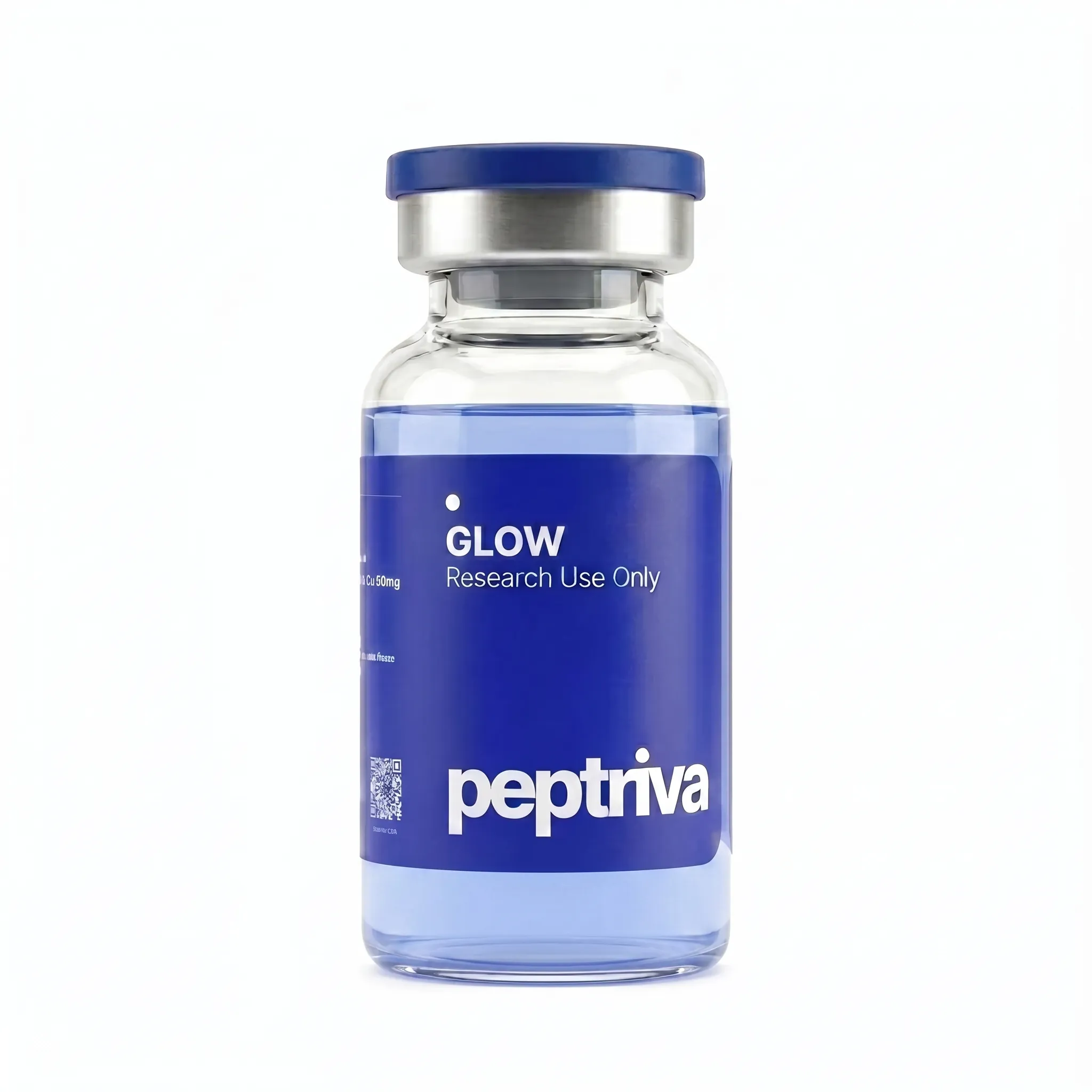
GLOW Blend
BPC-157 + TB-500 + GHK-Cu, 70 mg total in a single sterile vial (10/10/50). Per-component identity and HPLC purity, composition assay, endotoxin and bioburden on the finished cake, heavy metals with copper handled as the active. ISO 17025-verified reference material; COA with every lot.
The molecule is real, the topical use is well-supported, and the systemic injectable use is research-stage. GHK-Cu’s cosmetic credibility is the engine of the “glow” market — and the thing that credibility least supports is the injectable format it’s being used to sell.
— Our reading of the GHK-Cu literature, 2026
Frequently asked questions
Is the GLOW Blend legal to buy in the USA?
Yes, as research reference material labeled for laboratory use only. None of the three components is FDA-approved as an injectable drug, and none is a controlled substance. Selling the blend for human consumption is illegal; buying it as research material is not. GHK-Cu’s separate life as a cosmetic ingredient covers topical products only.
Is the blue color proof of real GHK-Cu?
No. Authentic GHK-Cu solutions are faintly blue because of the copper(II) complex — the same physics as blue copper proteins — but blue dye reproduces the look for pennies, and counterfeiters lean on exactly that expectation. Treat color as a consistency check only. Identity lives in the mass-spec line; the copper lives in the ICP-MS (or equivalent) number, which should come out near 16% of the GHK-Cu mass.
What should a GLOW Blend CoA show?
Six things: (1) separate mass-spec identity for each compound — near 1419.5 for BPC-157, near 889.0 for the TB-500 fragment (with the form declared), consistent with 401.9 g/mol for GHK-Cu; (2) per-component HPLC purity ≥98%; (3) a weight-percent composition assay confirming the labeled ratio; (4) elemental copper content; (5) endotoxin (LAL) and bioburden on the finished blend; (6) the name of the ISO 17025-accredited third-party lab. A one-line “purity: 99%” for a three-peptide vial is a document about a different product.
Is a pre-mixed blend better than three separate vials?
Different, not better. The pre-mix removes reconstitution steps and locks a fixed 10/10/50 ratio; separates cost more in total but let a researcher set any ratio, or study one compound in isolation — which is what most of the actual literature did. There is no controlled evidence that the combined format outperforms its parts, because the combination has never been tested in a controlled human study.
Is the GHK-Cu evidence injectable or topical?
Topical, overwhelmingly. Decades of cosmetic formulation history, replicated in-vitro biology (collagen-fibroblast stimulation, ~49% elastase inhibition (Dymek et al., 2023)), and small controlled topical studies — versus zero PubMed-indexed injectable human RCTs in 2020-2026. Full comparison: GHK-Cu injectable vs topical.
Is the blend banned in sport?
For tested athletes, effectively yes. TB-500/Tβ4 is prohibited under WADA S2, and BPC-157 was added under S0 effective January 2022. GHK-Cu isn’t explicitly listed, but two prohibited components make the blend prohibited material, and Tβ4 detection is part of standard anti-doping panels.
How does the GLOW Blend compare to the two-peptide BPC-157 + TB-500 blend?
The two-peptide blend is the recovery-focused pre-mix; GLOW adds 50 mg of GHK-Cu on top, which shifts the marketing toward skin and aesthetics and adds the copper-verification workload to the CoA. The evidence logic is identical for both: component literatures, no combination trials. Deep dive: the BPC-157 + TB-500 blend guide.
What to know now
- Three compounds = three identity checks. Mass-spec per component (1419.5 / 889.0 / 401.9-consistent), each with its CAS number. One merged “pass” verifies nothing.
- Ratio verification is the blend-only check. A weight-percent composition assay (~71/15/14 for a 10/10/50 fill) is the only defense against a vial padded with its cheapest ingredient.
- The blue tint is the easiest thing to fake. Copper is ~16% of the GHK-Cu mass and should be quantified by ICP-MS or equivalent. Dye is not a copper chelate.
- $110-$200 per 70 mg tri-blend vial. Below ~$80, assume a skewed ratio or skipped testing. Well above $250, you’re paying the “glow” premium.
- The evidence doesn’t blend. 36 mostly-preclinical BPC-157 orthopaedic studies, ~30 topical GHK-Cu studies on the wrong route, zero TB-500 human trials, zero combination trials.
- Athletes: two of three components are WADA-prohibited. S2 for TB-500/Tβ4, S0 for BPC-157. The blend is off-limits for tested competitors.
What we’re watching
Two tracks. Scientifically: whether injectable GHK-Cu ever generates a controlled human study — the 2020-2026 window produced interesting preclinical work (colitis, lung-fibrosis, and wound-healing models) but zero human RCTs for any systemic use, and until that changes, every aesthetic claim for injectable copper peptide is an extrapolation from topical and animal data. Commercially: the “glow” hype cycle itself. Blend SKUs multiply fastest where branding outruns documentation, and the copper tint gives this category a uniquely fakeable visual signature — we expect counterfeit pressure here to stay higher than for unpigmented single peptides. The durable buyer defense doesn’t change: per-component identity, composition assay, copper number, accredited lab. Separately, FDA’s compounding posture on BPC-157 (Category 2 since 2023) is worth tracking — any tightening tends to push aesthetic-market demand toward gray channels, where documentation is thinnest.
References
- Vasireddi, N., Hahamyan, H., Salata, M. J., et al. (2025). Emerging use of BPC-157 in orthopaedic sports medicine: A systematic review. HSS Journal, 21(4). https://doi.org/10.1177/15563316251355551
- McGuire, F. P., Martinez, R., Lenz, A., Skinner, L., & Cushman, D. M. (2025). Regeneration or risk? A narrative review of BPC-157 for musculoskeletal healing. Current Reviews in Musculoskeletal Medicine, 18(12), 611–619. https://doi.org/10.1007/s12178-025-09990-7
- Józwiak, M., Bauer, M., Kamysz, W., & Kleczkowska, P. (2025). Multifunctionality and possible medical application of the BPC 157 peptide — literature and patent review. Pharmaceuticals, 18(2), 185. https://doi.org/10.3390/ph18020185
- Ying, Y., Lin, C., Tao, N., et al. (2023). Thymosin β4 and actin: Binding modes, biological functions and clinical applications. Current Protein & Peptide Science, 24(1), 78–88. https://doi.org/10.2174/1389203724666221201093500
- Mendias, C. L., & Awan, T. M. (2026). Safety and efficacy of approved and unapproved peptide therapies for musculoskeletal injuries and athletic performance. Sports Medicine. https://doi.org/10.1007/s40279-026-02437-0
- Mayfield, C. K., Bolia, I. K., Feingold, C. L., et al. (2026). Injectable peptide therapy: A primer for orthopaedic and sports medicine physicians. The American Journal of Sports Medicine, 54(1), 223–229. https://doi.org/10.1177/03635465251357593
- Dou, Y., Lee, A., Zhu, L., Morton, J., & Ladiges, W. (2020). The potential of GHK as an anti-aging peptide. Aging Pathobiology and Therapeutics, 2(1), 58–61. https://doi.org/10.31491/apt.2020.03.014
- Dymek, M., Olechowska, K., Hąc-Wydro, K., & Sikora, E. (2023). Liposomes as carriers of GHK-Cu tripeptide for cosmetic application. Pharmaceutics, 15(10), 2485. https://doi.org/10.3390/pharmaceutics15102485
- Ogórek, K., Nowak, K., Wadych, E., Ruzik, L., Timerbaev, A. R., & Matczuk, M. (2025). Are we ready to measure skin permeation of modern antiaging GHK-Cu tripeptide encapsulated in liposomes? Molecules, 30(1), 136. https://doi.org/10.3390/molecules30010136
- Lee, E., & Padgett, B. (2021). Intra-articular injection of BPC 157 for multiple types of knee pain. Alternative Therapies in Health and Medicine, 27(4), 8–13. https://pubmed.ncbi.nlm.nih.gov/34324435/
- U.S. Food and Drug Administration. (2024). Research Use Only (RUO) and Investigational Use Only (IUO) labeling under 21 CFR § 809.10(b)(9). https://www.fda.gov/medical-devices/ivd-regulatory-assistance/research-use-only-and-investigational-use-only-ruoiuo-labels
- International Organization for Standardization. (2017). ISO/IEC 17025:2017 — General requirements for the competence of testing and calibration laboratories. https://www.iso.org/standard/66912.html