Here's the fact most TB-500 sellers won't tell you: TB-500 and Thymosin Beta-4 (Tβ4) aren't the same molecule. The 2026 sports-medicine literature has started flagging the mix-up by name.
Tβ4 is a natural 43-amino-acid peptide found in nearly every human cell. “TB-500” is a marketing label slapped on either full-length Tβ4 or a synthetic 7-amino-acid fragment (Ac-LKKTETQ) that holds the active actin-binding region. Recent reviews in Sports Medicine and the American Journal of Sports Medicine treat them as related but distinct. Buyers from research-chemical suppliers usually can't verify which form they're getting. And zero published human trials of “TB-500” exist for orthopedic, sports, or anti-aging use.
This guide is the cornerstone of our TB-500 coverage. We pull the identity question apart first, because every claim about evidence and mechanism depends on which molecule is under study.
We then walk through the actual biology. That means G-actin sequestration (peptide binds the building-block form of cellular scaffolding), the Ac-SDKP cleavage product, and mitochondrial transfer through tunneling nanotubes (thin tubes that connect cells). We cover preclinical results in cardiac, eye, and kidney models, the human-data gap, and the WADA S2 status.
What is TB-500, really?
Two different molecules wear the TB-500 label. The first is full-length thymosin beta-4 (Tβ4), a 43-residue peptide that begins Ac-Ser-Asp-Lys-Pro. The second is a 7-amino-acid fragment, Ac-Leu-Lys-Lys-Thr-Glu-Thr-Gln, often called the LKKTETQ active core.
Tβ4 is the most abundant member of the β-thymosin family in human cells. A 2023 Ying et al. review in Current Protein and Peptide Science puts Tβ4 at 70–80% of all β-thymosins in the human body. It is conserved across tissues, produced endogenously, and detected in circulating plasma. That alone separates Tβ4 from "research-only" peptides like BPC-157.
The Ying review pulls together over 100 citations on Tβ4 biology. It's the most-cited modern synthesis of the molecule's actin biology and clinical signal.
The 2026 Sports Medicine review by Mendias and Awan draws a clear line. They call Tβ4 the full-length 43-residue peptide. They call TB-500 a fragment of Tβ4. The 2026 American Journal of Sports Medicine review by Mayfield and colleagues treats them as related but distinct.
Why the mix-up matters in research
When a vendor cites a "thymosin beta-4 study" in cardiac repair or dry eye, that study almost always used full-length recombinant Tβ4 or a defined development candidate. It did not use the 7-amino-acid TB-500 fragment sold as a research compound. The published evidence therefore pertains to a different molecule than the one typically labeled TB-500.
How does the mechanism actually work?
Tβ4's molecular biology is comparatively well-mapped. Unlike BPC-157, the central mechanism is biochemically specific. Five effects drive most of the published literature.
- G-actin sequestration. Tβ4 binds monomeric G-actin (the building-block form of cell scaffolding) at a 1:1 ratio. That regulates how much G-actin sits free in the cytoplasm. Ying et al. explain how this controls cell motility, development, and differentiation. It's the cell-biological basis for Tβ4's effects on wound healing and tissue regeneration.
- Ac-SDKP cleavage product. A 2025 European Heart Journal study by Zhang and colleagues identified Tβ4 as a downstream effector of CCN5 signaling. The N-terminal tetrapeptide cleavage product, Ac-Ser-Asp-Lys-Pro (Ac-SDKP), promoted blood-vessel-wall repair after injury and reduced restenosis (re-narrowing of arteries after stenting).
- Anti-inflammatory and anti-cell-death signaling. A 2021 Frontiers in Endocrinology review by Xing and colleagues describes increased angiogenesis (new blood-vessel growth) and reduced cell death across cardiac, eye, liver, kidney, and gut models.
- Mitochondrial transfer. A 2025 Free Radical Biology and Medicine study showed Tβ4 upregulates the Rac/F-actin pathway. That builds more tunneling nanotubes (thin tubes between cells). Healthy mitochondria then transfer from fat-derived stem cells to damaged ones.
- Immune modulation. A 2025 Journal of Allergy and Clinical Immunology study found that Tβ4 from lung dendritic cells blocks the JAK1/STAT6 signaling that triggers macrophages. The result: less CCL2 protein and quieter allergic airway inflammation.
The molecule is more credible than BPC-157 from a basic-science standpoint; the product sold under the TB-500 name is not.
— encyclopedia synthesis, drawing on Mendias & Awan, Sports Medicine, 2026
Here's the honest read. Tβ4 has solid molecular biology behind it. The G-actin binding ratio, the Ac-SDKP cleavage cascade, and the CCN5 connection aren't speculation. They sit on decades of biochemistry.
The gap sits elsewhere. There's a difference between what we know about Tβ4 the molecule and what's actually inside the vial sold as TB-500.
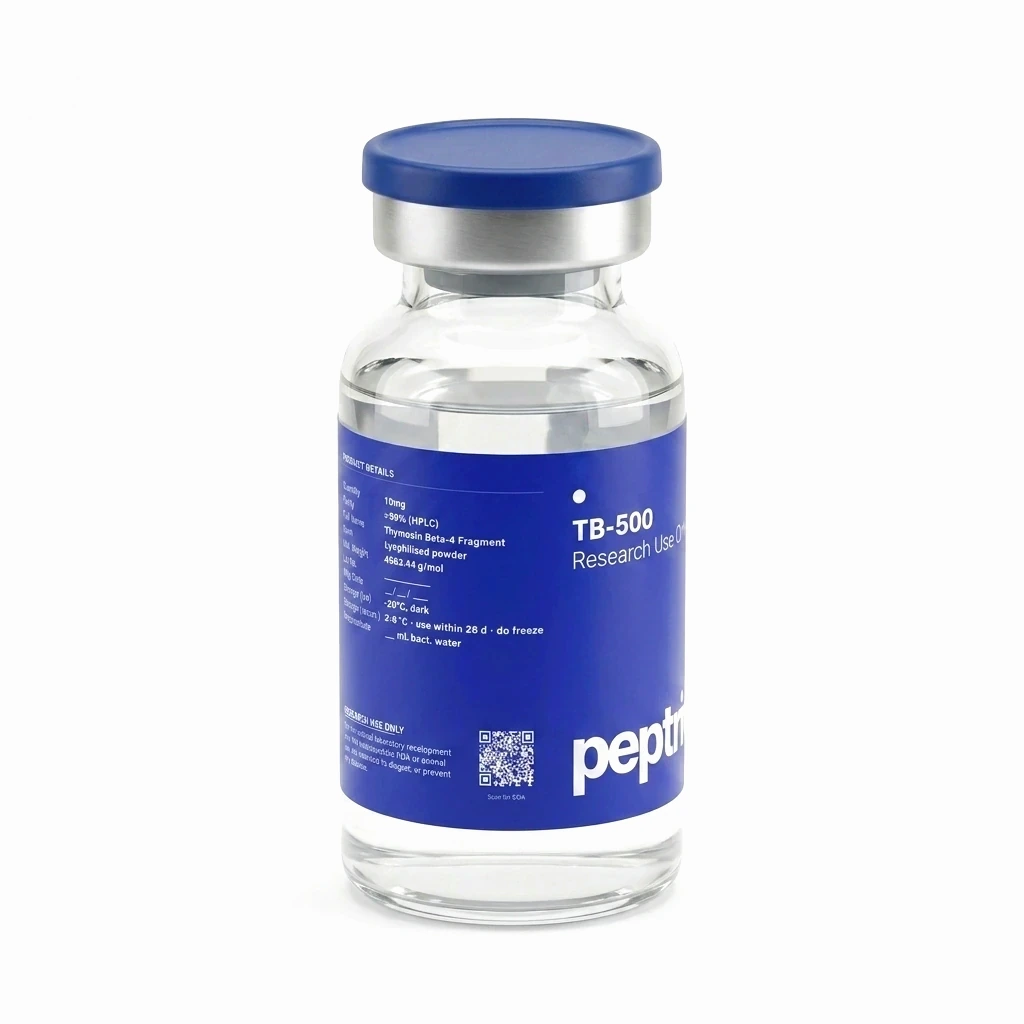
TB-500
The same compound cited across the 9 preclinical reviews in this article. Lab-verified identity and purity.
What does the preclinical evidence cover?
The preclinical signal spans six organ systems. Each one rests on full-length Tβ4, not the heptapeptide sold as TB-500. That distinction applies throughout the summaries below.
Cardiovascular. Tβ4 has been tested in heart-attack models, ischemia-reperfusion injury, and post-stenting restenosis. The 2025 Zhang European Heart Journal study is the most precise recent finding. It maps CCN5 to Tβ4 to Ac-SDKP as a coherent signaling pathway in vascular repair.
Eyes. A 2025 Signal Transduction and Targeted Therapy paper by Chen and colleagues showed mesenchymal stem cells plus Tβ4 beat either treatment alone in a rodent dry-eye model. The benefit ran through changes in glutamine metabolism. Tβ4 is also under study as an emerging therapy for corneal nerve damage (neurotrophic keratopathy). RegeneRx's RGN-259 (a Tβ4 eye-drop formulation) reached Phase II/III trials in dry eye.
Kidneys. Both natural and injected Tβ4 show anti-inflammatory effects in glomerular disease models (Mason & Vasilopoulou, 2023). That matters for chronic kidney disease.
Wound and tissue repair. Effects show up across skin trauma, corneal repair, hair-follicle regrowth, and bone formation. A 2025 ACS Nano study described an injectable Tβ4 hydrogel that grew new skull bone in rats by linking blood-vessel formation, nerve growth, and bone formation.
Antiviral. A 2021 Mediators of Inflammation mouse study showed recombinant human Tβ4 improved survival in mice infected with a coronavirus model. It blocked viral replication and dampened the immune response.
Brain development. A 2024 Nature Neuroscience paper identified Tβ4 (alongside Tβ10 and NP24) as a peptide critical for normal brain development in mice.
The preclinical signal is real. It's more varied than BPC-157's, and the mechanism is better anchored. But here's the catch that dominates the rest of this guide: nearly none of these studies used the heptapeptide TB-500 sold to athletes. Most used full-length recombinant Tβ4 or a defined development candidate.
Where's the human evidence?
Zero published human trials test TB-500 in orthopedic, sports performance, or anti-aging use cases. That's the honest answer most users don't want.
Human evidence for full-length Tβ4 exists in two areas. The first is ophthalmology. Tβ4 has been investigated as a development candidate for dry eye and corneal nerve damage under various trial codes. No Tβ4 product is FDA-approved as of mid-2026.
The second is cardiovascular research. The CCN5 / Ac-SDKP / restenosis program is at research stage, not a marketed drug. A 2024 Expert Opinion on Therapeutic Patents patent-landscape review by Quagliata notes that thymalfasin (Zadaxin), which is thymosin alpha-1 (a different thymosin entirely), is the only FDA-approved thymosin-based drug. It's used for chronic hepatitis B/C and as a chemotherapy adjunct.
The closest thing to human TB-500 data in orthopedics is the 2021 Lee & Padgett chart review at a Florida private clinic. The full series ran n=17 study participants. Only 4 participants received combination BPC-157 plus TB-500 injections. The study had no controls. It provides no interpretable data on isolated TB-500 efficacy.
TB-4 and its derivative TB-500 promoted angiogenesis and tissue repair in preclinical models, but human orthopaedic data are lacking, and both remain banned substances in sports.
— Mayfield et al., American Journal of Sports Medicine, 2026
What's the WADA and regulatory status?
The regulatory picture is unambiguous, and it has been for years. Here's the short list.
- FDA (US). No Tβ4 or TB-500 product is FDA-approved for any use. Tβ4 has been investigated as a development candidate in ophthalmology and dermatology.
- EMA (EU). Not approved.
- WADA. Banned under S2 (Peptide Hormones, Growth Factors, Related Substances). Athletes using TB-500 face sanctions if detected.
- Major sports leagues. Generally banned. Included in standard anti-doping panels.
The 2026 Mendias and Awan review in Sports Medicine names TB-500 as one of the unapproved peptides where rigorous human safety data are scarce and the potential for serious harm is real. It's the bluntest framing in the recent literature. The WADA S2 classification has been in force since 2014 and applies in all major Olympic sports.
What are the risks specific to TB-500?
The risk profile combines two layers. Tβ4 has theoretical biology concerns. TB-500 has product-specific manufacturing concerns. Both matter.
- Theoretical cancer concern. Tβ4 promotes new blood-vessel growth and has been implicated in some studies as a regulator of tumor spread (Ying et al., 2023). There's theoretical concern that injecting it could affect tumor biology. Direct human data don't exist.
- Manufacturing variability and identity uncertainty. "TB-500" from research-chemical suppliers may contain full-length Tβ4, the LKKTETQ active fragment, or an unrelated product. There's no standardization across suppliers.
- No long-term human safety data. The long-term effects of high-dose Tβ4 in healthy humans haven't been studied.
- WADA detection. Athletes face sanctions. Standard panels test for both full-length Tβ4 and the heptapeptide fragment.
Where this falls short
Compound identity cannot be confirmed without a Certificate of Analysis (a per-lot lab report listing identity and purity). Tβ4 has real biology. Most products labeled TB-500 have not been shown to carry the same molecule the published studies tested. The literature's own assessment: the science behind Tβ4 is substantiated; the commercial compound sold as TB-500 is not the same thing.
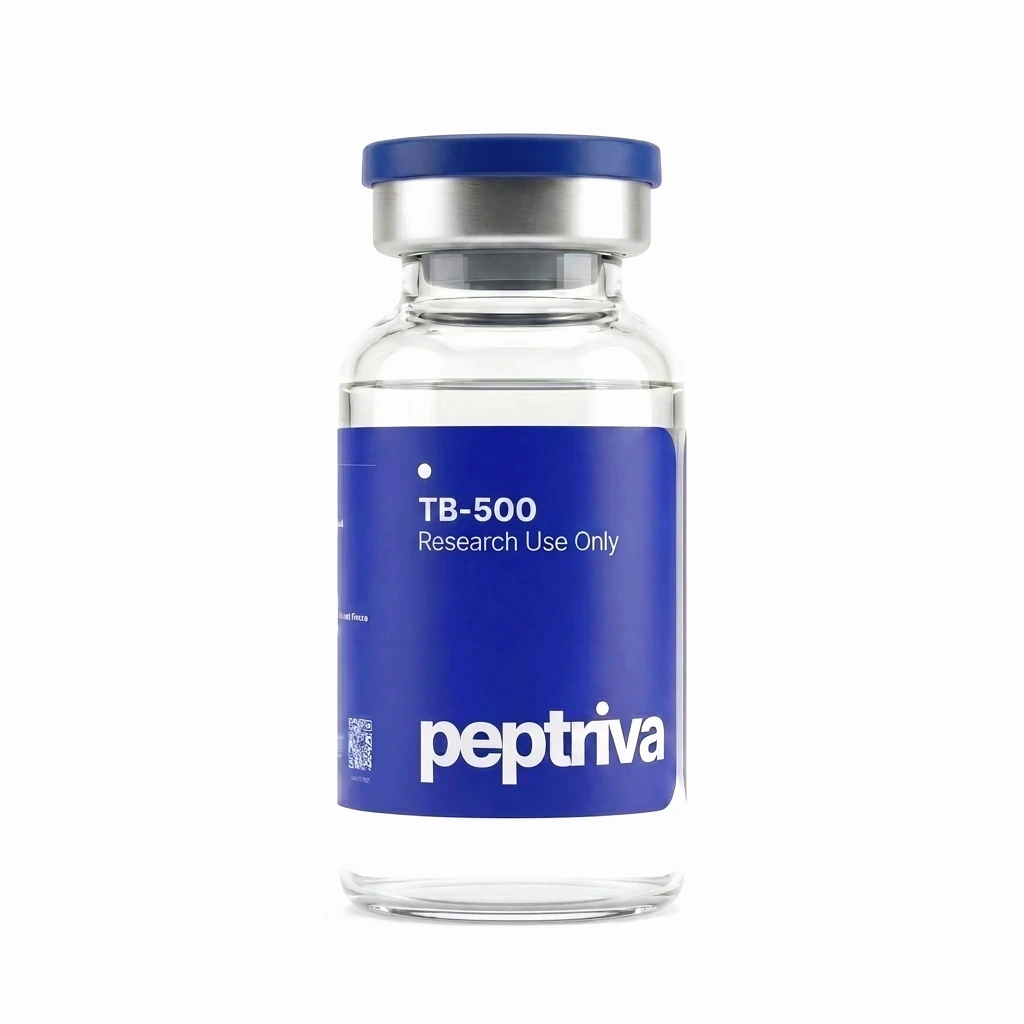
TB-500
Ac-LKKTETQ heptapeptide · Tβ4 active fragment. The same reference compound used across the cited preclinical studies. COA available with each lot.
How should a researcher think about TB-500 in 2026?
The honest framing: Tβ4 is a credible molecule with substantial mechanistic literature. Active human development continues in ophthalmology and cardiovascular disease.
The product sold as TB-500 is a marketing-driven offshoot of that biology. Sometimes it's full-length Tβ4. Sometimes it's the heptapeptide fragment. There's no standardized identity across suppliers and no published human trial in the use cases it's marketed for.
That distinction is important. It is the read the peer-reviewed sports-medicine literature has settled on. The 2026 Mendias review and the 2026 Mayfield review both make it explicit. Researchers working with TB-500 should verify which form is present (via Certificate of Analysis). Athletic-recovery efficacy cannot be assumed from cardiac or ophthalmic research data. The molecule is firmly WADA-prohibited.
What to know now
- Identity: Tβ4 is the full-length 43-aa natural peptide. TB-500 is a marketing label applied to Tβ4 or to a 7-aa fragment (Ac-LKKTETQ). Recent sports-medicine reviews treat them as distinct.
- Mechanism: G-actin binding at 1:1 ratio. Ac-SDKP cleavage product promotes blood-vessel repair. Anti-inflammatory and pro-angiogenic. Mitochondrial transfer via tunneling nanotubes.
- Preclinical: Consistent signal in cardiac, eye, kidney, and wound-healing models. Mostly full-length recombinant Tβ4, not the heptapeptide marketed as TB-500.
- Human evidence: No published trial of TB-500 in orthopedic, sports, or anti-aging use cases. Tβ4 has been studied in ophthalmology and cardiovascular research under development codes.
- Regulatory: No FDA-approved Tβ4 or TB-500 product. WADA S2 (Peptide Hormones, Growth Factors). Generally banned in major sports.
- Bottom line: The molecule has more basic-science credibility than BPC-157. The product sold under the TB-500 name is not the same thing as the molecule in the cited literature.
What we're watching
Three things over the next 18 months. First, whether the CCN5 / Ac-SDKP cardiovascular pathway becomes a registered Phase II in restenosis or vascular repair. That would be a real test for Tβ4 in humans. Second, whether Tβ4 ophthalmic candidates (in dry eye and corneal nerve damage) advance toward FDA filing. Third, whether sports-medicine reviews keep drawing the Tβ4-vs-TB-500 line more sharply. The mix-up is the field's main interpretive failure.
References
- Ying, Y., Lin, C., Tao, N., et al. (2023). Thymosin β4 and actin: Binding modes, biological functions and clinical applications. Current Protein and Peptide Science, 24(1), 78–88. https://doi.org/10.2174/1389203724666221201093500
- Xing, Y., Ye, Y., Zuo, H., & Li, Y. (2021). Progress on the function and application of thymosin β4. Frontiers in Endocrinology, 12, 767785. https://doi.org/10.3389/fendo.2021.767785
- Mendias, C. L., & Awan, T. M. (2026). Safety and efficacy of approved and unapproved peptide therapies for musculoskeletal injuries and athletic performance. Sports Medicine. https://doi.org/10.1007/s40279-026-02437-0
- Mayfield, C. K., Bolia, I. K., Feingold, C. L., et al. (2026). Injectable peptide therapy: A primer for orthopaedic and sports medicine physicians. American Journal of Sports Medicine, 54(1), 223–229. https://doi.org/10.1177/03635465251357593
- Zhang, Q., Li, H., Zhuang, T., et al. (2025). CCN5 suppresses injury-induced vascular restenosis via thymosin β4 and Cd9 pathway. European Heart Journal, 46(17), 1645–1658. https://doi.org/10.1093/eurheartj/ehae911
- Chen, X., Zhang, C., Peng, F., et al. (2025). Identification of glutamine as a potential therapeutic target in dry eye disease. Signal Transduction and Targeted Therapy, 10(1), 27. https://doi.org/10.1038/s41392-024-02119-1
- Mason, W. J., & Vasilopoulou, E. (2023). The pathophysiological role of thymosin β4 in the kidney glomerulus. International Journal of Molecular Sciences, 24(9), 7684. https://doi.org/10.3390/ijms24097684
- Zhang, X., Lin, Y., Li, H., Wang, Q., & Mu, D. (2025). Enhancing fat graft survival: Thymosin beta-4 facilitates mitochondrial transfer from ADSCs via tunneling nanotubes. Free Radical Biology and Medicine, 228, 281–298. https://doi.org/10.1016/j.freeradbiomed.2024.12.061
- Yu, R., Mao, Y., Li, K., et al. (2021). Recombinant human thymosin beta-4 protects against mouse coronavirus infection. Mediators of Inflammation, 2021, 9979032. https://doi.org/10.1155/2021/9979032
- Lee, E., & Padgett, B. (2021). Intra-articular injection of BPC 157 for multiple types of knee pain. Alternative Therapies in Health and Medicine, 27(4), 8–13. PMID 34324435