MOTS-c is among the most scientifically characterized mitochondrial-derived peptides available as a research reference compound — a 16-amino-acid molecule encoded in the mitochondrial genome, with broad preclinical literature behind it. The gap that matters: as of mid-2026, zero human randomized trials of synthetic MOTS-c have been published. Where to buy MOTS-c in 2026 means a research-supply vendor, full stop. The three identity-verification questions that matter: does the sequence match, does the mass match, and is the lot fresh enough that oxidation has not compromised the reference material?
MOTS-c is a synthetic 16-amino-acid peptide identical to the natural mitochondrial-derived peptide encoded in your mitochondrial DNA. Sequence: Met-Arg-Trp-Gln-Glu-Met-Gly-Tyr-Ile-Phe-Tyr-Pro-Arg-Lys-Leu-Arg. Molecular weight 2174.6 g/mol. Legal to buy as a research reference compound. 2026 pricing runs $50–$80 per 5 mg vial and $80–$120 per 10 mg vial. The two specific traps: pre-reconstituted solution shipped without cold chain (the methionines oxidize), and vendors making clinical exercise-mimetic claims that significantly outpace the human evidence.
The 60-second answer: Buy lyophilized (freeze-dried) powder from a research-supply vendor. Get a third-party CoA showing HPLC purity ≥98%, mass-spec at [M+H]+ 2175.6, and explicit methionine-sulfoxide disclosure. Standard 16-mer only — ignore “MOTS-c Plus” or “Stabilized MOTS-c” variants. Pay $50–$120 per vial.
Your three channels, and what each one gets you
MOTS-c is not an approved drug. So how do you actually buy it? Three channels exist:
- Doctor’s prescription: Not available. MOTS-c isn’t an FDA-approved drug.
- Compounding pharmacy: Theoretically possible but rare. The FDA hasn’t evaluated MOTS-c under the 503A framework, so the status is ambiguous. Most compounding pharmacies won’t touch it.
- Research-supply vendor: The standard channel. Lyophilized powder under Research Use Only labeling. No prescription.
What the research-supply channel provides: Lyophilized reference compound under Research Use Only labeling. No FDA-regulated batch testing or physician oversight. No published human interventional data — preclinical characterization is rodent-model-only as of mid-2026.
What you’re actually buying
MOTS-c is a 16-residue peptide. The full sequence: Met-Arg-Trp-Gln-Glu-Met-Gly-Tyr-Ile-Phe-Tyr-Pro-Arg-Lys-Leu-Arg.
Here’s what makes MOTS-c unusual. Unlike most research peptides, synthetic MOTS-c is chemically identical to a peptide your body produces. It’s encoded inside your mitochondrial DNA. It circulates in your blood. Its concentration drops measurably with age. The discovery paper came from Changhan Lee and Pinchas Cohen’s lab at USC (Lee et al., 2015).
That endogenous origin matters for sourcing. The 16-mer sequence is locked in. It’s not subject to vendor reinterpretation. A 2024 iScience paper identified a protein called CK2 as MOTS-c’s direct binding partner in muscle. A natural variant (K14Q) reduces that binding and is linked to higher sarcopenia and diabetes risk (Kumagai et al., 2024). The sequence is real biology, not marketing.
“
The mitochondrial-derived peptide MOTS-c promotes metabolic homeostasis and reduces obesity and insulin resistance.
— Lee et al., Cell Metabolism, 2015 (discovery paper, mouse model)
The four checks that matter for MOTS-c
The standard eight vendor criteria apply. Four are sharper here.
1. Sequence verification: the 16-mer matters
MOTS-c is 16 amino acids encoded in the human mitochondrial 12S rRNA. The sequence: Met-Arg-Trp-Gln-Glu-Met-Gly-Tyr-Ile-Phe-Tyr-Pro-Arg-Lys-Leu-Arg. A research-grade CoA should list it in full.
Cross-reference against the original 2015 Cell Metabolism paper or the UniProt database entry. Both are publicly accessible. If a vendor sells “mitochondrial peptide” with no sequence, or a partial sequence, or a modified variant, the material does not correspond to the molecule in the published literature.
2. The exercise-mimetic claim outpaces the human evidence
“Exercise mimetic” is the most heavily used MOTS-c marketing line. The gap between what that phrase implies and what’s been demonstrated in humans is the second-biggest red flag.
The mechanism is real in rodents. Exogenous MOTS-c improves exercise capacity and metabolic markers in young and aged mice. Acute high-intensity exercise also raises plasma MOTS-c in human subjects (Woodhead & Merry, 2021).
What doesn’t exist: a published randomized human trial showing synthetic MOTS-c produces the outcomes the marketing implies. Vendor copy calling it a “workout replacement” or “fat-loss peptide” is selling rodent data to human buyers.
3. Pricing that reflects the synthesis
MOTS-c is 16 residues, no modifications, but two methionines, two tryptophans, and three arginines make synthesis slightly more complex than simpler 16-mers. Expect $50–$80 per 5 mg and $80–$120 per 10 mg.
Below $40 per 5 mg, ask why. The HPLC purification step is what separates crude MOTS-c (with deletion impurities and oxidation products) from a clean reference compound. Above $25 per mg, you’re paying retail markup.
4. Storage: methionine oxidation is the killer
Two methionines (positions 1 and 6) get oxidized when air hits them. That’s the single most important storage consideration for MOTS-c. Controlled cold-chain shipping matters more here than for most simpler peptides.
Lyophilized MOTS-c, sealed and stored at −20°C, is stable for years. Reconstituted MOTS-c at 2–8°C is rated for 30 days. Repeated freeze-thaw cycles speed up oxidation. A credible CoA quantifies methionine sulfoxide as a separate impurity, not just total purity. Pre-reconstituted product without cold chain is the highest-risk format.
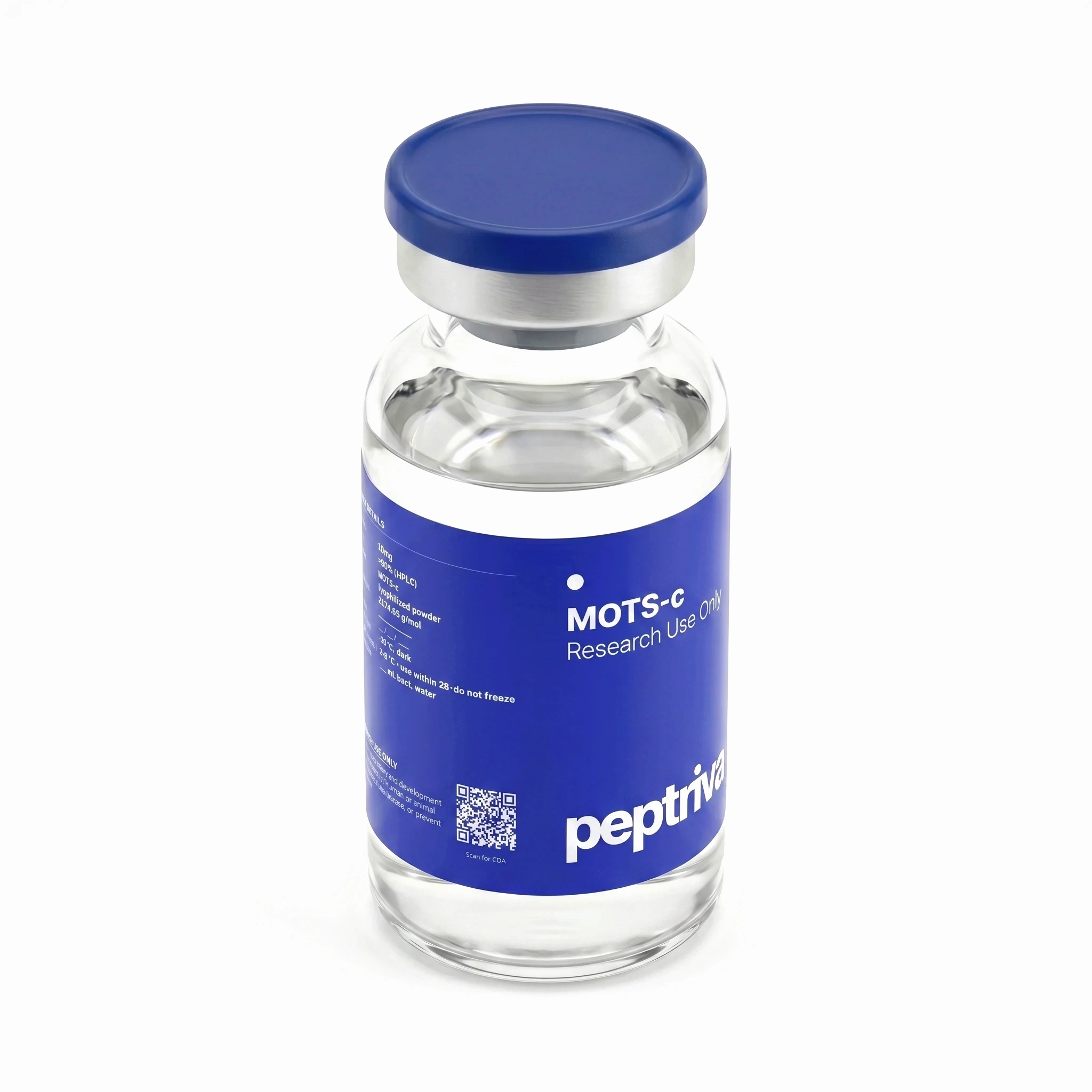
MOTS-c
The standard 16-mer sequence cited across the 2015 discovery paper in Cell Metabolism and the 2024 CK2-binding study in iScience. Met-Arg-Trp-Gln-Glu-Met-Gly-Tyr-Ile-Phe-Tyr-Pro-Arg-Lys-Leu-Arg, observed mass [M+H]+ 2175.6, ≥99% HPLC purity, ISO 17025 third-party CoA with methionine oxidation disclosure on every lot.
What you should pay in 2026
MOTS-c costs more per mg than the cheapest research peptides because of the two methionines and three arginines. The 2026 retail map:
- 5 mg vial: $50–$80 ($10–$16/mg). Most common size.
- 10 mg vial: $80–$120 ($8–$12/mg). Better per-mg value.
- 20 mg vial: $140–$200 ($7–$10/mg). Best per-mg economics.
- Multi-vial discounts: 10–20% off for 3-pack or 6-pack purchases.
Below $40 per 5 mg vial, ask why. The cheap end usually means skipped HPLC purification or expired stock with elevated oxidation. Above $25 per mg, you’re paying retail markup.
The legal picture
MOTS-c is not FDA-approved. Not EMA-approved either. It’s sold legally as a Research Use Only reference compound under 21 CFR § 809.10(b)(9).
MOTS-c has not received a 503A categorization. This is meaningfully different from BPC-157, which got Category 2 in 2023 (banning compounding pharmacies from preparing it). The FDA hasn’t formally evaluated MOTS-c under the compounding-pharmacy framework yet.
The WADA status is the line to watch. MOTS-c is not currently listed on the WADA Prohibited List. But WADA has flagged mitochondrial-derived peptides as a class of emerging interest. The 2024 K14Q variant paper documented muscle effects in humans — exactly the kind of finding anti-doping agencies track. For competing athletes, assume MOTS-c could move onto the Prohibited List on short notice.
Red flags specific to MOTS-c
- Pre-reconstituted MOTS-c shipped without cold chain. The methionines oxidize on air exposure. Pre-mixed product at ambient temperature has a much shorter usable window than lyophilized powder — and oxidation damage is not detectable without analytical testing.
- “Exercise mimetic” or “workout replacement” copy. Real in mice. Unproven in humans. Vendor copy that frames MOTS-c as a validated human therapy is selling rodent data.
- No methionine oxidation disclosure on the CoA. A flat “≥98% purity” figure does not indicate whether the remaining impurity is oxidized methionine or another species. A credible CoA quantifies methionine sulfoxide as a separate impurity.
- Capsules, sublingual sprays, or transdermal patches. Not validated in published research. The lyophilized powder form reconstituted in aqueous solution is the format used across the peer-reviewed literature.
- Mass-spec not matching 2175.6 [M+H]+. A mass at 2191.6 ([M+H]+ + 16 Da) means oxidation has already happened.
- Internal QC only, no third-party ISO 17025 lab. An outside accredited lab on the report is the standard.
- “MOTS-c Plus,” “Stabilized,” or “MOTS-c Acetate” variants. The standard 16-mer is what the published biology applies to. Branded variants are marketing.
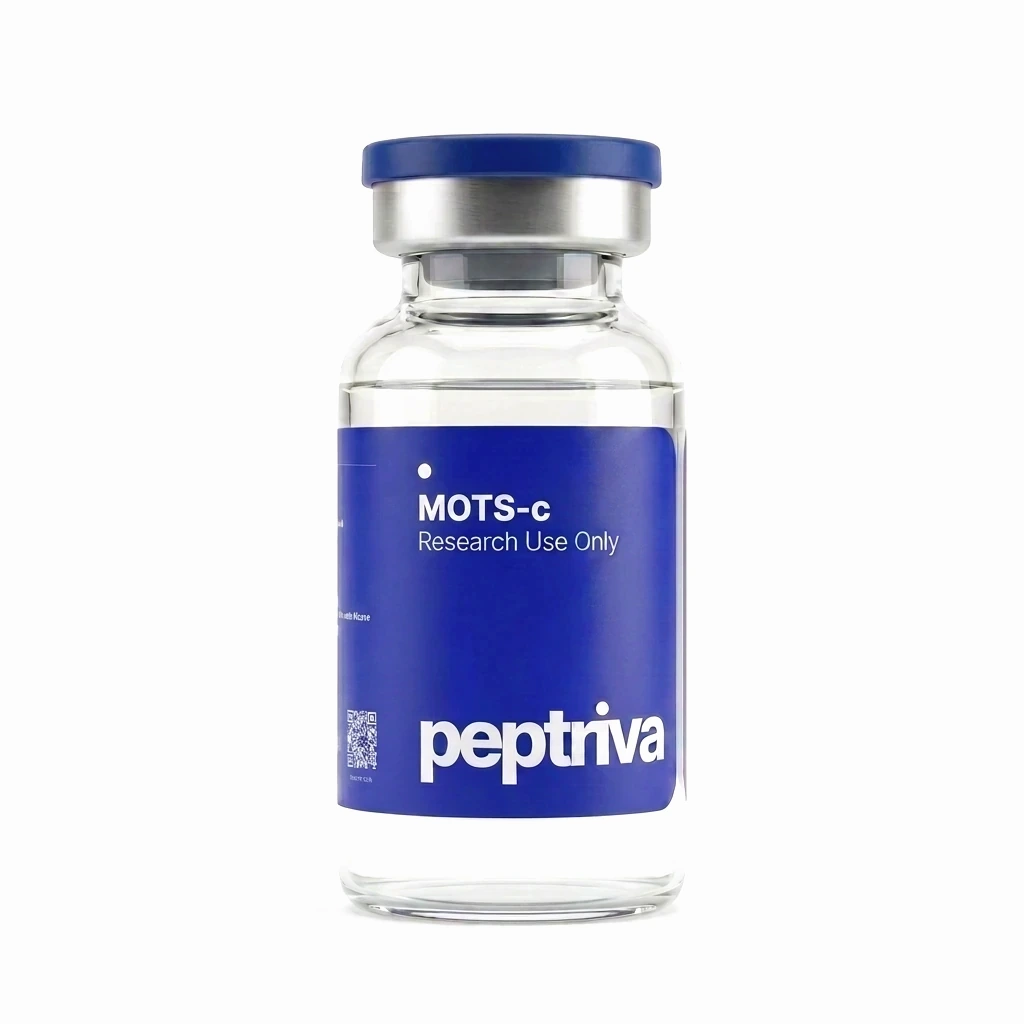
MOTS-c
Standard 16-mer mitochondrial-derived peptide. The same reference compound used across the 2024 CK2 binding study and the broader USC Cohen lab MOTS-c literature. COA with HPLC trace, mass-spec, and methionine oxidation disclosure ships with every order.
Frequently asked questions
Is MOTS-c legal to buy in the USA?
Yes, as a research reference compound. Not FDA-approved. No 503A categorization. Not on the WADA Prohibited List (yet). Selling for human consumption is illegal. Buying as research material is not.
How much should research-grade MOTS-c cost?
Typical research-grade pricing runs $50–$80 per 5 mg vial, $80–$120 per 10 mg, $140–$200 per 20 mg. Below this range, lower purity or oxidized material is more likely. Above it, the premium reflects retail markup rather than synthesis cost.
Is the “exercise mimetic” claim real?
Real in mice. Unproven in humans. The 2015 discovery paper and 2021 BBA review document the rodent effects. Acute exercise also raises endogenous MOTS-c in human blood. But no human trial of synthetic MOTS-c administration has been published. The mechanism is genuine; the human data is not yet there.
How does MOTS-c compare to other mitochondrial peptides?
MOTS-c and humanin are the two best-characterized mitochondrial-derived peptides, both from the USC Cohen lab. SS-31 (elamipretide) is different: a synthetic 4-residue peptide with completed Phase III trials (some negative, some positive). MOTS-c has cleaner endogenous biology than SS-31, but no human trial record. SS-31 has a thinner mechanism story but real human data. See SS-31 vs MOTS-c.
What should a MOTS-c Certificate of Analysis show?
The full 16-aa sequence. HPLC purity ≥98% with a chromatogram. Mass-spec at [M+H]+ 2175.6. Water content 2–8% via Karl Fischer titration (a chemistry test for trace water). Counterion content (usually trifluoroacetate). And critically: explicit methionine sulfoxide disclosure as a separate impurity. An ISO 17025-accredited lab on the report.
How should MOTS-c be stored?
The methionines oxidize. That’s the storage consideration unique to MOTS-c. Lyophilized at −20°C, sealed: stable for years. Reconstituted at 2–8°C: rated for 30 days. Avoid repeated freeze-thaw cycles. Each cycle speeds up oxidation. Air exposure above refrigerator temperature destroys it faster than the typical peptide.
What to know now
- 16-aa sequence, MW 2174.6, [M+H]+ 2175.6. The identity figures a research-grade CoA should report.
- $50–$120 per vial. Slightly above the cheapest peptides because of two methionines and three arginines.
- Exercise-mimetic claim: real in mice, unproven in humans. Zero published human trials.
- Methionine oxidation is the killer. CoA must quantify it. Pre-reconstituted product without cold chain is the highest-risk format.
- Standard 16-mer only. “Plus,” “Stabilized,” “Acetate” variants are marketing.
- WADA: not yet listed, but watch the space. Mitochondrial-derived peptides are an emerging area of anti-doping interest.
What we’re watching
The big MOTS-c development to track: whether a Phase I or Phase II controlled human trial ever publishes. Ten years into the literature, the human interventional evidence is still zero RCTs. The 2024 iScience CK2 paper and the K14Q variant work point to sarcopenia and type 2 diabetes as the most plausible first clinical indications. Separately, watch the WADA Prohibited List for any 2027 update that adds mitochondrial-derived peptides as a class. The anti-doping signal has been gathering for years. An explicit listing on short notice is the scenario research buyers should plan for.
References
- Lee, C., Zeng, J., Drew, B. G., Sallam, T., Martin-Montalvo, A., Wan, J., Kim, S.-J., Mehta, H., Hevener, A. L., de Cabo, R., & Cohen, P. (2015). The mitochondrial-derived peptide MOTS-c promotes metabolic homeostasis and reduces obesity and insulin resistance. Cell Metabolism, 21(3), 443–454. https://doi.org/10.1016/j.cmet.2015.02.009
- Kumagai, H., Kim, S.-J., Miller, B., Natsume, T., Wan, J., Kumagai, M. E., Ramirez, R., Lee, S. H., Sato, A., Mehta, H. H., Yen, K., & Cohen, P. (2024). MOTS-c modulates skeletal muscle function by directly binding and activating CK2. iScience, 27(11), 111212. https://doi.org/10.1016/j.isci.2024.111212
- Kumagai, H., Coelho, A. R., Wan, J., Mehta, H. H., Yen, K., Huang, A., Zempo, H., Fuku, N., Maeda, S., Oliveira, P. J., Cohen, P., & Kim, S.-J. (2021). MOTS-c reduces myostatin and muscle atrophy signaling. American Journal of Physiology-Endocrinology and Metabolism, 320(4), E680–E690. https://doi.org/10.1152/ajpendo.00275.2020
- Woodhead, J. S. T., & Merry, T. L. (2021). Mitochondrial-derived peptides and exercise. Biochimica et Biophysica Acta (BBA) - General Subjects, 1865(12), 130011. https://doi.org/10.1016/j.bbagen.2021.130011
- Zheng, Y., Wei, Z., & Wang, T. (2023). MOTS-c: A promising mitochondrial-derived peptide for therapeutic exploitation. Frontiers in Endocrinology, 14, 1120533. https://doi.org/10.3389/fendo.2023.1120533
- Kim, S.-J., Miller, B., Kumagai, H., Silverstein, A. R., Flores, M., & Yen, K. (2020). Mitochondrial-derived peptides in aging and age-related diseases. GeroScience, 43(3), 1113–1121. https://doi.org/10.1007/s11357-020-00262-5
- International Organization for Standardization. (2017). ISO/IEC 17025:2017 — General requirements for the competence of testing and calibration laboratories. https://www.iso.org/standard/66912.html
- World Anti-Doping Agency. (2026). The World Anti-Doping Code International Standard — Prohibited List. https://www.wada-ama.org/en/prohibited-list