Both peptides target mitochondrial function through distinct mechanisms. Only one has an FDA approval. SS-31 vs MOTS-c is the cleanest case study researchers have for why “same organelle” tells almost nothing about whether a peptide is ready for clinical use.
SS-31 (also called elamipretide, sold as Forzinity™) got FDA accelerated approval in September 2025 for Barth syndrome. It’s a 4-amino-acid synthetic peptide that binds cardiolipin (a fat in the mitochondrial membrane) and stabilizes the energy-producing machinery. MOTS-c is a 16-amino-acid peptide encoded in mitochondrial DNA and translated endogenously. The biology is interesting. The human trial count is zero. Same organelle. Wildly different evidence trajectories.
Both compounds show up in grey-market “longevity peptide” catalogs. SS-31 gets sold as a mitochondrial-energy booster. MOTS-c gets sold as an exercise mimetic.
That framing collapses two very different evidence stories into one shelf. The sections below pull them apart so researchers can evaluate each compound against the actual available evidence.
Quick comparison table
| Attribute | SS-31 (Elamipretide / Forzinity) | MOTS-c |
|---|---|---|
| Sequence / structure | 4 aa synthetic tetrapeptide with D-Arg and dimethyl-Tyr (D-Arg-Dmt-Lys-Phe-NH₂) | 16 aa mitochondrial-derived peptide encoded in 12S rRNA region |
| Origin | Synthetic small-molecule-like peptide; D-amino acids resist proteolysis | Endogenous — translated from mitochondrial DNA; circulates in human plasma |
| Mechanism | Direct cardiolipin binding in inner mitochondrial membrane; cristae stabilization | Mitochondrial-nuclear retrograde signaling; AMPK activation; CK2 binding; myostatin suppression |
| Receptor target | Cardiolipin (membrane lipid, not a classical receptor) | CK2 (direct binding); AMPK pathway; Bcl-2; multiple downstream effectors |
| Clinical development | Phase III completed in multiple indications; FDA-approved Sept 2025 | Preclinical only as of 2026 |
| FDA approval status | Approved (Forzinity, Sept 2025) for Barth syndrome muscle strength | Not approved for any indication |
| Other active Phase III programs | NuPOWER (mtDNA-maintenance PMM), PROGRESS-HF (heart failure), ReCLAIM (dry AMD) | None published |
| Human interventional evidence | MMPOWER-3, TAZPOWER (168-week OLE), supporting Phase I/II | Zero published interventional trials; observational studies only |
| Authorship breadth | Multi-lab, multi-institution Stealth-coordinated program | Concentrated in USC / Cohen lab with international collaborators |
| Indication breadth (claimed) | Mitochondrial dysfunction across cardiac, muscle, retinal, neurological | Exercise mimetic, metabolic disease, sarcopenia, NASH, antiviral (HBV), oncology |
| Grey-market positioning | Sold as longevity / cardioprotective peptide; not same product as Forzinity | Sold as exercise mimetic / metabolic peptide |
Mechanism: who does what, and how
SS-31 acts like a structural reinforcement bar. MOTS-c acts like a memo. Both modulate mitochondrial function, but they get there through very different molecular paths.
How SS-31 works
SS-31 is built from four amino acids that alternate between positively charged (cationic) and ring-shaped (aromatic). That charge pattern lets it slip through cell membranes and concentrate in the inner mitochondrial membrane.
Once there, it binds cardiolipin. Cardiolipin is the signature fat of healthy mitochondrial cristae (the inner folds where energy gets made). Tung and colleagues reviewed the mechanism in 2025: cardiolipin binding props up cristae shape, supports the cytochrome c supercomplex, cuts oxidative stress, and keeps ATP flowing.
This isn’t classical receptor signaling. Cardiolipin is a lipid, not a receptor. SS-31 behaves more like a small-molecule stabilizer than a peptide hormone. The D-amino acid swap (D-arginine, dimethyl-tyrosine) is also why it survives in the bloodstream — regular peptides get chopped up by enzymes in minutes.
How MOTS-c works
MOTS-c is the opposite story. It is encoded inside mitochondrial DNA, in the region that normally makes ribosomal RNA. Mitochondria translate it, and it enters the bloodstream as a signaling molecule.
Kumagai and colleagues showed in 2024 that MOTS-c directly binds protein kinase CK2 in skeletal muscle. The effect is tissue-specific: CK2 activation in muscle, suppression in fat.
The proposed role is retrograde signaling. The peptide moves from mitochondria to the nucleus during metabolic stress and changes how nuclear genes get read. Same destination as SS-31 (better mitochondrial function), totally different route.
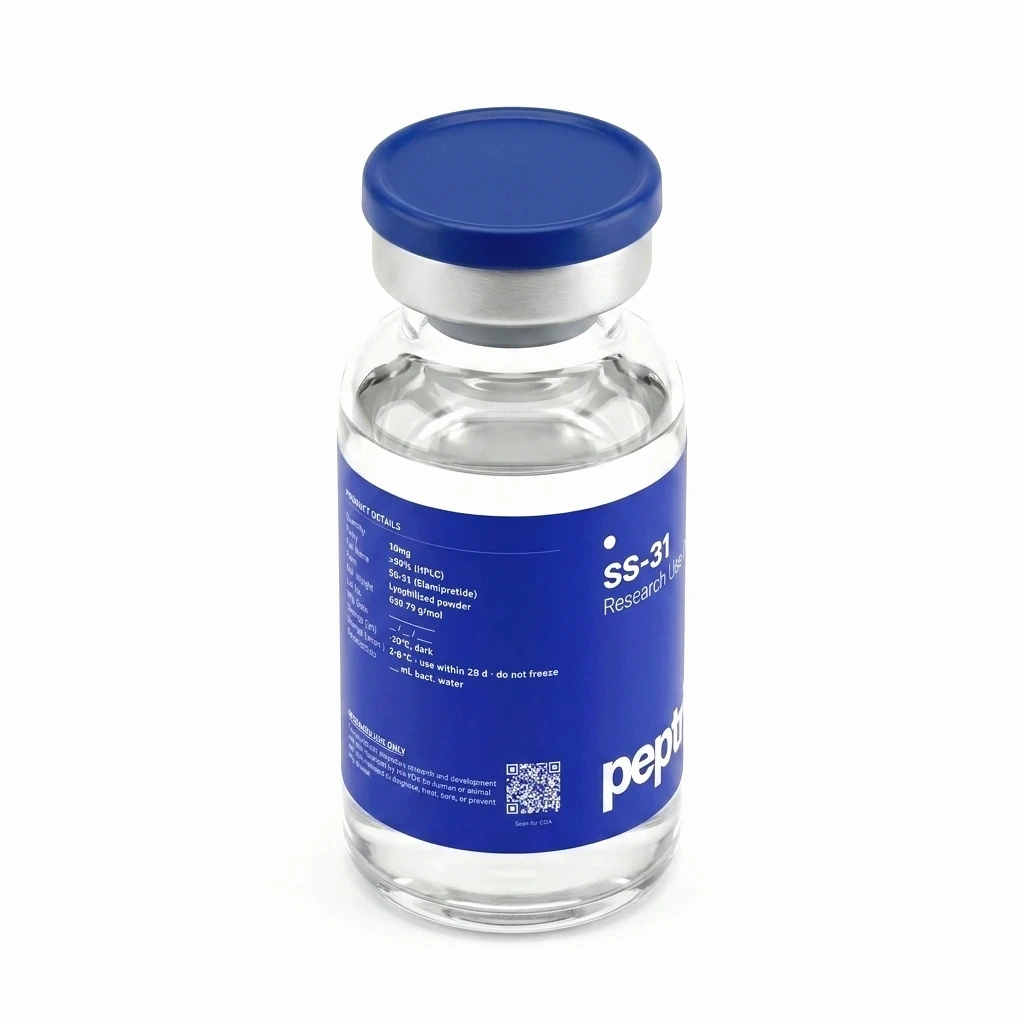
SS-31
The same compound cited across the MMPOWER, TAZPOWER, and Forzinity-approval literature in this comparison. Lab-verified identity and purity.
Who wins on evidence? SS-31, decisively.
SS-31 has run a real Phase III program. The results were mixed in instructive ways, and one trial earned an FDA approval.
Shirley’s 2025 review in Drugs documented the September 2025 FDA accelerated approval of Forzinity for muscle strength in adult and pediatric Barth syndrome patients weighing ≥30 kg. That makes it the first FDA-approved disease-specific treatment for Barth syndrome.
The path there wasn’t a straight win. The MMPOWER-3 trial published in Neurology 2023 was a Phase III RCT of SS-31 vs placebo over 24 weeks in adults with primary mitochondrial myopathy (a rare muscle disease caused by faulty mitochondria). It missed its primary endpoints.
What happened next is the part that separates serious drug development from supplement marketing.
Karaa and colleagues ran a post-hoc genotype analysis in 2024. Study participants with nuclear DNA mutations responded on the 6-minute walk test. Study participants with mitochondrial DNA mutations did not. The chronic progressive external ophthalmoplegia subgroup walked an extra 37.3 m vs −8.0 m for placebo (p=0.0024). That responder hypothesis became the prospective basis for the NuPOWER follow-up trial.
TAZPOWER was the trial that earned the Barth syndrome approval. The 168-week open-label extension reported sustained gains in 6MWT, fatigue score, muscle strength, echocardiographic markers, and cardiolipin biomarkers in 8 patients reaching the full duration.
Elamipretide is now the most clinically validated peptide for a specific therapeutic indication — September 2025 FDA accelerated approval as Forzinity™ for muscle strength improvement in adult and pediatric Barth syndrome patients ≥30 kg, becoming the first FDA-approved disease-specific treatment for Barth syndrome.
— Shirley, Drugs, 2025 (paraphrased summary)
That’s what real translation looks like. Primary endpoints sometimes miss. Post-hoc analyses inform the next trial. Narrow indications earn approval first. The off-label longevity story is what the marketing layer adds on top.
MOTS-c: high-quality biology, no human trials
MOTS-c has one of the better-told preclinical stories in the peptide research-chemical space. The Cohen lab at USC discovered it and has put out consistent mechanism work for over a decade. The 2021 Kumagai paper tied mouse mechanism to human biomarkers: plasma MOTS-c levels correlated inversely with myostatin (a muscle-growth brake) in human subjects.
The preclinical applications span an unusually wide range:
- Exercise mimetic. Hard exercise raises plasma and muscle MOTS-c in humans. Injecting MOTS-c into mice (young and old) improves exercise capacity, insulin sensitivity, and weight loss.
- Sarcopenia (age-related muscle loss). Myostatin suppression and CK2 activation point to a muscle-preservation pathway.
- NASH / fatty liver. Lu and colleagues showed in Cell Reports 2024 that MOTS-c eases liver steatosis, inflammation, and fibrosis in mice on a NASH diet.
- Hepatitis B antiviral activity. Lin and colleagues reported 50–70% inhibition of HBV replication in cells and mice.
- Ovarian cancer. Reduced MOTS-c was observed in study participant serum; exogenous MOTS-c slowed tumor proliferation in preclinical models.
- Bone metabolism. Osteoblast growth, osteoclast inhibition in preclinical work.
The catch sits in one sentence. There are zero published human trials of injected synthetic MOTS-c. Every human data point is observational.
The 2024 HBV paper looked at 404 study participants, but only measured MOTS-c in their blood. Treatment happened in mice. The K14Q polymorphism (a MOTS-c variant linked to sarcopenia and type 2 diabetes risk) supports human relevance, but it’s genetic association, not therapeutic evidence.
Regulatory asymmetry: where each one actually exists
SS-31 (as Forzinity) is FDA-approved for one narrow rare-disease indication. Active Phase III programs continue for primary mitochondrial myopathy (NuPOWER), heart failure with reduced ejection fraction (PROGRESS-HF), and dry age-related macular degeneration / geographic atrophy (ReCLAIM). It’s a real pharmaceutical product, regulated, prescribable, and tied to a specific patient population.
MOTS-c has no approved indication anywhere. The Cohen lab’s biology supports continued translational interest. The translation hasn’t happened. No trials are currently registered on ClinicalTrials.gov. No commercial development program has matched the visibility of Stealth BioTherapeutics’ SS-31 work.
The Mitchell 2025 paper in Aging Cell added a relevant nuance for both compounds. Eight weeks of elamipretide in aged mice improved cardiac strain, diastolic function, muscle fatigue resistance, and frailty index. It did not change DNA methylation age or transcriptomic age.
That finding tempers “reverse biological aging” marketing claims. Functional improvements were observed in preclinical models without detectable changes to biological-age markers.
Where this falls short. SS-31’s approval is for Barth syndrome muscle strength — not longevity, not general anti-aging, not athletic performance. MOTS-c’s evidence base is preclinical-only despite a decade of high-quality biology. Grey-market use of either compound for “longevity” runs well ahead of what the trials actually show. The Mitchell 2025 finding (function improved, age markers didn’t) is the kind of nuance the marketing layer skips.
Grey-market SS-31 isn’t prescription SS-31
A key distinction for research procurement: grey-market “SS-31” sold by research-chemical vendors is not the same product as prescription Forzinity. Stealth BioTherapeutics manufactures Forzinity to pharmaceutical-grade standards, with FDA-regulated manufacturing oversight, formulation validation, and clinical supply-chain integrity.
Research-chemical-grade SS-31 is a different context entirely. There is no comparable quality assurance, no clinical formulation, and no regulatory chain of custody.
Elamipretide marketed as a grey-market “mitochondrial-energy longevity peptide” extrapolates well past the approved indication. The compound is FDA-approved for one rare disease; the supporting clinical evidence covers a few mitochondrial conditions with active Phase III programs. The broader longevity narrative runs ahead of what the trials have demonstrated.
MOTS-c has the opposite problem. There’s no FDA-approved version at all, so the “pharma vs research-chemical” comparison doesn’t apply. What does apply: no characterized human safety profile, no controlled efficacy data, and no established reference dosing framework from published human trials.
SS-31
D-Arg-Dmt-Lys-Phe-NH₂ tetrapeptide · cardiolipin-binding scaffold. The same reference compound cited in the FDA-reviewed clinical literature. COA available with each lot.
How the evidence sorts by research context
The two compounds serve different investigational contexts. Here is how the evidence maps:
- Barth syndrome (clinical): SS-31 / Forzinity is FDA-approved for this indication. The TAZPOWER trial data provides the evidence basis. Clinical use requires working through a rare-disease specialist and the approved prescribing pathway.
- Primary mitochondrial myopathy: the NuPOWER Phase III trial is the active evidence-generation pathway. Population-level RCT evidence for off-label use has not been established.
- General longevity / aging research: neither compound has an established evidence base for this use case. The Mitchell 2025 paper demonstrated functional improvement in aged mice without changes to biological-age markers — an important distinction the broader marketing narrative omits.
- MOTS-c as an exercise-mimetic research target: the preclinical biology is consistent and well-characterized, but the human interventional trial count remains zero. Endogenous MOTS-c rises with exercise — the only validated human data point.
- Research-grade SS-31 vs prescription Forzinity: these are not the same product. Pharmaceutical-grade elamipretide carries regulatory manufacturing oversight that research-chemical-grade material does not.
What to know now
- Same organelle, different mechanisms. SS-31 stabilizes the inner mitochondrial membrane through cardiolipin binding. MOTS-c signals through CK2, AMPK, and Bcl-2 from the nucleus.
- SS-31 status: FDA-approved September 2025 as Forzinity for Barth syndrome. Phase III ongoing in PMM, heart failure, and dry AMD.
- MOTS-c status: not approved for anything. Preclinical research only as of 2026.
- SS-31 trial story: MMPOWER-3 missed its primary endpoint, then post-hoc genotype analysis salvaged a responder signal. TAZPOWER earned the Barth approval.
- MOTS-c trial story: deep preclinical biology across metabolism, sarcopenia, NASH, HBV, oncology. Zero published interventional human trials.
- Aging caveat: Mitchell 2025 showed elamipretide improved function in aged mice without changing biological-age markers. That’s the bit the marketing skips.
- Grey-market vs prescription: research-chemical SS-31 isn’t Forzinity. MOTS-c has no approved equivalent and no published human interventional data.
What we’re watching
Four things over the next 24 months. First, NuPOWER readout for elamipretide in mtDNA-maintenance primary mitochondrial myopathy. This is the prospectively designed responder-subgroup trial that follows the MMPOWER-3 post-hoc analysis. Second, PROGRESS-HF and ReCLAIM readouts. These are elamipretide’s indication-expansion programs in heart failure and dry AMD. Third, whether any independent group registers a first-in-human MOTS-c trial on ClinicalTrials.gov. That’s the single most important change in the MOTS-c evidence landscape. Fourth, whether broader biomarker-based aging research clarifies the Mitchell 2025 finding across mitochondrial peptides generally.
References
- Shirley, M. (2025). Elamipretide: First approval. Drugs, 86(3), 377–383. https://doi.org/10.1007/s40265-025-02269-8
- Karaa, A., Haas, R., Goldstein, A., Vockley, J., & Cohen, B. (2023). Efficacy and safety of elamipretide in individuals with primary mitochondrial myopathy: The MMPOWER-3 randomized clinical trial. Neurology. https://doi.org/10.1212/WNL.0000000000207402
- Karaa, A., Bertini, E., Carelli, V., et al. (2024). Genotype-specific effects of elamipretide in patients with primary mitochondrial myopathy: A post hoc analysis of the MMPOWER-3 trial. Orphanet Journal of Rare Diseases, 19(1), 431. https://doi.org/10.1186/s13023-024-03421-5
- Kumagai, H., Kim, S. J., Miller, B., et al. (2024). MOTS-c modulates skeletal muscle function by directly binding and activating CK2. iScience, 27(11), 111212. https://doi.org/10.1016/j.isci.2024.111212
- Lu, H., Fan, L., Zhang, W., et al. (2024). The mitochondrial genome-encoded peptide MOTS-c interacts with Bcl-2 to alleviate nonalcoholic steatohepatitis progression. Cell Reports, 43(1), 113587. https://doi.org/10.1016/j.celrep.2023.113587
- Mitchell, W., Pharaoh, G., Tyshkovskiy, A., et al. (2025). The mitochondria-targeted peptide therapeutic elamipretide improves cardiac and skeletal muscle function during aging without detectable changes in tissue epigenetic or transcriptomic age. Aging Cell, 24(6), e70026. https://doi.org/10.1111/acel.70026