Here’s what makes the MOTS-c AMPK mechanism different from every other peptide in this library. MOTS-c isn’t encoded in the nuclear DNA where most proteins come from. It’s encoded inside mitochondrial DNA, and it talks back to the nucleus.
MOTS-c is a 16-amino-acid peptide encoded inside mitochondrial DNA. It binds an enzyme called CK2, which then activates AMPK (the cell’s metabolic master switch, the same one metformin hits). Downstream, studies report it directs muscle cells to increase energy machinery and dampens myostatin (the protein that limits muscle growth). The biology is unusually well-mapped. The clinical translation gap is unusually wide. Zero randomised trials of synthetic MOTS-c in humans have ever been published.
This article is for researchers who want the molecular biology, not the “exercise mimetic” shorthand. We’ll cover the strange encoding inside mitochondrial DNA, the direct CK2 binding, the AMPK cascade, the retrograde signal from mitochondria to nucleus, and the muscle-protection pathway through myostatin. Kumagai 2024, Kumagai 2021, and Zheng 2023 are the workhorse sources.
A peptide encoded inside a ribosomal RNA gene
The strangest thing about MOTS-c is where it comes from. Almost every protein in a mammalian cell is built from instructions in nuclear DNA. MOTS-c is built from instructions inside mitochondrial DNA, the tiny separate genome inside the mitochondria — a second genome, and this peptide is written there.
Even stranger: MOTS-c is encoded inside a stretch of mitochondrial DNA traditionally thought to do something completely different. That stretch (the 12S rRNA gene) was supposed to be structural, building part of the ribosome that mitochondria use to make their other proteins. The fact that it also encodes a working peptide was a surprise when the Cohen lab at USC discovered it in 2015.
MOTS-c sits in a small family of mitochondrial-derived peptides that also includes humanin and the SHLPs. The functional concept is “retrograde signal”: peptides made inside mitochondria that travel out, reach the nucleus, and modulate gene expression under metabolic stress.
Measurable MOTS-c circulates in human plasma. Plasma levels drop with age. That positions MOTS-c as both an exogenous drug candidate and a biomarker for mitochondrial function. It is unusual for a single molecule to serve both roles.
Direct CK2 binding: the 2024 update
For most of MOTS-c’s first decade in the literature, the mechanism was “something activates AMPK,” with the “something” unclear. The 2024 iScience paper from Kumagai and colleagues changed that.
The study showed MOTS-c directly binds protein kinase CK2 in skeletal muscle. CK2 is a kinase, an enzyme that phosphorylates other proteins to switch them on or off. MOTS-c binding activates CK2 in muscle and suppresses it in fat. Tissue-specific direction, same molecule.
This matters for two reasons. First, MOTS-c now has a defined molecular target instead of a pathway description. Second, the paper found a naturally occurring K14Q variant of MOTS-c with weaker CK2 binding. Male carriers of this variant have higher risk of sarcopenia and type 2 diabetes. That’s human genetic evidence pointing back to the same mechanism the cell biology described. When a one-amino-acid swap that disrupts CK2 binding shows up as worse muscle and metabolic outcomes in carriers, the CK2 binding is doing real biological work.
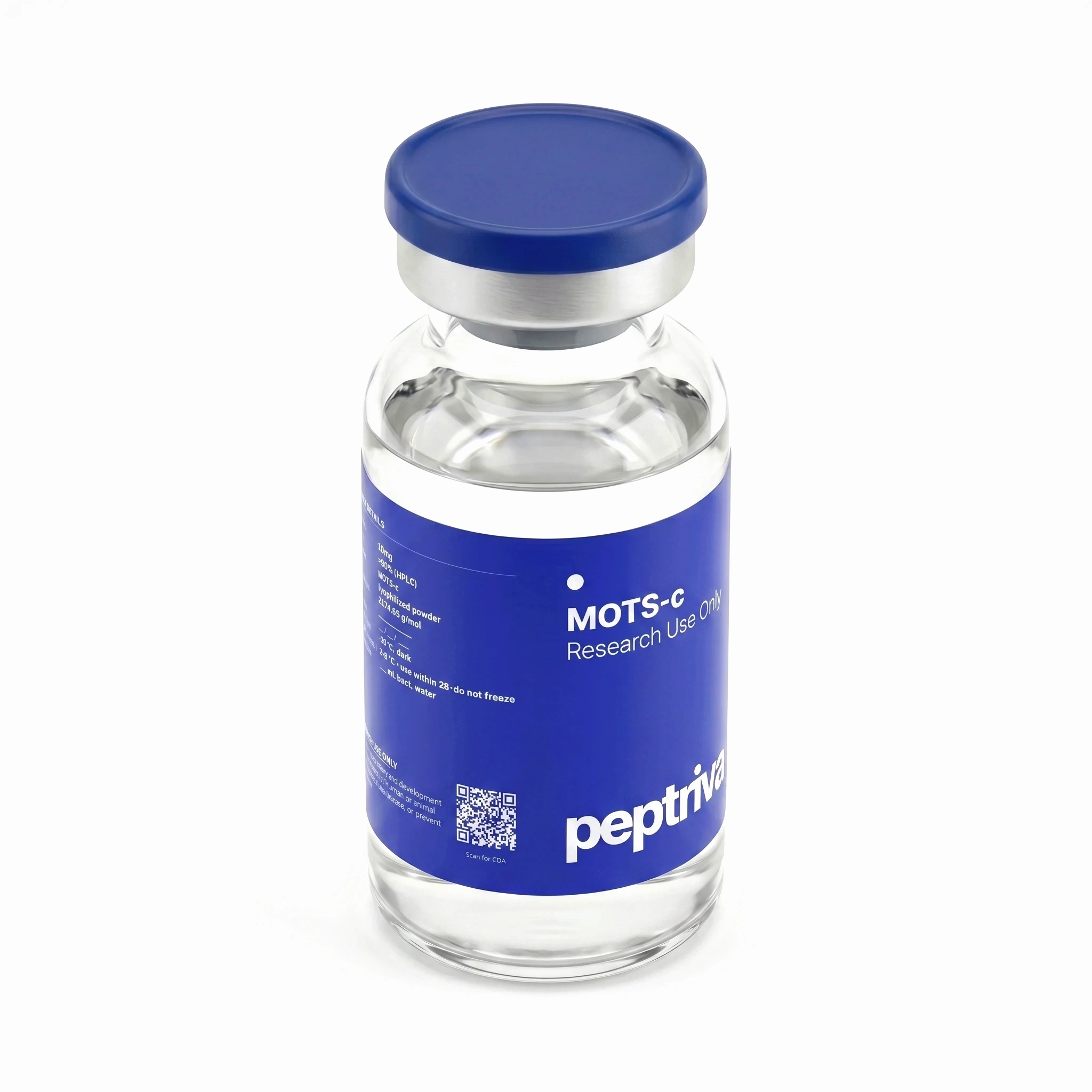
MOTS-c
The same compound cited across the 8 mechanism studies in this article. Lab-verified identity and purity. (Currently out of stock — next lot ETA on product page.)
AMPK: metabolism’s master switch
AMP-activated protein kinase (AMPK) is the cell’s energy sensor. When cells run low on ATP and high on AMP (the broken-down version of ATP), AMPK turns on. It shifts the whole cell from anabolic to catabolic mode.
Active AMPK does several things at once. It blocks fatty-acid synthesis. It promotes glucose uptake in muscle cells. It drives mitochondrial biogenesis through a transcription factor called PGC-1-alpha. It broadly mimics the metabolic effects of exercise. Metformin works by activating AMPK. So does training. So does fasting. Preclinical studies report the same downstream signature from this 16-amino-acid peptide from inside mitochondrial DNA.
Zheng’s 2023 review places AMPK at the centre of the MOTS-c mechanism. The downstream effects mapped in animal models (improved glucose uptake, better insulin sensitivity, weight loss on high-fat diets, more mitochondria) are the textbook AMPK fingerprint.
Whether MOTS-c activates AMPK directly or just through CK2 (which sits upstream of AMPK regulators) is the question the 2024 Kumagai paper started answering. CK2 phosphorylates several proteins that switch AMPK on. So the chain is likely MOTS-c → CK2 → AMPK regulators → AMPK → downstream metabolic effects.
MOTS-c modulates skeletal muscle function by directly binding and activating CK2. A naturally occurring K14Q MOTS-c variant has reduced CK2 binding and is associated with higher sarcopenia and type 2 diabetes risk in male carriers.
— Kumagai et al., iScience, 2024
How MOTS-c protects muscle: the myostatin pathway
Myostatin is the protein that puts the brakes on muscle growth. Cattle and dogs with broken myostatin become absurdly muscular (the famous “double-muscled” cows). Drug companies have been trying to block myostatin for sarcopenia and muscle-wasting for two decades, with mixed results.
The 2021 Kumagai paper showed MOTS-c reduces myostatin through a five-step cascade. CK2 (the MOTS-c target) phosphorylates a protein called PTEN. PTEN turns down a complex called mTORC2. mTORC2 normally activates AKT. AKT blocks a transcription factor called FOXO1. FOXO1 drives myostatin production. So when MOTS-c activates CK2, the result is reduced FOXO1 activity and reduced myostatin production.
That paper also found plasma MOTS-c inversely correlates with myostatin in human subjects. That’s human observational evidence that the mouse pathway is doing something in people.
Retrograde signaling: the conceptual core
The deepest concept in MOTS-c biology is retrograde signaling, and it’s worth getting right.
The classical picture of mitochondrial biology has information flowing one direction. The nucleus tells mitochondria what to do. Nuclear genes code for most of the proteins that mitochondria need. Nuclear transcription factors decide when to build new mitochondria.
Retrograde signaling reverses that arrow. Mitochondria sometimes need to tell the nucleus what’s happening (“energy is low, oxidative damage is up, we need help”). Mitochondrial-derived peptides are one of the proposed mechanisms for that backward conversation. They’re made inside the mitochondria, travel out to the rest of the cell, and reach the nucleus during metabolic stress.
If this framing is right, MOTS-c isn’t a drug imposed on biology. It’s a built-in participant. The 2020 Cohen-group review develops the retrograde-signaling concept in detail and is the right primary source.
The gap to human data
The biology is unusually clean for a research peptide. The human evidence is unusually thin.
No RCTs of exogenous synthetic MOTS-c in humans have been published anywhere in PubMed for 2020–2026. All human data are observational. Studies measure endogenous MOTS-c in plasma and correlate with diseases (hepatitis B, ovarian cancer, exercise capacity, sarcopenia risk in K14Q carriers). The 2024 Gut paper on hepatitis B measured 404 study participants, but used MOTS-c only as a biomarker. Therapeutic dosing remained mouse and cell work only.
Where this falls short. The mechanism work is some of the best in the research-peptide space: multi-lab replication, defined molecular target, mapped downstream cascade, human genetic evidence. But the bridge from “synthetic MOTS-c works in mice” to “synthetic MOTS-c works in people for indication X at dose Y” hasn’t been built. Anyone using exogenous MOTS-c outside a clinical trial is acting on rodent mechanism, not validated human efficacy.
MOTS-c
Mitochondrial-derived 16 aa peptide. The same reference compound used across the cited Cohen-lab mechanism studies. COA available with each lot. (Currently out of stock — check product page for next-lot ETA.)
How to read the MOTS-c literature
MOTS-c has one of the most credible mechanism stories in research peptides. Unusual encoding location. Defined molecular target. Downstream metabolic pathway shared with established drugs. A clinically meaningful endpoint (sarcopenia, via myostatin). A coherent cell-biology framework (retrograde signaling).
What the literature doesn’t support: dose-response or efficacy claims for exogenous administration in humans. The Kumagai 2021 correlation between plasma MOTS-c and myostatin is the closest anyone’s come, and it’s observational. The next decade is the clinical-translation decade. Whether all this molecular biology produces a real human therapeutic is still the question.
What to know now
- Where it comes from. 16-amino-acid peptide encoded inside mitochondrial DNA. Unusual non-nuclear origin.
- Molecular target. Direct binding to CK2 (Kumagai 2024). Activates CK2 in muscle, suppresses it in fat.
- Downstream cascade. AMPK activation. The same pathway metformin and exercise hit.
- Muscle protection. CK2-PTEN-mTORC2-AKT-FOXO1 cascade suppresses myostatin. Plasma MOTS-c inversely correlates with myostatin in humans.
- Retrograde signal. Mitochondria talking back to the nucleus. MOTS-c is a built-in participant, not an imposed drug.
- Human evidence gap. Zero RCTs of synthetic MOTS-c in humans. All human data are observational measurements of endogenous levels.
What we’re watching
Two questions over the next 24 months. First, whether anyone finally runs a Phase I/II trial in an age-related metabolic indication (sarcopenia, insulin resistance). The mechanism case is strong enough that the missing interventional trial is the field’s biggest gap. Second, whether the K14Q variant work produces more human genetic evidence linking mitochondrial-derived peptide biology to age-related disease. That’s the most promising lane for grounding MOTS-c in human-relevant outcomes without waiting for full RCTs.
References
- Kumagai, H., Kim, S. J., Miller, B., et al. (2024). MOTS-c modulates skeletal muscle function by directly binding and activating CK2. iScience, 27(11), 111212. https://doi.org/10.1016/j.isci.2024.111212
- Kumagai, H., Coelho, A. R., Wan, J., et al. (2021). MOTS-c reduces myostatin and muscle atrophy signaling. American Journal of Physiology — Endocrinology and Metabolism, 320(4), E680–E690. https://doi.org/10.1152/ajpendo.00275.2020
- Zheng, Y., Wei, Z., & Wang, T. (2023). MOTS-c: A promising mitochondrial-derived peptide for therapeutic exploitation. Frontiers in Endocrinology, 14, 1120533. https://doi.org/10.3389/fendo.2023.1120533
- Kim, S. J., Miller, B., Kumagai, H., Silverstein, A. R., Flores, M., & Yen, K. (2020). Mitochondrial-derived peptides in aging and age-related diseases. GeroScience, 43(3), 1113–1121. https://doi.org/10.1007/s11357-020-00262-5
- Woodhead, J. S. T., & Merry, T. L. (2021). Mitochondrial-derived peptides and exercise. Biochimica et Biophysica Acta (BBA) — General Subjects, 1865(12), 130011. https://doi.org/10.1016/j.bbagen.2021.130011
- Lu, H., Fan, L., Zhang, W., et al. (2024). The mitochondrial genome-encoded peptide MOTS-c interacts with Bcl-2 to alleviate nonalcoholic steatohepatitis progression. Cell Reports, 43(1), 113587. https://doi.org/10.1016/j.celrep.2023.113587
- Yin, Y., Pan, Y., He, J., et al. (2021). The mitochondrial-derived peptide MOTS-c relieves hyperglycemia and insulin resistance in gestational diabetes mellitus. Pharmacological Research, 175, 105987. https://doi.org/10.1016/j.phrs.2021.105987
- Yi, X., Hu, G., Yang, Y., Li, J., Jin, J., & Chang, B. (2023). Role of MOTS-c in the regulation of bone metabolism. Frontiers in Physiology, 14, 1149120. https://doi.org/10.3389/fphys.2023.1149120