BPC-157 has the largest preclinical literature of any research peptide in tissue repair: 35 rodent studies, 1 uncontrolled human case series, and zero controlled human trials as of 2026. Buying it is simple once you know what to ask. Where to buy BPC-157 in 2026 comes down to three checks: is the Certificate of Analysis (CoA) from a third-party lab, does the mass match, and is it the standard 15-amino-acid peptide rather than an undisclosed variant?
BPC-157 (Body Protection Compound-157) is a synthetic 15-amino-acid peptide originally isolated from human gastric juice. Look for CAS number 137525-51-0 and molecular weight 1419.6 g/mol on the CoA. It’s legal to buy as research material, but the FDA flagged it as 503A Category 2 in 2023, which closes the compounding-pharmacy channel for human use. Expect to pay $50–$100 per 5 mg vial or $80–$150 per 10 mg vial. The two red flags: vendors selling “Plus” or “Stable” variants without disclosing structural changes, and vendors making clinical claims like “heals tendons in 4 weeks.”
Quick answer: Pay $50–$150 per vial for lyophilized (freeze-dried) BPC-157. Demand a CoA from an ISO 17025 lab (an internationally recognized testing standard) showing HPLC purity above 98%, mass-spec at 1420.6, and water under 8%. Stick with the standard pentadecapeptide. Skip the “Plus” or “Advanced” variants.
What you’re actually buying
BPC-157 is a chain of 15 amino acids with the sequence Gly-Glu-Pro-Pro-Pro-Gly-Lys-Pro-Ala-Asp-Asp-Ala-Gly-Leu-Val. The name “Body Protection Compound” comes from how it was discovered: as a partial sequence inside a larger protein found in human gastric juice.
A 2025 review describes BPC-157 as showing diverse effects across animal models — tissue injury, gut inflammation, brain injury — though the studies remain almost entirely preclinical (Jozwiak et al., 2025).
One unusual property: BPC-157 stays stable in stomach acid for over 24 hours (Sikiric et al., 2022). That stability is why some vendors market “Stable BPC-157” variants. But the standard peptide is already stable. “Improved” variants without published structures are marketing language, not chemistry.
Three buyer checks for BPC-157
The general eight criteria for any peptide vendor apply. Three matter more for BPC-157:
1. The CAS number on the CoA must be 137525-51-0
CAS Registry Numbers are unique chemical IDs that never change. BPC-157’s is 137525-51-0. A credible CoA lists it on the identity line. Cross-check it against PubChem or ChemSpider in 30 seconds. A missing CAS, or one that doesn’t resolve to BPC-157, is a critical gap.
2. The mass-spec result must match 1420.6
BPC-157’s theoretical mass is 1419.6 g/mol. Mass-spec on the CoA should show observed mass at [M+H]+ 1420.6 (or [M−H]− 1418.6 in negative mode), within 0.5 Da of theoretical. An observed mass meaningfully different means the vial contains either a different molecule or a partially synthesized fragment. The mass match is your single most direct identity check.
3. The form should be lyophilized injectable
BPC-157 ships as a lyophilized (freeze-dried) powder, the form used across the published preclinical literature. Reconstitution with bacteriostatic water prior to in-vitro or in-vivo research use is standard laboratory practice. Some vendors sell pre-mixed liquid, oral capsules, or sublingual sprays. Pre-mixed liquid has a much shorter stability window — weeks instead of years. Oral and sublingual forms have not been validated in any controlled study. Research matching the published literature requires the lyophilized powder.
Where this falls short: The published BPC-157 literature is huge but lopsided. Roughly 75% of preclinical studies come from one research group in Zagreb. The 35-plus rodent studies haven’t been replicated by independent labs at scale. The single human study is a 17-patient uncontrolled case series. The FDA flagged BPC-157 as a safety question in 2023 precisely because the human data is too thin to support compounded human use. Buy it as a research tool. Don’t buy it as a proven therapeutic.
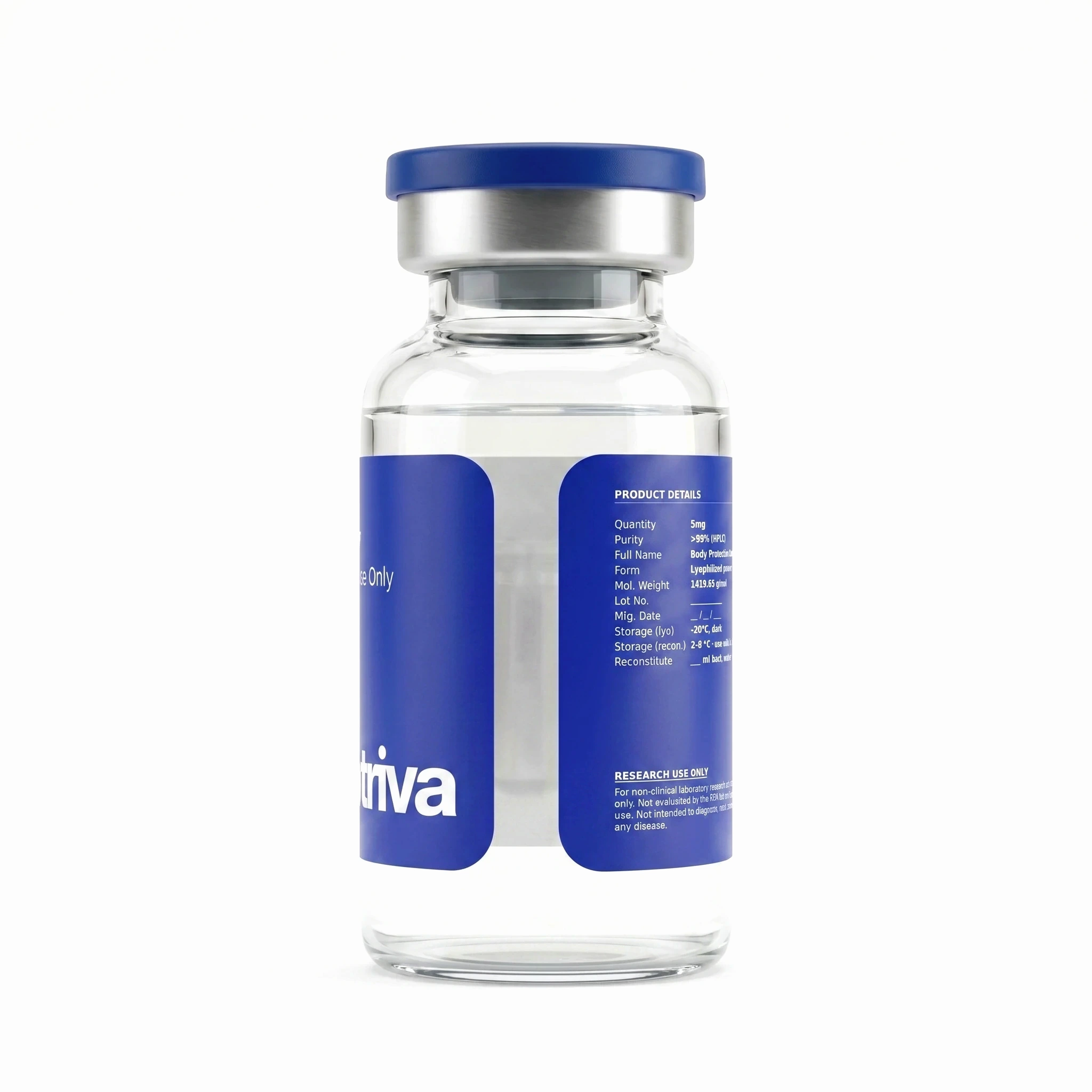
BPC-157
The standard pentadecapeptide cited across the 2025 multifunctionality review and the 2025 HSS Journal systematic review. CAS 137525-51-0, observed mass [M+H]+ 1420.6, ≥99% HPLC purity, ISO 17025 third-party CoA on every lot.
2026 pricing benchmarks
BPC-157 is one of the cheaper research peptides to make — only 15 residues, no chemical modifications, well-established synthesis route. Here’s what we see at research-grade retail in 2026:
- 5 mg vial: $50–$100 ($10–$20 per mg). The standard retail size.
- 10 mg vial: $80–$150 ($8–$15 per mg). Better per-mg value than the 5 mg.
- 20 mg vial: $140–$240 ($7–$12 per mg). Available from larger suppliers.
- Multi-vial tiers: 10–25% off for 3- or 6-pack orders at most vendors.
Below $40 per 5 mg vial deserves a question. The HPLC purification step is what separates “crude BPC-157” (right sequence, contaminated with synthesis byproducts) from “research-grade BPC-157” (purified above 98%). The cheap end of the market usually skips that step. Above $30 per mg, you’re paying retail markup, not synthesis cost.
What does 503A Category 2 actually mean?
In February 2023, the FDA reviewed BPC-157 and put it in 503A Category 2 — the “may present significant safety risks” bucket. Section 503A is the part of federal law that governs compounding pharmacies (the kind that make custom medications a doctor prescribes).
The 2023 decision was widely covered as a “ban.” That’s partly true and partly misleading.
What the designation does:
- Closes compounding pharmacies as a human-use channel. Pharmacies can’t include BPC-157 in compounded prescriptions anymore. That shut down a small but visible path BPC-157 had been reaching human users through.
- Signals FDA concern about the human-safety evidence. The decision reflects the agency’s view that human data is too thin.
What the designation does not do:
- It doesn’t stop research-grade sales. Research-use-only suppliers operate under a different regulation entirely (21 CFR § 809.10(b)(9)).
- It doesn’t make laboratory research illegal. Animal studies and in-vitro work continue.
- It doesn’t ban formal clinical trials. Pharmaceutical-grade BPC-157 can still be tested in an FDA-approved trial under standard IND (investigational new drug) procedures.
For more detail, see our article on peptides and the 2023 503A categorization.
Red flags specific to BPC-157
Seven warning signs we’d skip:
- “BPC-157 Plus,” “Advanced,” “Stable,” or “Arg” variants. Marketing names without disclosed structural changes. The standard peptide is already gastric-stable; “improved” without a published structure is marketing.
- Pre-mixed liquid shipped without cold chain. The powder survives shipping. Liquid at room temperature degrades fast.
- Capsules, sublingual sprays, or patches. No controlled study has validated any of these. The injectable powder is what the published research uses.
- Clinical claims on the product page. “Treats joint pain.” “Heals tendons in 4 weeks.” A vendor making clinical claims about a 503A Category 2 substance is in FDA enforcement territory.
- Missing CAS number on the CoA. CAS 137525-51-0 is the molecule’s ID. Its absence is a red flag.
- Mass-spec result not at 1420.6. If the mass is wrong, the molecule is wrong.
- Vendor’s own QC instead of third-party testing. Internal QC is fine for raw material. Independent ISO 17025 testing is the standard for research grade.
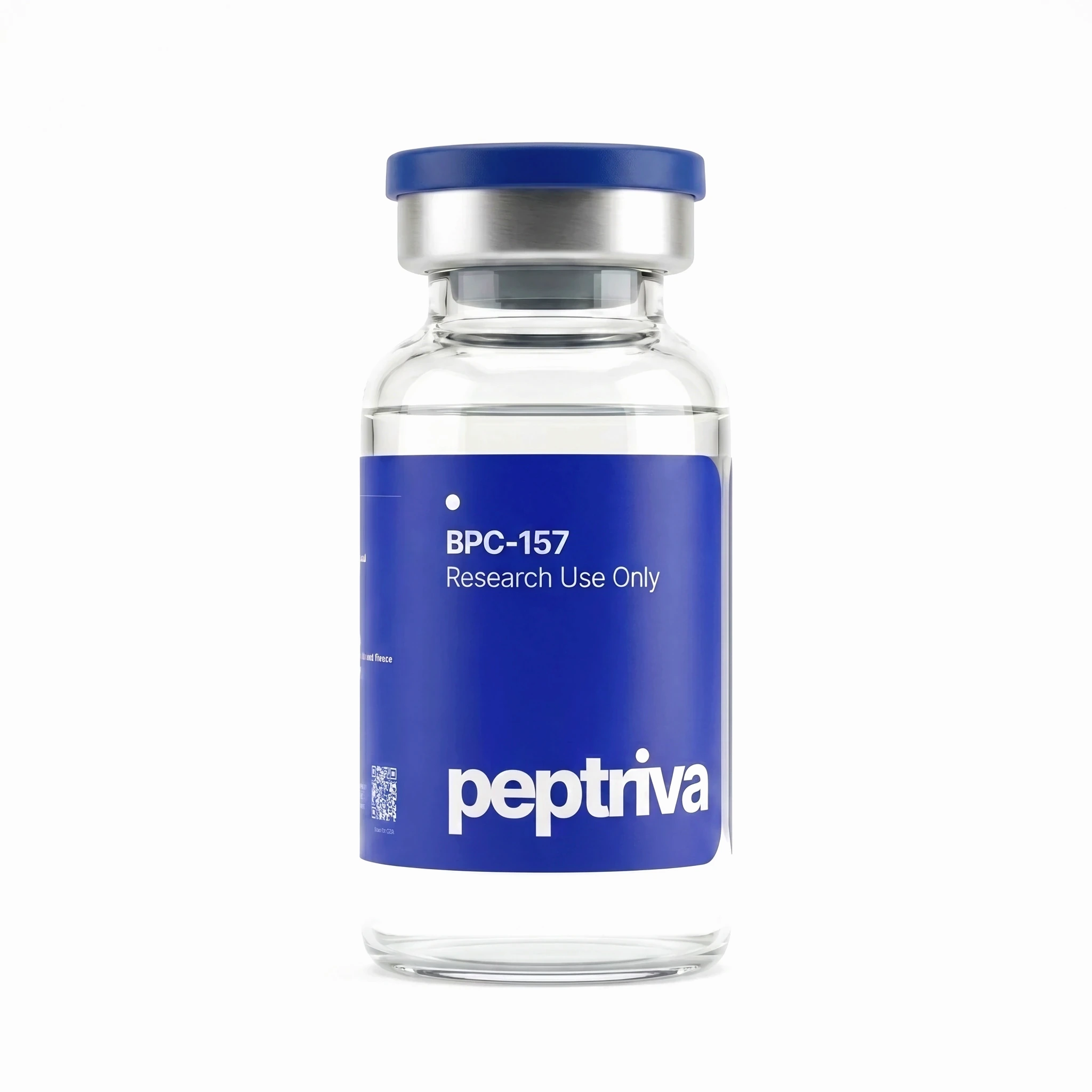
BPC-157
Standard pentadecapeptide, CAS 137525-51-0. The same reference compound used across the 35+ preclinical studies aggregated in the 2025 HSS Journal systematic review. COA with HPLC trace and mass-spec ships with every order.
Frequently asked questions
Is BPC-157 legal to buy in the USA?
Yes, as a research reference compound. The 2023 FDA 503A Category 2 designation closed the compounding-pharmacy channel for human use. It didn’t affect research-grade sales. Buying as research material is legal. Selling with human-use claims isn’t.
How much should research-grade BPC-157 cost?
$50–$100 for a 5 mg vial, $80–$150 for 10 mg, $140–$240 for 20 mg. Below that range, purity is usually the trade-off. Above it, you’re paying retail markup, not synthesis cost.
What should a BPC-157 CoA show?
Five things: CAS 137525-51-0 on the identity line, HPLC purity above 98% with the chromatogram attached, mass-spec at observed [M+H]+ 1420.6, water content (Karl Fischer titration) of 2–8%, and counterion content (usually trifluoroacetate at 5–15% by mass). The testing lab should be ISO 17025-accredited and named on the report.
What does 503A Category 2 mean for buyers?
Compounding pharmacies can’t prepare BPC-157 for human use anymore. That’s it. Research-grade sales operate under a different regulation and aren’t affected. Only the compounding-pharmacy channel changed.
What are “BPC-157 Plus” or “Advanced” variants?
Marketing names. Vendors claim improved stability or bioavailability but don’t publish the structural modification or peer-reviewed evidence. These products aren’t the BPC-157 in the literature. If you’re matching published research, buy the standard pentadecapeptide.
How does BPC-157 compare to TB-500?
Different mechanisms. BPC-157 acts through growth-factor pathways and angiogenesis. TB-500 acts through actin and cell migration. Preclinical studies have investigated the two compounds together, noting that their pharmacological mechanisms are largely non-overlapping. See the BPC-157 vs TB-500 comparison.
What to know now
- CAS 137525-51-0, MW 1419.6, observed [M+H]+ 1420.6. The numbers a credible CoA shows.
- $50–$150 per vial depending on size. 15 residues with no modifications keeps synthesis cheap.
- 503A Category 2 closed compounding pharmacies, not research suppliers. Research sales continue unchanged.
- Standard pentadecapeptide only. “Plus,” “Stable,” or “Advanced” without published structures aren’t BPC-157.
- Lyophilized injectable is the literature form. Capsules and sprays aren’t validated.
- Preclinical-heavy evidence. 35+ rodent studies, 1 uncontrolled case series, zero RCTs.
What we’re watching
The big development to track: whether a controlled human trial — randomized, blinded, real outcome measures — ever publishes. Twenty years into the literature, the human evidence is one 17-patient case series. Both the 2025 HSS Journal review and the 2026 Sports Medicine review explicitly call for proper clinical investigation. Until those trials run, BPC-157 stays a mechanistically interesting research compound where the preclinical signal outpaces the human data. We’re also watching the FDA 503A category review for any change to the BPC-157 designation — the list is reviewed periodically.
References
- Józwiak, M., Bauer, M., Kamysz, W., & Kleczkowska, P. (2025). Multifunctionality and possible medical application of the BPC 157 peptide — literature and patent review. Pharmaceuticals, 18(2), 185. https://doi.org/10.3390/ph18020185
- Vasireddi, N., Vasireddi, N., Shankar, D. S., Mojica, E. S., Boylan, M. R., Aitcheson, J. C., Wilson, A., Strauss, E. J., Alaia, M. J., & Campbell, K. A. (2025). Emerging use of BPC-157 in orthopaedic sports medicine: A systematic review. HSS Journal: The Musculoskeletal Journal of Hospital for Special Surgery. https://doi.org/10.1177/15563316251355551
- Sikiric, P., Skrtic, A., Gojkovic, S., Krezic, I., Zizek, H., Lovric, E., Sikiric, S., Pavlov, K. H., Rucman, R., Boban Blagaic, A., Brcic, L., & Strbe, S. (2022). Gastric pentadecapeptide BPC 157 in cytoprotection to resolve major vessel occlusion disturbances, ischemia-reperfusion injury following Pringle maneuver, and Budd-Chiari syndrome. World Journal of Gastroenterology, 28(1), 23–46. https://doi.org/10.3748/wjg.v28.i1.23
- Mendias, C. L., & Awan, T. M. (2026). Safety and efficacy of approved and unapproved peptide therapies for musculoskeletal injuries and athletic performance. Sports Medicine. https://doi.org/10.1007/s40279-026-02437-0
- Lee, E., & Padgett, B. (2021). Intra-articular injection of BPC 157 for multiple types of knee pain. Altern Ther Health Med. PMID 34324435
- U.S. Food and Drug Administration. (2023). Section 503A of the Federal Food, Drug, and Cosmetic Act. https://www.fda.gov/drugs/human-drug-compounding/section-503a-federal-food-drug-and-cosmetic-act
- International Organization for Standardization. (2017). ISO/IEC 17025:2017 — General requirements for the competence of testing and calibration laboratories. https://www.iso.org/standard/66912.html