Research comparing topical and injectable GHK-Cu reveals an evidence asymmetry that is not close. Same peptide, two routes, very different research records.
The topical evidence base is substantially stronger. The literature includes ~30 controlled studies across 50 years of cosmetic-dermatology research, plus modern hydrogel trials. Injectable has 0 human RCTs for the conditions it is marketed for. The 2026 Sports Medicine review notes that "rigorous human safety data is scarce" for injectable use. Topical is the evidence-supported route for skin and wound applications; systemic injectable claims have not been validated in controlled human studies.
GHK-Cu is short for glycyl-L-histidyl-L-lysine — a three-amino-acid peptide produced endogenously. The copper ion attached to it is what gives the powder its trademark blue color.
Loren Pickart discovered the molecule in 1973. Since then, scientists have studied what it does to skin in vitro (in a dish) and in real people. We've got reproducible data on collagen synthesis, blood-vessel growth (angiogenesis), and inflammation control. None of that science is in dispute.
What is in dispute: does the injectable form produce meaningful systemic effects in humans? The sections below examine why the same peptide yields such different evidence profiles depending on the route of administration.
Quick comparison table
| Attribute | Topical GHK-Cu | Injectable GHK-Cu |
|---|---|---|
| Commercial history | ~50 years; longstanding cosmetic ingredient (“tripeptide-1 copper”) | Grey-market history; no FDA-regulated injectable product exists |
| Mechanism (route-specific) | Local fibroblast and matrix stimulation; angiogenesis at skin level; elastase inhibition | Systemic distribution; receptor pharmacology poorly characterized at target tissues |
| Controlled human evidence | Small pressure-ulcer / diabetic-wound trials (1990s–2000s); modern hydrogel preclinical work | Essentially zero PubMed-indexed RCTs in humans for any systemic indication |
| Safety profile | Favorable at conventional cosmetic concentrations across decades of dermatologic use | Not characterized in controlled human trials |
| Permeation challenge | Hydrophilic molecule; poor stratum corneum permeation; liposomal / hydrogel delivery improves it | N/A — subcutaneous bypasses permeation |
| Bioavailability concern | Local concentrations dependent on formulation | Rapid systemic clearance; concentrations at target tissues uncertain |
| Regulatory framing | FDA-regulated as cosmetic ingredient | Not FDA-approved for any therapeutic indication |
| Modern literature focus | Hydrogel-encapsulated wound healing; cosmetic formulation chemistry | Anti-doping monitoring; preclinical rodent models |
| 2026 Sports Medicine review framing | Cosmetic-dermatology supported use | Grouped with peptides where rigorous human safety data is scarce |
| WADA status | Not explicitly listed for topical cosmetic use | Not explicitly listed but subject to S2 scrutiny for injectable use in athletes |
Mechanism: why the route matters more than the marketing admits
Topical answers a simple question: can the molecule reach skin cells and tell them to behave younger? Yes, with caveats. Injectable answers a harder one: where does it go, and what does it do there? We don't really know.
The 2020 Dou review summarized what GHK-Cu does in skin. Studies report that it stimulates fibroblasts (the collagen-making cells in the dermis) to build more matrix. It has been shown to trigger new blood-vessel growth through VEGF, a growth-factor signal. It has been observed to modulate inflammation and to inhibit elastase, an enzyme that degrades skin elasticity.
Endogenous GHK levels decline with age — from 200 ng/mL at age 20 to roughly 80 ng/mL by age 60 — a pattern documented in the literature.
Topical: the science fits the delivery
Topical application places the molecule at the intended target tissues — skin fibroblasts, keratinocytes, and the dermal matrix. The key pharmacological question is whether GHK-Cu can cross the stratum corneum — the lipid-rich outer layer of skin that limits permeation of hydrophilic molecules.
Permeation is limited. GHK-Cu is hydrophilic, which means it does not dissolve readily through lipid-rich barriers. The stratum corneum is primarily lipid-based. Modern formulations address this by encapsulating the peptide in a carrier. A 2023 Dymek paper tested liposomes (microscopic lipid bubbles). A 2025 Ogórek paper benchmarked skin permeation across delivery vehicles. Both found the same pattern: unencapsulated GHK-Cu in aqueous solution penetrates poorly; carrier-based delivery substantially improves it.
Injectable: the targets get blurry
Subcutaneous delivery routes GHK-Cu into systemic circulation. No controlled human pharmacokinetic data characterizing tissue distribution has been published. The 2023 Lee paper tested hydrogel nanofibers in murine models. The 2025 Mao paper studied colitis in murine models. Both represent valid preclinical science; neither establishes a validated human dose or pharmacokinetic profile.
The pharmacological picture for injectable use remains unclear. GHK-Cu clears from blood rapidly, and concentrations reaching target tissues are not characterized. The 2024 Bian paper identified a specific binding target (peroxiredoxin 6) in mouse silicosis models, but dose-translation data for human application has not been published.
Topical evidence: the substantial case
Topical GHK-Cu has the best evidence base of any peptide in skincare. The four pillars holding it up:
- Decades of cosmetic use. GHK-Cu (labeled "tripeptide-1 copper" in INCI nomenclature) has been a commercial skincare ingredient since the 1980s. The safety record at standard cosmetic concentrations is extensive.
- Reproducible cell biology. Independent labs have shown fibroblast growth, collagen synthesis, ~49% elastase inhibition (Dymek 2023), and VEGF-driven blood-vessel growth.
- Human trials in chronic wounds. Topical trials for pressure ulcers and diabetic foot ulcers ran in the 1990s and 2000s. Effect sizes were modest but consistent. Small studies, single centers — but they kept hitting positive.
- Modern hydrogel work. A 2025 Chen paper tested egg-white hydrogels for self-healing wound dressings. Today's delivery vehicles fix the old permeation problem.
Where the evidence falls short: no large modern multi-center trials have been conducted. The 1990s data is small and dated. Phase III–scale work for any specific skin indication has not been published. Cosmetic-grade formulations vary in concentration, carrier, and stability — outcomes in the literature reflect these differences across formulations.
The safety record is good. Decades of consumer use, controlled wound-care trials, and cosmetic-regulatory oversight all point the same direction: at the concentrations used in skincare, GHK-Cu doesn't cause problems.
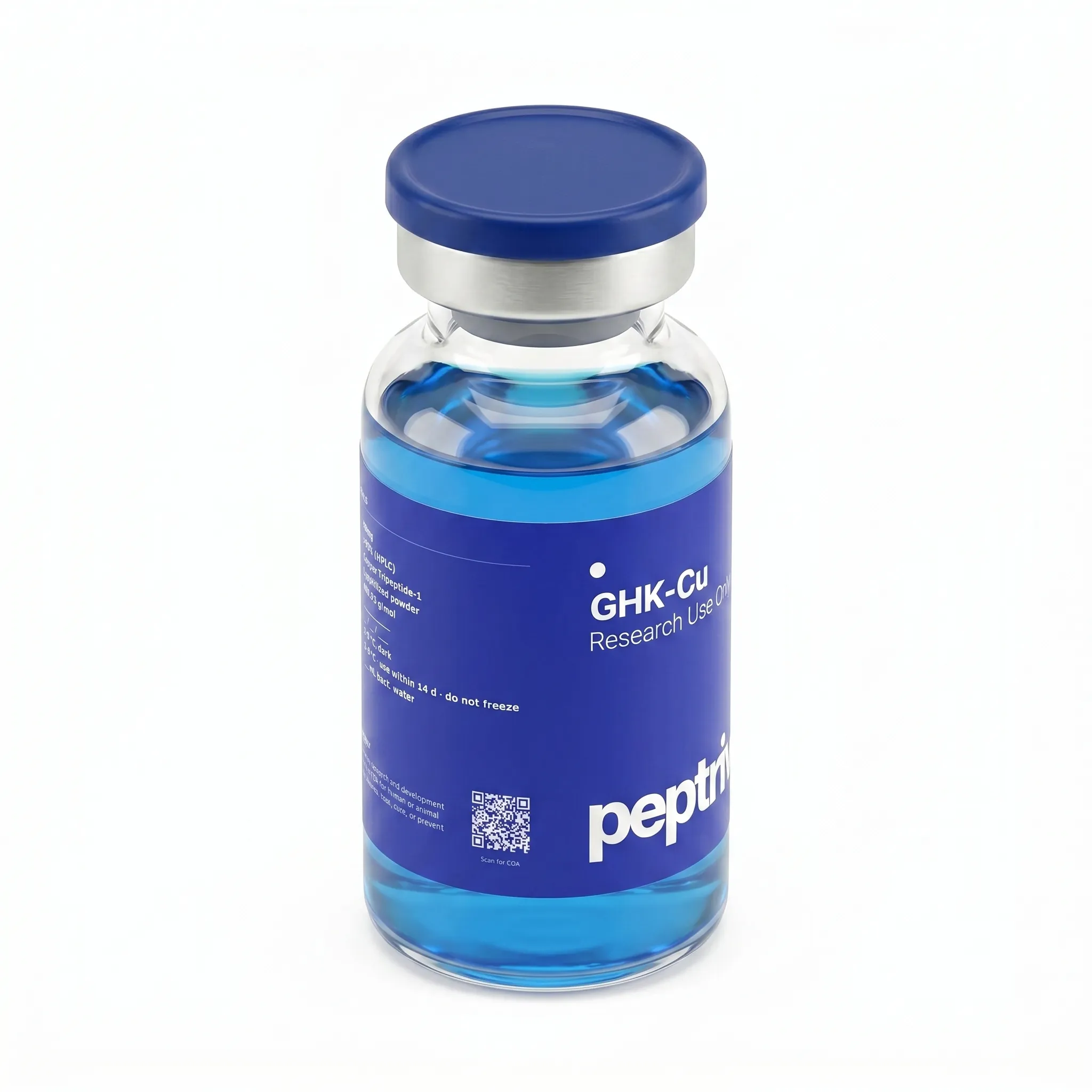
GHK-Cu
The same compound cited across the topical wound-healing and dermatology studies in this comparison. Lab-verified identity and purity.
Injectable evidence: the thin case
Search PubMed for randomized controlled trials of injectable GHK-Cu in humans. You'll find zero for any systemic condition. The marketed claims — faster wound healing, tissue repair, inflammation control, "anti-aging" — all rest on mouse studies and cell-culture work.
The 2026 Mendias and Awan review in Sports Medicine grouped injectable GHK-Cu with grey-market peptides where "rigorous human safety data is scarce." That's the most authoritative recent take, and it lands the topical-vs-injectable gap clearly.
The pharmacokinetics tell the same story. GHK-Cu clears from blood quickly. Its half-life is short. We don't have published human data on how much actually reaches deeper tissues. The mouse studies that show injectable GHK-Cu working in colitis (Mao 2025) and silicosis (Bian 2024) use specific doses in specific tissues — and nobody has done the dose-translation work to bridge that to humans.
No PubMed-indexed RCTs of injectable or systemic GHK-Cu in humans have been published between 2020 and 2026. For any indication. All systemic efficacy claims rest on rodent models. The 2026 Sports Medicine review by Mendias and Awan groups injectable GHK-Cu with peptides where rigorous human safety data is scarce.
— peptriva research, summarizing the published GHK-Cu literature
Quality: why grey-market injectable raises the stakes
Cosmetic-grade and research-grade GHK-Cu look the same in a vial. They aren't.
Cosmetic-grade material is made for skincare. Concentrations, purity, and stability all follow mainstream ingredient standards. Research-grade material is made for lab work. Quality varies by vendor. No FDA oversight. No clinical-grade contamination control.
For topical use, cosmetic-grade material is incorporated into a finished formulation. The primary variable is formulation-to-formulation efficacy differences — a quality and delivery-vehicle issue, not a safety issue at typical concentrations.
For injectable use in grey-market contexts, research-grade powder is typically self-reconstituted. The Coutinho 2026 review warned that this unregulated supply chain produces mislabeled and contaminated products. Quality-control concerns in this context include identity verification, purity, endotoxin levels, sterility of the reconstituted solution, and contamination from non-clinical manufacturing lines.
What the topical evidence supports
The research record for topical GHK-Cu maps to several investigated application areas:
- Cosmetic dermatology. Fine lines, photo-aging, post-procedure recovery, and general matrix remodeling have been studied. Evidence is modest but reproducible.
- Chronic wound adjunct. Pressure ulcers, diabetic foot ulcers, and post-surgical wounds were investigated in small controlled trials — topical use alongside (not replacing) standard wound care.
- Scalp and hair follicle. A separate evidence track with its own small-trial base; topical scalp formulations fall within the broader topical evidence picture.
None of these findings extend to injectable routes for systemic effects. Topical studies demonstrated benefit by concentrating GHK-Cu at the dermal targets. Injectable delivery routes the compound through circulation, where rapid clearance limits target-tissue concentration — a pharmacologically distinct situation.
Where this falls short. Even the topical case has gaps. The big modern multi-center trials don't exist — most of the human data is from small studies in the 1990s and 2000s. Cosmetic-grade formulation quality varies across brands in ways that affect real-world results. And the injectable evidence is so thin that any claim about systemic effects in humans should be treated as marketing, not science.
Route selection: what the evidence indicates
The published literature maps routes to specific research contexts as follows:
- Cosmetic dermatology investigations. Topical route. Published studies used cosmetic-grade formulations with carrier systems (liposomes, hyaluronic acid). Effects were modest; the safety record across decades is favorable.
- Chronic wound research. Topical route as an adjunct. Modern hydrogel and liposomal delivery formats align with the recent literature. Studied alongside standard wound management, not as a replacement.
- Systemic efficacy in humans. Neither route has controlled human evidence. The 2026 Sports Medicine framing — "rigorous human safety data is scarce" — applies to injectable use; no comparable claims are supported by human trials.
- Cell-culture and preclinical research. Research-grade GHK-Cu is appropriate for in vitro and animal model work. This is the validated use for research-grade material.
- Grade and route alignment. Cosmetic-grade and research-grade material are manufactured to different standards. The research literature reflects this distinction.
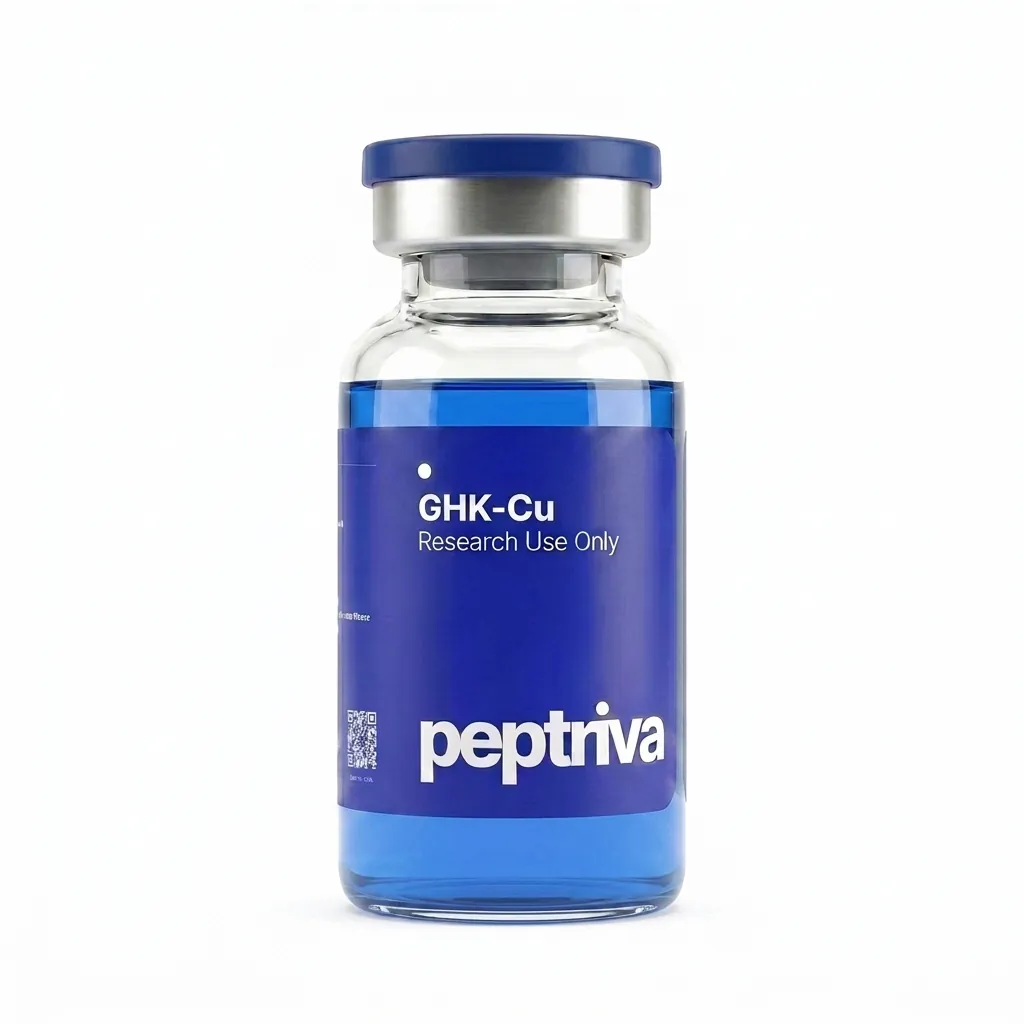
GHK-Cu
Endogenous copper tripeptide · 3 aa, glycyl-L-histidyl-L-lysine. The same reference compound used across the cited preclinical studies. COA available with each lot.
What would change the picture?
One trial would shift the conversation. A modern multi-center randomized trial of injectable GHK-Cu, for a specific condition, with validated dosing and proper safety endpoints. No such trial exists. None is announced.
Other peptides have made the Phase III jump (Forzinity, Cagrilintide, retatrutide). GHK-Cu has not attracted equivalent commercial investment for any systemic indication despite 50 years of preclinical interest — a notable signal regarding how drug developers have assessed the systemic evidence base.
Until a controlled human trial is conducted and published, the route evidence gap remains where it is. The topical literature supports modest, reproducible effects with a favorable safety record. The injectable literature does not provide equivalent support — no controlled human study has been conducted to establish efficacy or safety for systemic use.
What to know now
- Same molecule, different evidence. Topical and injectable are the same peptide — but the controlled trials behind each route are worlds apart.
- Topical: ~50 years of data. Cosmetic-dermatology research, reproducible cell biology, small wound-care RCTs, modern hydrogel work.
- Injectable: 0 human RCTs. For any systemic condition. Rodent preclinical only.
- Mechanism by route. Topical concentrates the molecule at skin targets. Injectable spreads it through circulation, where target distribution isn't characterized.
- Safety. Topical: good record across decades. Injectable: not established in controlled human studies.
- 2026 sports-medicine flag. Mendias and Awan group injectable GHK-Cu with peptides "where rigorous human safety data is scarce."
- Grade matters. Cosmetic-grade and research-grade material are manufactured to different standards and are not interchangeable across routes.
What we’re watching
Three things over the next 24 months. First, whether 2023–2025 hydrogel preclinical work translates into a registered Phase II in chronic wounds. That's the natural next step for topical. Second, whether anyone registers a Phase I/II of injectable GHK-Cu for a specific indication. That's what would close the injectable evidence gap. Third, whether the FDA or another regulator clarifies the cosmetic-vs-research-grade boundary. The gap between "skincare ingredient" and "grey-market injectable" is a regulatory blind spot.
References
- Dou, Y., Lee, A., Zhu, L., Morton, J., & Ladiges, W. (2020). The potential of GHK as an anti-aging peptide. Aging Pathobiology & Therapeutics, 2(1), 58–61. https://doi.org/10.31491/apt.2020.03.014
- Lee, S., Lee, S. M., Lee, S. H., et al. (2023). In situ photo-crosslinkable hyaluronic acid-based hydrogel embedded with GHK peptide nanofibers for bioactive wound healing. Acta Biomaterialia, 172, 159–174. https://doi.org/10.1016/j.actbio.2023.10.011
- Mao, S., Huang, J., Li, J., et al. (2025). Exploring the beneficial effects of GHK-Cu on an experimental model of colitis and the underlying mechanisms. Frontiers in Pharmacology, 16, 1551843. https://doi.org/10.3389/fphar.2025.1551843
- Bian, Y., Deng, M., Liu, J., et al. (2024). The glycyl-l-histidyl-l-lysine-Cu tripeptide complex attenuates lung inflammation and fibrosis in silicosis by targeting peroxiredoxin 6. Redox Biology, 75, 103237. https://doi.org/10.1016/j.redox.2024.103237
- Dymek, M., Olechowska, K., Hąc-Wydro, K., & Sikora, E. (2023). Liposomes as carriers of GHK-Cu tripeptide for cosmetic application. Pharmaceutics, 15(10), 2485. https://doi.org/10.3390/pharmaceutics15102485
- Mendias, C. L., & Awan, T. M. (2026). Safety and efficacy of approved and unapproved peptide therapies for musculoskeletal injuries and athletic performance. Sports Medicine. https://doi.org/10.1007/s40279-026-02437-0