GHK-Cu has the longest paper trail of any research peptide. It is an endogenous tripeptide with 50+ years of cosmetic-dermatology research behind it. It is also deep blue, which provides a free identity check available for no other research peptide. Where to buy GHK-Cu for research in 2026 hinges on three checks: is the powder actually blue, does the CoA report copper content, and is the form purchased matched to the evidence base being referenced?
GHK-Cu is the copper-bound form of a tripeptide called glycyl-L-histidyl-L-lysine. Look for CAS 49557-75-7 on the CoA (Certificate of Analysis, a one-page lab report). Molecular weight is 340.4 g/mol. Copper content should be ~17% by mass. The deep blue color is how the copper sits inside the peptide's binding pocket. 2026 pricing: $40-$80 per 50 mg vial, $70-$140 per 100 mg vial, $40-$80 per 30 mL topical cream. Topical use has decades of clinical research. Injectable use has zero controlled human trials.
Quick answer
Research-grade GHK-Cu runs $40–$140 per vial. The powder should be lyophilized and visibly blue. A credible CoA from an ISO 17025-accredited lab (an international testing-quality standard) should show HPLC purity above 98%, correct mass-spec identity, and atomic copper content measured by ICP-MS. The visible blue color is the first identity check. A white or off-white powder is not the molecule characterized in the published research.
The three buying channels.
GHK-Cu reaches buyers through three distinct channels. Each has different rules, different formats, and different gaps.
1. Cosmetic-grade finished topical
Cosmetic finished products (creams, serums, gels) regulated by the FDA as cosmetics, not drugs. The active ingredient is listed as "copper tripeptide-1" or "tripeptide-1 copper" on the box. This is the format the published cosmetic-dermatology research actually used. Typical pricing runs $40–$80 per 30 mL jar.
What this channel does not provide: a known peptide concentration. Most cosmetic products list GHK-Cu in the ingredients without specifying mg per mL. The actual dose is formulator-controlled and not disclosed on the label.
2. Research-supply (laboratory use only)
Lyophilized blue powder in vials, labeled for research use only. Per-mg pricing in this channel typically runs $0.70–$1.60 per mg, and CoA quality should be highest here. The standard vial sizes are 50 mg, 100 mg, and 200 mg.
What this channel does not provide: a finished formulation. The powder requires reconstitution and — for topical-application research — a suitable carrier. The label restricts use to laboratory work.
3. Compounding pharmacy (injectable)
Compounding pharmacies operating under 503A rules (a section of US drug-compounding law that lets pharmacies prepare custom doses with a prescription) can prepare injectable GHK-Cu. A doctor writes the prescription. The pharmacy mixes and ships.
What this channel does not provide: clinical-trial-grade evidence that injectable GHK-Cu produces any confirmed effect in humans. The injectable form has zero controlled human trials as of 2026. The 2026 Sports Medicine review grouped it with grey-market peptides lacking rigorous safety data.
Where this falls short
The topical evidence base is real but old. Many studies date from the 1980s and 1990s, with sample sizes in the low double digits. The injectable evidence is essentially zero. Vendors selling injectable GHK-Cu for "systemic anti-aging" or "IBD treatment" are crossing the evidence line. The 2026 Sports Medicine review explicitly flagged the injectable form as outside supported use cases. For validated GHK-Cu activity, the topical route is where the published science has been conducted.
What the compound is.
GHK-Cu (often labeled "copper tripeptide-1" in cosmetics) is the copper-bound form of glycyl-L-histidyl-L-lysine. Loren Pickart discovered the peptide in 1973 by isolating it from human plasma while screening fractions that restored healthy growth in aged rat liver cells. He published it in Nature. He's spent the past 50 years characterizing it.
The peptide is endogenous — it is produced by the human body. A 2020 review reports circulating levels averaging 200 ng/mL at age 20 and dropping to 80 ng/mL by age 60 (Dou et al., 2020). That age-associated decline is among the reasons GHK-Cu has been investigated as a longevity research target.
The biochemistry that sets GHK-Cu apart is the copper. Two parts of the peptide form a binding pocket around a copper ion. The resulting complex absorbs red light and transmits blue. That's why properly complexed material is deep blue (Pickart & Margolina, 2018). For a buyer, the identity check is unusually simple: it should be blue.
Properly complexed GHK-Cu is deep blue. A pale or white powder labeled "GHK-Cu" is either uncomplexed peptide or only partially complexed. Either way, it isn't the molecule in the published literature.
— The simplest identity check in research peptides
Four buyer checks for GHK-Cu.
The general eight peptide-buyer criteria all apply. These four matter more for GHK-Cu.
1. The powder must be blue, not white.
The most common mix-up in the GHK-Cu market is between the copper-bound form (deep blue) and the bare peptide (white or off-white). The published research on collagen synthesis, blood-vessel formation, and inflammation was all done with the copper-bound form.
A white powder labeled "GHK-Cu" is either uncomplexed peptide or only partly complexed. Either way, it isn't the molecule in the published literature. The visible color is a free identity check.
2. The CoA must show atomic copper content.
A credible GHK-Cu CoA reports copper percentage measured by ICP-MS or AAS. Those are two lab techniques that quantify metals in a sample. The theoretical copper content for fully complexed GHK-Cu is 17% by mass: one copper atom (63.5 g/mol) per peptide molecule (340 g/mol).
If the CoA reports HPLC purity for the peptide but skips copper content, there is a peptide-purity number but no confirmation of the "-Cu" part of the name.
3. Match the form to the evidence.
The cosmetic-dermatology evidence base is for topical GHK-Cu. That's clinical trials in photoaged skin and chronic wounds, modern hydrogel delivery work, and 2025 liposomal-encapsulation research. The injectable form that's become common in the research peptide community has essentially zero controlled human trials as of 2026.
The 2026 Sports Medicine review grouped injectable GHK-Cu with grey-market peptides lacking rigorous human safety data. See our injectable vs topical comparison for the full breakdown.
Topical cosmetic-grade material is matched to the topical evidence base. Lyophilized blue vial powder is appropriate for research chemistry requiring a characterized reference compound.
4. Bigger vials, lower per-mg cost.
GHK-Cu ships in 50 mg, 100 mg, or 200 mg vials. That's about 10x larger than the 5-10 mg standard for most peptides. Two reasons. The synthesis is cheap (three amino acids, no modifications, plus a copper-binding step). And the molecule is unusually stable at room temperature when stored as freeze-dried solid.
The cosmetic industry works with GHK-Cu because finished topical products can sit on a shelf for months. Reconstituted solution should still be refrigerated and expiration dates observed, but storage is more forgiving than for GLP-1-class peptides.
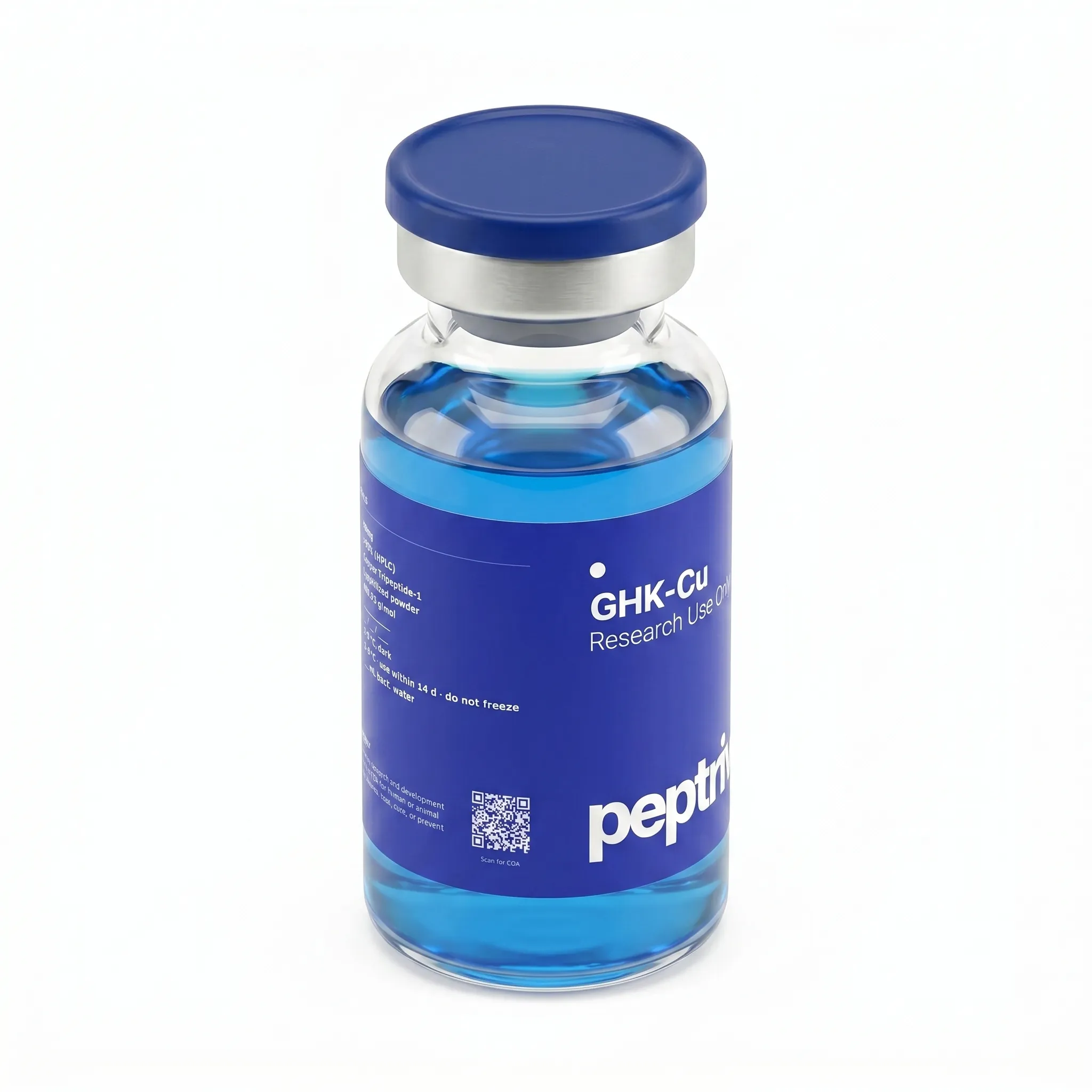
GHK-Cu
The same copper-binding tripeptide cited across the Pickart cosmetic-dermatology evidence base. The 2018 Pickart & Margolina review, the 2020 Dou anti-aging review, and the modern 2023-2025 wound-healing literature. Deep blue lyophilized powder, third-party CoA with copper-content verification on every lot.
2026 pricing benchmarks.
GHK-Cu is the cheapest peptide in most research catalogs on a per-mg basis. Three amino acids, well-established synthesis, room-temperature-stable powder, and vials 10x larger than typical. Research-grade retail in 2026:
- 50 mg vial: $40-$80 ($0.80-$1.60 per mg). The standard research-grade size.
- 100 mg vial: $70-$140 ($0.70-$1.40 per mg). The size most cosmetic researchers buy.
- 200 mg vial: $130-$260 ($0.65-$1.30 per mg). Bulk research use, best per-mg.
- Finished topical (cream, serum): $40-$80 per 30 mL jar. Pre-formulated and ready to apply.
Below $30 for a 50 mg vial deserves a question. That's below typical bulk synthesis cost and usually means uncomplexed GHK or low copper content. Above $80 is retail markup, not synthesis cost. For finished topical products, the price reflects the formulation work as much as the GHK-Cu itself. The carrier system (liposomes, hyaluronic acid, tallow) is doing real bioavailability work.
Is GHK-Cu legal to buy?
Yes, in two distinct legal channels.
As a topical cosmetic ingredient under FDA cosmetic regulations (labeled "tripeptide-1" or "copper tripeptide-1"), it's been used since the 1980s. As a research reference compound, it's sold under the same Research Use Only framework as other research peptides.
Neither the FDA nor the EMA has approved GHK-Cu as a therapeutic drug. It's regulated as a cosmetic, not a medicine. The FDA's 2023 categorization that flagged BPC-157 didn't include GHK-Cu. WADA hasn't placed GHK-Cu on the Prohibited List.
Those are the two legitimate channels: cosmetic-grade topical products and research-grade reference compound. The two channels differ in manufacturing standards and intended use.
Red flags specific to GHK-Cu.
Seven warning signs we'd skip:
- White, off-white, or pale tan powder. Properly complexed GHK-Cu is deep blue. A pale powder is uncomplexed or only partially complexed. Not the molecule in the published literature.
- CoA without atomic copper content. HPLC peptide purity is necessary but not sufficient. Without ICP-MS or AAS copper data, there is no verification of the "-Cu" part of the molecule.
- Confusion between "GHK" and "GHK-Cu." Some suppliers list both as the same product. They aren't. The bioactive form in the literature is the copper-complexed version.
- Clinical claims for injectable use. "Reverses systemic aging." "Treats IBD." The injectable evidence base in humans is zero controlled trials. These claims attract FDA enforcement.
- Cosmetic vs research-grade mislabeling. The two are made under different standards. Research-chemical powder isn't appropriate for direct skin application without formulation. Cosmetic-grade finished products aren't reference standards.
- Pricing below $30 per 50 mg vial. Likely uncomplexed GHK or low copper content.
- Vendor's in-house QC instead of third-party testing. Independent ISO 17025 verification of HPLC purity, mass-spec identity, and copper content is the standard.
Copper Peptide Tallow Cream
The finished topical form. GHK-Cu pre-formulated in a tallow carrier that addresses the historical permeation challenge described in the 2025 Ogórek skin-permeation paper. The form matched to the topical evidence base the cosmetic-dermatology literature is built on. 30 mL jar, ready-to-apply.
Frequently asked questions.
Is GHK-Cu legal to buy?
Yes, in two channels. As a cosmetic ingredient or finished topical under FDA cosmetic regulations, and as a research reference compound. GHK-Cu isn't on the WADA Prohibited List. The FDA didn't include it in the 2023 categorization that affected BPC-157. Selling for human injectable consumption isn't permitted. Buying as a topical or research compound is.
How much does GHK-Cu cost?
Research-grade lyophilized GHK-Cu in 2026: $40-$80 per 50 mg vial, $70-$140 per 100 mg vial, $130-$260 per 200 mg vial. Finished topical cosmetics: $40-$80 per 30 mL jar. Per-mg pricing is among the lowest of any peptide because the synthesis is short and well-established and the vials are larger than typical.
What should a GHK-Cu CoA show?
Three things matter. HPLC purity above 98% with the chromatogram. Mass-spec at 340.4 g/mol for the bare peptide. And atomic copper content (via ICP-MS or AAS) of about 17% by mass for properly complexed material. The copper measurement verifies the "-Cu" part. Without it, the CoA reports a peptide-purity number with no copper confirmation. The lab should be ISO 17025-accredited and named on the report.
Why is GHK-Cu blue?
The blue color comes from copper sitting in a specific geometry inside the peptide's binding pocket. Copper coordinated this way absorbs red light and transmits blue. The color is a visible signature of proper copper complexation. White or off-white powder labeled "GHK-Cu" is uncomplexed or partially complexed. Not the molecule in the published literature.
Topical vs injectable: which has better evidence?
Topical, by a long way. Five decades of cosmetic-dermatology research, small controlled trials in photoaged skin and chronic wounds, reproducible in-vitro biology including about 49% elastase inhibition and collagen-synthesis stimulation. Modern delivery research with liposomal and hyaluronic acid carriers. Injectable GHK-Cu in humans has effectively zero controlled trials as of 2026. The preclinical rodent work in colitis, silicosis, and wound-healing models is real but rodent-bound. The 2026 Sports Medicine review grouped injectable GHK-Cu with grey-market peptides lacking rigorous human safety data.
How does GHK-Cu compare to Argireline or Matrixyl?
All three are short-peptide cosmetic ingredients with different mechanisms. In published studies, GHK-Cu has been investigated for effects on fibroblast stimulation, collagen synthesis, elastase inhibition, and angiogenesis. Argireline (acetyl hexapeptide-8) is marketed as a topical analog of botulinum-toxin-like effects on expression lines, though the human evidence is thinner than the marketing. Matrixyl is a procollagen fragment designed to signal collagen synthesis. GHK-Cu has the deepest published evidence base of the three by a substantial margin.
What's the difference between GHK and GHK-Cu?
GHK is the bare tripeptide. Three amino acids, molecular weight 340.4 g/mol. GHK-Cu is the copper-bound version. The published activity was characterized with the copper-bound form. The color is the immediate tell: GHK is white. GHK-Cu is deep blue. For research matching the published literature, GHK-Cu is the molecule of interest.
What to know now
- The blue color is a free identity check. Properly complexed GHK-Cu is deep blue. White or off-white is uncomplexed.
- Copper content on the CoA matters. About 17% by mass, measured by ICP-MS or AAS. Without it, no copper confirmation.
- Pricing: $40-$140 per vial depending on size. Three amino acids and well-established synthesis make it one of the cheapest peptides per mg.
- Topical evidence is well-supported. Five decades of research, small controlled trials, modern hydrogel delivery work.
- Injectable evidence is preclinical-only. Zero controlled human trials. The 2026 Sports Medicine review applies.
- Match the form to the evidence. Topical cosmetic-grade for skin or wound use. Research-grade lyophilized powder for lab research. They aren't interchangeable.
What we're watching
The big development to track: whether any controlled human trial of injectable GHK-Cu publishes. Randomized, blinded, real endpoints. The preclinical rodent literature in colitis, silicosis, and wound-healing models gives mechanistic hooks for several potential uses. But until those translate to controlled human investigation, the topical-vs-injectable evidence asymmetry stays. We're also watching the modern delivery research: liposomal encapsulation, hyaluronic acid hydrogels, photo-crosslinkable nanofibers. That work is solving the historical poor-permeation problem for topical GHK-Cu, and it's the most credible direction for the next decade of cosmetic-dermatology applications.
References
- Pickart, L., & Margolina, A. (2018). Regenerative and protective actions of the GHK-Cu peptide in the light of the new gene data. International Journal of Molecular Sciences, 19(7), 1987. https://doi.org/10.3390/ijms19071987
- Dou, Y., Lee, A., Zhu, L., Morton, J., & Ladiges, W. (2020). The potential of GHK as an anti-aging peptide. Aging Pathobiology & Therapeutics, 2(1), 58–61. https://doi.org/10.31491/apt.2020.03.014
- Lee, S., Lee, S. M., Lee, S. H., et al. (2023). In situ photo-crosslinkable hyaluronic acid-based hydrogel embedded with GHK peptide nanofibers for bioactive wound healing. Acta Biomaterialia, 172, 159–174. https://doi.org/10.1016/j.actbio.2023.10.011
- Mao, S., Huang, J., Li, J., et al. (2025). Exploring the beneficial effects of GHK-Cu on an experimental model of colitis and the underlying mechanisms. Frontiers in Pharmacology, 16, 1551843. https://doi.org/10.3389/fphar.2025.1551843
- Bian, Y., Deng, M., Liu, J., et al. (2024). The glycyl-l-histidyl-l-lysine-Cu tripeptide complex attenuates lung inflammation and fibrosis in silicosis by targeting peroxiredoxin 6. Redox Biology, 75, 103237. https://doi.org/10.1016/j.redox.2024.103237
- Dymek, M., Olechowska, K., Hąc-Wydro, K., & Sikora, E. (2023). Liposomes as carriers of GHK-Cu tripeptide for cosmetic application. Pharmaceutics, 15(10), 2485. https://doi.org/10.3390/pharmaceutics15102485
- Ogórek, K., Nowak, K., Wadych, E., Ruzik, L., Timerbaev, A. R., & Matczuk, M. (2025). Are we ready to measure skin permeation of modern antiaging GHK-Cu tripeptide encapsulated in liposomes? Molecules, 30(1), 136. https://doi.org/10.3390/molecules30010136
- Mendias, C. L., & Awan, T. M. (2026). Safety and efficacy of approved and unapproved peptide therapies for musculoskeletal injuries and athletic performance. Sports Medicine. https://doi.org/10.1007/s40279-026-02437-0
- International Organization for Standardization. (2017). ISO/IEC 17025:2017 — General requirements for the competence of testing and calibration laboratories. https://www.iso.org/standard/66912.html