Here’s what nobody tells you when you go shopping for 5-Amino-1MQ: it isn’t a peptide. It has zero amino acids, no peptide bonds, and weighs in at just 159 g/mol. It’s a small-molecule enzyme blocker sold in the same vendor catalogs as BPC-157 and tirzepatide. That mismatch matters when you’re buying it. We’ll walk you through three questions that decide whether you’re getting the real compound or the wrong product entirely.
5-Amino-1MQ is a small-molecule NNMT inhibitor (an enzyme blocker), not a peptide. It’s sold legally in the U.S. as a research reference compound. Expect to pay $50–$150 per 50 mg vial — roughly 10x cheaper per milligram than peptides because the manufacturing method is completely different. A credible Certificate of Analysis (CoA) shows HPLC purity above 98%, mass-spec at 159.1 m/z, and lists CAS number 42464-96-0. Every published efficacy study is in rodents. Zero human trials exist.
Quick answer: Buy a 50 mg vial labeled with CAS 42464-96-0 and molecular weight 159.21 g/mol. Pay $50–$150. Get a CoA from an ISO 17025 lab (an internationally recognized testing standard) that tests small molecules, not peptides. Set your evidence expectations to mouse-only.
What you’re actually buying
5-Amino-1MQ blocks an enzyme called NNMT (nicotinamide N-methyltransferase). NNMT chews through two valuable cellular resources at once: a methyl-donor molecule called SAM, and nicotinamide, which is the precursor your cells use to build NAD+. When NNMT runs hot in fat tissue, aging muscle, or tumors, it drains both supplies. Blocking it restores them.
That’s the science. The biology is interesting. The compound is real. It just isn’t a peptide.
A peptide is a chain of amino acids joined by amide bonds. The smallest peptides we sell — selank, semax — have at least seven amino acids and weigh over 700 g/mol. 5-Amino-1MQ has zero amino acids and weighs 159 g/mol. It’s a flat aromatic ring with two nitrogens. It ships in the “research peptide” category because the same warehouses ship both. That’s a logistics fact, not a chemistry fact.
Four buyer checks for 5-Amino-1MQ
The general eight criteria for any research compound all apply. These four matter more because of the small-molecule identity:
1. The CoA must list small-molecule data, not a peptide sequence
A credible Certificate of Analysis for 5-Amino-1MQ shows three things on the identity line:
- Molecular formula: C10H11N2 (the active cation) or C10H11N2I (the iodide salt as sold).
- Molecular weight: 159.21 g/mol for the cation.
- IUPAC name: includes “quinolin-1-ium.”
If the CoA lists an amino-acid sequence, the vendor is on autopilot. Cross-check the CAS number against PubChem in 30 seconds: 42464-96-0 is the only correct entry.
2. Set evidence expectations to rodent-only
The entire efficacy literature for 5-Amino-1MQ comes down to two preclinical studies:
- A 2022 mouse study showing fat-mass reductions when 5-Amino-1MQ was paired with a diet switch (Dimet-Wiley et al., 2022).
- A 2024 mouse study showing tumor shrinkage in bladder cancer models when combined with an immunotherapy antibody (Yang et al., 2024).
A 2021 cervical-cancer paper (Akar et al., 2021) used a closely related compound, not 5-Amino-1MQ itself.
That’s the whole literature. Zero human trials have been published as of May 2026. Anyone extrapolating from a mouse fat-pad to a human weight-loss outcome is crossing the largest inferential gap in pharmacology with no safety net.
3. Oral bioavailability is a real differentiator
5-Amino-1MQ is small and stable enough to survive a stomach. The Dimet-Wiley team dosed mice by oral gavage and saw biological activity. Most peptides can’t do this. BPC-157, tirzepatide, retatrutide — they all need injection because gut enzymes destroy peptide bonds in minutes. That’s a legitimate point for 5-Amino-1MQ. But it’s only validated in mice. Human oral pharmacokinetics aren’t characterized yet.
4. Pricing follows different math
Peptides are made by solid-phase peptide synthesis (SPPS), which is expensive per milligram. Small molecules like 5-Amino-1MQ are made by classical organic chemistry, which isn’t. The cost gap is roughly 10x:
- 5-Amino-1MQ: $1–$3 per mg ($60 for a 50 mg vial).
- BPC-157: $5–$10 per mg.
- Tirzepatide: $15–$30 per mg.
Watch the vial size when you compare prices. A $60 vial that contains only 5 mg is peptide pricing applied to a non-peptide. The standard size is 50 mg.
Where this falls short: The all-rodent evidence base is the single biggest limitation. There’s no published human safety profile, no characterized human dosing, no controlled efficacy data outside of mice. The compound’s commercial sponsor, Ridgeline Therapeutics, has signaled interest in clinical development — but until a registered trial reads out, every claim about “NNMT inhibitor weight loss” is extrapolation. Buy it for what it is: a research tool, not a therapeutic.
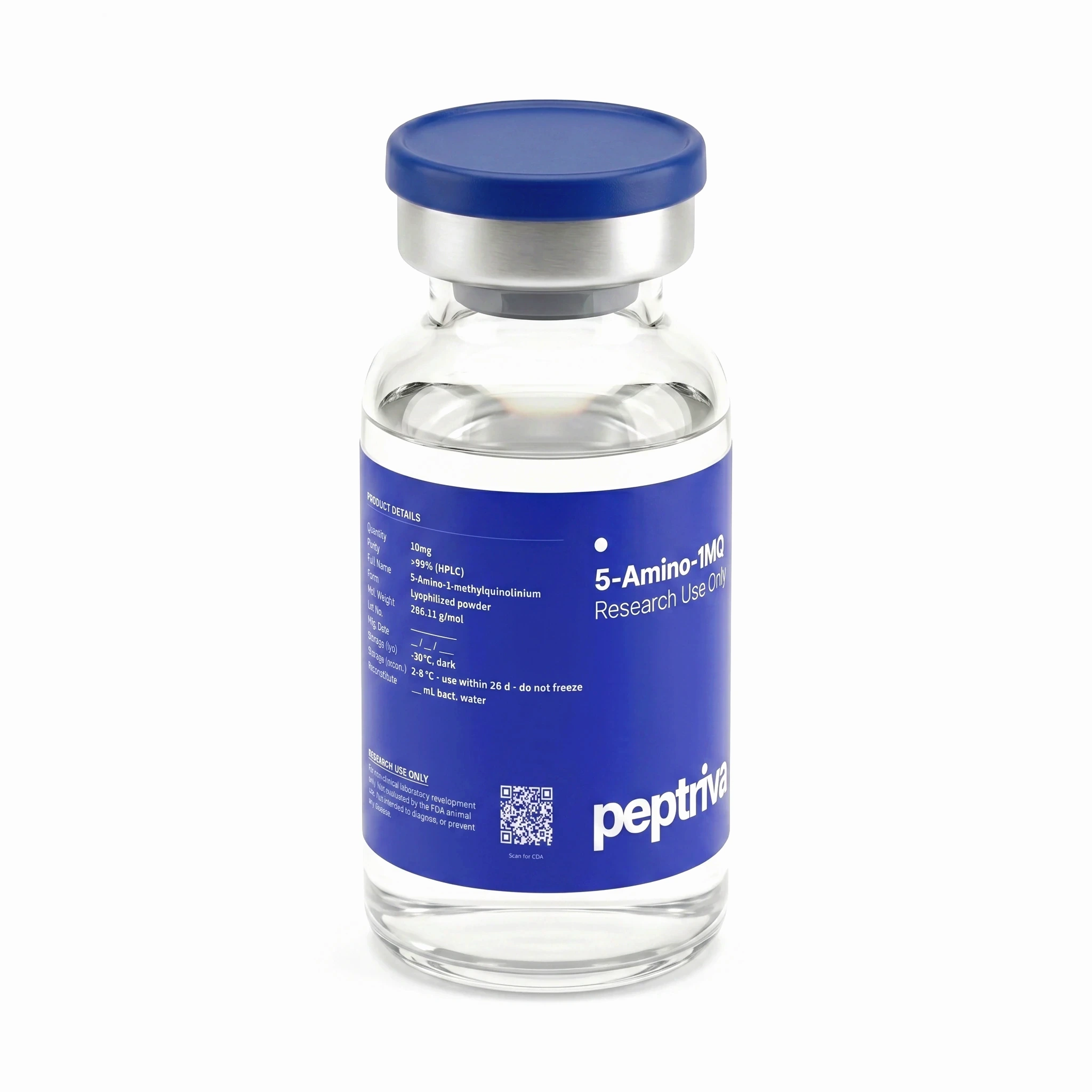
5-Amino-1MQ
The same reference compound cited in the 2022 Watowich-group DIO-mouse study and the 2024 bladder-cancer immunotherapy paper. CAS 42464-96-0, MW 159.21 g/mol, ≥99% HPLC purity, ISO 17025 third-party CoA per lot — tested by methods appropriate for small molecules, not peptides.
2026 pricing benchmarks
5-Amino-1MQ is cheap per milligram because the synthesis is cheap per milligram. Here’s what we see across research-grade retail in 2026:
- 50 mg vial: $50–$80 ($1.00–$1.60 per mg). The standard retail size.
- 100 mg vial: $80–$120 ($0.80–$1.20 per mg). Good for sustained rodent protocols.
- 250 mg vial: $130–$200 ($0.50–$0.80 per mg). Lab-scale work.
- 500 mg / 1 g vial: available from specialty suppliers with further per-mg discounts.
Anything below $30 per 50 mg deserves a second look. At that floor, the common substitutions are the demethylated precursor 5-aminoquinoline (CAS 611-34-7) or the unaminated analog 5-methylquinolinium. They look similar on a partial chromatogram, but they aren’t the compound used in the Watowich studies.
Is 5-Amino-1MQ legal to buy?
Yes, as a research reference compound labeled for laboratory use only. It’s not a controlled substance and not scheduled by the DEA. Because it’s a small molecule, it sits outside the FDA’s 2023 peptide-compounding rules (the 503A Category 2 list) entirely.
The catch: selling it with weight-loss claims for human use triggers FDA enforcement no matter what the chemistry is. The legal research-use-only framework under 21 CFR § 809.10(b)(9) allows sale as a research material. It doesn’t allow vendors to call it a weight-loss drug.
WADA has not added 5-Amino-1MQ to the Prohibited List as of 2026. Researchers whose study participants are subject to WADA jurisdiction should consult the current WADA Prohibited List, as metabolic-modulating compounds are an active anti-doping watch area.
Red flags specific to 5-Amino-1MQ
Six warning signs we’d walk away from:
- Sold as a “peptide.” The vendor either doesn’t know what the molecule is or is comfortable misrepresenting it. Either way, it’s a quality-control red flag for the rest of their catalog.
- Priced like a peptide. A 5 mg vial at $60–$80 is peptide pricing applied to a small molecule. The standard size is 50 mg at that price.
- CoA from a peptide-focused lab. Peptide HPLC methods don’t cleanly transfer to small molecules. Look for a lab that tests small-molecule pharmaceutical intermediates.
- “GLP-1 alternative” marketing. Anyone framing 5-Amino-1MQ as a substitute for Ozempic is making clinical claims about a compound with zero human trials. That’s the exact pattern that draws FDA letters.
- Missing CAS number 42464-96-0. The CAS is the molecule’s ID number. If it’s missing — or worse, replaced with 611-34-7 (precursor) — that’s the wrong compound.
- Pre-reconstituted liquid. 5-Amino-1MQ ships stable as a lyophilized (freeze-dried) iodide salt at −20°C. Liquid solutions sold at room temperature degrade, including by exposure to light.
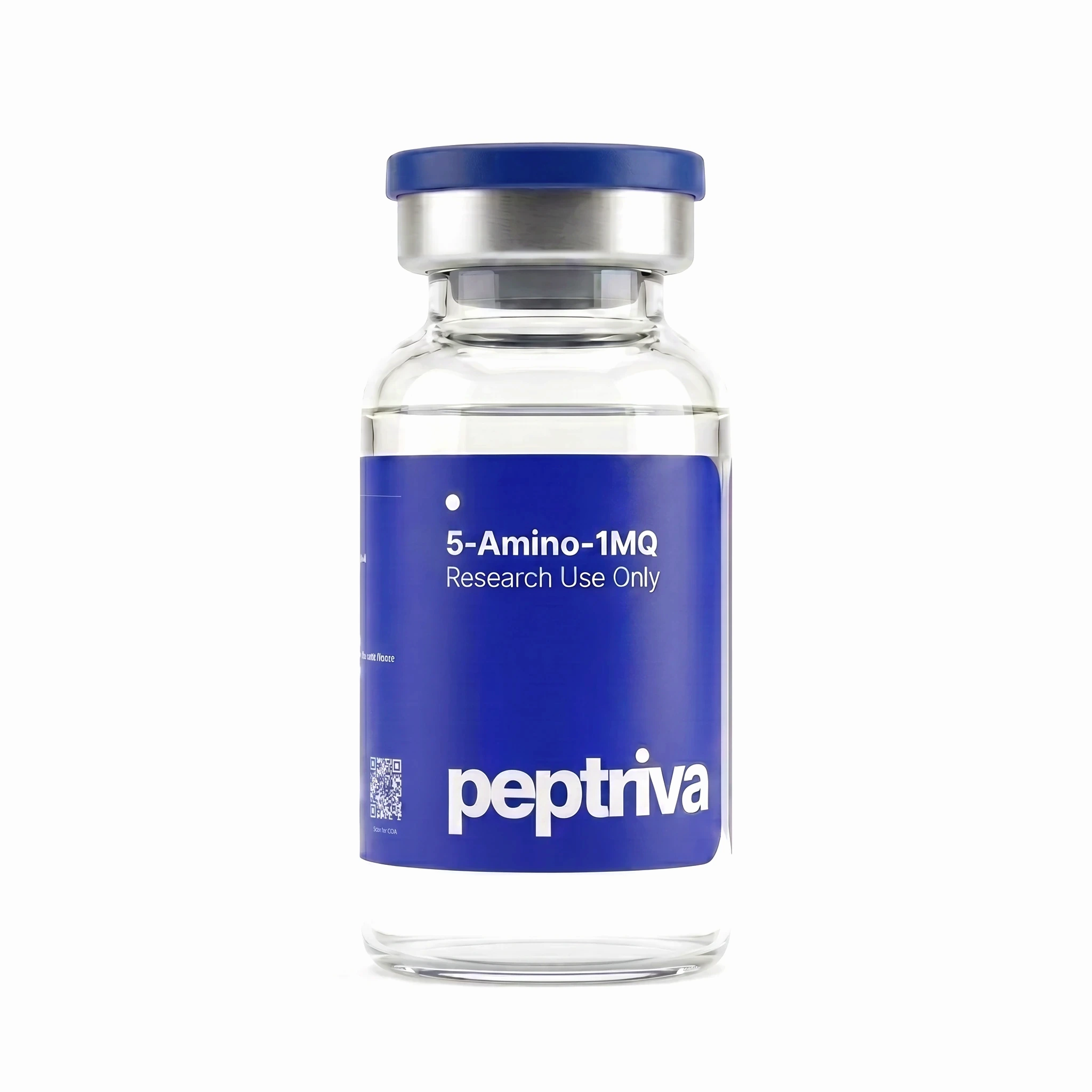
5-Amino-1MQ
5-Amino-1-methylquinolinium iodide, CAS 42464-96-0. A small-molecule NNMT inhibitor with the reference identity used across the published Watowich-lab preclinical literature. COA tested by small-molecule-appropriate HPLC and mass-spec methods ships with every order.
Frequently asked questions
Is 5-Amino-1MQ legal to buy in the USA?
Yes, as a research reference compound. It is not a controlled substance, not FDA-approved for any indication, and not scheduled by the DEA. Because it is a small molecule, it sits outside the FDA’s 2023 peptide-compounding rules. It is available to purchase as labeled research material. Vendors may not market it with human-use claims.
Is 5-Amino-1MQ actually a peptide?
No. It has no amino acids and no peptide bonds. It’s a small-molecule quinolinium — a flat aromatic ring with two nitrogens — weighing 159.21 g/mol. That’s about one-tenth the size of the smallest real peptide. The “peptide” framing is marketing language, not chemistry.
How much should research-grade 5-Amino-1MQ cost?
Pay $50–$80 for a 50 mg vial, $80–$120 for 100 mg, or $130–$200 for 250 mg. That’s roughly $1–$3 per mg. Compare with $5–$20 per mg for most peptides — the synthesis method is what drives the gap. Below $30 per 50 mg deserves a question.
What does the human evidence actually show?
Nothing. There are zero PubMed-indexed human trials for 5-Amino-1MQ as of May 2026. Every efficacy claim rests on rodent or cell-culture data. Ridgeline Therapeutics has signaled interest in human development, but no clinical readouts exist yet.
Is 5-Amino-1MQ a real alternative to Ozempic or tirzepatide?
No, and that comparison is misleading. Tirzepatide and semaglutide are FDA-approved with Phase III trials in tens of thousands of people, with documented mean weight loss of 15–22% from baseline. 5-Amino-1MQ has only rodent data. Researchers studying NNMT pharmacology may find it useful in preclinical models; it has no published human efficacy or safety data.
How does NNMT inhibition affect metabolic activity in preclinical models?
NNMT consumes two cellular resources simultaneously — a methyl-donor (SAM) and nicotinamide (the NAD+ precursor). In obese adipose tissue in rodent models, elevated NNMT activity has been reported to deplete both. Preclinical studies have investigated whether inhibiting NNMT increases cellular energy expenditure; Dimet-Wiley et al. (2022) reported such effects in DIO mice. The mechanism article walks through the biochemistry. The metabolic research article covers the rodent findings in detail.
What to know now
- CAS 42464-96-0, MW 159.21 g/mol, formula C10H11N2. The numbers a credible CoA should show.
- $50–$150 per 50 mg vial. Small-molecule synthesis is roughly 10x cheaper per mg than peptide synthesis.
- Not a peptide. Zero amino acids, sold in the peptide category by warehouse convention only.
- Mouse-only evidence. DIO obesity model + bladder cancer xenograft. No human trials published.
- Orally bioavailable in rodents. A real differentiator from injectable peptides, but human pharmacokinetics aren’t characterized.
- Not a GLP-1 alternative. Marketing that compares it to Ozempic ignores the evidence gap.
What we’re watching
The single development we’re tracking: whether Ridgeline Therapeutics or another sponsor moves an NNMT inhibitor into a registered human trial. The 2024 bladder-cancer paper in Journal for ImmunoTherapy of Cancer is the kind of preclinical signal that often precedes serious development. Until a Phase I readout appears, the human-translation question stays open. Separately, we’re watching whether WADA adds metabolic NNMT inhibitors to its Prohibited List as a class.
References
- Dimet-Wiley, A., Wu, Q., Wiley, J. T., Eswar, A., Neelakantan, H., Savidge, T. C., & Watowich, S. J. (2022). Reduced calorie diet combined with NNMT inhibition establishes a distinct microbiome in DIO mice. Scientific Reports, 12(1), 484. https://doi.org/10.1038/s41598-021-03670-5
- Yang, M., Wang, B., Hou, W., Yu, H., Zhou, B., Zhong, W., Liu, Z., Li, J., Zhang, H., Yang, G., & Wang, X. (2024). NAD+ metabolism enzyme NNMT in cancer-associated fibroblasts drives tumor progression and resistance to immunotherapy by modulating macrophages in urothelial bladder cancer. Journal for ImmunoTherapy of Cancer, 12(7), e009281. https://doi.org/10.1136/jitc-2024-009281
- Akar, S., Duran, T., Azzawri, A. A., Koçak, N., Çelik, Ç., & Yıldırım, H. İ. (2021). Small molecule inhibitor of nicotinamide N-methyltransferase shows anti-proliferative activity in HeLa cells. Journal of Obstetrics and Gynaecology, 41(8), 1240–1245. https://doi.org/10.1080/01443615.2020.1854696
- U.S. Food and Drug Administration. (2023). Section 503A of the Federal Food, Drug, and Cosmetic Act. https://www.fda.gov/drugs/human-drug-compounding/section-503a-federal-food-drug-and-cosmetic-act
- U.S. Code of Federal Regulations. (2024). 21 CFR § 809.10(b)(9) — Labeling for in vitro diagnostic products: Research use only. https://www.ecfr.gov/current/title-21/chapter-I/subchapter-H/part-809/section-809.10
- World Anti-Doping Agency. (2026). The 2026 Prohibited List. https://www.wada-ama.org/en/prohibited-list
- International Organization for Standardization. (2017). ISO/IEC 17025:2017 — General requirements for the competence of testing and calibration laboratories. https://www.iso.org/standard/66912.html