Sourcing tirzepatide for research in 2026 involves three distinct legal channels, and they are not interchangeable.
Tirzepatide is Eli Lilly's GIP/GLP-1 dual-agonist peptide. It is available through three channels: as prescription Mounjaro or Zepbound through a licensed pharmacy, as compounded tirzepatide from a 503A pharmacy (a pharmacy that mixes custom preparations to order), or as research-grade lyophilized powder for laboratory use. The first two require a prescription and are for human therapeutic use. The third does not require a prescription and is labeled Research Use Only. Pricing benchmarks: approximately $1,060/month for Zepbound, $300–$600/month compounded, and $140–$280 per 10 mg research vial.
The three channels at a glance
We built this side-by-side so you can rule out two channels in a minute and focus on the one that fits.
- Prescription Mounjaro or Zepbound. The FDA-approved finished drug, made by Eli Lilly. Needs a prescription. About $1,060/month cash, less with insurance. For human therapeutic use.
- 503A compounded tirzepatide. A pharmacy mixes injectable tirzepatide for a named patient with a prescription. $300–$600/month. Legal channel narrowed sharply in October 2024.
- Research-grade tirzepatide. Freeze-dried powder sold as a laboratory reference compound. No prescription. Not for human use. $140–$280 per 10 mg vial.
Same molecule across all three. Different supply chains, different rules, different intended uses. We'll walk through each in plain English below.
In SURMOUNT-1, the highest-dose tirzepatide arm produced a 22.5% mean reduction in body weight at 72 weeks, versus 2.4% on placebo.
Jastreboff et al., New England Journal of Medicine, 2022
What does tirzepatide actually do?
Before the sourcing breakdown, a brief molecular summary. Tirzepatide is a synthetic 39-amino-acid peptide that acts as a dual agonist at the GIP and GLP-1 receptors. Preclinical and clinical studies have investigated its effects on insulin secretion, gastric emptying, and energy homeostasis.
The SURMOUNT-1 trial (n=2,539) reported that study participants receiving tirzepatide 15 mg once weekly demonstrated a 22.5% mean reduction in body weight at 72 weeks versus 2.4% on placebo (Jastreboff et al., 2022).
In the SURPASS-2 trial, a head-to-head study against semaglutide in 1,879 research subjects with type 2 diabetes, tirzepatide 15 mg was associated with a 2.30-point HbA1c reduction and a 11.2 kg body weight reduction, exceeding semaglutide on both measures (Frías et al., 2021).
Channel 1: Mounjaro or Zepbound by prescription
This is the only legal way to get tirzepatide for human use. Mounjaro is approved for type 2 diabetes (FDA approval May 13, 2022). Zepbound is approved for chronic weight management in adults with obesity (FDA approval November 8, 2023). Same molecule in both. Different label, different indication.
Key channel characteristics:
- Access route. Via a licensed prescriber (primary care, endocrinologist, or telehealth provider). Cash price is roughly $1,060 per month. With insurance, copays frequently range from $25–$100.
- Product form. A pre-filled single-dose injection pen at 2.5, 5, 7.5, 10, 12.5, or 15 mg. Sterile, injection-ready, dispensed with the FDA-approved prescribing information.
- Regulatory status. The only channel approved for human therapeutic use. Requires a valid prescription and documented clinical indication.
- Coverage note. Insurance coverage for the weight management indication varies substantially. Out-of-pocket Zepbound at $12,000+/year is a reported cost for cash-pay patients.
Channel 2: 503A compounded tirzepatide
This is the channel that's changed the most in the last year. Here's what you need to know.
A 503A compounding pharmacy is a licensed pharmacy that mixes drugs from raw ingredients to fill an individual prescription. Think of it as bespoke pharmacy work, regulated under Section 503A of the federal drug law.
During the 2022–2024 supply crunch, the FDA put tirzepatide on its Drug Shortage list. That listing authorized 503A pharmacies to compound their own tirzepatide for patients who couldn't get the branded product.
What the FDA shortage delisting changed. In October 2024, the FDA removed tirzepatide from the Drug Shortage list after Eli Lilly confirmed supply had stabilized. That delisting pulled the legal rug out from under most compounded tirzepatide. Pharmacies can no longer cite "shortage" as the reason for compounding. Standard 503A rules now apply: there has to be a documented clinical reason your patient can't take the FDA-approved version. If you've seen telehealth ads for $199/month compounded tirzepatide in 2026, many of those operators are running on borrowed time. FDA enforcement letters are landing.
Key channel characteristics:
- Access route. A licensed prescriber writes a prescription; a 503A pharmacy compounds and ships. Cost runs $300–$600 per month.
- Product form. Compounded injectable tirzepatide vials, often available in custom concentrations not offered in the branded pens.
- Legal reality in 2026. Post-delisting, the legitimate compounding window is narrow. Vendors still operating on the shortage rationale are outside FDA guidance. The primary risk is supply-chain disruption.
- Quality considerations. 503A pharmacies do not operate under the same cGMP standard as Eli Lilly. Sterility testing on the finished injectable varies by pharmacy.
Channel 3: Research-grade tirzepatide
This is what we sell at Peptriva, and we'll be straight about what it is and isn't.
Research-grade tirzepatide is the same 39-residue peptide as Mounjaro's active ingredient, ordered from a peptide synthesis house, sold as freeze-dried powder. It's labeled Research Use Only (RUO) and is intended for laboratory work. It is not a drug product. It's not for human use.
Key channel characteristics:
- Access route. Order from a research-supply company. No prescription required. Ships as lyophilized powder in a sealed research vial.
- Pricing benchmarks. $140–$280 per 10 mg vial. The 20 mg size runs $260–$520. Bulk discounts of 10–25% are common on 3-packs and 6-packs.
- Documentation. A Certificate of Analysis (CoA) from an independent laboratory, confirming HPLC purity at ≥98% plus mass-spec identity, ships with every lot.
- Regulatory framing. Labeled Research Use Only; not for human or veterinary administration.
What research-grade does not include. No prescriber oversight. No sterile injectable solution — the powder is reconstituted in a laboratory setting. No insurance billing pathway. No FDA finished-drug oversight on the final product. Channels 1 or 2 are the appropriate pathways for clinical or therapeutic use.
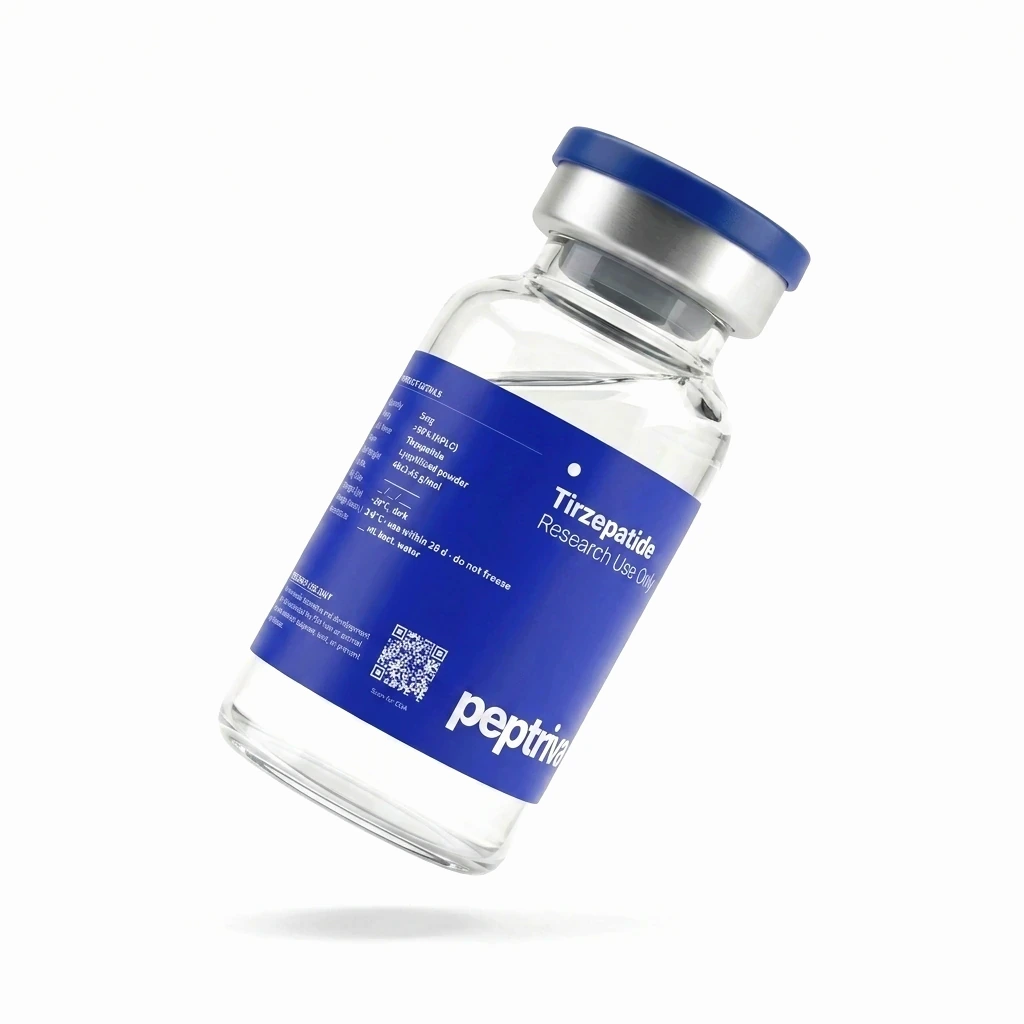
Tirzepatide
The same dual-agonist molecule cited across the SURMOUNT-1 and SURPASS-2 Phase III trials. Sold under the actual peptide name, with a batch-matched CoA from an ISO/IEC 17025 third-party lab. Mass-spec identity confirmed for the lipid-modified 39-residue peptide.
How the three channels stack up
Here's the comparison if you're still deciding:
- Cost benchmarks. Prescription Zepbound: ~$1,060 cash/month. 503A compounded: $300–$600/month. Research-grade: roughly $140–$280 per 10 mg vial.
- Prescription required. Channels 1 and 2: yes. Channel 3: no.
- Appropriate for human administration. Channel 1: yes (FDA-approved). Channel 2: yes, within narrowing legal parameters. Channel 3: no — Research Use Only.
- Quality oversight. Channel 1: FDA cGMP, full pharma quality system. Channel 2: state board of pharmacy plus 503A rules. Channel 3: third-party CoA, no FDA oversight on the final powder.
- Concentration flexibility. Channel 1: six fixed-dose pens per the approved label. Channel 2: custom concentrations available at the compounding pharmacy's discretion. Channel 3: researcher-controlled reconstitution volume.
- Supply reliability in 2026. Channel 1: excellent. Channel 2: variable, enforcement actions ongoing. Channel 3: stable from credible vendors.
If you go research-grade: four things we check
If you decide Channel 3 fits your work, here's the short list of what separates a credible supplier from a sketchy one. The longer version lives in our general peptide buyer's guide.
1. The product page says "tirzepatide," not a codename
Some grey-market vendors sell what they call tirzepatide under opaque labels like FG2-T or FG-blend, refusing to confirm chemical identity. The pattern is usually about dodging Eli Lilly's patent enforcement. But it also lets vendors swap the actual contents of the vial without you knowing.
Our rule: if it's not labeled tirzepatide on both the product page and the CoA, it isn't tirzepatide. You're buying an unknown compound.
2. Mass-spec on the CoA shows ~4813 Da
Tirzepatide's full molecular weight, with the lipid side chain attached, is about 4813 Da. A CoA that reports an observed mass near 4813 Da confirms the molecule is what the label says.
A CoA showing a mass near 4114 Da? That's semaglutide, not tirzepatide. The 700-Da gap is impossible to miss on a competent mass spectrometer. If the mass-spec line is missing entirely, you can't rule out substitution.
3. The semaglutide substitution risk is real
Semaglutide costs roughly 30% as much to make as tirzepatide. Tirzepatide has 8 more amino acids and a more complex lipid modification.
So when a vendor lists tirzepatide at $60 per 10 mg vial, there's a strong chance you're actually paying tirzepatide prices for semaglutide. This isn't theoretical. We've seen it happen.
4. Storage and stability data exist
Tirzepatide's lipid chain makes the molecule more sensitive to freeze-thaw than simpler peptides. A credible supplier publishes how long the powder stays stable at −20 °C and how long a reconstituted solution lasts at refrigerator temperature. Vendors that ship a vial with no stability documentation are skipping a step that matters.
Pricing benchmarks for 2026
Where research-grade tirzepatide should sit:
- 5 mg vial: $80–$150 ($16–$30 per mg).
- 10 mg vial: $140–$280 ($14–$28 per mg). The most common retail size.
- 20 mg vial: $260–$520, with a small per-mg discount.
- 3-pack or 6-pack: 10–25% off per vial at most reputable suppliers.
Below $100 per 10 mg vial, pause. The synthesis floor for a 39-residue lipid-modified peptide is real. Manufacturing cost runs roughly 10x that of a simpler 15-residue peptide like BPC-157. A supplier offering $60 per 10 mg is doing one of four things:
- Running at a loss to win new customers (it happens, but rarely).
- Shipping a lower-purity preparation.
- Substituting semaglutide under a tirzepatide label.
- Selling something else entirely.
The mass-spec CoA tells you which one. That's why we keep coming back to it.
Red flags we'd walk away from
- Sold under codenames (FG2-T, FG-blend). The single biggest tirzepatide red flag.
- Price below $100 per 10 mg vial. Below the synthesis cost floor. Ask why.
- No mass-spec on the CoA, or a mass near 4114 Da. That's semaglutide. Walk away.
- Human dosing instructions on the product page. Directions to self-administer at specific weekly doses (e.g., copying the Zepbound titration schedule) indicate marketing for human use, which is inconsistent with a research-grade designation and outside FDA guidance for RUO vendors.
- No third-party lab partner. Internal-only QC isn't enough for a molecule this complex. ISO/IEC 17025 accredited testing is the standard.
- "Same as Mounjaro" or "pharmaceutical-grade" copy. Conflates channels. Vendors that do this are blurring research-grade with prescription drug, which the FDA notices.
- No lot numbers, or recycled CoAs. Each batch should have its own lot and its own CoA.
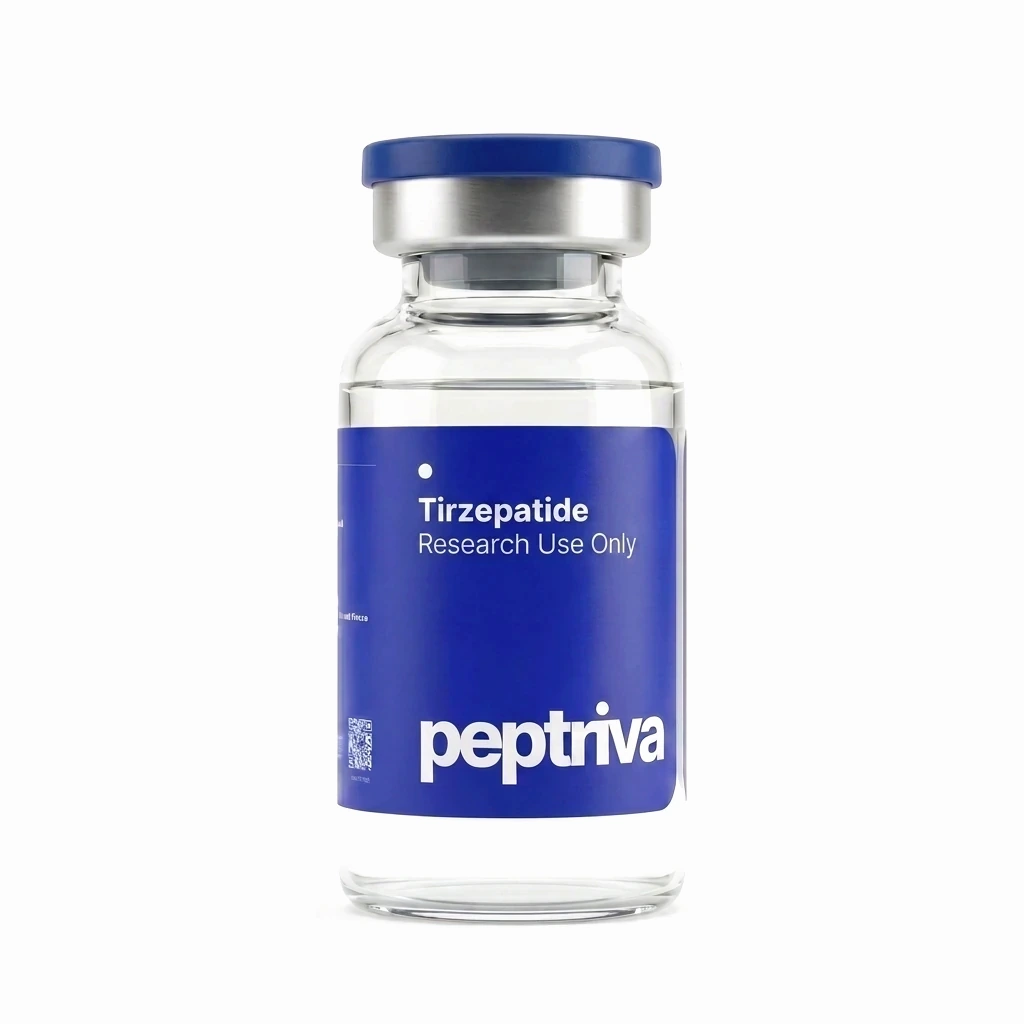
Tirzepatide
39-residue GIP/GLP-1 dual agonist with C20 fatty-diacid acyl modification. Lot-specific CoA with ISO/IEC 17025 third-party HPLC and mass-spec identity ships with every order, including the modified-peptide mass-spec line that distinguishes tirzepatide from semaglutide.
Frequently asked questions
Is research-grade tirzepatide the same molecule as Mounjaro?
Chemically, yes. Both are the same 39-amino-acid peptide with the same lipid side chain (CAS 2023788-19-2). What differs is the regulatory framing, the supply chain, and the intended use.
Mounjaro and Zepbound are FDA-approved finished drug products, made by Eli Lilly under cGMP, dispensed by pharmacies against a prescription. Research-grade tirzepatide is laboratory powder, RUO-labeled, not for human use.
Can tirzepatide be obtained from a telehealth provider?
Yes. Tirzepatide is FDA-approved and telehealth providers routinely prescribe it when clinical criteria are met. That is Channel 1 in this guide — the prescription pathway for human therapeutic use.
Research-grade tirzepatide sold as an RUO reference compound is a separate channel and is not for human administration.
Why is research-grade tirzepatide cheaper than compounded?
Three reasons:
- Compounded tirzepatide carries pharmacy preparation costs, sterility testing, prescriber consultation, and pharmacy markup.
- Research-grade ships as bulk powder, without the prescription or finished-form costs.
- The legal compounding window narrowed in October 2024 when the FDA delisted tirzepatide from the Drug Shortage list, reducing supply on the 503A side.
Is research-grade tirzepatide legal in the USA?
Yes, when labeled and sold as Research Use Only. FDA-approved drug molecules can be sold as analytical reference standards for laboratory work, consistent with the same framework that governs other research-grade reference compounds.
Selling tirzepatide as a therapeutic without a prescription is illegal. Purchasing it from a supplier that labels and ships it as RUO for laboratory research purposes is legal. Intended use must remain consistent with the research framing.
How do I know my tirzepatide isn't actually semaglutide?
Mass spectrometry. Tirzepatide's observed mass should be near 4813 Da. Semaglutide is near 4114 Da. A CoA showing the right mass confirms the molecule. A CoA missing that line, or showing 4114 Da, tells you what's actually in the vial.
What does tirzepatide cost compared to Zepbound?
Three tiers:
- Zepbound cash price: ~$1,060/month.
- 503A compounded: $300–$600/month.
- Research-grade: $140–$280 per 10 mg vial.
The tiers aren't directly comparable as cost-per-dose. They reflect different supply chains, regulatory frameworks, and intended uses.
How does tirzepatide compare to retatrutide?
Tirzepatide is the FDA-approved dual-receptor benchmark with the largest Phase III evidence base. Retatrutide adds a third hormone receptor target and Phase II data reported 24.2% mean body weight reduction, but the compound remains pre-approval and is available only as a research reference compound. Full breakdown in our retatrutide vs. tirzepatide article.
What to know now
- Three channels, one molecule. Mounjaro/Zepbound by prescription, 503A compounded (narrowing), research-grade RUO.
- Mass-spec at ~4813 Da is the identity check. Semaglutide at ~4114 Da is the most common substitution. The 700-Da gap is easy to spot.
- $140–$280 per 10 mg vial is the research-grade range. Below $100, ask why.
- FDA approval doesn't legalize unprescribed use. Research-grade is RUO, not a workaround.
- Codenames like FG2-T are a hard pass. If a vendor won't name the molecule, you can't verify it.
What we're watching
The post-shortage compounding picture keeps shifting. We expect more FDA enforcement letters to land on 503A pharmacies still using the shortage rationale.
Eli Lilly's patent stack on tirzepatide runs to roughly 2036. Specific manufacturing-process patents expire on different schedules. Patent litigation against grey-market suppliers could reshape research-grade supply.
The retatrutide Phase III TRIUMPH readouts in 2026–2027 are the bigger variable. If the Phase II 24.2% weight loss holds at Phase III scale, tirzepatide becomes the second-best option, not the best. That shifts research demand and pricing for both.
References
- Jastreboff, A. M., Aronne, L. J., Ahmad, N. N., Wharton, S., Connery, L., Alves, B., Kiyosue, A., Zhang, S., Liu, B., Bunck, M. C., & Stefanski, A. (2022). Tirzepatide once weekly for the treatment of obesity. New England Journal of Medicine, 387(3), 205–216. https://doi.org/10.1056/NEJMoa2206038
- Frías, J. P., Davies, M. J., Rosenstock, J., Pérez Manghi, F. C., Landó, L. F., Bergman, B. K., Liu, B., Cui, X., & Brown, K. (2021). Tirzepatide versus semaglutide once weekly in patients with type 2 diabetes. New England Journal of Medicine, 385(6), 503–515. https://doi.org/10.1056/NEJMoa2107519
- Aronne, L. J., Sattar, N., Horn, D. B., Bays, H. E., Wharton, S., Lin, W.-Y., Ahmad, N. N., Zhang, S., Liao, R., Bunck, M. C., Jouravskaya, I., & Murphy, M. A. (2024). Continued treatment with tirzepatide for maintenance of weight reduction in adults with obesity: The SURMOUNT-4 randomized clinical trial. JAMA, 331(1), 38–48. https://doi.org/10.1001/jama.2023.24945
- Wilding, J. P. H., Batterham, R. L., Calanna, S., Davies, M., Van Gaal, L. F., Lingvay, I., McGowan, B. M., Rosenstock, J., Tran, M. T. D., Wadden, T. A., Wharton, S., Yokote, K., Zeuthen, N., & Kushner, R. F. (2021). Once-weekly semaglutide in adults with overweight or obesity. New England Journal of Medicine, 384(11), 989–1002. https://doi.org/10.1056/NEJMoa2032183
- Melson, E., Ashraf, U., Papamargaritis, D., & Davies, M. J. (2024). What is the pipeline for future medications for obesity? International Journal of Obesity, 49(3), 433–451. https://doi.org/10.1038/s41366-024-01473-y
- U.S. Food and Drug Administration. (2022). Mounjaro (tirzepatide) injection — Prescribing Information. NDA 215866. accessdata.fda.gov/drugsatfda_docs/label/2022/215866s000lbl.pdf
- U.S. Food and Drug Administration. (2023). Zepbound (tirzepatide) injection — Prescribing Information. NDA 217806. accessdata.fda.gov/drugsatfda_docs/label/2023/217806s000lbl.pdf
- U.S. Food and Drug Administration. (2023). Section 503A of the Federal Food, Drug, and Cosmetic Act. https://www.fda.gov/drugs/human-drug-compounding/section-503a-federal-food-drug-and-cosmetic-act
- International Organization for Standardization. (2017). ISO/IEC 17025:2017 — General requirements for the competence of testing and calibration laboratories. https://www.iso.org/standard/66912.html