The 5-Amino-1MQ NNMT mechanism is one of the more interesting in the longevity space. Partly because it isn't a peptide. It's a small-molecule quinolinium (a flat aromatic ring with a positive charge on the nitrogen) that blocks one enzyme. The downstream effects ripple through methyl metabolism, NAD+ salvage, and — more recently — tumor immunology.
5-Amino-1MQ blocks NNMT (nicotinamide N-methyltransferase), an enzyme that takes nicotinamide and methylates it to MNA (N-methylnicotinamide). The enzyme consumes SAM (S-adenosylmethionine, the universal cellular methyl donor) to do that. Blocking the enzyme preserves SAM and frees nicotinamide to re-enter the NAD+ salvage pathway. Zero PubMed-indexed human trials exist as of mid-2026. The preclinical biology is interesting — the 2024 JITC bladder-cancer paper especially. But the molecule is a research-chemical tool compound, not a clinical drug.
We wrote this for researchers who want the NNMT enzymology in detail, not as "boosts metabolism" marketing. The sections below cover what the enzyme normally does, why blocking it matters, how that connects back to the NAD+ pathway, what the adipocyte and skeletal-muscle data show, the 2024 bladder-cancer signal, and the empty space in the human evidence base. A glossary first.
NNMT is nicotinamide N-methyltransferase. NAD+ is nicotinamide adenine dinucleotide — the energy carrier sirtuins and PARPs use. SAM is S-adenosylmethionine, the universal methyl donor. Sirtuins are NAD+-dependent enzymes that remove acetyl groups from proteins (relevant to metabolism and aging). NAMPT is the rate-limiting enzyme that recycles nicotinamide back into NAD+. Hold those four definitions and the rest of this article reads cleanly.
What NNMT actually does
NNMT lives in the cytoplasm. It catalyzes a one-way reaction: it takes a methyl group from SAM and slaps it onto the nitrogen of nicotinamide. The products are MNA (N-methylnicotinamide) and SAH (S-adenosylhomocysteine).
The one-way part is the key. Methylated nicotinamide can't re-enter the NAD+ salvage cycle. So NNMT activity diverts nicotinamide away from NAD+ regeneration. And it consumes SAM doing so.
Under normal physiology, NNMT activity is modest. It clears excess nicotinamide and tunes the methyl-donor pool. The interesting biology shows up when NNMT is upregulated. Its expression rises in obesity, type 2 diabetes, sarcopenia, and many cancer types. In those contexts, NNMT has two consequences at once. It depletes SAM (the universal methyl donor). And it depletes nicotinamide (the NAD+ precursor).
So here's why blocking NNMT matters. An inhibitor like 5-Amino-1MQ preserves SAM, with downstream effects on methylation reactions including epigenetic regulation. It also frees nicotinamide to re-enter the NAD+ salvage pathway via NAMPT, where it gets converted to NMN and then to NAD+. One enzyme inhibition. Two complementary metabolic effects. We find this the cleanest mechanistic story in the longevity space.
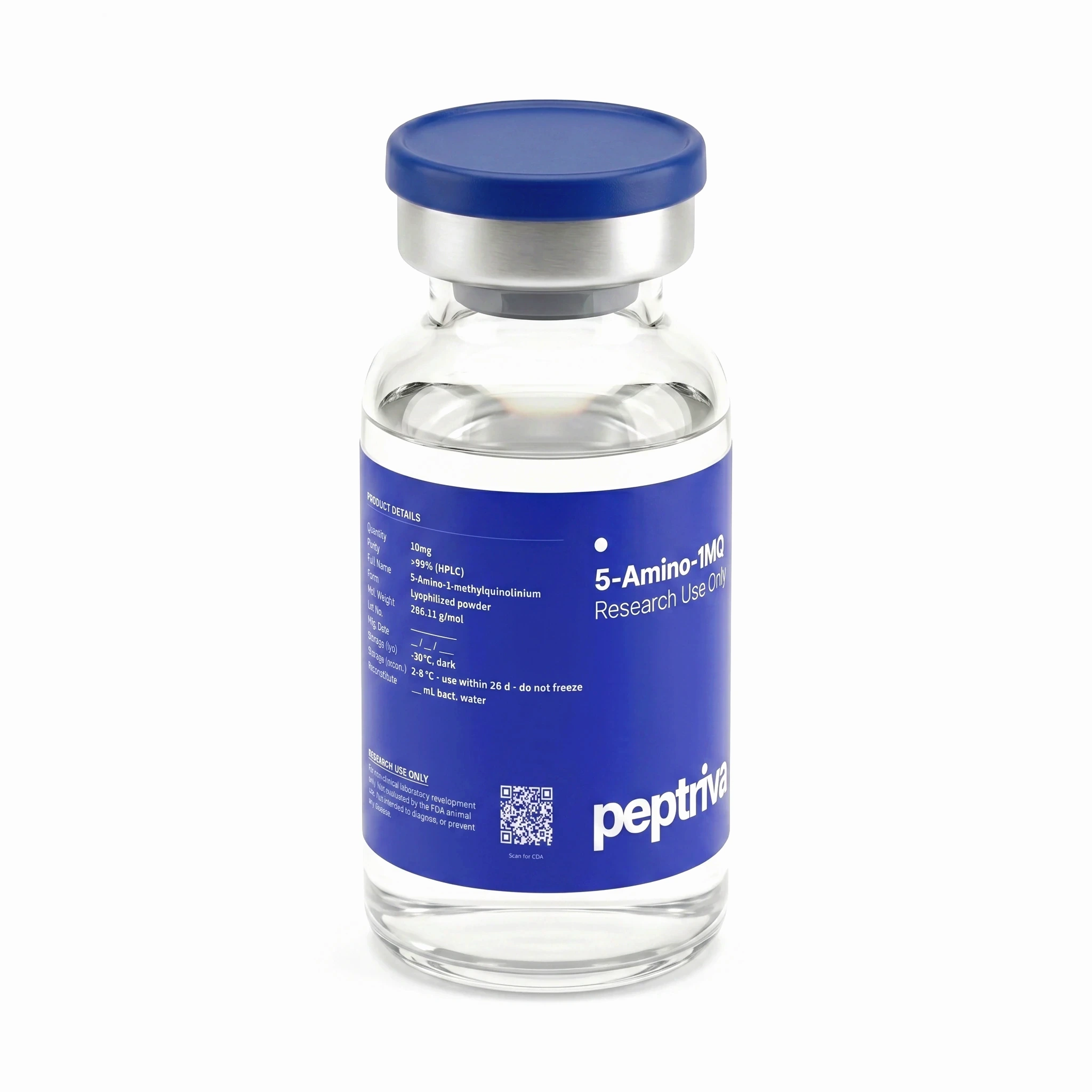
5-Amino-1MQ
The same compound cited across the NNMT mechanism and adipocyte energy-expenditure literature in this article. Lab-verified identity and purity of the membrane-permeable quinolinium NNMT inhibitor used in the Watowich-lab studies.
Why "small molecule" matters — it's not a peptide
5-Amino-1MQ is sold alongside peptides in research-chemical catalogs. It isn't one. The molecule is a small heterocyclic quinolinium — 159 g/mol, membrane-permeable, with pharmacokinetics fundamentally different from peptides. Peptides need parenteral administration to avoid being chewed up in the gut. Small molecules like 5-Amino-1MQ can be orally bioavailable and cost less to manufacture.
The compound was developed primarily by Watowich and colleagues at the University of Texas Medical Branch. Commercial development is at Ridgeline Therapeutics. We see it in peptide catalogs because of market-channel overlap, not chemical similarity. The biological target (NNMT) connects to the NAD+ pathway we discuss elsewhere in this series. But the compound itself is small-molecule pharmacology, not peptide pharmacology.
The methyl-pool model, plainly
SAM is the universal cellular methyl donor. It supplies methyl groups for hundreds of reactions: DNA methylation, histone methylation, neurotransmitter biosynthesis, phosphatidylcholine synthesis, creatine production. When SAM is abundant, those reactions run normally. When SAM is depleted, methylation-dependent pathways can stall.
NNMT consumes SAM at a rate proportional to its expression. In obesity and metabolic disease, NNMT is substantially upregulated across adipose tissue and skeletal muscle. At that elevated activity, the enzyme becomes a serious methyl-pool sink. Inhibiting NNMT preserves SAM for the methylation reactions that depend on it. That's the methyl-pool preservation model.
Here's a useful reframe. High-dose NMN/NR supplementation raises a related theoretical worry: more substrate through the pathway means more SAM consumed via NNMT. 5-Amino-1MQ blocks the consumption step and preserves SAM. So NNMT inhibition and NAD+ precursor supplementation are complementary, not competing. NMN/NR add substrate. 5-Amino-1MQ prevents that substrate from leaking out into the methylation sink.
The 2022 Dimet-Wiley Scientific Reports paper from the Watowich group tested this in diet-induced obesity. 5-Amino-1MQ combined with a low-fat diet produced "dramatic" reductions in adiposity that diet alone couldn't match in the same timeframe.
Reduced calorie diet combined with NNMT inhibition establishes a distinct microbiome in DIO mice. The combination normalized whole-body adiposity to age-matched lean controls within a timeframe that diet alone could not achieve.
— Dimet-Wiley et al., Scientific Reports, 2022
The adipocyte energy-expenditure data
The most-cited rationale for 5-Amino-1MQ in metabolic disease is its effect on adipocyte energy expenditure. NNMT is upregulated in adipose tissue in obesity. Blocking it in fat cells appears to raise metabolic activity. Part of that is NAD+/sirtuin activation. Part is methyl-pool effects on lipid metabolism. Part is changes in adipocyte browning markers.
The 2022 Dimet-Wiley study is the central reference. In diet-induced obese mice, low-fat diet plus 5-Amino-1MQ produced significant body-weight and adiposity reductions. It also produced a distinct cecal microbiome signature: decreased Erysipelatoclostridium, increased Lactobacillus. We find the microbiome shift mechanistically interesting. It suggests NNMT inhibition has effects beyond direct metabolic regulation — possibly through changes in nicotinamide and other metabolites that reach the gut.
What this data doesn't include is human trials. As of mid-2026, you'll find zero PubMed-indexed human trials of 5-Amino-1MQ for obesity, sarcopenia, or any metabolic indication. Every efficacy claim we've seen rests on rodent and cell-culture data. Ridgeline has signaled interest in clinical development. The published trial data isn't there yet.
How NNMT inhibition raises intracellular NAD+
The connection back to NAD+ runs through the salvage cycle. Most cellular NAD+ gets regenerated from nicotinamide via: nicotinamide → NMN (catalyzed by NAMPT) → NAD+ (catalyzed by NMNAT). When NNMT is active, nicotinamide gets methylated to MNA and is permanently lost. When NNMT is inhibited, nicotinamide stays in the salvage cycle and contributes to NAD+ maintenance.
This is the substrate-diversion mechanism behind the "NAD+ sparing" framing. The compound doesn't directly raise NAD+ synthesis. It prevents nicotinamide from being shunted out of the regeneration pathway. The downstream consequence — if cellular NAD+ is genuinely substrate-limited in the disease state being treated — would be higher steady-state NAD+ and higher sirtuin activity.
Whether NAD+ is the rate-limiting factor for sirtuin activity in any given context is an open question. Sirtuins have measurable Km values (the substrate concentration at which they hit half-maximum activity) within the physiological NAD+ range. So changes in NAD+ do translate into changes in sirtuin activity over that range. But the magnitude of any NAD+ rise from NNMT inhibition, and what that means for sirtuin activity in human tissues, hasn't been characterized in controlled trials.
The 2024 JITC bladder cancer signal
The most provocative recent finding for 5-Amino-1MQ comes from oncology, not metabolism. The 2024 Yang and colleagues paper in the Journal for ImmunoTherapy of Cancer showed that NNMT-expressing cancer-associated fibroblasts drive tumor progression and PD-L1 immunotherapy resistance in urothelial bladder cancer. The mechanism: recruitment of tumor-associated macrophages. 5-Amino-1MQ produced significant tumor-growth reduction in mouse models and enhanced anti-PD-L1 antibody efficacy. You should read this as preclinical, not clinical — but it's the strongest oncology signal in the NNMT-inhibitor space to date.
This is a different framing of the same NNMT biology. In oncology, the relevant mechanism isn't methyl-pool preservation or NAD+ salvage. It's interrupting tumor-stromal signaling that supports tumor growth and immune evasion. An NNMT inhibitor developed for metabolic indications showing activity in a tumor immunotherapy combination is the kind of cross-indication signal that occasionally drives expanded clinical development.
The 2021 Akar cervical cancer paper showed that a closely related compound (5-methylquinolinium) inhibited HeLa cervical cancer cell proliferation in a dose- and time-dependent manner. It raised apoptotic markers and reduced phospho-Akt and SIRT1 expression. Critically, it didn't affect HEK-293 cells (a normal kidney cell line). That selectivity for tumor cells over normal cells is the kind of preclinical signal that suggests druggability.
Where this falls short. The Watowich-lab adipocyte data is from one research group. Independent replication outside that lineage is sparse. Single-group findings always warrant a second look. No human trials means no human dose-response, no human safety data, and no characterization of theoretical drug interactions with NMN/NR, methyl donors (SAMe, methylfolate, B12), or oncology drugs. The cervical-cancer paper used 5-methylquinolinium, a related compound, not 5-Amino-1MQ itself. The "obesity peptide" marketing framing is a category error: this molecule isn't a peptide, and the human evidence for the obesity indication is essentially nil.
Where the evidence runs out
The mechanism is interesting. The preclinical data are consistent. The cross-indication signal in oncology is real. None of this fills the gap where human clinical trials should sit.
Here's where 5-Amino-1MQ stands in 2026:
- Mechanism is clean. Selective NNMT inhibition, well-characterized at the enzyme level.
- Preclinical biology is consistent. Watowich-group adipocyte data, multiple oncology papers, repeated rodent obesity findings.
- Zero human trials. No PubMed-indexed human trials for any indication, 2020 through 2026.
- Marketed alongside peptides incorrectly. It's a small-molecule research chemical. Different pharmacokinetics, different manufacturing.
- Drug interactions theoretically concerning. With NAD+ precursors (NMN, NR), one-carbon-metabolism agents (SAMe, methylfolate, B12), oncology drugs. None characterized in controlled studies.
- Regulatory status. Not FDA-approved. Not in active U.S. clinical trial registry. Not explicitly WADA-listed.
What this means for the product on the shelf
Here's the honest reading. 5-Amino-1MQ is a research-chemical tool compound with interesting preclinical biology and zero published human trials. The metabolic and oncology signals from rodent and cell-culture data are real and potentially translatable. "Potentially translatable" is the operative phrase.
We think the bladder-cancer paper points to where formal drug development might take this compound — through an oncology context with proper trials, not through a consumer-aesthetic-medicine context with no controlled evidence.
The mechanism summary, in one sentence. 5-Amino-1MQ blocks NNMT, preserves cellular SAM, frees nicotinamide for the NAD+ salvage pathway, and produces metabolic effects (adipocyte energy expenditure in DIO mice) and oncology effects (tumor-stromal NNMT disruption in bladder cancer) in preclinical models — with no published human trial data for any indication as of mid-2026.
5-Amino-1MQ
Small-molecule quinolinium NNMT inhibitor · 5-amino-1-methylquinolinium iodide. The same reference compound used across the cited Watowich-lab adipocyte studies and the 2024 JITC bladder-cancer mechanism paper. COA available with each lot.
How to read the 5-Amino-1MQ literature
Read the NNMT enzymology as solid biochemistry. The reaction, substrates, and pathway connections to methyl metabolism and NAD+ salvage are well-characterized. Read the Watowich-lab adipocyte data as the central preclinical story, with the caveat that single-group findings warrant independent replication. Read the 2024 JITC bladder-cancer paper as the most translationally interesting recent finding — oncology is where this compound has the highest chance of producing real clinical trial data. Read the "obesity peptide" marketing as a category error. It isn't a peptide. The human evidence for the obesity indication is essentially nil.
What to know now
- NNMT enzymology. Methylates nicotinamide using SAM as methyl donor. Produces MNA and SAH.
- Two-way mechanism. Inhibition preserves SAM (methyl pool) and frees nicotinamide (NAD+ salvage).
- Small molecule, not peptide. 159 g/mol quinolinium. Oral-bioavailability potential. Different pharmacokinetics and manufacturing than peptides.
- Adipocyte data. Watowich-lab DIO mouse studies show combination effects with low-fat diet.
- Bladder cancer signal. 2024 JITC paper shows enhanced anti-PD-L1 efficacy via tumor-stromal NNMT disruption.
- Zero human trials. No PubMed-indexed human studies for any indication as of mid-2026.
- Drug interactions theoretical. With NMN/NR, methyl donors, oncology drugs. None characterized in controlled studies.
What we're watching
Two mechanistic questions over the next 18 months. First. Whether Ridgeline Therapeutics (or another developer) advances an NNMT inhibitor into a registered human clinical trial. The mechanistic case is strong enough that a properly designed Phase I/IIa in metabolic disease or oncology would generate the human safety and pharmacokinetic data the consumer market is currently operating without. Second. Whether independent groups replicate the 2024 JITC bladder-cancer finding. The tumor-stromal NNMT signal is the most translationally interesting recent result. Replication across multiple cancer types would strengthen the case for oncology-focused development.
References
- Dimet-Wiley, A., Wu, Q., Wiley, J. T., et al. (2022). Reduced calorie diet combined with NNMT inhibition establishes a distinct microbiome in DIO mice. Scientific Reports, 12(1), 484. https://doi.org/10.1038/s41598-021-03670-5
- Yang, M., Wang, B., Hou, W., et al. (2024). NAD metabolism enzyme NNMT in cancer-associated fibroblasts drives tumor progression and resistance to immunotherapy by modulating macrophages in urothelial bladder cancer. Journal for ImmunoTherapy of Cancer, 12(7), e009281. https://doi.org/10.1136/jitc-2024-009281
- Akar, S., Duran, T., Azzawri, A. A., Koçak, N., Çelik, Ç., & Yıldırım, H. İ. (2021). Small molecule inhibitor of nicotinamide N-methyltransferase shows anti-proliferative activity in HeLa cells. Journal of Obstetrics and Gynaecology, 41(8), 1240–1245. https://doi.org/10.1080/01443615.2020.1854696
- Yi, L., Maier, A. B., Tao, R., et al. (2023). The efficacy and safety of β-nicotinamide mononucleotide (NMN) supplementation in healthy middle-aged adults: A randomized, multicenter, double-blind, placebo-controlled, parallel-group, dose-dependent clinical trial. GeroScience, 45(1), 29–43. https://doi.org/10.1007/s11357-022-00705-1
- Mavrych, V., Shypilova, I., & Bolgova, O. (2026). Therapeutic peptides in gerontology: Mechanisms and applications for healthy aging. Frontiers in Aging, 7, 1790247. https://doi.org/10.3389/fragi.2026.1790247
- Coutinho, L. F. D., De Oliveira Neves, L. F., & Camilo, R. P. (2026). A new era of doping? Use of peptide and peptide-analog drugs in recreational and professional sport and bodybuilding. Journal of Sports Medicine and Physical Fitness. https://doi.org/10.23736/S0022-4707.26.17773-1