The headline number on 5-Amino-1MQ fat-loss is zero: zero PubMed-indexed human trials, for any indication, in the 2020–2026 window. The marketing tells you it’s an “Ozempic alternative.” The data tells you it’s a mouse study.
5-Amino-1MQ isn’t a peptide. It’s a small molecule that blocks an enzyme called NNMT, sold by peptide vendors. The mechanism is real and interesting. The strongest finding is a 2022 mouse study that paired the drug with a low-fat diet and got dramatic fat loss. The catch: zero human trials exist. Tirzepatide and semaglutide delivered 20–25% weight loss in Phase III trials. As of 2026, 5-Amino-1MQ remains a preclinical research tool compound with no published human evidence base.
The grey-market peptide world occasionally picks up compounds that aren’t peptides. 5-Amino-1MQ is the textbook example. It’s a small molecule, not a peptide chain. It works by blocking an enzyme, not by activating a receptor.
The wrapper around it is the part you should notice. Vendors call it “the Ozempic alternative that works through your NAD pathway.” That framing’s designed to make the missing human trials feel less load-bearing than they are.
We’ll walk through what NNMT does, what the mouse data shows, why the mechanism’s interesting, and why the 2026 consumer claim isn’t supported by anything beyond animal extrapolation.
What is NNMT, and why would blocking it matter?
NNMT (nicotinamide N-methyltransferase) is a cell enzyme that takes two valuable molecules and burns them on a low-priority reaction. It consumes SAM (the cell’s main methyl donor) and nicotinamide (a building block for NAD⁺, the energy-shuttle molecule).
When NNMT is overactive, both SAM and NAD⁺ run low. That matters because both are doing important work elsewhere.
NNMT is dialed up in obesity, type 2 diabetes, sarcopenia, and many cancers. The hypothesis: overactive NNMT in fat tissue wastes SAM, wrecks NAD⁺ salvage, and degrades the cellular machinery for burning fat. Block NNMT, the thinking goes, and you restore that machinery.
The biology is real. SAM and NAD⁺ matter. NNMT is genuinely elevated in obese fat tissue. The open question: does blocking NNMT produce clinically meaningful fat loss in humans, or is it a target that’s tractable in a lab dish but doesn’t move the needle on body composition?
What does the mouse data actually show?
The most-cited paper is the 2022 Dimet-Wiley study from Stanley Watowich’s lab at the University of Texas Medical Branch, published in Scientific Reports.
The design: fat mice (the DIO model, or diet-induced obese C57BL/6) were split into four groups. One got 5-Amino-1MQ alone. One got a low-fat diet alone. One got both. One got nothing. The combination group produced “dramatic” fat loss, normalizing body composition to lean controls in a window that diet switch alone couldn’t match.
That’s a real finding and it lines up with the NNMT-inhibition theory. The combo group also shifted the gut microbiome (less Erysipelatoclostridium, more Lactobacillus), hinting that the effect isn’t purely fat-cell biology.
Here’s the detail the marketing skips. 5-Amino-1MQ alone didn’t normalize body fat. Only the combo with diet did. The headline effect depended on the diet half.
That matters when the consumer pitch is “take this and lose fat” rather than “take this while cutting calories.”
Combined treatment with 5-Amino-1MQ and a low-fat diet produced dramatic reductions in whole-body adiposity and weight in diet-induced obese mice, normalizing them to age-matched lean controls within a timeframe that low-fat-diet switch alone could not achieve.
— Dimet-Wiley et al., Scientific Reports, 2022 (paraphrased summary)
The 2024 oncology data lives in a different lane. A Chinese group showed that NNMT-expressing fibroblasts in bladder cancer drive tumor growth and resistance to PD-L1 immunotherapy. Blocking NNMT with 5-Amino-1MQ shrank tumors and made the immunotherapy work better. Interesting science. Not obesity data.
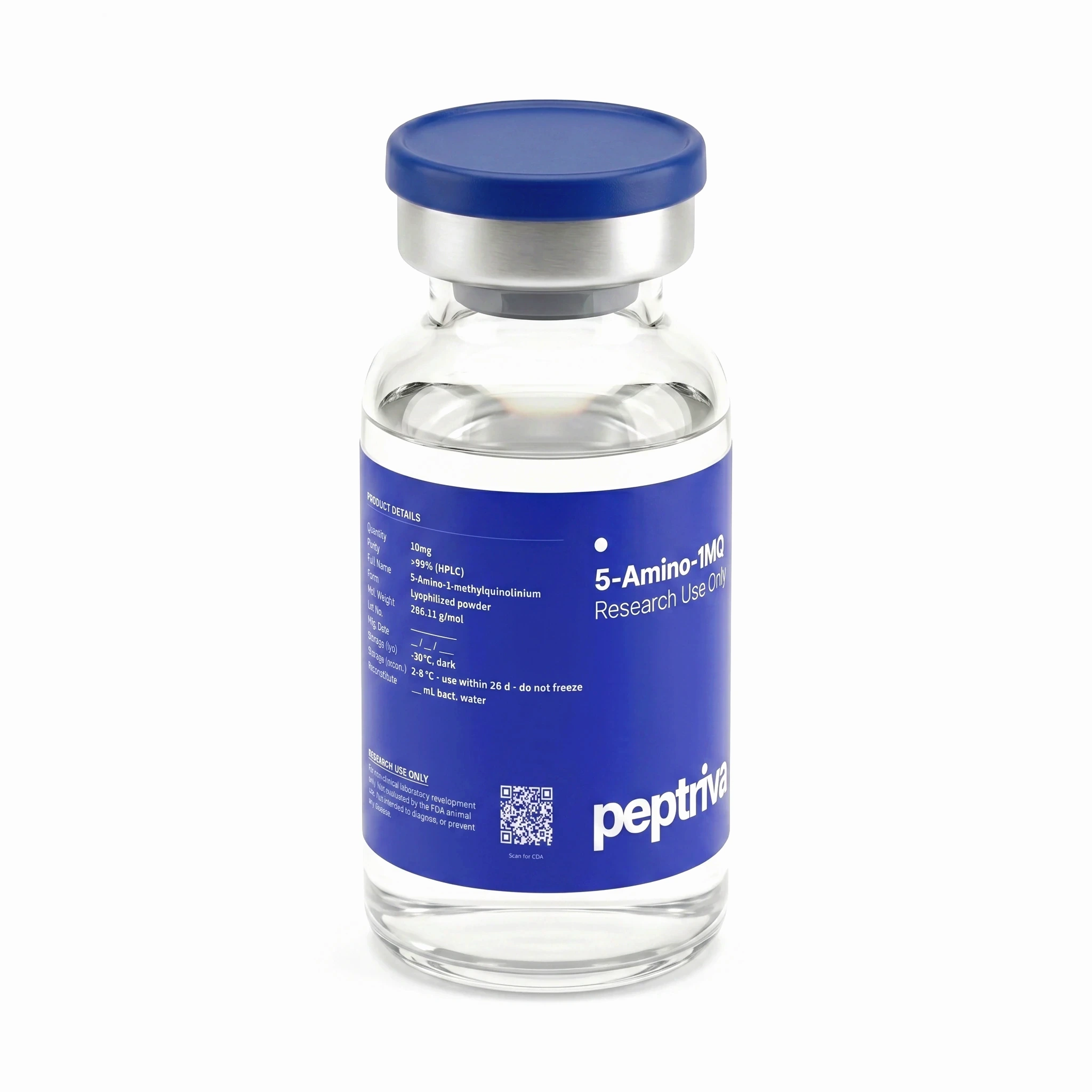
5-Amino-1MQ
The same compound cited across the rodent obesity and oncology studies in this review. Lab-verified identity and purity.
Where are the human trials?
This is the question the marketing avoids. As of mid-2026, you can search PubMed and find zero human trials of 5-Amino-1MQ for any indication. Not obesity. Not muscle loss. Not cancer.
Ridgeline Therapeutics, the company furthest along in NNMT-inhibitor development, has signaled clinical interest. Published trial data hasn’t appeared.
Where this falls short. The whole evidence base for 5-Amino-1MQ in obesity sits on rodent work. Tirzepatide and semaglutide have delivered 20–25% weight loss in Phase III trials with thousands of study participants and cardiovascular safety data. The “Ozempic alternative” comparison is asymmetric in a way that makes the framing itself misleading: a research-stage tool compound is being compared to drugs that have cleared four phases of clinical development.
The 2021 Akar study used a sibling compound (5MQ) on HeLa cancer cells. It killed tumor cells while sparing normal HEK-293 cells. Interesting selectivity. Still cell-line work. Still not human obesity data.
Why does the “Ozempic alternative” framing fail?
The grey-market story positions 5-Amino-1MQ as a cheap, peptide-free swap for GLP-1 drugs. The framing has four specific problems that any honest review surfaces.
- Mechanism mismatch. GLP-1 drugs work through gut hormones, satiety, slowed stomach emptying, and glucose-dependent insulin release. NNMT inhibition works through methyl donors, NAD⁺ salvage, and energy expenditure. Different strategies, different expected outcomes. The “alternative” framing implies equivalence that the biology doesn’t support.
- No validated human dose. The compound has not progressed through the pharmacokinetic and safety phases that produce a human clinical dose. Any dosing figures circulating in grey-market channels are extrapolated from rodent studies, not validated in human trials.
- Unknown oral bioavailability. 5-Amino-1MQ is a quinolinium salt. Its absorption, metabolism, and distribution in humans have not been published. Human tissue exposure levels remain uncharacterized.
- Unknown chronic-dosing safety. NNMT has normal physiological roles in methylation. Long-term blockade has never been tested in humans. The theoretical concerns about altered methylation aren’t trivial.
None of this means NNMT inhibition is fake or that 5-Amino-1MQ is fraudulent. The bladder-cancer immunotherapy paper is interesting translational science. An NNMT inhibitor will probably get approved for something eventually. The 2026 consumer purchase just isn’t that drug yet.
What about muscle preservation and sarcopenia?
The secondary claim is that 5-Amino-1MQ preserves muscle in aging populations. The mechanism is plausible. NNMT is elevated in atrophied muscle, and the SAM/NAD⁺ drain is consistent with sarcopenia’s metabolic profile.
The animal data here is thinner than the fat-loss data. Human evidence remains nil.
Research evaluating 5-Amino-1MQ on either fat-loss or muscle-preservation endpoints must contend with several open questions in the literature:
- No published human RCT for any indication. As of mid-2026, zero human trials of 5-Amino-1MQ have appeared in the indexed literature. That is the load-bearing evidentiary gap.
- No validated human pharmacokinetic or dosing data. The compound has not advanced to the dose-escalation phase required to establish a clinical dose in humans; extrapolations from rodent studies are unvalidated.
- No published human safety profile. Rodent tolerability data exists; human safety data does not. The distinction matters for chronic-exposure scenarios given NNMT’s physiological role in methylation.
- Evidence-based comparators are available. For obesity research, tirzepatide and semaglutide have Phase III RCT data at 20–25% weight-loss magnitudes; for sarcopenia research, resistance-exercise interventions have the strongest human evidence base.
5-Amino-1MQ
Membrane-permeable quinolinium · selective NNMT inhibitor. The same reference compound used across the cited preclinical obesity studies. COA available with each lot.
What does the mechanism actually predict?
If we take NNMT inhibition seriously and project to humans, the honest call is modest. Probably not the 20–25% magnitudes you see with incretin drugs.
The mechanism is upstream of energy expenditure rather than appetite. Historically, energy-expenditure drugs produce smaller effect sizes than appetite suppressants. And the mouse data already told us the big win came from the drug-plus-diet combo, not the drug alone.
That projection isn’t science fiction. NNMT inhibitors will probably enter the clinic in the next decade. The 2026 evidence picture is of a tool compound that has demonstrated preclinical proof-of-concept but has not yet advanced to human Phase I; Phase II readouts, if and when published, will meaningfully change the translational calculus.
What to know now
- Not a peptide: 5-Amino-1MQ is a small-molecule quinolinium, sold by peptide vendors but chemically distinct from peptides.
- Mechanism: NNMT inhibition, preserving SAM and NAD⁺ in adipose tissue and other NNMT-overactive tissues.
- Animal evidence: Watowich 2022 DIO mouse paper showed dramatic adiposity reductions with combined 5-Amino-1MQ + low-fat diet; monotherapy effect was smaller.
- Human evidence: zero published trials for any indication in the 2020–2026 window.
- Realistic projection: NNMT inhibition will likely produce modest metabolic benefits in selected populations, not GLP-1-class weight-loss magnitudes.
- Clinical comparators: FDA-approved tirzepatide and semaglutide have Phase III RCT evidence at 20–25% weight-loss magnitudes in human trials — a substantially larger evidence base than preclinical NNMT-inhibitor work.
What we’re watching
Three things over the next 24 months. First, whether Ridgeline or anyone else files an IND for a clinical NNMT-inhibitor trial. A first human Phase I would meaningfully change the evidence conversation. Second, whether the bladder-cancer immunotherapy work crosses into a Phase I/II oncology trial. That’s where human data may emerge first. Third, whether the FDA addresses grey-market sale of research-chemical NNMT inhibitors specifically.
References
- Dimet-Wiley, A., Wu, Q., Wiley, J. T., et al. (2022). Reduced calorie diet combined with NNMT inhibition establishes a distinct microbiome in DIO mice. Scientific Reports, 12(1), 484. https://doi.org/10.1038/s41598-021-03670-5
- Yang, M., Wang, B., Hou, W., et al. (2024). NAD metabolism enzyme NNMT in cancer-associated fibroblasts drives tumor progression and resistance to immunotherapy by modulating macrophages in urothelial bladder cancer. Journal for ImmunoTherapy of Cancer, 12(7), e009281. https://doi.org/10.1136/jitc-2024-009281
- Akar, S., Duran, T., Azzawri, A. A., et al. (2021). Small molecule inhibitor of nicotinamide N-methyltransferase shows anti-proliferative activity in HeLa cells. Journal of Obstetrics and Gynaecology, 41(8), 1240–1245. https://doi.org/10.1080/01443615.2020.1854696
- Jastreboff, A. M., Aronne, L. J., Ahmad, N. N., et al. (2022). Tirzepatide once weekly for the treatment of obesity. New England Journal of Medicine, 387(3), 205–216. https://doi.org/10.1056/NEJMoa2206038
- Mendias, C. L., & Awan, T. M. (2026). Safety and efficacy of approved and unapproved peptide therapies for musculoskeletal injuries and athletic performance. Sports Medicine. https://doi.org/10.1007/s40279-026-02437-0