The peer-reviewed TB-500 cardiac research isn't actually about TB-500. It's about the full Tβ4 molecule and a tiny piece of it called Ac-SDKP. That swap is the whole story.
Thymosin beta-4 (Tβ4) is a real molecule with real cardiac biology. The 2025 Zhang study in European Heart Journal showed Tβ4 sits downstream of a vascular-injury signal called CCN5. Its 4-amino-acid breakdown product Ac-SDKP heals damaged blood-vessel walls after stent placement. The 2021 Xing review mapped Tβ4 effects across heart, eye, liver, kidney, and gut models. The catch: zero human cardiac trials have used "TB-500" as sold in research-peptide channels. The heart biology belongs to the 43-amino-acid parent molecule, not the 7-amino-acid marketed fragment.
This article addresses the Tβ4 cardiac literature as it stands. The biology is genuinely interesting. It's also the most-cited preclinical area when TB-500 gets marketed for "recovery." The CCN5 / Ac-SDKP story, the post-heart-attack repair data, and the persistent confusion between Tβ4 (the real molecule in the papers) and TB-500 (the fragment sold in research channels) are each examined below.
What did the 2025 Zhang study actually find?
The Zhang study in European Heart Journal is the most mechanistically specific Tβ4 cardiovascular finding in years. The team identified Tβ4 as a downstream effector of CCN5. CCN5 is an injury-response signal in the vascular wall. When an enzyme called prolyl oligopeptidase clips Tβ4, it releases Ac-SDKP. That 4-amino-acid fragment engages the Cd9 pathway to regrow the endothelial layer (the inner skin of blood vessels) after stent damage.
The result in rodent and cell models: less neointimal hyperplasia (the scar tissue that re-narrows a vessel after stenting) and less restenosis (the vessel staying narrowed). If the biology translates, that's clinically useful. In-stent restenosis remains a real complication of percutaneous coronary intervention (PCI), even with modern drug-eluting stents. An injectable that speeds endothelial repair would have a defensible place in interventional cardiology.
This is a mechanism paper, not a clinical trial. But it's the kind of paper that points clearly toward what a human trial would look like.
CCN5 suppresses injury-induced vascular restenosis via thymosin β4 and the Cd9 pathway.
— Zhang et al., European Heart Journal, 2025 (preclinical models)
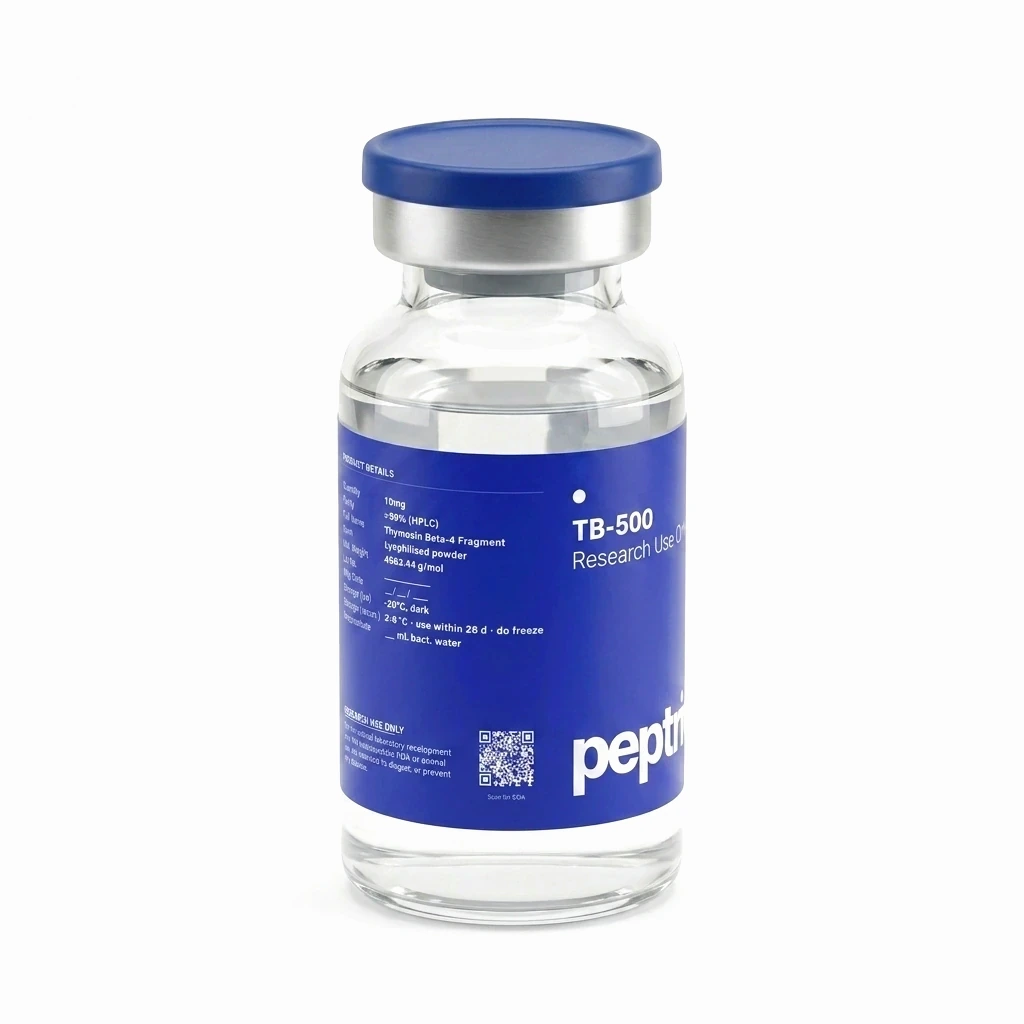
TB-500
The same reference compound cited across the 7 preclinical reviews in this article. Lab-verified identity and purity.
What about post-heart-attack repair?
The post-MI literature on Tβ4 is older and broader than the Zhang restenosis work. The 2021 Xing review in Frontiers in Endocrinology describes Tβ4 as a molecule with documented effects on cardiac repair, ischemia-reperfusion injury, and post-MI remodeling. The mechanism stacks several effects: G-actin sequestration (managing cellular scaffolding), angiogenesis (new blood vessels), anti-inflammatory cytokine modulation, and reduced cell death.
Rodent heart-attack models repeatedly show reduced scar size, improved left ventricular function, and higher capillary density when Tβ4 is given systemically or injected directly into the heart muscle. The most-cited early work appeared in the late 2000s and early 2010s, with the field continuing to mature through 2025.
Where this falls short: the studies use full-length recombinant Tβ4 or defined development candidates, not the heptapeptide fragment sold as TB-500 in research-chemical channels. The 2026 Mayfield review in American Journal of Sports Medicine explicitly treats "TB-4" and "TB-500" as related but distinct entities. The 2026 Mendias and Awan review in Sports Medicine draws the same line. A vial labeled TB-500 contains the heptapeptide fragment, not the full-length molecule the cardiac papers tested.
What does Tβ4 do in cardiac tissue?
The mechanism has several layers, each documented in recent peer-reviewed work:
- Endothelial repair via Ac-SDKP. The Zhang 2025 EHJ paper is the most specific finding — the Tβ4 cleavage product promoting re-endothelialization through Cd9.
- Angiogenesis and capillary density. Higher capillary density in post-MI rodent hearts is one of the most-replicated cardiac findings, driven by Tβ4's effects on G-actin dynamics and endothelial cell migration.
- Reduced cell death. Less cardiomyocyte apoptosis (programmed cell death) after ischemia-reperfusion in rodent models.
- Inflammation control. Reduced TNF-α and IL-6 in post-MI tissue, which feeds back into less scarring and remodeling.
- Mitochondrial transfer. A 2025 study in Free Radical Biology and Medicine showed Tβ4 helps stem cells pass healthy mitochondria to damaged neighbors via tunneling nanotubes — relevant to post-ischemic cardiac repair.
The honest reading: Tβ4's cardiac biology is more mechanistically specific than BPC-157's, more reproducible across independent labs, and more closely tied to a defined clinical target (post-PCI restenosis) than the orthopedic angle of either peptide. It's genuinely interesting cardiovascular biology.
Where is the human evidence?
Tβ4 has been a clinical-development candidate in cardiac and eye indications for two decades. Programs in dry eye and neurotrophic keratitis have advanced furthest. The 2024 Quagliata patent-landscape review notes that thymalfasin (Zadaxin), a thymosin alpha-1 product distinct from Tβ4, is the only FDA-approved thymosin drug. No Tβ4 product is FDA-approved for any indication as of mid-2026.
For "TB-500" specifically — the heptapeptide marketed for athletic recovery and cardiac performance — there are zero published human cardiac trials. None. The cardiac biology from the published literature doesn't transfer to TB-500 without its own evidence base, and that evidence base doesn't exist.
TB-4 and its derivative TB-500 promoted angiogenesis and tissue repair in preclinical models, but human orthopaedic data are lacking, and both remain banned substances in sports.
— Mayfield et al., American Journal of Sports Medicine, 2026
Interpreting a "thymosin beta-4 cardiac study": three critical distinctions
When evaluating a marketing claim that cites a thymosin beta-4 cardiac study, three questions determine whether the cited evidence actually supports the claim:
- Which molecule was used? Full-length Tβ4 or the heptapeptide TB-500 fragment?
- What was the administration route? Systemic IV in cardiac trial contexts versus subcutaneous routes studied in athletic-context channels?
- What outcome was measured? Re-endothelialization or capillary density in preclinical models versus subjective performance claims in marketing?
The Zhang 2025 paper used full-length Tβ4 and the Ac-SDKP fragment, in vascular-injury rodent models, with re-endothelialization as the outcome. None of those design choices match the marketed TB-500 context. The biology is real. The leap from rodent endothelial repair to "TB-500 for athlete recovery" is what lacks published evidence.
The cardiac summary in one sentence: Tβ4 cardiac biology is genuinely interesting and the 2025 Zhang EHJ paper is the most mechanistically specific finding in years — and none of it transfers to "TB-500" as marketed, because no human trial of the marketed product exists.
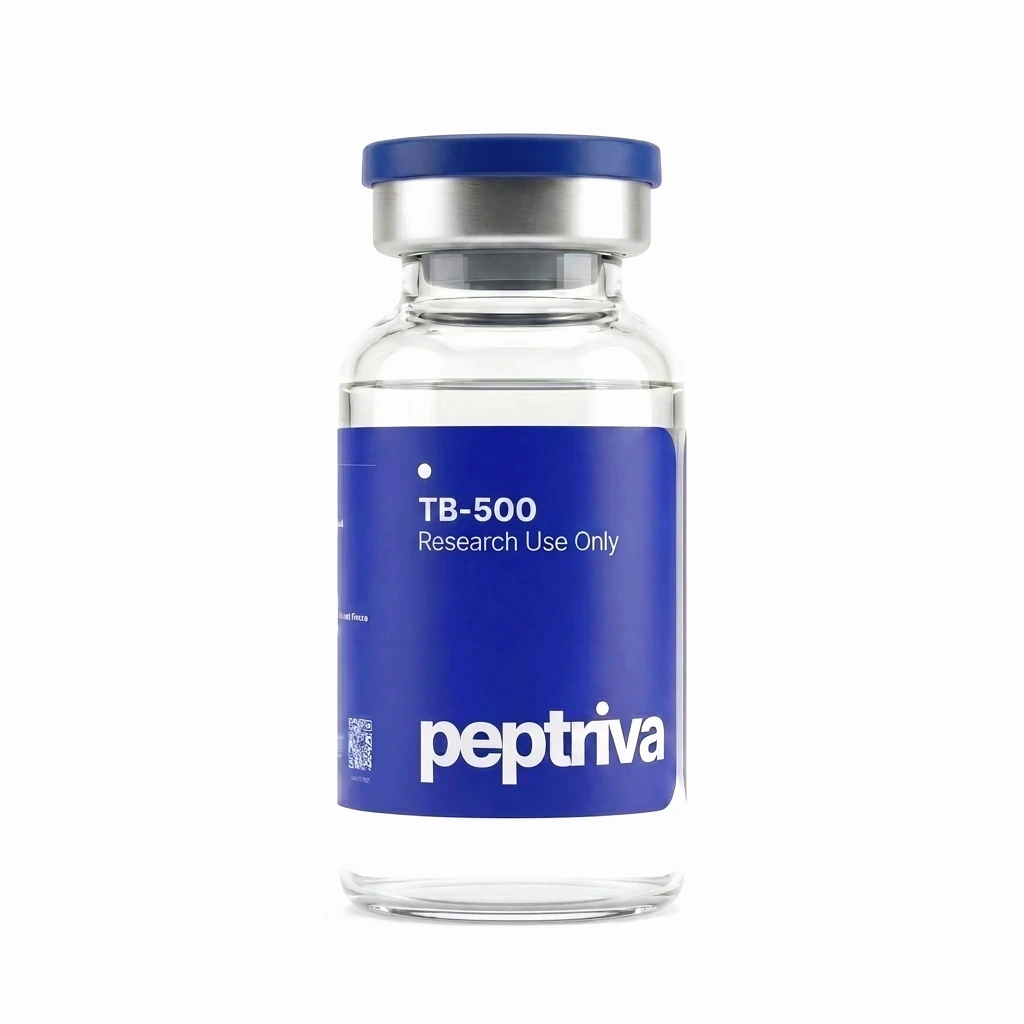
TB-500
Ac-LKKTETQ heptapeptide · Tβ4 active fragment. The same reference compound used in research contexts referencing the cited preclinical Tβ4 cardiac literature. COA available with each lot.
What about kidney and eye biology?
Tβ4's cardiac relevance overlaps with its kidney and eye biology. The same anti-inflammatory and endothelial-repair mechanisms that operate in heart tissue have been documented in the glomerulus and cornea in preclinical models. A 2023 Mason and Vasilopoulou review in International Journal of Molecular Sciences describes anti-inflammatory effects of both endogenous and exogenous Tβ4 in glomerular disease models, with potential relevance to chronic kidney disease research. A 2025 Chen paper in Signal Transduction and Targeted Therapy showed combined mesenchymal stem cell plus Tβ4 therapy beat either alone in a rodent dry eye model.
These adjacent indications matter because they suggest the biology is broader and more reproducible than the cardiac story alone would imply. Multiple independent groups, across multiple tissue types, are documenting similar anti-inflammatory and pro-repair effects. That breadth gives the cardiac mechanism more credibility than it would have in isolation.
What to know now
- The 2025 Zhang EHJ study: CCN5 / Tβ4 / Ac-SDKP / Cd9 pathway in vascular restenosis. The most mechanistically specific recent Tβ4 cardiovascular finding.
- Post-MI: reduced scar size, improved LV function, increased capillary density in rodent MI models. Replicated across multiple groups.
- Adjacent biology: renal (Mason & Vasilopoulou 2023), ophthalmologic (Chen et al. 2025), mitochondrial transfer (Zhang et al. 2025) — consistent anti-inflammatory and pro-repair signal across tissue types.
- Human cardiac trials of TB-500: zero. Tβ4 development candidates exist in other indications; the heptapeptide marketed as TB-500 has no human cardiac trial.
- Conflation problem: 2026 sports-medicine reviews (Mayfield AJSM, Mendias Sports Medicine) explicitly distinguish Tβ4 from TB-500. The biology and the product are not the same thing.
- Regulatory: No Tβ4 or TB-500 product FDA-approved. WADA S2. Standard anti-doping panels test for both forms.
What we're watching
Two things over the next 18 months. First, whether the CCN5 / Ac-SDKP pathway from the Zhang 2025 EHJ paper converts into a registered Phase II in post-PCI restenosis — that would be the natural first formal human cardiac test of Tβ4. Second, whether the Tβ4 vs TB-500 distinction is drawn more sharply by regulators and review articles — the conflation is the single biggest interpretive problem in this corner of the literature.
References
- Zhang, Q., Li, H., Zhuang, T., et al. (2025). CCN5 suppresses injury-induced vascular restenosis via thymosin β4 and Cd9 pathway. European Heart Journal, 46(17), 1645–1658. https://doi.org/10.1093/eurheartj/ehae911
- Xing, Y., Ye, Y., Zuo, H., & Li, Y. (2021). Progress on the function and application of thymosin β4. Frontiers in Endocrinology, 12, 767785. https://doi.org/10.3389/fendo.2021.767785
- Ying, Y., Lin, C., Tao, N., et al. (2023). Thymosin β4 and actin: Binding modes, biological functions and clinical applications. Current Protein and Peptide Science, 24(1), 78–88. https://doi.org/10.2174/1389203724666221201093500
- Mayfield, C. K., Bolia, I. K., Feingold, C. L., et al. (2026). Injectable peptide therapy: A primer for orthopaedic and sports medicine physicians. American Journal of Sports Medicine, 54(1), 223–229. https://doi.org/10.1177/03635465251357593
- Mendias, C. L., & Awan, T. M. (2026). Safety and efficacy of approved and unapproved peptide therapies for musculoskeletal injuries and athletic performance. Sports Medicine. https://doi.org/10.1007/s40279-026-02437-0
- Mason, W. J., & Vasilopoulou, E. (2023). The pathophysiological role of thymosin β4 in the kidney glomerulus. International Journal of Molecular Sciences, 24(9), 7684. https://doi.org/10.3390/ijms24097684
- Chen, X., Zhang, C., Peng, F., et al. (2025). Identification of glutamine as a potential therapeutic target in dry eye disease. Signal Transduction and Targeted Therapy, 10(1), 27. https://doi.org/10.1038/s41392-024-02119-1
- Zhang, X., Lin, Y., Li, H., Wang, Q., & Mu, D. (2025). Enhancing fat graft survival: Thymosin beta-4 facilitates mitochondrial transfer from ADSCs via tunneling nanotubes. Free Radical Biology and Medicine, 228, 281–298. https://doi.org/10.1016/j.freeradbiomed.2024.12.061