The TB-500 mechanism of action starts with one of the cleanest molecular interactions in peptide biology. The parent peptide, thymosin β4, binds a specific cellular protein (G-actin) at a strict 1-to-1 ratio. The binding site is a 7-amino-acid stretch called LKKTETQ. That's the simple story. The complicated story is whether a given vial of marketed TB-500 actually contains the molecule the research papers describe.
TB-500's mechanism is the best-characterized of any tissue-repair peptide we cover. The parent molecule binds G-actin (the building block of cellular skeleton fibers) at a 1-to-1 ratio. That binding controls how cells move and migrate. The peptide also gets cleaved into a smaller fragment (Ac-SDKP) that does separate work on blood-vessel repair. The hard truth: zero human RCTs have tested TB-500 for athletic recovery, and the 2026 Sports Medicine review notes that "TB-500" sold from research-chemical channels may contain the full peptide, just the active fragment, or something else entirely.
This article walks through the actin-binding biology in plain language, then addresses the product-quality problem. The sections below cover the G-actin binding, the cell-migration effect, the Ac-SDKP cleavage arm, and the question of what identity a given TB-500 vial may contain.
The 1-to-1 G-actin binding: the cleanest mechanism we cover
Start with one fact about cell biology. Inside every cell, there is a protein called actin. Loose actin molecules are called G-actin (G for globular). When G-actin molecules link up into a long filament, the result is F-actin (F for filamentous). Cells use F-actin filaments as their skeleton and as the motors that let them crawl, divide, and reshape themselves.
Thymosin β4 (Tβ4) is the dominant regulator of how much free G-actin is available to form new filaments. The 2023 Ying paper in Current Protein and Peptide Science describes the mechanism: Tβ4 binds G-actin one-to-one, locks it up, and controls how much is available for filament assembly.
The scale matters. Tβ4 makes up roughly 70–80% of all β-thymosins in mammalian cells. It is the master controller for actin availability. Most of the effects studied for TB-500 (wound healing, angiogenesis, cardiac repair) trace back to this single binding interaction and the downstream cell-migration consequences.
Inside the full-length Tβ4 molecule (which is 43 amino acids long), the actin-binding action lives in a specific 7-amino-acid stretch called LKKTETQ. That short sequence is what the research-peptide market typically sells as "TB-500." The 2026 Sports Medicine review by Mendias and Awan explicitly separates Tβ4 (the full 43-amino-acid parent) from TB-500 (a fragment of it). That distinction will become important in a few paragraphs.
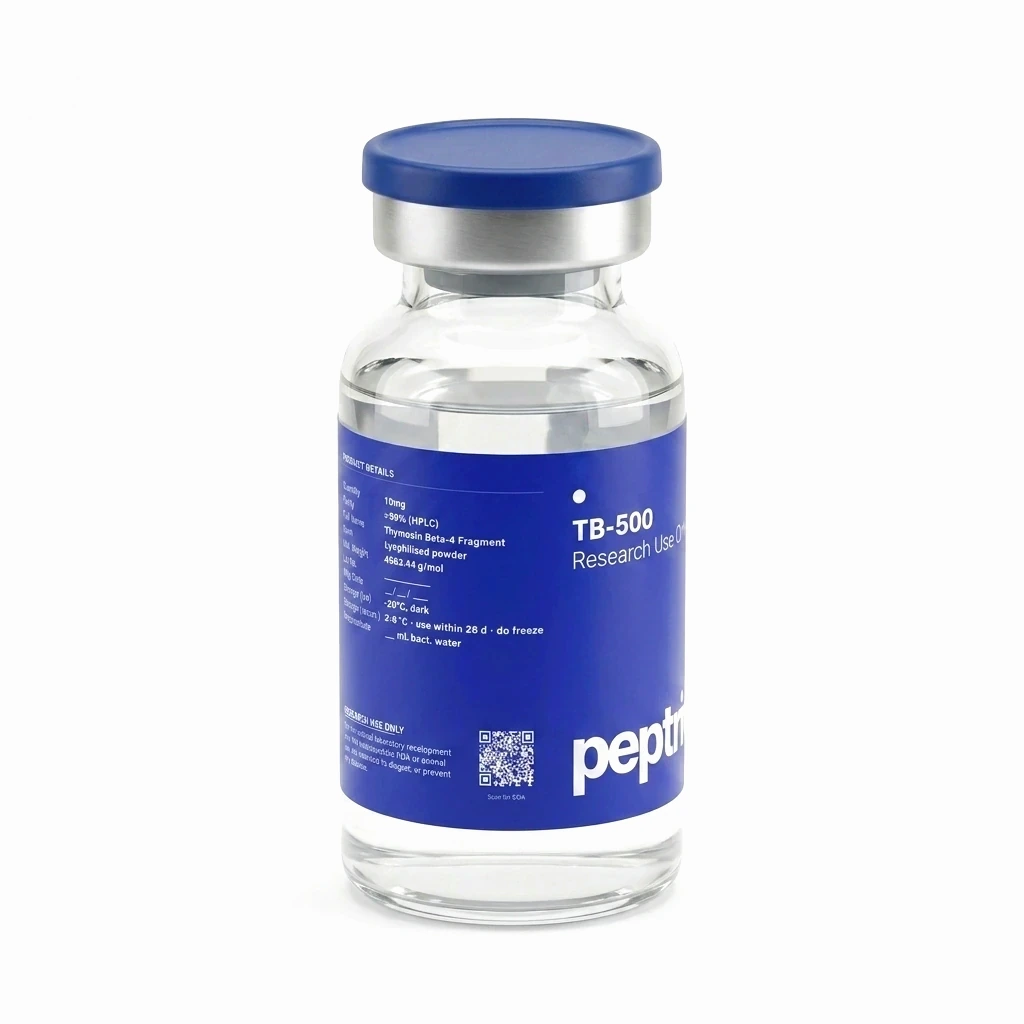
TB-500
The same compound cited across the actin-binding mechanism reviews in this article. Lab-verified identity and purity, with the heptapeptide active sequence confirmed by HPLC.
F-actin treadmilling: how this turns into cell movement
Here's the next link in the chain. F-actin filaments don't just sit there. They constantly grow at one end and shrink at the other. The technical term is treadmilling. The rate of treadmilling depends on how much free G-actin is around to add to the growing end.
When Tβ4 locks up G-actin, fewer monomers are available, and treadmilling slows. When Tβ4 releases G-actin, more is available, and treadmilling speeds up. Tβ4 is the cellular tap that controls actin-flow rate.
Why does that produce wound healing? Because moving cells need to keep building and tearing down actin filaments at high speed. Skin cells crawling into a wound, endothelial cells re-lining a damaged blood vessel, fibroblasts laying down new connective tissue — they all need fast, coordinated actin turnover. A peptide that tunes that turnover tunes the speed at which cells repair.
The 2021 Xing review in Frontiers in Endocrinology catalogs this same chain operating across heart, eye, liver, kidney, and gut tissue. Same binding biology, same migration consequences, different tissues. Whether that maps to athletic tendon or muscle recovery in humans is the open question. The cellular biology is solid.
Ac-SDKP: the second mechanism nobody markets
The mechanism gets more interesting when considering what happens to Tβ4 after enzymatic cleavage in vivo. The N-terminal end of Tβ4 is cleaved to produce a separate, very small peptide called Ac-SDKP (acetyl-Ser-Asp-Lys-Pro). It is just 4 amino acids, with its own biological activity.
The 2025 Zhang paper in European Heart Journal tracked Ac-SDKP through a vascular-injury model. The result: Ac-SDKP promoted endothelial repair and reduced in-stent restenosis (re-narrowing) in rats. That's a top-tier cardiology journal, a defined signaling pathway (CCN5 to Tβ4 to Ac-SDKP to CD9), and a clinically translatable outcome.
CCN5 suppresses injury-induced vascular restenosis via thymosin β4 and the Cd9 pathway. The Ac-SDKP cleavage product is the downstream effector for endothelial repair.
— Zhang et al., European Heart Journal, 2025
Here's the bombshell. The actin-binding LKKTETQ fragment, the 7-amino-acid stretch most "TB-500" products contain, does NOT contain the SDKP sequence. So a buyer who gets a pure LKKTETQ fragment gets the actin-binding mechanism. They do NOT get the Ac-SDKP endothelial-repair mechanism. Those require the full-length Tβ4 to be present and then cleaved. That's two different drugs, with different effects, often sold under the same name.
The "what's actually in the vial" problem
The mechanism story for thymosin β4 is well-characterized. The product-identity story for marketed TB-500 is not. Depending on the supplier, a researcher may receive any one of four different entities.
What "TB-500" can mean, depending on supplier:
- Full-length Tβ4 (43 amino acids): the parent peptide with both actin-binding and Ac-SDKP-generating activity. This is the molecule legitimate Phase II ophthalmology trials use.
- LKKTETQ active fragment (7 amino acids): the short synthetic peptide that contains the actin-binding motif but can't be cleaved to Ac-SDKP. The cheapest to synthesize, so the most commonly sold.
- Longer N-terminal fragment: some suppliers offer fragments that include the SDKP sequence but not the full actin-binding region. Intermediate activity, intermediate price.
- Mislabeled or low-purity product: a documented hazard across the unregulated research-chemical market.
This is the gap between "thymosin β4 has well-characterized biology" and "a marketed TB-500 vial will replicate the effects described in the papers." The molecule the research papers studied and the product available from research-chemical suppliers are not always the same thing.
Other documented effects: inflammation, angiogenesis, immune signaling
Beyond actin binding and Ac-SDKP, the Tβ4 literature catalogs a third tier of effects. We'll keep this short, because they all trace back to the cell-migration and signaling work above.
The 2025 Li paper in Journal of Allergy and Clinical Immunology showed Tβ4 made by certain lung immune cells dampens allergic airway inflammation by blocking IL-4 and IL-13 signaling. The 2024 Zhang paper in Nature Neuroscience identified Tβ4 as one of the peptides released during mouse brain development.
The honest read: a single peptide turning up in immune signaling, neurodevelopment, and tissue repair either reflects genuinely broad biology, or it reflects how many labs have studied the same molecule in different contexts. Both explanations are possible. The cleanest mechanism we can defend is the actin-binding one. The rest hangs off it or runs in parallel.
Product-identity implications for TB-500 research use
The 2024 American Journal of Sports Medicine review by Mayfield treated Tβ4 and TB-500 as related but distinct entities. Their conclusion: both promoted tissue repair in preclinical models, but human orthopedic data are lacking and both are banned in competitive sport.
The 2021 Lee and Padgett case series in study participants presenting with knee pain included four subjects who received combination BPC-157 plus TB-500 injections. The study had no controls and no way to isolate TB-500 effects. As of mid-2026, that case series is the only human exposure data we have in the published literature for the marketed product.
Where this falls short. The mechanism story for thymosin β4 is one of the best-characterized in peptide biology, but the marketed TB-500 product is not the same entity. Most marketed TB-500 is the 7-amino-acid LKKTETQ fragment, which retains actin binding but lacks the Ac-SDKP arm. There are zero published human RCTs of TB-500 for athletic recovery. The single human case series co-administered BPC-157, precluding isolation of TB-500 effects. WADA prohibits it. Studies of the full-length Tβ4 parent peptide do not automatically apply to a 7-amino-acid fragment product.
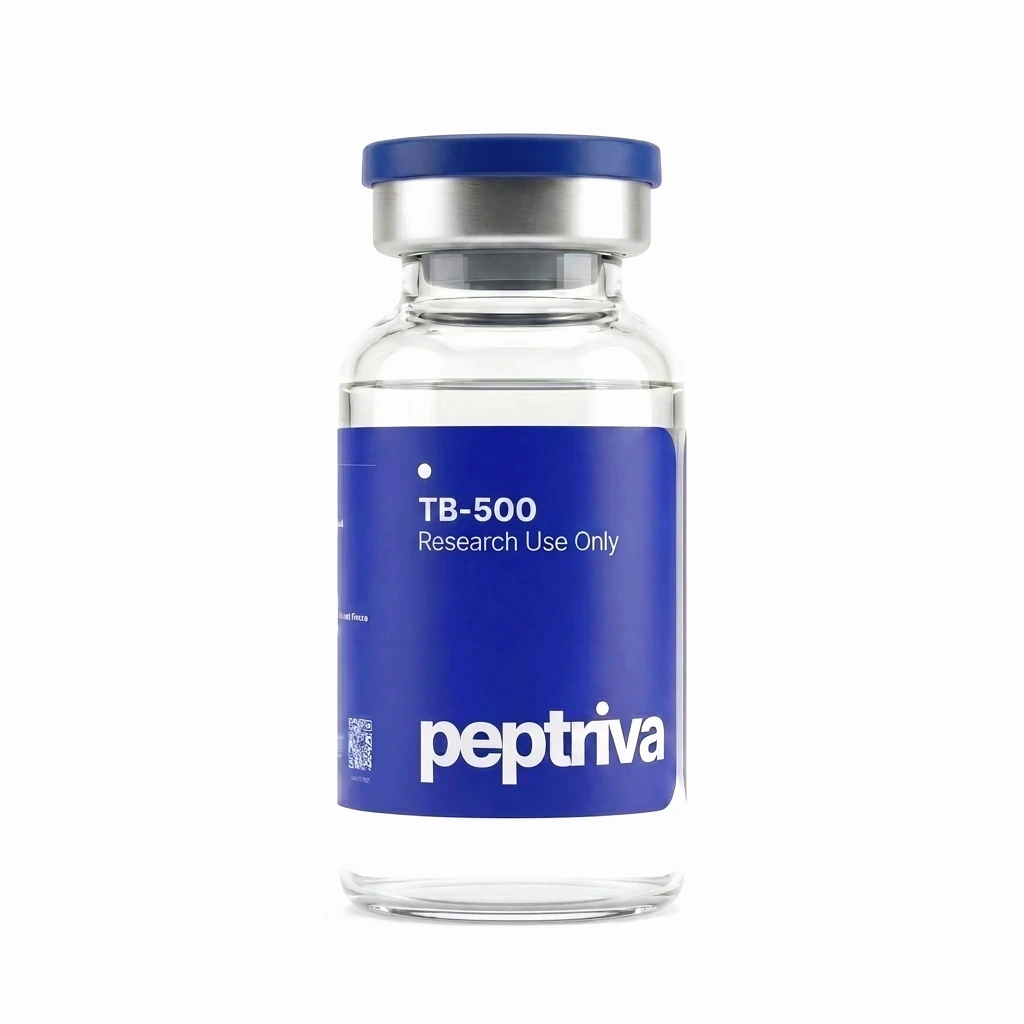
TB-500
Ac-LKKTETQ heptapeptide · the seven-residue active core of thymosin β4. The same reference compound used across the cited mechanistic studies. COA available with each lot.
Interpreting the TB-500 literature
Papers on Tβ4 (the parent peptide) represent well-characterized molecular biology. The G-actin binding is documented across multiple independent groups. The downstream cell-migration biology is consistent. The Ac-SDKP cleavage arm has been published in top-tier journals.
Papers labeled "TB-500" require a prior question: which fragment did the authors actually use? If the study used full-length Tβ4, the mechanism includes both arms. If the study used LKKTETQ, the mechanism is actin-binding only. Vendors who sell "TB-500" without specifying the molecular identity of their product leave that question unresolved for the researcher.
Practically: a vial labeled "TB-500" without a Certificate of Analysis confirming full-length Tβ4 should be assumed to contain the LKKTETQ fragment. Studies using that fragment report actin-binding activity; the endothelial-repair mechanism documented in the cardiology literature requires the full-length parent peptide.
What to know now
- 1-to-1 G-actin binding: the central biochemistry. Lives in a 7-amino-acid active core called LKKTETQ.
- Actin filament dynamics: the downstream effect. Slows or speeds the build-and-tear-down cycle that lets cells crawl.
- Ac-SDKP cleavage product: a second mechanism in full-length Tβ4 only. Drives endothelial repair via CCN5 / CD9 signaling.
- Vial identity: marketed TB-500 may contain full-length Tβ4, the 7-amino-acid fragment, a longer N-terminal piece, or mislabeled product. The mechanism implications differ for each form.
- Zero human RCTs: no published randomized trials of TB-500 for orthopedic or sports indications. The only case series mixed it with BPC-157.
- WADA banned: on the prohibited list and reliably detected by accredited labs.
What we're watching
Two questions over the next 18 months. First, will the legitimate full-length Tβ4 trials in ophthalmology and cardiology produce the kind of pharmacokinetic and efficacy data we'd need to separate parent-peptide effects from fragment effects? Second, will any independent group test what's actually in marketed TB-500 products? The product-quality question is the one that matters most to buyers, and nobody has run that audit yet.
References
- Ying, Y., Lin, C., Tao, N., et al. (2023). Thymosin β4 and actin: Binding modes, biological functions and clinical applications. Current Protein & Peptide Science, 24(1), 78–88. https://doi.org/10.2174/1389203724666221201093500
- Xing, Y., Ye, Y., Zuo, H., & Li, Y. (2021). Progress on the function and application of thymosin β4. Frontiers in Endocrinology, 12, 767785. https://doi.org/10.3389/fendo.2021.767785
- Zhang, Q., Li, H., Zhuang, T., et al. (2025). CCN5 suppresses injury-induced vascular restenosis via thymosin β4 and Cd9 pathway. European Heart Journal, 46(17), 1645–1658. https://doi.org/10.1093/eurheartj/ehae911
- Li, Y., Chen, Z., Han, M., et al. (2025). Plasmacytoid dendritic cells alleviate allergic asthma via airway epithelial cell-dependent thymosin β4 expression. Journal of Allergy and Clinical Immunology, 156(1), 171–185. https://doi.org/10.1016/j.jaci.2025.01.047
- Zhang, T., Ai, D., Wei, P., et al. (2024). The subcommissural organ regulates brain development via secreted peptides. Nature Neuroscience, 27(6), 1103–1115. https://doi.org/10.1038/s41593-024-01639-x
- Mendias, C. L., & Awan, T. M. (2026). Safety and efficacy of approved and unapproved peptide therapies for musculoskeletal injuries and athletic performance. Sports Medicine. https://doi.org/10.1007/s40279-026-02437-0
- Mayfield, C. K., Bolia, I. K., Feingold, C. L., et al. (2026). Injectable peptide therapy: A primer for orthopaedic and sports medicine physicians. American Journal of Sports Medicine, 54(1), 223–229. https://doi.org/10.1177/03635465251357593
- Lee, E., & Padgett, B. (2021). Intra-articular injection of BPC 157 for multiple types of knee pain. Alternative Therapies in Health and Medicine, 27(4), 8–13. PMID 34324435