Peptide prices look chaotic from the outside. One vendor lists BPC-157 at $55, another at $90, a third at $19. Tirzepatide runs $180 to $400 at reputable suppliers. GHK-Cu sells in 50 mg vials for less than a 5 mg vial of MOTS-c. We’ll cover the four synthesis variables that explain almost all of it, and why prices below the floor are a question rather than a bargain.
Four levers drive peptide pricing: sequence length (each amino acid is one more synthesis cycle), chemical modifications (lipidation, D-amino acids, PEGylation), purification rigor (99% vs 95% can double column time), and documentation overhead (ISO 17025 testing runs $150–$400 per lot). Class median in 2026: cosmetic $0.50–$2/mg, cognitive $3–$8/mg, tissue repair $5–$10/mg, GH-axis $5–$25/mg, mitochondrial $5–$30/mg, GLP-1 $40–$80/mg. Any 10 mg vial under $30 has almost certainly cut corners on purification, testing, or both.
Quick answer: Research peptide prices reflect synthesis complexity. Short tripeptides like GHK-Cu cost under $2/mg. 15-residue compounds like BPC-157 cost $5–$10/mg. 39-residue lipidated GLP-1 analogs like tirzepatide cost $40–$80/mg. A 4-week BPC-157 study supply runs $50–$100. An 8-week tirzepatide study supply (mirroring SURMOUNT-1 quantities) runs $1,000–$2,000. Prices well below class median almost always mean the supplier skipped purification (purity under 90%) or third-party testing, not that they discovered a synthesis miracle.
This article is the cost-math companion to our buyer’s guide. That piece answers “how do I evaluate a vendor.” This one answers “how do I evaluate a price.” The same documentation chain that proves a peptide is what the label claims is the cost the vendor has to recover in the per-vial price.
The four levers that drive peptide pricing
Almost all the variance in peptide retail prices traces to four variables, every one rooted in how the molecule is physically built. None of them are marketing decisions. They’re consequences of the chemistry described in the industrial SPPS literature (Verlander, 2007).
1. Sequence length — each amino acid is one more cycle
Solid-phase peptide synthesis (SPPS) builds a peptide one residue at a time on a polystyrene bead. Each cycle deprotects, couples a new amino acid, and washes. GHK-Cu needs 3 cycles. BPC-157 needs 15. Tirzepatide needs 39.
Each cycle hits roughly 98–99.5% coupling efficiency. A 5-residue peptide retains about 95% of starting material. A 40-residue peptide at the same per-cycle efficiency keeps only 67%. The longer peptide isn’t just 8× the cycles. It’s a messier crude mixture that costs more HPLC time to clean up. That’s why a tetrapeptide and a 40-residue compound show roughly an order-of-magnitude price gap per mg.
2. Chemical modifications — specialty chemistry adds specialty cost
Standard SPPS handles the 20 normal L-amino acids efficiently. Anything beyond that costs more:
- D-amino acids. SS-31 contains D-arginine. D-residues provide protease resistance but cost 3–10× the equivalent L-residue.
- Lipidation. Tirzepatide has a fatty-acid side chain at lysine-20; retatrutide has a similar long-chain modification. These enable once-weekly dosing through albumin binding but add on-resin acylation and extra purification.
- PEGylation. PEG attachment extends half-life but requires conjugation chemistry and characterization separate from the synthesis itself.
- Unnatural residues. Aib (aminoisobutyric acid) appears in semaglutide for protease resistance. Non-canonical amino acids cost more than the natural set.
- Cyclization. Disulfide bridges, head-to-tail cyclization, or side-chain stapling all add steps after the linear sequence is built.
Tesamorelin is the textbook case. The 44-residue GHRH(1-44) backbone is long but standard SPPS handles it. The N-terminal trans-3-hexenoyl modification is what turns it into tesamorelin (rather than sermorelin), and what makes it meaningfully more expensive per mg.
3. Purification rigor — 95% vs 99% is mostly column time
The 2026 working standard for research-grade peptide purity is ≥98% HPLC. Leading suppliers reach 99%+ (Verlander, 2007). Tightening the preparative HPLC collection window from 95% to 99% means rejecting more borderline fractions and cutting yield by 10–30%. Cost-per-mg goes up accordingly.
This is the lever behind most price gaps between vendors selling “the same” peptide. Two suppliers can buy crude peptide from the same contract manufacturer. One purifies to 95% and sells for $30. The other purifies to 99% with a documented chromatogram and sells for $75. The synthesis source is identical. The purification depth differs. The cheaper vial isn’t actually the same product. It has a different impurity profile.
4. Documentation overhead — third-party testing is a real cost
A research-grade CoA from an ISO/IEC 17025–accredited third-party lab costs the supplier $150–$400 per lot for HPLC + mass-spec identity + water content. Bacterial endotoxin testing (USP <85> LAL) adds another $80–$200 per lot when included. Storage stability data, serialized lot traceability, and the quality system to maintain all of this are ongoing costs. Small at the per-vial level, but real. And zero for vendors who skip them.
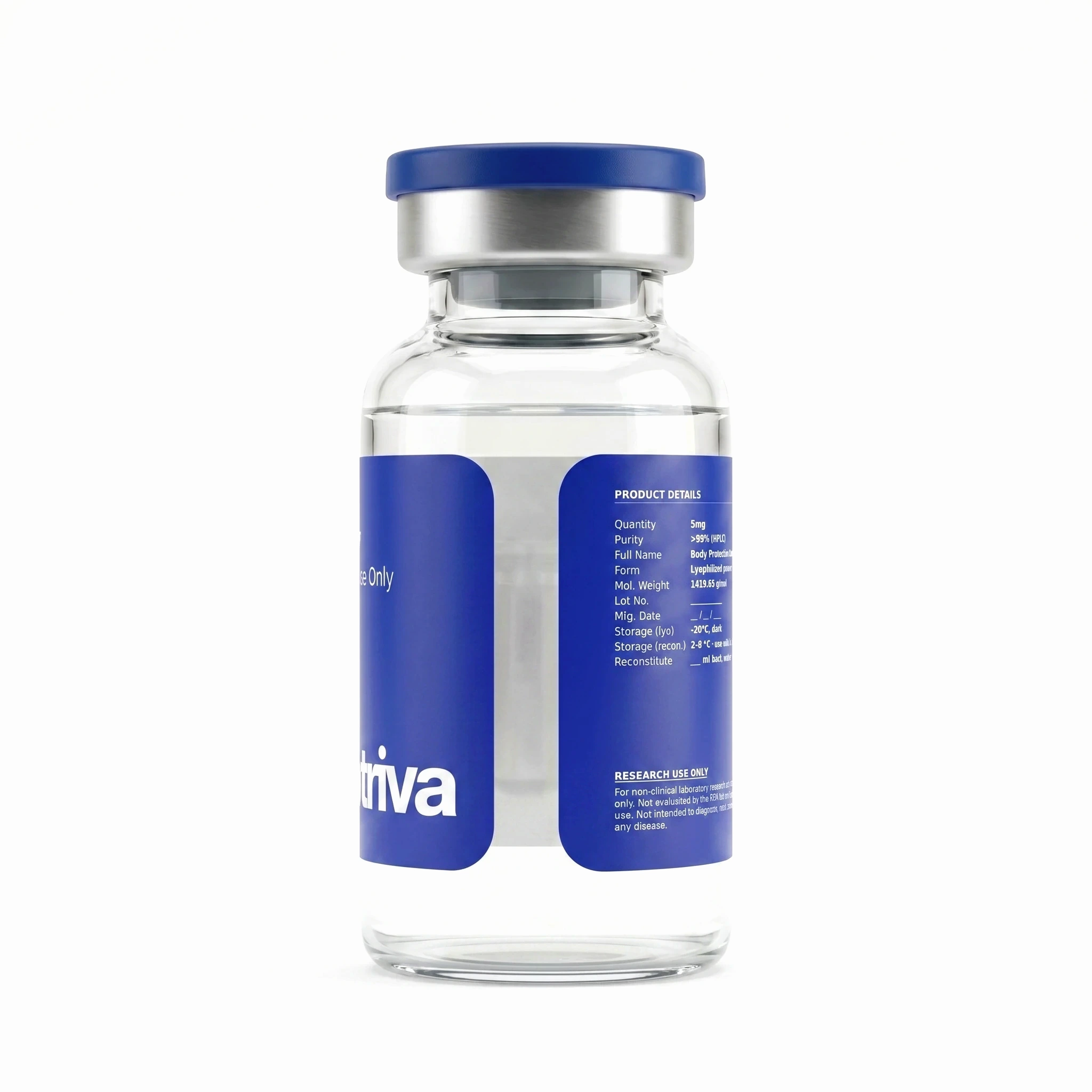
BPC-157
The 15-residue gastric pentadecapeptide sits at the class median for tissue-repair peptides — the same compound cited across the 2025 BPC-157 literature review and the 2025 HSS Journal systematic review. Lab-verified identity, ISO 17025 third-party CoA on every lot, priced to reflect synthesis and documentation cost rather than race-to-the-bottom shortcuts.
Cost per cycle — what research actually costs
Cost-per-mg is the supplier’s economics. Cost-per-cycle is the researcher’s economics. The two diverge because the compound quantities and study durations differ widely across peptide classes. Three worked examples that span the price spectrum:
Per-mg price tells you how the molecule was made. Per-cycle cost tells you what the research actually costs to run.
— Peptriva research team note, May 2026
BPC-157 — the “cheap peptide” case
Published BPC-157 preclinical studies have investigated doses that translate to approximately 7 mg of compound across a 4-week study period. A single 10 mg vial covers that quantity with a small buffer of ~3 mg remaining. At class-median pricing, a 4-week study cycle costs roughly $50–$100 in peptide, plus a $10–$15 vial of bacteriostatic water amortized across multiple cycles. The unit economics are forgiving because the quantities studied are microgram-scale and per-mg cost is low.
Tirzepatide — the GLP-1 reality check
The SURMOUNT-1 clinical trial investigated tirzepatide using an 8-week dose-escalation schedule (2.5 → 5 → 7.5 → 10 mg/week), consuming roughly 50 mg of compound across the titration period. At class-median pricing ($40–$80/mg), a single 8-week study supply costs $1,000–$2,000. An order of magnitude more than BPC-157, because a 39-residue lipidated peptide is not a $50 compound to synthesize. A $40 vial of “tirzepatide” from an unfamiliar source is almost certainly misidentified, underdosed, or substantially impure. The synthesis-cost floor doesn’t bend.
GHK-Cu — the cosmetic-bulk case
In vitro and dermatology research studies have investigated GHK-Cu at concentrations corresponding to very small quantities per application. A 50 mg vial — the typical commercial format — supports months of in vitro or topical research work. Per-cycle cost is roughly $40–$80 for an entire vial, making it closer to a multi-month supply than a per-cycle expense. The compound is cost-effective because the tripeptide is cheap to synthesize, the research quantities are small, and the manufacturing is mature.
Why cheap is suspicious — the synthesis-cost floor
There’s a real floor below which the math doesn’t add up. It isn’t a vendor decision. It’s a consequence of synthesis cost, purification depth, and third-party testing. A supplier below the floor has skipped something. What they’ve skipped is what determines whether the molecule in the vial is what the label claims.
Three below-floor signals:
- Any 10 mg peptide vial priced below $30. Wholesale synthesis cost of even the cheapest tripeptide plus reasonable margins sits around $25–$35. A 10 mg BPC-157 vial at $19 retail (a real listing at low-tier vendors) is below the cost to produce a CoA, let alone the cost to produce the peptide.
- $5–$10 vials of any peptide. At that price the contents are almost always under-dosed (a few mg labeled as 10 mg), substantially impure (sub-90% purity), misidentified entirely, or mostly diluent. The chemistry doesn’t support real research-grade peptide here.
- $50–$80 vials of lipidated GLP-1 analogs. Tirzepatide and retatrutide at one-fifth to one-tenth class-median price are essentially impossible inside the ISO 17025-testable supply chain. The 39-residue backbone plus lipidation plus third-party identity verification doesn’t fit that envelope. The vial is either a non-tirzepatide compound under a tirzepatide label, or it’s sold without the testing chain that would let you verify.
Floor rule of thumb: For any 10 mg peptide vial, expect a price floor around $30. For lipidated GLP-1 peptides, expect a floor closer to $150. Below these floors, the vial may still arrive. The question is whether the molecule in it is what the label claims.
Why prices vary between reputable vendors
Even above the synthesis-cost floor, prices vary by roughly 30–50% across the market for the same peptide. The variation tracks four legitimate cost-stack differences:
- Synthesis source. Vendors buying crude peptide from established U.S. contract manufacturers (Bachem, AmbioPharm, PolyPeptide) pay more than vendors sourcing from smaller Asian manufacturers. Quality is more consistent at the established shops, and wholesale cost reflects that.
- Purification depth. A vendor consistently delivering 99.5%+ purity carries roughly 15–25% more cost per mg than one delivering 98%.
- Third-party testing thoroughness. Per-lot external testing costs more than batch sampling (one external CoA per 5–10 lots) with internal QC on the rest. The first approach produces granular traceability. The second is cheaper.
- Operational overhead. U.S. fulfillment, named lab partners, published return policy, real customer service, a warehouse with proper storage, lot traceability back to the buyer — all real operating costs. Re-shippers drop-shipping from an Asian manufacturer carry almost none of these. The difference shows up in the buyer experience, not the molecule: missing orders, slow shipping, no recourse when a lot tests out of spec.
A 30–50% gap between reputable suppliers usually maps to one of these four. A 5× or 10× gap doesn’t. That’s the floor versus the cellar.
The Peptriva catalog
The full Peptriva catalog is priced to sit at or near class median — tissue-repair peptides at $5–$10/mg, GH-axis at $5–$25/mg, GLP-1 class at $40–$80/mg. Every lot ships with a batch-matched ISO 17025 third-party CoA. COAs available before purchase on request — the synthesis-cost floor is not a marketing claim.
Frequently asked questions about peptide prices
How much do peptides cost?
Research peptide prices span roughly an order of magnitude by class. Cosmetic peptides like GHK-Cu run $0.50–$2/mg. Tissue-repair peptides like BPC-157 run $5–$10/mg ($50–$100 per 10 mg vial). GH-axis secretagogues like CJC-1295 or ipamorelin run $5–$25/mg. GLP-1 class peptides like tirzepatide and retatrutide run $40–$80/mg ($200–$400 per 10 mg vial). The gap reflects synthesis complexity, not vendor markup.
Why is tirzepatide so expensive?
Tirzepatide is a 39-residue peptide with a fatty-acid side-chain modification at lysine-20. Thirty-nine SPPS coupling cycles, specialized lipidation chemistry, and the purification needed to clean up a longer crude mixture compound into a per-mg cost roughly 10× that of an unmodified 15-residue peptide like BPC-157. A “cheap tirzepatide” at $50 per 10 mg vial is almost certainly not actually tirzepatide as labeled.
Are cheap peptides safe?
Cheap peptides should prompt identity questions, not bargain enthusiasm. A 10 mg vial of any peptide priced under $30 has almost certainly skipped purification, third-party testing, or both. The compound in the vial may not be what the label claims: underdosed, a different peptide entirely, or substantially impure. Safety isn’t the right framing. Identity is. Without third-party testing, you don’t know what’s in the vial.
How much does a BPC-157 research cycle cost?
Published BPC-157 preclinical studies have used quantities that translate to approximately 7 mg consumed over a 4-week study period. At $5–$10/mg, that is $35–$70 in peptide cost. A single 10 mg vial covers one study cycle, bringing all-in cost to roughly $50–$100, plus a $10–$15 vial of bacteriostatic water amortized across multiple cycles.
What’s the cheapest peptide?
GHK-Cu, a copper-bound tripeptide, is the cheapest research peptide per mg ($0.50–$2/mg). It’s short (one synthesis cycle versus thirty-nine for tirzepatide), the synthesis is mature thanks to decades of cosmetic-scale production, and it’s sold in larger doses (50 mg vials). Short cognitive peptides like Selank, Semax, and DSIP are next-cheapest at $3–$8/mg. They’re heptapeptides or nonapeptides that need only 7–9 cycles.
Why do prices vary so much between vendors?
Variation tracks four cost-stack differences: synthesis source (U.S. contract manufacturers cost more than smaller Asian sources), purification depth, third-party testing thoroughness, and operational overhead (U.S. fulfillment, named lab partners, real customer service, lot traceability). A 30–50% gap between two reputable suppliers usually maps to one of these. A 5× gap doesn’t. That’s a sign one supplier skipped purification or testing.
What to know now
- Four levers drive every peptide price. Sequence length, chemical modifications, purification depth, and documentation overhead. Memorise these and most pricing decisions become obvious.
- The synthesis-cost floor is real. About $30 for a 10 mg vial of any peptide, $150 for a 10 mg vial of a GLP-1 analog. Below the floor, the molecule isn’t what the label claims.
- Per-mg price is supplier economics; per-study-cycle cost is researcher economics. A 4-week BPC-157 study supply is $50–$100. A tirzepatide SURMOUNT-1-quantity supply is $1,000–$2,000. A multi-month GHK-Cu in vitro supply is $40–$80. Research budgets are best anchored to per-cycle cost, not per-mg.
- Cheap GLP-1 peptides are the biggest red flag. The synthesis economics of a 39-residue lipidated peptide don’t support sub-$150 pricing for a 10 mg vial. A $50 tirzepatide listing is almost certainly not tirzepatide.
- 30–50% price gaps between reputable suppliers are normal. 5× or 10× gaps aren’t. The first reflects different cost stacks; the second reflects one supplier operating below the floor.
- The CoA is what justifies the price. A vendor who can’t produce a lot-specific Certificate of Analysis isn’t cheap — they’re just missing the documentation that proves the molecule is the molecule. That’s a different question from price.
What we’re watching
Three pricing developments worth tracking in 2026 and beyond. First, the gradual price compression in the GLP-1 class as patents on tirzepatide and retatrutide age and contract manufacturers scale up production — expect class-median price to drift down by 15–25% over the next 18–24 months without compromising the synthesis-cost floor logic. Second, the emergence of small-molecule oral GLP-1 receptor agonists (orforglipron from Eli Lilly, danuglipron from Pfizer in earlier development) that will compete with injectable peptides at potentially different unit-economics — not directly comparable to per-mg peptide pricing, but a market force. Third, the ongoing tightening of FDA enforcement against grey-market “research peptide” sites making clinical claims, which is gradually clearing out the bottom of the cost-floor cellar — the vendors selling $19 vials of BPC-157 with dosing instructions for human use have been receiving warning letters at an increasing rate, and that’s a net positive for the market.
References
- Verlander, M. (2007). Industrial applications of solid-phase peptide synthesis — a status report. International Journal of Peptide Research and Therapeutics, 13(1–2), 75–82. https://doi.org/10.1007/s10989-006-9075-7
- International Organization for Standardization. (2017). ISO/IEC 17025:2017 — General requirements for the competence of testing and calibration laboratories. https://www.iso.org/standard/66912.html
- United States Pharmacopeia. (2022). General Chapter <1503>: Quality attributes of therapeutic peptides. USP-NF. https://www.usp.org/
- United States Pharmacopeia. (2022). General Chapter <85>: Bacterial endotoxins test. USP-NF. https://www.usp.org/
- International Council for Harmonisation. (2022). ICH guideline Q3A(R2): Impurities in new drug substances. https://www.ich.org/page/quality-guidelines
- U.S. Food and Drug Administration. Warning Letters database. https://www.fda.gov/inspections-compliance-enforcement-and-criminal-investigations/warning-letters
- Józwiak, M., Bauer, M., Kamysz, W., & Kleczkowska, P. (2025). Multifunctionality and possible medical application of the BPC 157 peptide — literature and patent review. Pharmaceuticals, 18(2), 185. https://doi.org/10.3390/ph18020185
- Vukojević, J., et al. (2025). Pentadecapeptide BPC 157 in clinical orthopaedics — current evidence and outlook. HSS Journal. https://doi.org/10.1177/15563316251355551
- American Association for Laboratory Accreditation (A2LA). Accredited laboratory directory. https://a2la.org/
- Peptriva research team observations across U.S. research-peptide vendor catalogs (Peptriva, BiotechPeptides, CorePeptides, Phoenix Pharmaceuticals), May 2026. Pricing data reflects single-vial retail, lyophilized, U.S. domestic shipping. https://www.peptriva.com/catalog.html