How peptides are made. Almost every short and medium peptide you’ve heard of comes from one process. The Ozempic-class drugs in the news. BPC-157. The insulin analogs millions of diabetics inject every day. All of them are built using solid-phase peptide synthesis (SPPS). It won the Nobel Prize in Chemistry in 1984 and now drives the entire peptide-drug industry.
SPPS is the dominant method for making peptides under 50 amino acids long. The peptide is built one amino acid at a time on a tiny plastic bead. Each cycle adds one amino acid and rinses away excess reagents, then repeats until you’ve built the full sequence. The finished peptide is sliced off the bead, cleaned up, purified, and freeze-dried into the white powder you see in vials. Bruce Merrifield invented the technique at Rockefeller in 1963 and won the Nobel Prize in 1984. A modern automated machine can build a 30-residue peptide in 24 to 48 hours. Purification takes longer.
SPPS matters because of logistics, not chemistry. The underlying bond-forming reactions have been understood since the 1940s. Before Merrifield, building a peptide meant linking amino acids in a beaker, fishing out each intermediate, purifying it, then starting the next step. A 10-residue peptide could take months. Now it takes hours. The entire modern peptide-drug industry runs on the technique Merrifield introduced. The GLP-1 drug boom, the research peptides used in orthopedic studies, the copper tripeptide in your face cream, every approved peptide drug shorter than insulin.
The core idea: a chain attached to a bead
Pre-SPPS chemistry had one structural problem. At every step, you had to physically separate the growing peptide from the reaction leftovers before you could start the next step. The usual methods were crystallization or chromatography. Each separation lost material and ate time.
Merrifield’s insight: attach the first amino acid (the back end of the future peptide) to a tiny insoluble bead of plastic resin. Everything you do to the peptide after that happens with the peptide still tethered to the bead. To remove excess reagents, you filter out the beads and rinse them. The peptide stays on the bead. Everything else washes through. The isolation problem disappears. At the end of the synthesis, the finished peptide gets sliced off the bead in one final step.
The bead itself is a plastic sphere about 50 to 200 microns across. Small enough to look like a fine powder. Big enough to filter cleanly. The chemical linker between peptide and bead is engineered to hold tight through every step and release cleanly at the end. There are hundreds of linker chemistries. The most common in modern synthesis are called Wang resin and 2-chlorotrityl resin.
The repeating cycle, step by step
Once the first amino acid is attached to the bead, the synthesis runs the same cycle over and over. Each cycle adds exactly one amino acid. The cycle has four steps:
Step 1: unblock. The growing chain’s front end is covered by a protective chemical group (called Fmoc in modern synthesis) so it doesn’t react with itself. Before you can add the next amino acid, you have to peel that protection off. A base solution (20% piperidine in a solvent called DMF) cleaves it within minutes. Then you rinse. The front end is now reactive.
Step 2: activate and bond. The next amino acid arrives pre-protected. You dissolve it with a bond-making reagent (HBTU, HATU, or DIC/Oxyma) and a base. The reagent activates the amino acid’s back end so it can attack the front end of the growing chain. Within 20 to 60 minutes at room temperature, a new peptide bond forms. The chain has grown by one residue.
Step 3: rinse. Wash away the leftover reagents with DMF and dichloromethane. This is the step that makes SPPS so much faster than the old solution chemistry. Rinsing is fast. Crystallizing intermediates was slow.
Step 4: repeat. Go back to step 1 with a fresh unblocking. The cycle repeats until the full sequence is built.
A typical cycle takes 30 to 60 minutes on an automated machine. A 30-residue peptide takes roughly 15 to 30 hours of synthesis time, plus overnight cleaning. A 5-residue peptide like ipamorelin gets built in a single day.
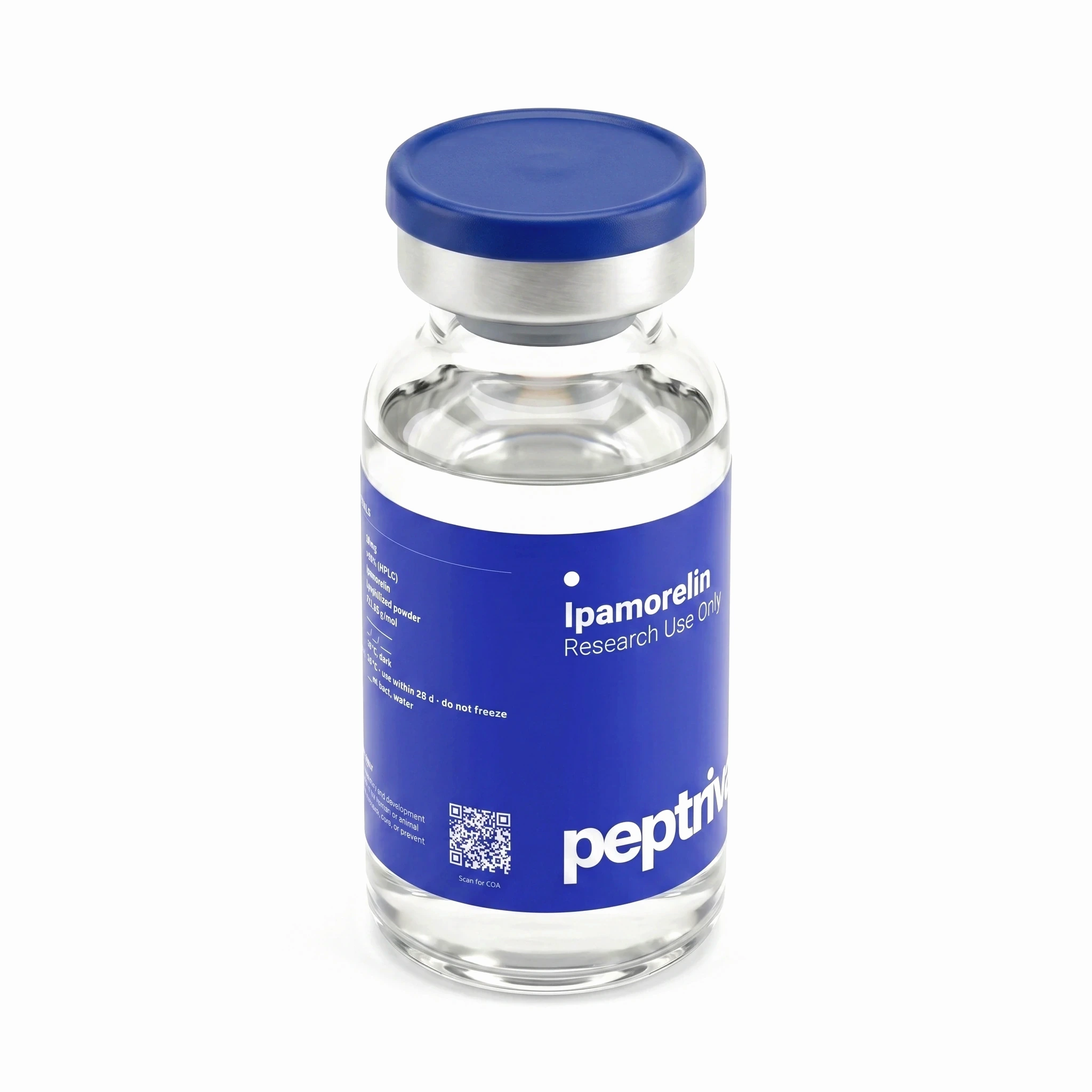
Ipamorelin
A textbook short peptide — just five residues, including an Aib non-natural amino acid. The kind of molecule SPPS handles in a single day. Lab-verified identity and purity.
Cleavage and final deprotection
After the last amino acid is coupled and its protective group removed, the peptide is still attached to the bead, and the side chains still wear their protective groups. The final cleavage step does two things at once. It cuts the peptide free from the bead and strips off every side-chain protective group. A cocktail of trifluoroacetic acid (TFA) plus scavenger chemicals goes on the resin and reacts for 2 to 4 hours at room temperature.
The fully unblocked peptide dissolves into the TFA. The bead (now bare plastic) gets filtered out and tossed. The TFA-peptide solution gets concentrated, then poured into cold ether. The peptide crashes out as a white solid while the TFA and small organics stay in solution. You collect the crude peptide by centrifugation.
Why the result is rarely pure
Even at 99% coupling efficiency per step, errors compound. If each step is 99% efficient, the chance of building a fully correct n-residue peptide is 0.99 raised to the (n-1). For a 15-residue peptide like BPC-157, that’s about 87% correct. For a 30-residue peptide, about 75%. For a 40-residue peptide like tirzepatide, about 67%. The rest is deletion errors, addition errors, and other side products.
That’s why crude peptide is never the final product. The crude has to go through preparative HPLC purification. That’s a high-pressure column run that separates the target peptide from the deletion errors and other impurities by how water-loving each one is. You collect the pure fractions, pool them, and freeze-dry. This is where most of the time and cost of peptide manufacturing lives.
For very long peptides (tirzepatide’s 39 residues with a lipid modification, retatrutide’s 39 residues, tesamorelin’s 44 residues), the error problem gets worse. Chemists then use fragment coupling. Build the peptide in two or three pieces. Purify each piece. Stitch them together. More work, higher-purity final material.
For this development of methodology for chemical synthesis on a solid matrix, Bruce Merrifield is awarded the Nobel Prize in Chemistry 1984. His method has had a profound effect on the development of biochemistry and on the pharmaceutical industry.
— Royal Swedish Academy of Sciences, 1984 Nobel Prize citation
Fmoc vs Boc, the two main flavors
There are two main protective-group strategies in SPPS, named after the chemical that protects the front end of each incoming amino acid.
Boc-SPPS was Merrifield’s original method. Each unblocking step uses TFA. The final cleavage from the bead uses hydrogen fluoride (HF). HF cleavage is fast and clean but requires specialized fluoride-resistant glassware and is hazardous to handle. Boc chemistry still gets used in some specialty settings (large peptides, sequences that misbehave), but it’s less common today.
Fmoc-SPPS uses a base-removable protective group. Unblocking uses piperidine. Final cleavage uses TFA. No HF, much easier to automate. Fmoc-SPPS is now the dominant method for both research and pharmaceutical peptide manufacturing. Essentially every peptide in our catalog is built this way.
Where SPPS breaks down
Two situations where solid-phase synthesis stops being the right answer:
First, very long peptides. Past roughly 50 residues, the compounded error rate becomes prohibitive. The resin’s capacity also runs out. For long peptides, you use fragment coupling. For true proteins (insulin, antibodies), growing them in engineered cells is the practical route.
Second, peptides with difficult sequences. Oily stretches can cause the chain to fold back on itself while still on the bead, blocking later couplings. Sequences with multiple cysteines need careful planning so the disulfide bridges form in the right places. Cyclic peptides need a final ring-closing step after the linear chain is built. None of these are deal-breakers. They just extend timelines and lower yields.
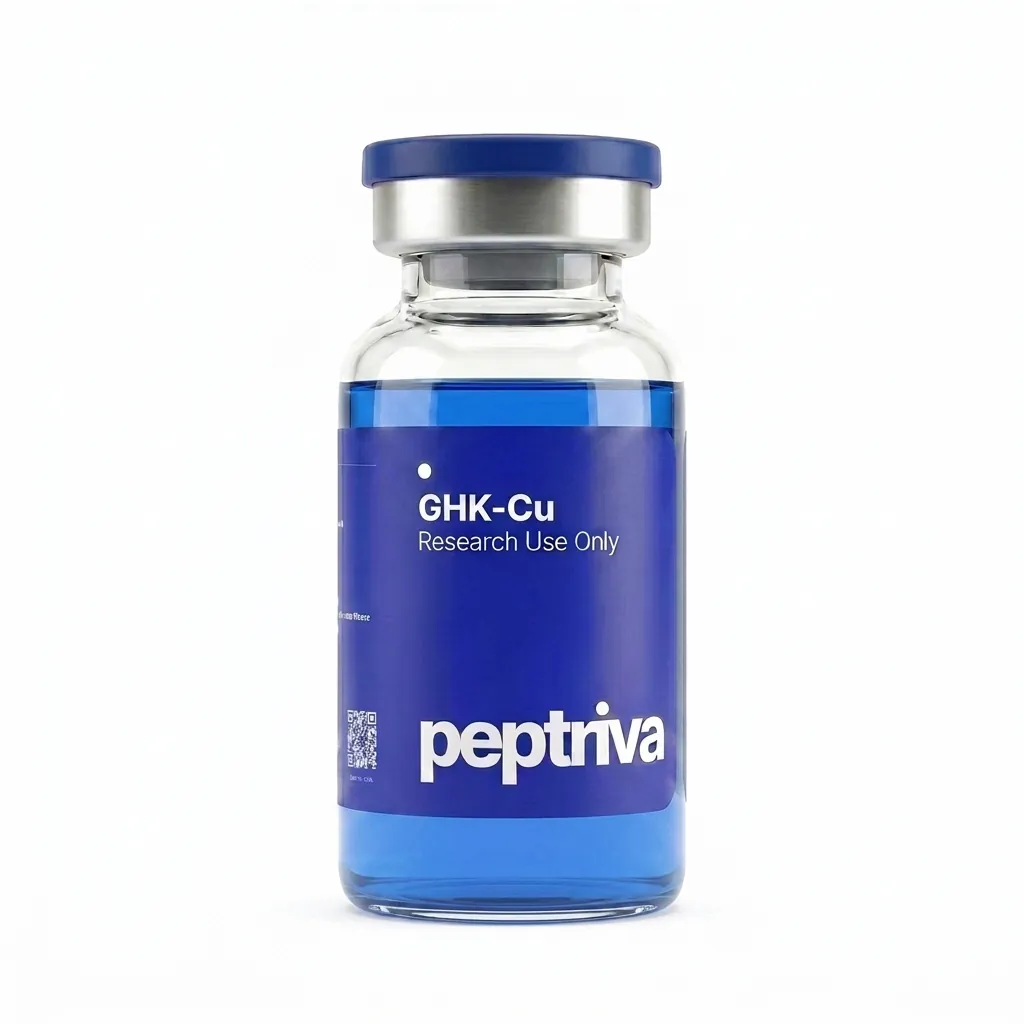
GHK-Cu
A copper-binding tripeptide — just three residues (Gly-His-Lys), the kind of short sequence Fmoc-SPPS assembles in a single run. COA available with each lot.
What this tells you about peptide cost
Peptide pricing follows three things: length, complexity, and purity. The length-cost curve isn’t linear. Doubling the length more than doubles the cost. The error rate forces extra purification work. A 5-residue peptide like ipamorelin or KPV is among the simplest and cheapest research peptides to make. A 39-residue peptide like tirzepatide, with its lipid tail and acyl linker, is dramatically more expensive per milligram. Cyclization, N-terminal acetylation, PEGylation, and non-natural amino acids all pile on cost.
The other big cost lever is purity target. Hitting 95% HPLC purity usually takes one preparative HPLC pass on the crude material. Hitting 99% often takes a second pass and a real yield hit. The marginal cost of the last two percentage points is real. That’s part of why catalog prices vary the way they do.
Where this falls short: the cheap-vial test. If a peptide vial seems suspiciously cheap, the cut corner almost certainly isn’t the underlying chemistry. SPPS is well-trodden. The cut corner is purification. Crude peptide is cheap. Purified peptide isn’t. The Certificate of Analysis (CoA) is where you check which one you’re getting.
What to know now
- What SPPS is: solid-phase peptide synthesis, invented by Bruce Merrifield (Nobel 1984). The peptide is built one amino acid at a time on a polystyrene bead, then cleaved off at the end.
- The cycle: deprotect, couple, wash, repeat. About 30–60 minutes per residue on an automated synthesiser.
- Two main flavours: Boc-SPPS (older, uses HF) and Fmoc-SPPS (modern, uses TFA). Fmoc dominates today.
- Practical length limit: roughly 50 residues. Beyond that, fragment coupling or recombinant expression takes over.
- Why crude isn’t pure: even at 99% per-step efficiency, errors compound — only ~67% of a 40-residue crude is the intended sequence. Preparative HPLC purification is where most of the cost and time lives.
- Cost drivers: length, modifications (cyclisation, acetylation, lipidation), non-natural amino acids, and the gap between 95% and 99% purity.
What we’re watching
Two technical trends to track. First, flow-based peptide synthesis — pioneered by Bradley Pentelute’s lab at MIT — which compresses each coupling cycle to a few minutes. If the technique generalises to long peptides, total synthesis time for a 40-residue peptide could drop from days to hours, with knock-on effects on cost and supplier turnaround. Second, the gradual adoption of greener solvent systems — the traditional DMF/DCM workhorses are being replaced in some shops with less-toxic alternatives. Both trends are most visible in pharmaceutical-grade manufacturing first; expect them to reach the research-peptide market with a lag.
References
- Merrifield, R. B. (1963). Solid phase peptide synthesis. I. The synthesis of a tetrapeptide. Journal of the American Chemical Society, 85(14), 2149–2154. https://doi.org/10.1021/ja00897a025
- Royal Swedish Academy of Sciences. (1984). The Nobel Prize in Chemistry 1984 — press release. Nobel Prize 1984 citation
- Verlander, M. (2007). Industrial applications of solid-phase peptide synthesis — a status report. International Journal of Peptide Research and Therapeutics, 13(1–2), 75–82. https://doi.org/10.1007/s10989-006-9075-7
- Behrendt, R., White, P., & Offer, J. (2016). Advances in Fmoc solid-phase peptide synthesis. Journal of Peptide Science, 22(1), 4–27. https://doi.org/10.1002/psc.2836
- Mijalis, A. J., Thomas, D. A., Simon, M. D., et al. (2017). A fully automated flow-based approach for accelerated peptide synthesis. Nature Chemical Biology, 13(5), 464–466. https://doi.org/10.1038/nchembio.2318