The GH-axis triple stack is research-community shorthand for one combination: CJC-1295 + Ipamorelin + Tesamorelin. Two GHRH analogs (drugs that mimic growth hormone-releasing hormone) plus one ghrelin-receptor agonist. The pair (CJC + Ipamorelin) is the most-talked-about growth hormone combo in performance-peptide circles. The triple adds Tesamorelin on top.
The GH-axis triple stack is CJC-1295 + Ipamorelin + Tesamorelin. Two receptor pathways are engaged: the GHRH receptor (by CJC-1295 and Tesamorelin) and the ghrelin receptor (by Ipamorelin). Hitting both at once produces a supra-additive growth hormone pulse in pharmacology studies. Tesamorelin is the only one of the three with an FDA approval (2010, for HIV lipodystrophy) and the only one with Phase III trial data. CJC-1295's clinical program was halted. Ipamorelin failed Phase III for ileus. No controlled trial of the three-peptide combo has been published. All three are WADA-prohibited.
The sections below cover what the triple stack is, why researchers have added Tesamorelin to the standard pair, what the published literature does and does not support, and the community-described combination patterns that appear in the research discussion. The cost differential and the point at which the evidence stops are also addressed.
- GHRH. Growth hormone-releasing hormone. The body's own signal that tells the pituitary gland to release growth hormone. CJC-1295 and Tesamorelin are synthetic mimics.
- GHRP. Growth hormone-releasing peptide. A separate class of drugs that hits the ghrelin receptor (also called GHS-R1a) to amplify the GH pulse. Ipamorelin is a GHRP.
- Somatotroph. The specific pituitary cells that make and release growth hormone. Both GHRH and ghrelin signals land there.
- Supra-additive. A combined effect larger than the arithmetic sum of the two individual effects.
- DPP-4. Dipeptidyl peptidase-4, a serum enzyme that cleaves many short peptides. Tesamorelin carries a structural modification that confers resistance to DPP-4 degradation.
What the triple stack is, in plain terms
Growth hormone is secreted from the pituitary gland in pulses, controlled by two upstream signaling pathways. The first pathway engages the GHRH receptor and triggers a pulse. The second, mediated by ghrelin (a gut-derived peptide also called the "hunger hormone"), binds a separate receptor and amplifies that pulse. The two receptors use distinct intracellular machinery. Simultaneous engagement of both pathways produces a larger GH pulse than either pathway alone, as documented in pharmacology studies.
The triple stack maps onto that biology:
- CJC-1295 — a 30-amino-acid synthetic GHRH analog. The version most researchers use is the "no-DAC" form, also called Modified GRF 1-29. It hits the GHRH receptor (Rahman et al., 2026).
- Tesamorelin — a 44-amino-acid synthetic GHRH analog with a chemical tag (trans-3-hexenoic acid) that protects it from DPP-4. Sold as Egrifta and Egrifta SV for HIV lipodystrophy (Russo et al., 2024). Same receptor as CJC, different half-life, different regulatory status.
- Ipamorelin — a 5-amino-acid GHRP that hits the ghrelin receptor without raising cortisol or prolactin. That's its defining trait, and it's what separates it from older GHRPs like GHRP-6 (Lu et al., 2024).
The dual-receptor pharmacology is what makes the combination interesting. A 2026 review in the American Journal of Sports Medicine reports CJC + Ipamorelin produced better maximum tetanic tension (the peak force a muscle can sustain) in mice with steroid-induced muscle loss (Mayfield et al., 2026). That's the most-cited preclinical data point for the pair. The triple's separate question: does layering a second analog on top of that pair buy you anything?
Why researchers add Tesamorelin to the pair
The pair already hits both receptor pathways. So why bring in a third peptide? Three reasons turn up in research-community talk, each with different evidence behind it.
Reason 1: Tesamorelin has a real evidence base
This is the strongest argument. Tesamorelin is the only one of the three with an FDA approval and a published Phase III trial record. The 2024 AIDS sub-analysis (n=38 on integrase-inhibitor HIV regimens) showed Tesamorelin cut visceral fat by a median of 25 cm² vs +14 cm² on placebo. It also reduced liver fat (Russo et al., 2024).
A 2020 JCI Insight biopsy study showed Tesamorelin turned up genes for energy production (oxidative phosphorylation) and turned down genes for inflammation in liver tissue (Fourman et al., 2020). Researchers who put Tesamorelin in a stack are anchoring it to the peptide with the deepest real pharmacology in this class.
Reason 2: Two analogs with different durations extend the signal
Tesamorelin's chemical tag protects it from breakdown, so it lasts longer in blood than the natural hormone. CJC-1295 no-DAC stays in blood for about 30 minutes. The DAC version clips onto a blood protein called albumin and stretches the dwell time into days (Memdouh et al., 2021). Stacking two analogs of different durations, the idea goes, keeps the signal on for longer.
That's mechanistically reasonable. It hasn't been shown to produce better GH numbers than just using the longer-acting peptide alone at a higher dose.
Reason 3: Cost optimization
Prescription Egrifta SV is expensive. Off-label use without an HIV-lipodystrophy diagnosis isn't usually insurance-covered, and the bill can hit several thousand dollars a month. Research-grade Tesamorelin vials cost a fraction of that. Smaller doses across three peptides may hit the same GH/IGF-1 target as a big monotherapy dose, at lower per-vial spend. This is an operational rationale, not evidence.
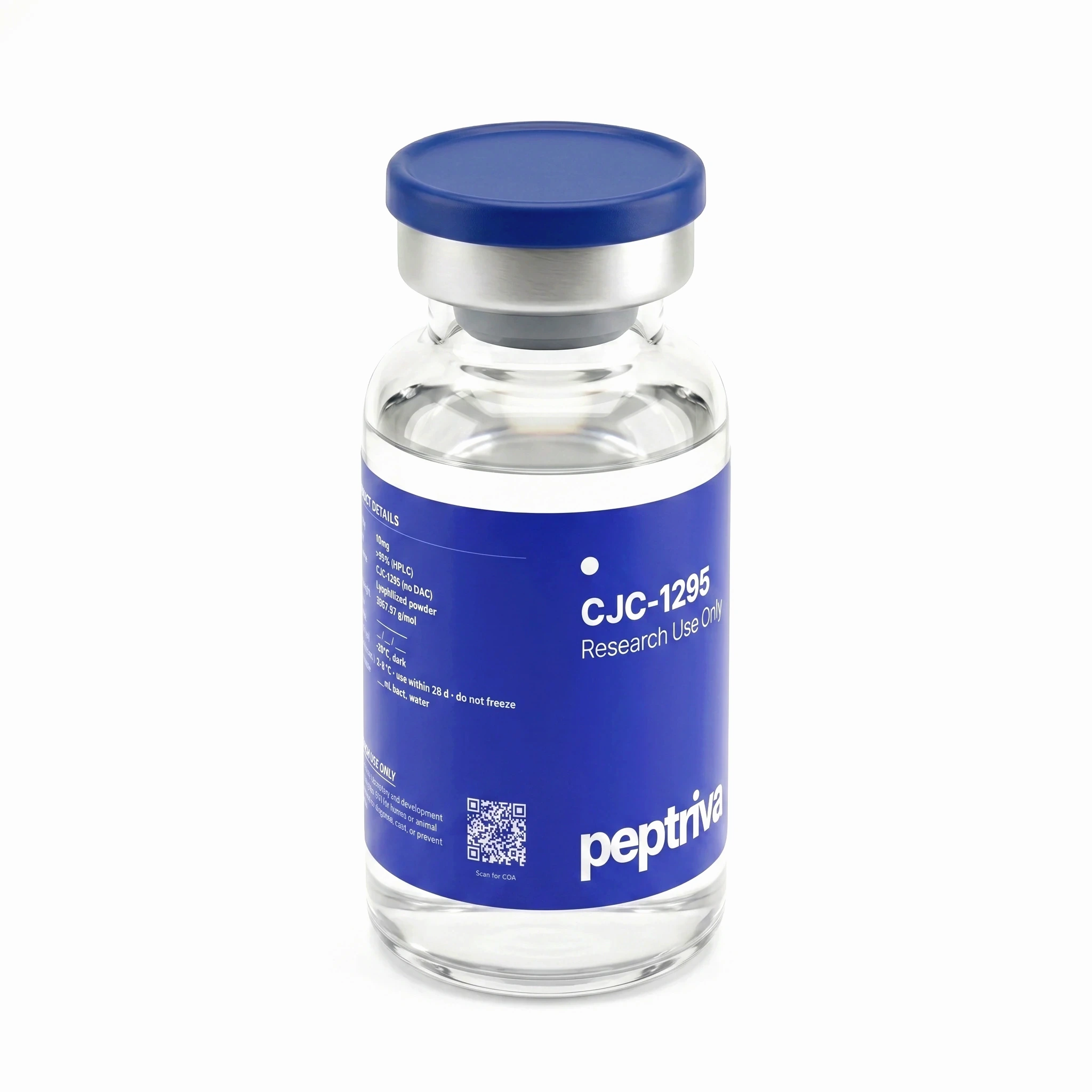
CJC-1295 (no DAC)
A 29-amino-acid GHRH analog referenced in the 2026 AAOS orthopedic peptide review and the Mayfield et al. 2026 sports medicine review. Research-grade reference compound. Lab-verified identity and purity. COA per lot.
Why two receptors beats one
The core claim behind any GHRH + GHRP stack: hitting both receptors at once produces a GH pulse meaningfully bigger than adding the solo pulses together. The pharmacology behind this is well established. It's documented in older clinical work and summarized in current reviews.
A 2020 review in Translational Andrology and Urology explains why. The GHRH receptor and the ghrelin receptor use different internal cell-signaling chains. The GHRH receptor uses cAMP (a small molecule the cell uses as a "go" signal). The ghrelin receptor uses calcium. Engage both at once and you get a much larger GH pulse than either path delivers alone (Sinha et al., 2020).
Here's the critical point. The supra-additive effect comes from engaging both receptors. Stacking two GHRH analogs doesn't add a third receptor. Both CJC and Tesamorelin hit the same growth-hormone signaling receptor. Two analogs may keep that signal on longer. They don't add a new mechanism. The triple is a duration-extended pair, not a different combo.
The triple stack adds duration to the pair's pharmacology. It does not add a new receptor pathway. Whether sustained GHRH-receptor signaling beats pulsed signaling for GH and IGF-1 output is a real question that has not been answered in any controlled study.
— Our reading of Sinha et al., Translational Andrology and Urology, 2020
What the published evidence actually shows
The triple-stack literature requires three distinct layers of analysis. What has been studied for each peptide alone. What has been studied for the pair. And what has been studied for the triple as a combination. The three layers do not agree.
Tesamorelin: the FDA-approved component
Multiple Phase III trials have been conducted in HIV lipodystrophy populations. The 2020-2026 record also covers HIV-associated fatty liver disease. A 1-year trial of n=61 study participants reported reductions in liver fat and slowed fibrosis progression. A 2021 plasma proteomics study found that Tesamorelin reduced inflammatory signaling proteins alongside the liver improvement (Fourman et al., 2021).
Not every Tesamorelin trial has yielded positive results. A 2025 Phase II trial in HIV study participants with abdominal obesity (n=73) reported reduced waist circumference but no improvement in neurocognitive function (Ellis et al., 2025). The evidence base is substantial but remains specific to HIV-related metabolic disease.
CJC-1295: no recent human trials
The 2020-2026 PubMed record on CJC-1295 is dominated by anti-doping detection methods (Memdouh et al., 2021; Cristea et al., 2023). No new randomized trial for performance or anti-aging has been published in that window. Older pharmacology studies did show dose-dependent GH and IGF-1 elevation. The clinical program was halted.
Ipamorelin: a Phase III failure
The biggest human trial of ipamorelin was a Phase III study for post-surgery bowel paralysis. It missed its primary endpoint. The development program was shelved. No RCT has tested ipamorelin for muscle gain, fat loss, or athletic recovery (Mendias & Awan, 2026). Preclinical data includes a 2024 ferret study where ipamorelin blocked chemo-induced weight loss (Lu et al., 2024).
The pair and the triple
For the CJC + Ipamorelin pair, the most-cited data point is the mouse tetanic-tension finding from Mayfield et al. 2026. No published human trial of the pair exists.
For the triple? Effectively zero. No RCT, no preclinical study, no case series isolates the three-peptide combo from its parts.
Where this falls short. The triple stack rests on real receptor pharmacology, a deep evidence base for one component (Tesamorelin in HIV lipodystrophy), a thin literature for the second (CJC-1295), a failed Phase III program for the third (Ipamorelin), and zero published trials of the three together. The marketing implies more confidence than the evidence supports.
Triple vs pair: key distinctions
Three differences between the pair and the triple are relevant to researchers assessing the combination.
The addition of an FDA-approved component
Tesamorelin is the GHRH-analog class's most extensively studied member, with Phase III trials, biopsy mechanistic substudies, and post-marketing surveillance. Researchers who include it in a combination are grounding the combination in a component with established clinical pharmacology. The regulatory weight of its FDA approval is specific to HIV lipodystrophy; off-approval research use does not inherit that status.
No additional receptor pathway is engaged
The pair already engages both receptor pathways. Tesamorelin targets the same GHRH receptor as CJC-1295 — different half-life, same target. Whether longer GHRH-receptor signaling produces different outcomes than pulsed CJC-1295 alone is a relevant pharmacodynamic question. No controlled study has addressed it.
Increased material cost without established incremental benefit
Research-grade Tesamorelin is substantially less expensive than prescription Egrifta SV, but it adds per-vial cost on top of the pair. Whether that additional cost corresponds to any additional measurable outcome in research models has not been studied.
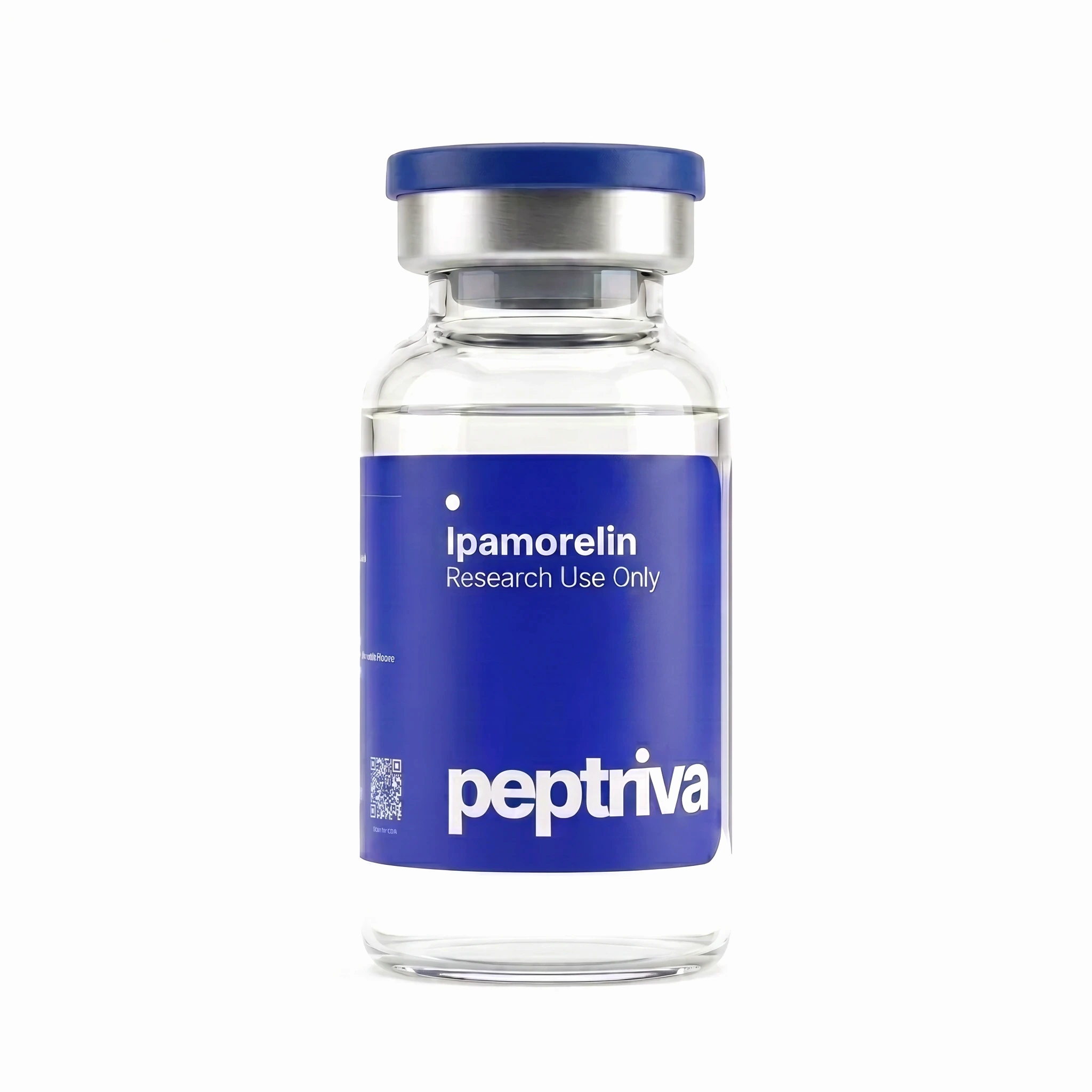
Ipamorelin
A selective GHS-R1a agonist distinguished from earlier-generation GHRPs by negligible cortisol and prolactin elevation in published studies. The same reference compound used across the cited preclinical work. Research-grade, lab-verified ≥99% pure. Third-party COA per lot.
Combination approaches described in the literature
Research-community discussions describe several approaches to combining the three compounds — varying which analogs are used concurrently versus sequentially, and whether dosing is modeled on the Tesamorelin clinical label or at lower exploratory levels. None of these approaches has been published in a peer-reviewed study. The mechanistic rationale (dual-receptor engagement, differential half-lives) is consistent across all described approaches; what varies is the relative emphasis on the longer-acting versus shorter-acting GHRH analog and the frequency of ghrelin-receptor co-stimulation.
Published dose-response data exists only for Tesamorelin monotherapy in HIV lipodystrophy populations (Russo et al., 2024). No dose-response data for CJC-1295, Ipamorelin, or the triple combination has been published in a peer-reviewed, controlled study.
Safety, regulation, and the WADA reality
- One FDA approval, two not approved. Tesamorelin holds the only FDA approval (sold as Egrifta and Egrifta SV) for HIV lipodystrophy. CJC-1295 and Ipamorelin are not FDA-approved. Both sit on FDA bulks-not-eligible lists, meaning compounding pharmacies can't legally make them for human use.
- All three are WADA-prohibited. Listed under Category S2 of the WADA Prohibited List. Banned in and out of competition for any WADA-tested athlete.
- Detection is reliable. Standard lab methods catch CJC-1295 and Tesamorelin in athlete urine at sub-ng/mL concentrations (Memdouh et al., 2021).
- GH-axis adverse effects reported in trials. Elevated blood glucose, worsened insulin sensitivity, injection-site reactions, arthralgia, edema, and paresthesia have been reported across GH secretagogue trials. Tesamorelin trials have noted an IGF-1-mediated cancer-growth theoretical concern, and the compound is contraindicated in active malignancy per its FDA label.
- Supply-chain hazards. A 2026 review in J Sports Med Phys Fitness warns that the unregulated grey-market for these peptides adds cardiovascular strain, insulin resistance, and contamination risk on top of the drug's own profile (Coutinho et al., 2026).
What to know now
- Triple stack = CJC-1295 + Ipamorelin + Tesamorelin. Two GHRH analogs and one ghrelin-receptor agonist. The pair (CJC + Ipamorelin) is the much more common combination; the triple adds Tesamorelin on top.
- The supra-additive logic is real, but only across the two receptor pathways. Adding a second GHRH analog extends signaling duration but does not engage a third receptor.
- Tesamorelin is the only component with a real FDA approval and Phase III RCT base. But the approval is for HIV-associated lipodystrophy; off-approval use does not inherit that regulatory weight.
- CJC-1295 development was halted; Ipamorelin failed its Phase III ileus trial. Both peptides have meaningful pharmacology but no recent human RCT supporting performance or anti-aging indications.
- Zero published trials of the triple combination. The combination is research-community convention, not evidence-validated protocol.
- All three are WADA-prohibited and reliably detectable. Validated LC-MS/MS methods catch them at sub-ng/mL urine concentrations.
- Material cost for the triple combination is roughly 50–100% higher than the pair. Whether the incremental cost corresponds to any measurable incremental outcome in research models has not been studied.
What we’re watching
The most important development to track is whether any controlled human trial of CJC-1295 or Ipamorelin in performance or recovery indications ever publishes. Both peptides have been clinically inactive for years — CJC since its development program was halted, Ipamorelin since the Phase III ileus failure. The 2026 Sports Medicine and American Journal of Sports Medicine reviews both call for properly designed clinical investigation. For Tesamorelin, the pipeline expansion into non-HIV NASH is the trial set worth watching — if Tesamorelin clears Phase III in non-HIV indications, the GHRH-analog class gains meaningful new regulatory footing. Until those trials run, the triple stack remains a mechanistically reasonable pharmacology stitched together from peptides whose individual evidence bases range from one FDA approval to one Phase III failure.
References
- Russo, S. C., Ockene, M. W., Arpante, A. K., et al. (2024). Efficacy and safety of tesamorelin in people with HIV on integrase inhibitors. AIDS, 38(12), 1758–1764. https://doi.org/10.1097/QAD.0000000000003965
- Fourman, L. T., Billingsley, J. M., Agyapong, G., et al. (2020). Effects of tesamorelin on hepatic transcriptomic signatures in HIV-associated NAFLD. JCI Insight, 5(16). https://doi.org/10.1172/jci.insight.140134
- Stanley, T. L., Fourman, L. T., Wong, L. P., et al. (2021). Growth hormone releasing hormone reduces circulating markers of immune activation in parallel with effects on hepatic immune pathways in individuals with HIV-infection and nonalcoholic fatty liver disease. Clinical Infectious Diseases, 73(4), 621–630. https://doi.org/10.1093/cid/ciab019
- Fourman, L. T., Stanley, T. L., Billingsley, J. M., et al. (2021). Delineating tesamorelin response pathways in HIV-associated NAFLD using a targeted proteomic and transcriptomic approach. Scientific Reports, 11(1), 10485. https://doi.org/10.1038/s41598-021-89966-y
- Ellis, R. J., Vaida, F., Hu, K., et al. (2025). Effects of tesamorelin on neurocognitive impairment in persons with HIV and abdominal obesity. The Journal of Infectious Diseases, 231(5), 1230–1238. https://doi.org/10.1093/infdis/jiaf012
- Memdouh, S., Gavrilović, I., Ng, K., Cowan, D., & Abbate, V. (2021). Advances in the detection of growth hormone releasing hormone synthetic analogs. Drug Testing and Analysis, 13(11–12), 1871–1887. https://doi.org/10.1002/dta.3183
- Cristea, C. D., Radu, M., Toboc, A., Stan, C., & David, V. (2023). Cationic exchange SPE combined with triple quadrupole UHPLC-MS/MS for detection of GHRHs in urine samples. Analytical Biochemistry, 682, 115336. https://doi.org/10.1016/j.ab.2023.115336
- Sinha, D. K., Balasubramanian, A., Tatem, A. J., et al. (2020). Beyond the androgen receptor: The role of growth hormone secretagogues in the modern management of body composition in hypogonadal males. Translational Andrology and Urology, 9(Suppl 2), S149–S159. https://doi.org/10.21037/tau.2019.11.30
- Lu, Z., Ngan, M. P., Liu, J. Y. H., et al. (2024). The growth hormone secretagogue receptor 1a agonists, anamorelin and ipamorelin, inhibit cisplatin-induced weight loss in ferrets. Physiology & Behavior, 284, 114644. https://doi.org/10.1016/j.physbeh.2024.114644
- Mayfield, C. K., Bolia, I. K., Feingold, C. L., et al. (2026). Injectable peptide therapy. The American Journal of Sports Medicine, 54(1), 223–229. https://doi.org/10.1177/03635465251357593
- Mendias, C. L., & Awan, T. M. (2026). Safety and efficacy of approved and unapproved peptide therapies for musculoskeletal injuries and athletic performance. Sports Medicine. https://doi.org/10.1007/s40279-026-02437-0
- Rahman, O. F., Lee, S. J., & Seeds, W. A. (2026). Therapeutic peptides in orthopaedics: Applications, challenges, and future directions. Journal of the AAOS Global Research & Reviews, 10(1). https://doi.org/10.5435/JAAOSGlobal-D-25-00236
- Coutinho, L. F. D., De Oliveira Neves, L. F., & Camilo, R. P. (2026). A new era of doping? Use of peptide and peptide-analog drugs in recreational and professional sport and bodybuilding. Journal of Sports Medicine and Physical Fitness. https://doi.org/10.23736/S0022-4707.26.17773-1
- World Anti-Doping Agency. (2026). The Prohibited List. https://www.wada-ama.org/en/prohibited-list