Only one growth-hormone-boosting peptide has cleared the bar that matters. Tesamorelin is FDA-approved. It ran two large Phase III trials. It has a real labeled use. We treat it as the gold standard and compare every other peptide in this class to it.
Tesamorelin (sold as Egrifta and Egrifta SV) is the only FDA-approved growth-hormone-releasing peptide for adult use. Approved in 2010, reformulated in 2019. It's labeled for reducing belly fat in adults with HIV-associated lipodystrophy. The pivotal trials cut visceral fat by 15-18% at 26 weeks vs placebo. Later studies showed it also drops liver fat and quiets immune activation, but a 2025 trial failed to improve cognition. WADA bans it (category S2). Cost is steep: ~$3,500-5,000/month in the US, and insurance only covers the HIV indication.
Why does tesamorelin matter so much? It sets the bar. Compared to CJC-1295 or ipamorelin, what is clearly absent from those compounds' evidence bases becomes visible. Tesamorelin isn't mechanically unique. It just ran the trials.
This guide covers what tesamorelin is, what the FDA trials showed, what later research added, where the negative trials sit, and what it actually costs to access the drug in 2026.
What is tesamorelin?
Tesamorelin is a synthetic copy of a natural pituitary signal called growth-hormone-releasing hormone. It's 44 amino acids long. The key trick: a chemical tweak on one end protects it from the enzyme DPP-4, which would otherwise destroy the natural version within minutes.
That tweak stretches how long the peptide stays active in blood to roughly 26-38 minutes in healthy adults. Long enough to do its job. Short enough to preserve the body's natural pulsing rhythm of growth hormone release.
The mechanism is straightforward. Tesamorelin docks onto a binding site on the pituitary. The pituitary releases growth hormone in pulses. Growth hormone then tells the liver to make a downstream signal called IGF-1 (insulin-like growth factor-1), the main builder of tissue.
Why does pulsing matter? Synthetic growth hormone produces a flat, continuous level in blood. Tissues respond less efficiently to continuous exposure than to natural pulses. Tesamorelin preserves the pulsatile rhythm, which is why it achieves effects at growth-hormone levels consistent with healthy physiology — not at the unnaturally elevated levels that direct growth-hormone administration produces.
Tesamorelin's evidence base is the deepest and highest-quality of any peptide in this category, with multiple large randomized controlled trials and ongoing post-marketing research.
— from a 2025 review of GHRH analogs in HIV-associated metabolic disease
The pivotal Phase III data: what the FDA approved
The FDA approved tesamorelin in 2010 based on two large randomized placebo-controlled trials. Study participants all had HIV-associated lipodystrophy — a body-composition disorder where visceral fat (fat around organs) accumulates while subcutaneous fat wastes away.
The trials measured visceral fat on CT scans. At 26 weeks, tesamorelin reduced visceral fat by 15-18% vs placebo. Waist measurements decreased. Tissue-building signals rose, consistent with the mechanism.
One notable finding: the effect was selective. Tesamorelin reduced visceral fat without depleting subcutaneous fat — relevant because lipodystrophy study participants had already experienced subcutaneous fat loss. Pulsatile growth hormone stimulation preferentially mobilizes visceral fat. That selectivity underpins the labeled indication.
The SV formulation (approved in 2019) is the same active compound in a more concentrated formula, producing a smaller administration volume. The pharmacology is unchanged.
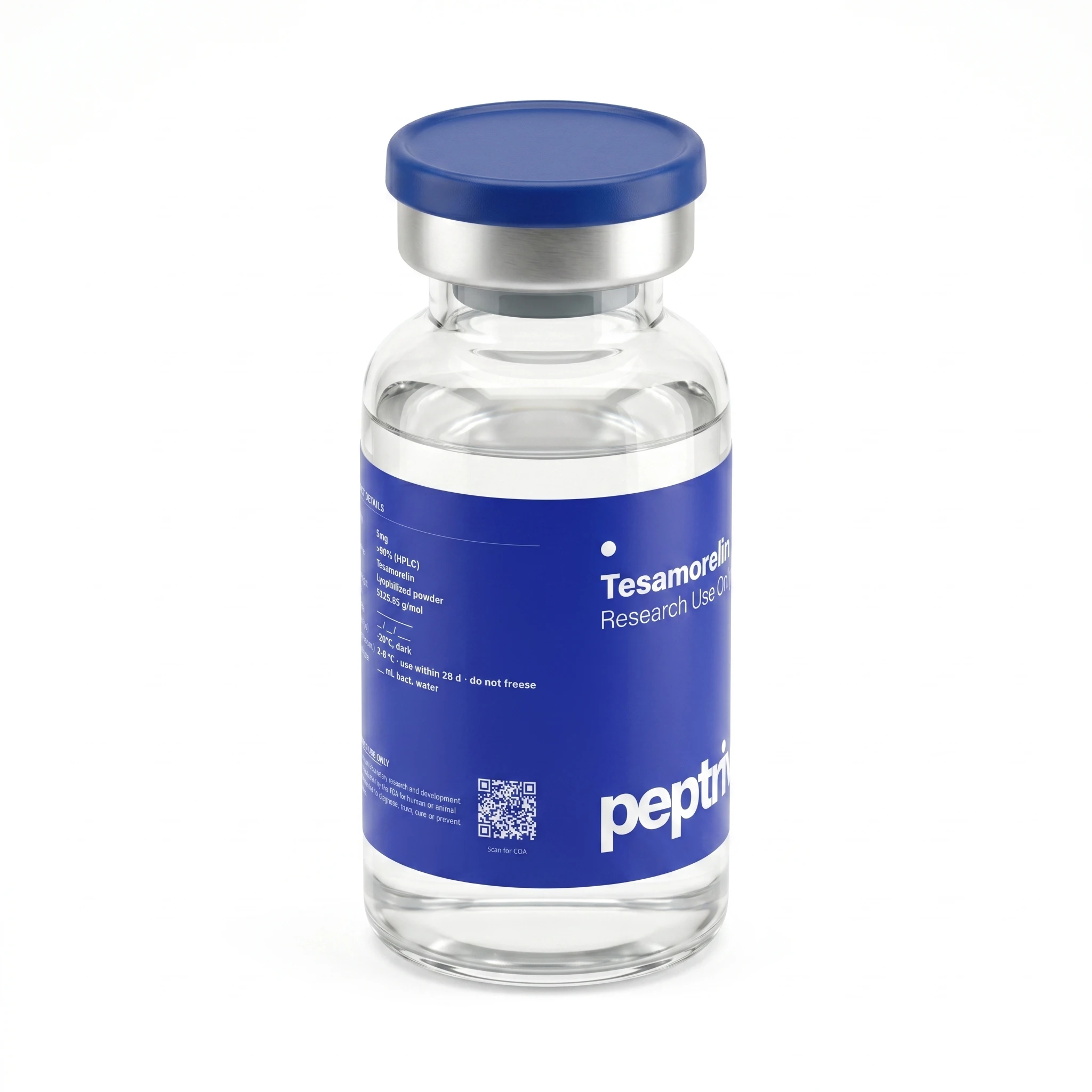
Tesamorelin
The same compound cited across the Phase III pivotal trials and the post-marketing research summarised in this guide. Lab-verified identity and purity.
HIV-associated fatty liver: a year of paired biopsies
The most-cited follow-up trial enrolled 61 study participants with HIV-associated fatty liver disease at Massachusetts General Hospital. It ran 12 months with paired liver biopsies at start and end.
The findings: tesamorelin reduced liver fat. More important, it prevented fibrosis (scarring) progression vs placebo. That's a hard endpoint, not a surrogate.
Three substudies spun off the same dataset and showed how tesamorelin works in liver tissue:
- Gene expression in the liver. Fourman and colleagues found tesamorelin turned up energy-production genes and turned down inflammation genes in paired biopsies (Fourman et al., 2020, JCI Insight).
- Blood proteomics. A targeted study showed drops in VEGFA, TGFB1, and CSF1. The drops tracked with better liver scores (Fourman et al., 2021, Scientific Reports).
- Immune activation. A Clinical Infectious Diseases paper reported tesamorelin lowered 13 immune-activation proteins, including chemokines, cytokines, and T-cell markers (Stanley et al., 2021).
Our reading: tesamorelin doesn't just move fat. It quiets liver inflammation and immune activation too. Whether those effects translate to non-HIV fatty liver disease (MASLD) is the open question driving current research.
The 2024 integrase-inhibitor sub-analysis
Modern HIV treatment uses integrase inhibitors as first-line therapy (drugs like dolutegravir and bictegravir). These regimens are associated with weight gain and visceral fat accumulation. A 2024 sub-analysis examined whether tesamorelin retained efficacy in study participants receiving these contemporary regimens.
Russo and colleagues analyzed 38 participants and reported:
- Median visceral fat change: −25 cm² on tesamorelin vs +14 cm² on placebo
- Liver fat: −4.2% on tesamorelin vs −0.5% on placebo
- Improved trunk-to-limb fat ratio in the treatment arm
- Hyperglycemia rates similar between groups
The sub-analysis is relevant because it demonstrates the compound's activity was maintained in study participants on first-line integrase-inhibitor regimens — the predominant HIV treatment context today.
Fat quality, not just quantity
One of the more interesting recent papers analyzed CT data from 341 participants. Lake and colleagues looked at fat density, not just fat area (Lake et al., 2021, AIDS).
Higher density on CT means healthier, smaller fat cells. Lower density means swollen, stressed fat cells that pump out inflammation. Tesamorelin increased fat density independent of changes in fat area.
The implication: adipose tissue volume and adipose tissue quality are distinct variables. Tesamorelin appears to shift fat toward a healthier cellular pattern independent of volume reduction — a finding the authors note as relevant to cardiometabolic risk assessment.
Where this falls short: the cognition trial
What the data doesn't show. Tesamorelin's observed metabolic effects did not translate to cognitive improvement. A 2025 Phase II trial of 73 study participants with HIV and abdominal obesity compared tesamorelin to standard care. Waist circumference decreased 2.7 cm in the treatment arm. Cognitive outcomes did not improve (Ellis et al., 2025). That is a clean negative readout, and it is why a rigorous evidence base includes negative trials alongside positive ones.
An earlier 2012 study (Baker et al.) had hinted tesamorelin might help cognition in older adults with mild impairment. The 2025 Ellis trial is the most rigorous follow-up we've seen. It didn't confirm the signal.
For us, this is what distinguishes tesamorelin from grey-market peptides. Someone actually ran the trial that could have gone either way. It went negative, and that's now part of our record.
Adverse events and labeled contraindications
Tesamorelin's safety profile is well-characterized after a decade of post-marketing surveillance in the labeled HIV-lipodystrophy population. Adverse events reported in the pivotal trials and post-marketing studies include:
- Administration-site reactions. Erythema, pruritus, and induration were observed in clinical trial populations. Generally characterized as mild in trial reports.
- Hyperglycemia. Growth hormone antagonizes insulin signaling. Trials reported worsened glycemic control in some study participants; the drug label requires glucose monitoring and lists poorly controlled diabetes as a contraindication.
- Arthralgias, edema, paresthesias. Adverse events consistent with elevated IGF-1 were observed across trial cohorts.
- Theoretical oncological risk. Elevated growth-factor signaling has been associated with proliferative pathways in preclinical models. Active malignancy is a labeled contraindication; baseline cancer screening was protocol-specified in pivotal trials.
- Pituitary pathology. Listed as a contraindication; the mechanism of action requires intact pituitary function.
- Pregnancy. Listed as a contraindication in the prescribing information.
The available safety data derive from the labeled HIV-lipodystrophy indication. Long-term safety in other research contexts has not been studied in controlled trials; that data does not exist because those trials have not been conducted.
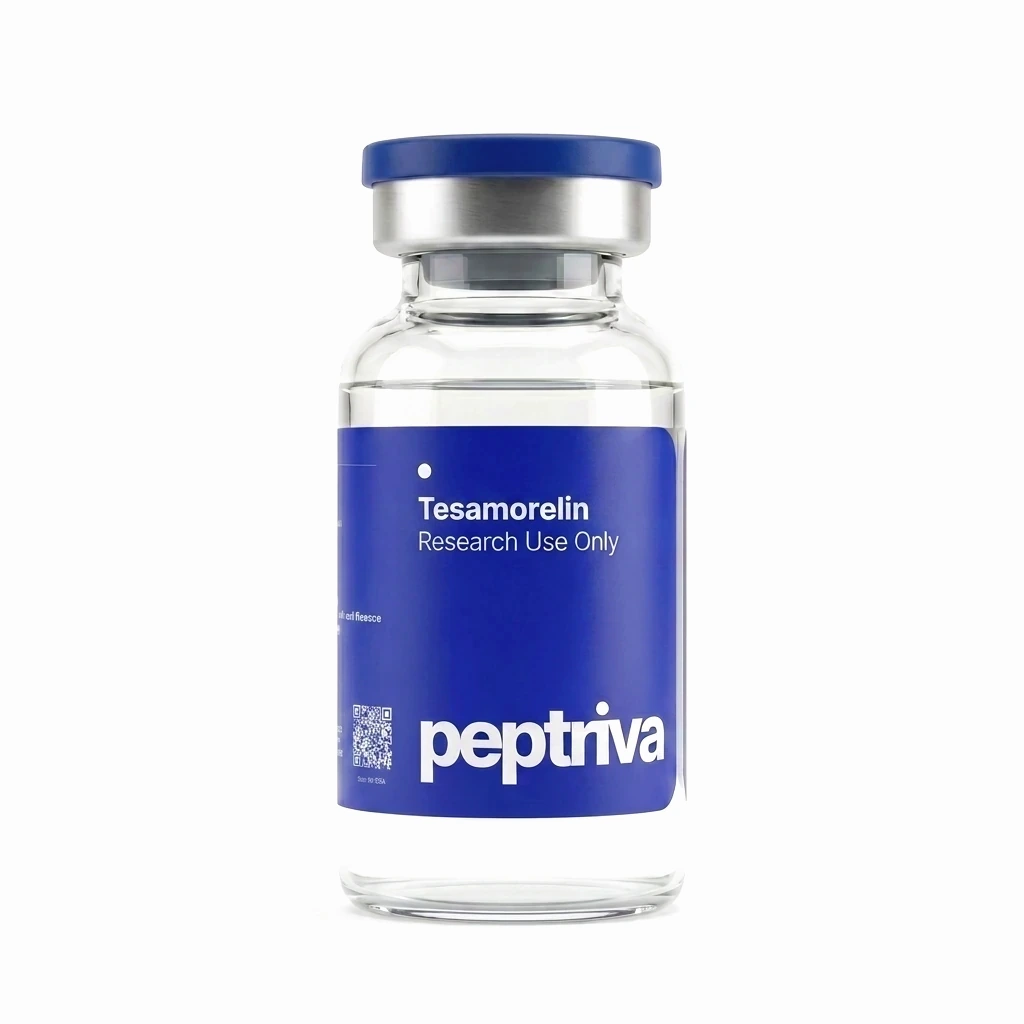
Tesamorelin
44-aa stabilized GHRH analog. The same reference compound used across the cited Phase III and mechanistic studies. COA available with each lot.
Cost and access in 2026
Tesamorelin is one of the most expensive prescription peptides on the US market. Egrifta SV runs $3,500-5,000 per month retail without insurance. Even with insurance, prior authorization and step therapy are common.
Coverage is limited to the FDA-approved HIV lipodystrophy indication. Off-label coverage for general metabolic disease, fatty liver, or body recomposition is essentially nonexistent.
This creates a notable dynamic. The molecule has the strongest evidence in its class. But the labeled indication covers a relatively small population (HIV patients with documented lipodystrophy). Research interest in off-label metabolic applications — including MASLD and general visceral adiposity — significantly exceeds the on-label market.
Off-label clinical use historically flowed through compounding pharmacies. The FDA has tightened which peptides can be compounded under section 503A. Tesamorelin's compounding status has shifted multiple times; the current rule should be verified before assuming a 503A compounding route is available.
Research-grade tesamorelin supplied for in-vitro work is a separate supply chain. It is appropriate for cell and animal model studies conducted in a laboratory setting, not for human use.
Regulatory status worldwide
Tesamorelin's status varies by region:
- FDA (US): Approved (Egrifta, Egrifta SV) for reduction of excess abdominal fat in adults with HIV-associated lipodystrophy. Original approval 2010, reformulated SV version 2019.
- Health Canada: Approved for the same HIV indication.
- EMA (EU): Pulled from the EU market by the sponsor in 2020. Commercial reasons, not safety.
- WADA: Banned under category S2 (peptide hormones and growth factors). Detection methods exist.
- Major sports leagues: Banned.
The EU withdrawal deserves a note. Theratechnologies pulled the drug because the European HIV-lipodystrophy market was too small to support distribution. It's not a safety signal. But European patients with the approved indication now have no pharmaceutical access.
What to know now
- Approval: FDA-approved 2010 (Egrifta), reformulated 2019 (Egrifta SV). The only GHRH analog with an FDA approval letter.
- Labeled use: reducing excess belly fat in adults with HIV-associated lipodystrophy.
- Pivotal data: 15-18% reduction in visceral fat at 26 weeks vs placebo, across two large Phase III trials.
- Liver effects: 12-month trial in HIV-fatty liver showed reduced liver fat and prevention of fibrosis, with rich mechanism substudies.
- 2024 modern-drug data: efficacy maintained in study participants on first-line integrase-inhibitor HIV regimens; visceral fat change −25 cm² vs +14 cm² placebo.
- Cognition trial (2025): negative. Waist shrank. Cognition didn't improve.
- Cost: ~$3,500-5,000/month retail US. Insurance only covers the HIV indication.
- WADA: Banned under S2 for athletes.
What we're watching
Three things over the next 18 months. First, whether the pipeline expansion into non-HIV fatty liver disease produces a registered Phase III readout. That would be the molecule's clearest path to a second labeled indication. Second, whether the FDA's section 503A compounding rules tighten or loosen for GHRH peptides. The decision changes off-label access overnight. Third, whether real-world data on tesamorelin in study populations on modern HIV regimens accumulates fast enough to update clinical guidelines.
References
- Russo, S. C., Ockene, M. W., Arpante, A. K., et al. (2024). Efficacy and safety of tesamorelin in people with HIV on integrase inhibitors. AIDS, 38(12), 1758–1764. https://doi.org/10.1097/QAD.0000000000003965
- Fourman, L. T., Billingsley, J. M., Agyapong, G., et al. (2020). Effects of tesamorelin on hepatic transcriptomic signatures in HIV-associated NAFLD. JCI Insight, 5(16). https://doi.org/10.1172/jci.insight.140134
- Stanley, T. L., Fourman, L. T., Wong, L. P., et al. (2021). Growth hormone releasing hormone reduces circulating markers of immune activation in parallel with effects on hepatic immune pathways in individuals with HIV-infection and nonalcoholic fatty liver disease. Clinical Infectious Diseases, 73(4), 621–630. https://doi.org/10.1093/cid/ciab019
- Fourman, L. T., Stanley, T. L., Billingsley, J. M., et al. (2021). Delineating tesamorelin response pathways in HIV-associated NAFLD using a targeted proteomic and transcriptomic approach. Scientific Reports, 11(1), 10485. https://doi.org/10.1038/s41598-021-89966-y
- Lake, J. E., La, K., Erlandson, K. M., et al. (2021). Tesamorelin improves fat quality independent of changes in fat quantity. AIDS, 35(9), 1395–1402. https://doi.org/10.1097/QAD.0000000000002897
- Ellis, R. J., Vaida, F., Hu, K., et al. (2025). Effects of tesamorelin on neurocognitive impairment in persons with HIV and abdominal obesity. Journal of Infectious Diseases, 231(5), 1230–1238. https://doi.org/10.1093/infdis/jiaf012
- Fourman, L. T., & Grinspoon, S. K. (2022). Approach to the patient with lipodystrophy. Journal of Clinical Endocrinology and Metabolism, 107(6), 1714–1726. https://doi.org/10.1210/clinem/dgac079
- Rahman, F., McLaughlin, T., Mesquita, P., et al. (2022). Effect of tesamorelin in people with HIV with and without dorsocervical fat. Journal of Clinical and Translational Science, 7(1), e40. https://doi.org/10.1017/cts.2022.515
- Gattu, A. K., & Fourman, L. T. (2025). Metabolic dysfunction-associated steatotic liver disease in people with HIV. Current Opinion in HIV and AIDS, 20(4), 350–358. https://doi.org/10.1097/COH.0000000000000952
- Fraile, J. M., Palliyil, S., Barelle, C., Porter, A. J., & Kovaleva, M. (2021). Non-alcoholic steatohepatitis (NASH) - a review of a crowded clinical landscape. Drug Design, Development and Therapy, 15, 3997–4009. https://doi.org/10.2147/DDDT.S315724
- Chege, P. M., Sokoya, T., Mwaura, B., et al. (2024). Tesamorelin reverses obesogenic metabolic effects of cART regimens combined with low-protein high-calorie diets in rats. PLOS ONE, 19(3), e0298752. https://doi.org/10.1371/journal.pone.0298752