CJC-1295 is a GHRH analog with well-characterized pharmacology and a thin human-evidence base. The mechanism is real. The randomized clinical data behind the muscle, fat-loss, and anti-aging claims circulating in grey-market literature is almost entirely absent.
CJC-1295 is a 29-amino-acid GHRH analog that stimulates pituitary GH release. The "no DAC" variant has a half-life of ~30 minutes. The "DAC" variant circulates for 6 to 8 days through albumin conjugation. The 2020–2026 literature is dominated by anti-doping detection methodology, not efficacy trials. Zero randomized controlled trials have evaluated it for muscle accretion, adiposity, or aging outcomes in that window. WADA classifies it under category S2.
The short version of how CJC-1295 got here: ConjuChem developed it in the early 2000s as a once-weekly treatment for adult growth hormone deficiency. It made it through early human safety studies. Then the program got shelved. The molecule resurfaced in research supply chains and found two audiences.
One audience: lab researchers who use it to study how growth hormone pulses behave. The other: grey-market users chasing GH-axis effects without a prescription. This guide is for the first group. The second group, in our view, is swimming upstream of a thin evidence base.
What is CJC-1295?
CJC-1295 is a modified version of the first 29 amino acids of GHRH (growth hormone-releasing hormone, the endogenous signal that stimulates pituitary GH release). Researchers substituted four amino acids to increase enzymatic resistance and extend circulating half-life. Those four substitutions give the peptide its other common name, "Modified GRF 1-29" or "Mod GRF." The no-DAC form of CJC-1295 and Mod GRF 1-29 are the same molecule.
It acts by binding the GHRH receptor on pituitary somatotrophs. Receptor occupancy triggers a burst of GH secretion via the same cAMP/PKA pathway activated by endogenous GHRH, but with greater enzymatic stability.
A 2026 review classified CJC-1295 alongside sermorelin, tesamorelin, ipamorelin, and AOD-9604 as growth-hormone secretagogues — compounds that stimulate endogenous GH release rather than supplying exogenous GH. The compounds share a common downstream target but differ substantially in half-life, receptor affinity, and regulatory standing (Rahman et al., 2026).
CJC-1295 is mechanistically credible. It really does raise GH and IGF-1. But the recent published research is dominated by anti-doping detection methods, not trials of whether it works or whether it's safe long-term.
— 2026 narrative review of growth-hormone secretagogues
"Mechanistically credible, clinically unstudied" is the most accurate one-line summary of CJC-1295 in 2026.
DAC vs no-DAC: what's the difference?
The central pharmacokinetic distinction in the CJC-1295 literature is whether the peptide carries a "DAC" linker. DAC stands for Drug Affinity Complex — a small chemical handle that binds non-covalently to albumin (the most abundant plasma protein). Since albumin has a circulatory half-life of approximately 19 days, conjugated peptides benefit from that extended residence time.
The half-life data illustrate the magnitude of the difference. Native GHRH circulates for ~7 minutes. CJC-1295 no DAC (Mod GRF 1-29) extends this to approximately 30 minutes through the four amino-acid substitutions alone. CJC-1295 DAC circulates for 6 to 8 days via the albumin-binding mechanism. That represents a roughly 400-fold difference from one chemical modification.
For a once-weekly pharmaceutical, DAC is the enabling modification. A 30-minute peptide cannot support weekly administration. For pulsatility research, DAC introduces a confound: the pituitary evolved to release GH episodically, and bathing it in continuous GHRH signaling for a week is a pharmacological artifact rather than a physiological model.
Research groups investigating pulse dynamics therefore use the no-DAC form. Healthy adults release GH in 6 to 10 discrete bursts every 24 hours, predominantly during slow-wave sleep. The short half-life of no-DAC CJC-1295 means each administered dose produces one pulse that decays before the next, preserving the episodic pattern. The DAC variant flattens those pulses into sustained elevation — appropriate for some experimental questions, but a limitation for pulse-fidelity studies.
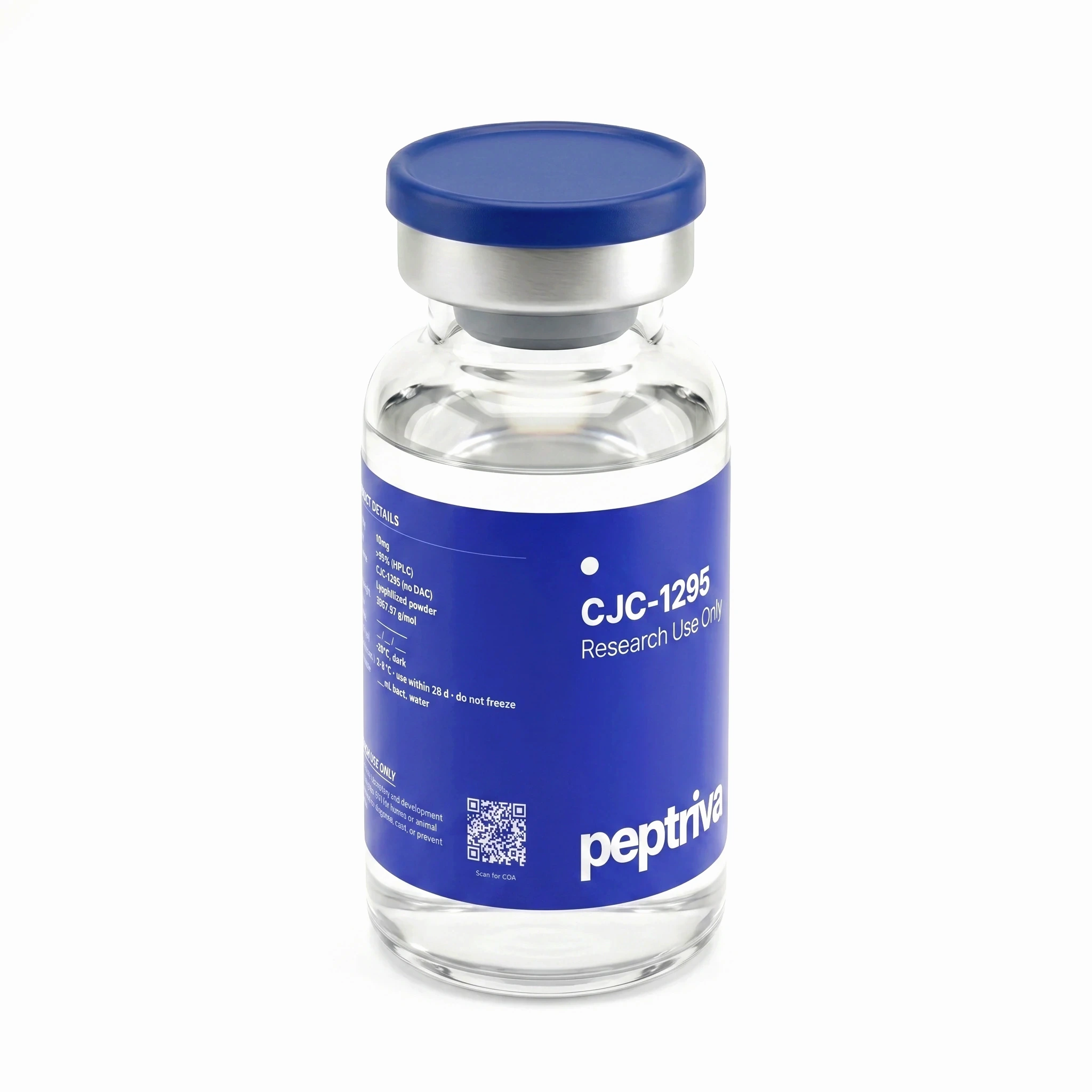
CJC-1295 (no DAC)
The same compound cited across the GHRH-analog reviews in this guide. Lab-verified identity and purity, third-party COA per lot.
Why do researchers prefer no-DAC?
The pituitary functions as a pulse generator. Healthy adults release GH in 6 to 10 discrete bursts every 24 hours, with the largest pulse occurring during the first hours of slow-wave sleep. Between bursts, circulating GH drops to near-basal levels. This episodic pattern is not incidental — downstream tissues are calibrated to respond to pulse amplitude rather than area under the curve.
Hepatic IGF-1 production, for instance, tracks GH pulse height. Continuous GH exposure — whether from recombinant GH infusion or from CJC-1295 DAC — has been shown in pharmacology studies to blunt IGF-1 output by saturating the receptor and triggering negative feedback. Pulsatile GH secretion preserves receptor sensitivity.
Most published GHRH-analog research consequently uses tesamorelin (also ~30-minute half-life) in preference to CJC-1295 DAC. CJC-1295 no DAC occupies a similar research niche: short half-life, pulse-preserving pharmacokinetics.
The practical limitation is dosing frequency. Maintaining meaningful exposure across a full day requires multiple daily administrations of the no-DAC form — a logistical constraint that has historically reduced its prevalence in grey-market use relative to the DAC variant.
CJC-1295 and ipamorelin: co-administration in the literature
A combination studied frequently in the literature pairs CJC-1295 with ipamorelin. Ipamorelin is a 5-amino-acid peptide that binds the ghrelin receptor (GHS-R1a) rather than the GHRH receptor. The mechanistic rationale for co-administration is that the two receptors activate complementary intracellular signals within pituitary somatotrophs, producing additive or synergistic GH release — mirroring the physiological co-secretion of GHRH and ghrelin that governs natural GH pulses.
A 2026 review in the American Journal of Sports Medicine reported that co-administration of CJC-1295 and ipamorelin improved muscle force in a murine model of steroid-induced muscle wasting (Mayfield et al., 2026). That represents the strongest recent body-composition signal for this combination in the published record — though the model involved pathological muscle atrophy in rodents, not resistance-trained subjects.
Mechanistic basis for co-administration. CJC-1295 activates the GHRH receptor, amplifying the "go" signal for GH pulse initiation. Ipamorelin activates GHS-R1a, increasing pulse amplitude. Studies have reported roughly 3 to 5x greater GH secretion from combined versus single-agent administration. Whether that amplified secretion produces durable downstream tissue effects — versus a transient IGF-1 elevation — has not been tested in controlled human trials.
Where does the human evidence stop?
CJC-1295 has circulated in grey-market channels since approximately 2010. Despite that long tenure, the 2020–2026 published literature on human efficacy is essentially absent.
The recent literature divides into two categories. The first is anti-doping detection methodology: multiple papers have described validated analytical methods for identifying CJC-1295 in athlete urine and blood matrices (Memdouh et al., 2021; Coppieters et al., 2022; Cristea et al., 2023; Thomas et al., 2024). The volume of anti-doping research indicates that regulators regard misuse as sufficiently prevalent to warrant sustained analytical investment.
The second category is narrative reviews and book chapters that discuss CJC-1295 as part of broader peptide pharmacology overviews (Sinha et al., 2020; Mavrych et al., 2026; Mendias and Awan, 2026). These contributions contextualize the compound within its class but contribute no new controlled efficacy data.
No randomized controlled trial of CJC-1295 for muscle accretion, adiposity, aging outcomes, sleep, recovery, or cognitive function has been published. That evidentiary gap is the defining characteristic of the compound's current research standing.
Where this falls short. CJC-1295 raises GH and IGF-1. That's a biomarker effect, not a clinical outcome. Whether the elevation translates into more muscle, less fat, better sleep, or anti-aging effects has never been tested in a real human trial. The DAC version showed declining GH response over multi-week dosing in older pharmacology data, hinting at tolerance buildup. We don't know if no-DAC dosing avoids that. The molecule is investigational by the strictest reading. Anyone calling it therapy is ahead of the data.
Putative effects investigated in the literature
The following outcomes have been attributed to CJC-1295 in grey-market discourse. The evidence base for each is summarized below.
- Lean body mass accretion. Theoretical basis: elevated IGF-1 is anabolic in skeletal muscle. No controlled human trials have tested this specifically for CJC-1295.
- Adiposity reduction. The only RCT-backed body-composition data in the GHRH-analog class involves tesamorelin in HIV-related visceral fat redistribution. No equivalent data exist for CJC-1295 in otherwise healthy research subjects.
- Sleep architecture and recovery. Mechanistically plausible: the largest physiological GH pulse occurs during slow-wave sleep onset. No controlled sleep-study data have been published for CJC-1295 specifically.
- GH and IGF-1 biomarker elevation. Supported by older pharmacokinetic studies, primarily for the DAC form. Biomarker shifts do not automatically imply downstream tissue benefit.
- Aging-related outcomes. No human RCT data. The hypothesis derives from the observed age-related decline in GH secretion; whether pharmacological restoration of GH levels reverses aging-related physiology has not been demonstrated in controlled trials.
In summary, published studies have confirmed that CJC-1295 elevates GH and IGF-1 as biomarkers. Whether those elevations translate to clinical outcomes in healthy research subjects has not been measured in randomized controlled trials, which is why the compound is consistently classified as investigational in the literature.
Safety considerations and documented risks
The expected adverse-event profile for agents that elevate GH and IGF-1 is well characterized from decades of recombinant GH pharmacology. Studies have documented edema, arthralgia, paresthesias, carpal tunnel syndrome, and worsened insulin sensitivity as class effects. Whether CJC-1295 reproduces these at investigational doses has not been formally quantified, as no dedicated safety trials have been completed.
Two longer-term concerns have been identified in the broader GH-axis literature.
- IGF-1 and oncologic risk. Epidemiological studies have observed associations between chronically elevated IGF-1 and increased rates of colorectal, prostate, and breast cancers. This is a class-level concern for GH-axis modulation, not specific to CJC-1295. Whether intermittent, pulse-synchronized IGF-1 elevation carries equivalent risk to continuous elevation has not been established.
- Receptor desensitization. Sustained GHRH receptor stimulation is hypothesized to downregulate somatotroph responsiveness. Older pharmacokinetic data for the DAC form showed declining GH responses over multi-week observation periods. Whether the no-DAC form, with its shorter half-life and interval between doses, avoids this is not established.
A 2026 review in the Journal of Sports Medicine and Physical Fitness noted that the unregulated supply chain amplifies these risks (Coutinho et al., 2026). The review identified cardiovascular strain, insulin resistance, dyslipidemia, and psychiatric instability as emerging concerns in the literature, and flagged manufacturing quality and contamination as documented hazards in unregulated channels — distinct from the intrinsic properties of the molecule.
CJC-1295 (no DAC)
Modified GRF 1-29, the 29-aa GHRH analog. The same reference compound used across the cited preclinical studies. COA available with each lot.
What's the regulatory status?
CJC-1295 isn't approved by the FDA, the EMA, or any other major regulator for any condition. ConjuChem's clinical development stopped in the late 2000s. The published reason: a fatal adverse event in an unrelated CJC-1131 trial prompted broader scrutiny of the CJC platform. No new registered clinical trial has appeared on ClinicalTrials.gov in the last decade.
In sport, CJC-1295 is listed on the WADA Prohibited List under category S2 (peptide hormones, growth factors, and related substances). Published detection methods operate at sub-nanogram-per-milliliter urine concentrations. The sustained volume of detection research published across the 2020s reflects continued analytical development in this area.
The FDA added CJC-1295 to its "bulks not eligible for 503A compounding" list. This designation means licensed compounding pharmacies cannot legally prepare the compound for clinical administration. That regulatory action effectively removed CJC-1295 from medical practice channels, limiting its availability to research-only supply.
What to know now
- Identity: a 29-amino-acid GHRH analog (Mod GRF 1-29) that stimulates pituitary GH secretion via the GHRH receptor.
- DAC vs no DAC: the DAC linker extends half-life from ~30 minutes (no DAC) to 6–8 days (DAC). Studies of pulsatile GH dynamics use the no-DAC form to preserve physiological pulse patterns.
- Co-administration studies: CJC-1295 + ipamorelin has been investigated as a dual-receptor combination for synergistic GH pulse amplification.
- Human RCT data: zero trials for muscle accretion, adiposity, or aging outcomes. Published data are limited to biomarker (GH/IGF-1) pharmacokinetics.
- FDA status: not approved for any indication. Development halted. Listed on the FDA bulks-not-eligible-for-503A-compounding list.
- WADA status: prohibited under S2. Multiple validated detection methods in urine and blood have been published.
- Class-level risks: edema, arthralgia, paresthesias, insulin resistance — documented for the GH-axis class; no dedicated CJC-1295 safety trial data available.
What we're watching
Three signals to track over the next 18 months. First: whether any GHRH analog enters a registered Phase II or III trial for a non-HIV indication. Tesamorelin's potential expansion into NASH/MASLD (a liver disease tied to obesity) is the most plausible path back into mainstream research. Second: whether the FDA changes the 503A compounding status of any peptide in this class. A move in either direction would signal regulator confidence. Third: whether independent labs reproduce the CJC-1295 + ipamorelin synergy in non-rodent models. That's the gap between mechanism and translational signal.
References
- Memdouh, S., Gavrilović, I., Ng, K., Cowan, D., & Abbate, V. (2021). Advances in the detection of growth hormone releasing hormone synthetic analogs. Drug Testing and Analysis, 13(11–12), 1871–1887. https://doi.org/10.1002/dta.3183
- Sinha, D. K., Balasubramanian, A., Tatem, A. J., et al. (2020). Beyond the androgen receptor: the role of growth hormone secretagogues in the modern management of body composition in hypogonadal males. Translational Andrology and Urology, 9(Suppl 2), S149–S159. https://doi.org/10.21037/tau.2019.11.30
- Coppieters, G., Deventer, K., Polet, M., Van Eenoo, P., & Judák, P. (2022). An antibody-free, ultrafiltration-based assay for the detection of growth hormone-releasing hormones in urine. Journal of Pharmaceutical and Biomedical Analysis, 214, 114726. https://doi.org/10.1016/j.jpba.2022.114726
- Cristea, C. D., Radu, M., Toboc, A., Stan, C., & David, V. (2023). Cationic exchange SPE combined with triple quadrupole UHPLC-MS/MS for detection of GHRHs in urine samples. Analytical Biochemistry, 682, 115336. https://doi.org/10.1016/j.ab.2023.115336
- Thomas, A., Walpurgis, K., & Thevis, M. (2024). Chromatographic-mass spectrometric analysis of peptidic analytes in doping control urine samples. Journal of Mass Spectrometry, 59(1), e4996. https://doi.org/10.1002/jms.4996
- Mayfield, C. K., Bolia, I. K., Feingold, C. L., et al. (2026). Injectable peptide therapy: A primer for orthopaedic and sports medicine physicians. American Journal of Sports Medicine, 54(1), 223–229. https://doi.org/10.1177/03635465251357593
- Mendias, C. L., & Awan, T. M. (2026). Safety and efficacy of approved and unapproved peptide therapies for musculoskeletal injuries and athletic performance. Sports Medicine. https://doi.org/10.1007/s40279-026-02437-0
- Mavrych, V., Shypilova, I., & Bolgova, O. (2026). Therapeutic peptides in gerontology: mechanisms and applications for healthy aging. Frontiers in Aging, 7, 1790247. https://doi.org/10.3389/fragi.2026.1790247
- Coutinho, L. F. D., De Oliveira Neves, L. F., & Camilo, R. P. (2026). A new era of doping? Use of peptide and peptide-analog drugs in recreational and professional sport and bodybuilding. Journal of Sports Medicine and Physical Fitness. https://doi.org/10.23736/S0022-4707.26.17773-1
- Rahman, O. F., Lee, S. J., & Seeds, W. A. (2026). Therapeutic peptides in orthopaedics: Applications, challenges, and future directions. Journal of the American Academy of Orthopaedic Surgeons Global Research & Reviews, 10(1). https://doi.org/10.5435/JAAOSGlobal-D-25-00236