Most "best peptide companies" articles rank vendors subjectively, with the writer's favorite supplier conveniently in first place. That isn't useful, and it isn't honest. The right question is what a researcher actually needs: proof of what's in the vial, a testing chain you can verify, and a paper trail of operating history. Then you score any vendor against those criteria in fifteen minutes. This article gives you the rubric and applies it transparently to four named operators, us included.
You can score any peptide company against eight criteria, all yes/no checkable from the vendor's own website. We score Peptriva below with evidence links, and tell you exactly where on each competitor's site to score them yourself. No vendor scores 8/8, us included. The honest framing is which trade-offs each vendor makes.
Quick answer: The "best" peptide company depends on which of the eight criteria matter most for your work. Score any vendor in fifteen minutes by checking their site for an ISO 17025 third-party COA, batch-matched verification, publicly named labs, Ahrefs Domain Rating, years in business, a published return policy, disclosed lab methods, and an llms.txt at site root. Peptriva is new (2026) but documents 8/8. Established competitors trade newness for tenure but vary on documentation. Verify each yourself.
Subjective rankings are what most SEO content in this category delivers. A "top 5 best peptide vendors" listicle, ranked "based on extensive research," tells you nothing about whether vendor #1 ships a real ISO 17025 COA.
The rubric below flips that. It's a fixed set of binary checks where you score the vendor yourself from publicly visible evidence. We score Peptriva with links to the proof, and tell you which page on each competitor's site to visit. We don't make factual claims about competitor documentation we haven't independently audited.
The eight criteria, in detail
Each criterion below is a yes/no check. We tell you what it is, why it matters, how Peptriva scores with a link to the evidence, and exactly where to look on each competitor's site to score them yourself.
1. ISO/IEC 17025–accredited third-party COA
The COA proves what's in the vial. Two attributes separate a real COA from a marketing prop. It must be signed by a third-party testing laboratory (not the vendor's own QC team), and that lab must carry ISO/IEC 17025:2017 accreditation. Internal-only QC is a starting point, not corroboration.
Peptriva: yes. Every lot is tested by an independent, ISO/IEC 17025–accredited third-party lab, with methods documented on the Quality & Methods page. The COA is signed by the testing lab, not by us.
Score competitors: visit the vendor's "Quality," "Testing," or "COA" page (usually footer-linked). Look for an independent lab name and confirm ISO/IEC 17025 accreditation in the A2LA accredited-laboratory directory. No third-party lab named? Score no.
2. Batch-matched COA available before purchase
Some vendors publish a generic example COA. Some send the lot-specific COA only with the shipment. Some refuse pre-purchase entirely. You need to verify the exact lot you're about to buy. That's "batch-matched." A generic COA tells you nothing about the vial that lands on your bench.
Peptriva: yes. Every lot has its own COA, searchable via the /verify lot lookup tool. The /coa page shows the template with a representative example. Current-lot COAs are emailable pre-purchase.
Score competitors: on a product page, look for "Download COA" or a lot-lookup tool. Email the vendor and ask for the current lot's COA on a specific peptide. A "yes, here's the PDF" within one business day is the green light. "Ships with the order" or silence is a no.
3. Lab partners publicly named on the website
Common third-party labs for U.S. peptide suppliers: Eurofins, Alcami, SGS, Charles River, BioReliance. All ISO 17025–accredited and verifiable through their national accreditation bodies. A supplier refusing to name their lab is either fabricating the chain or contracting with a lab unwilling to be named publicly. Neither is good.
Peptriva: in progress. Every lot is third-party tested with the COA signed by the testing lab; as Peptriva brings its own ISO 17025 testing program online, the specific lab will be named on the Quality & Methods page.
Score competitors: on each "Quality" or "Testing" page, search for "Eurofins," "Alcami," "SGS," "Charles River," or "BioReliance." Named lab = yes. "Our independent partners" without specifics = no.
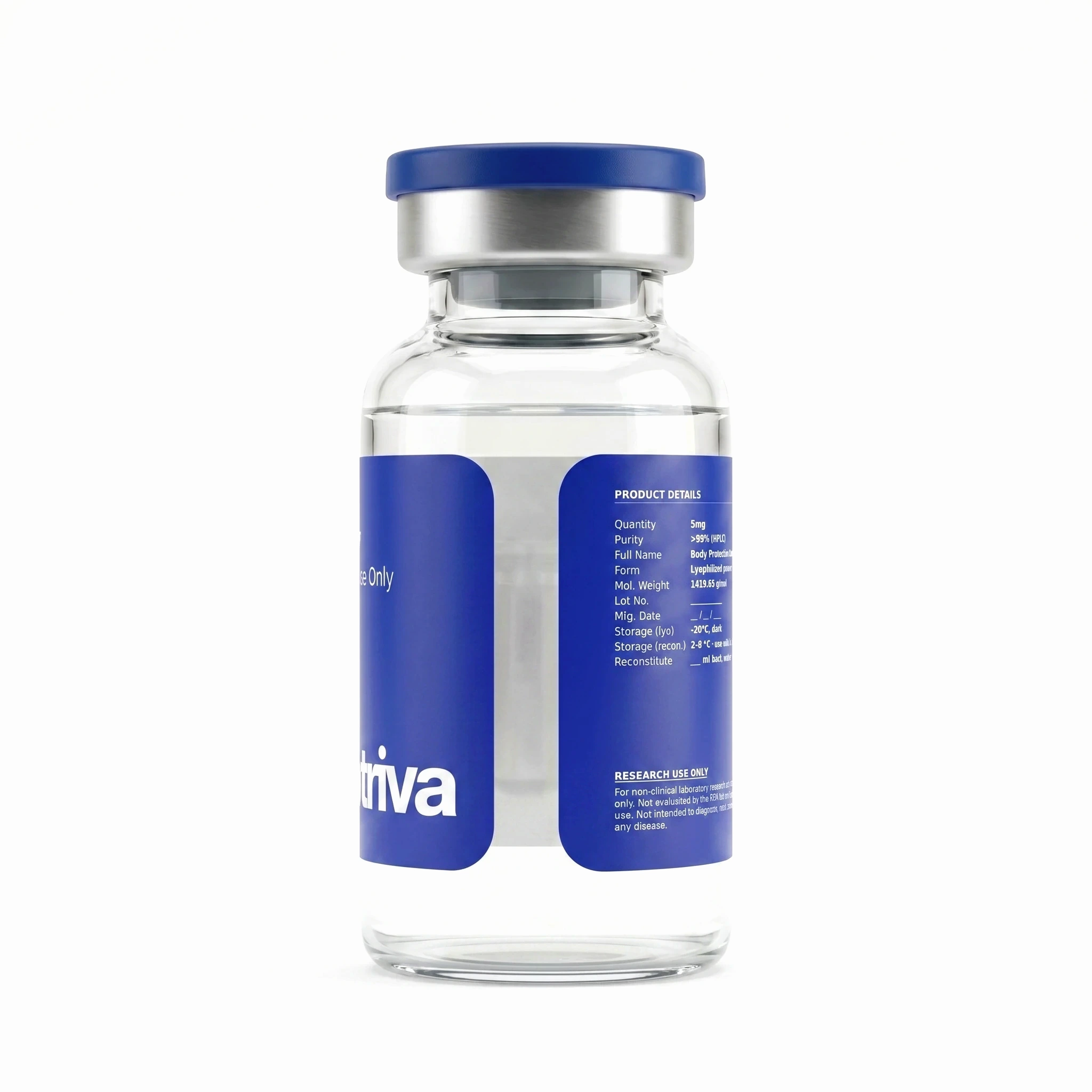
BPC-157
Score Peptriva on the eight criteria yourself — every claim above links to public evidence on /quality, /verify, and /coa. The BPC-157 product page is the cleanest place to see all three in action: pentadecapeptide identity confirmed by third-party LC-MS, ≥99% HPLC purity, lot-specific COA downloadable before purchase.
4. Ahrefs Domain Rating — proxy for inbound citation
Ahrefs Domain Rating (DR) is a 0–100 score of a site's backlink profile. For peptide vendors it's a rough proxy for citation accumulation across research forums and supplier directories. DR usually tracks with time in business. It isn't a quality measure on its own. A low-DR vendor can have great docs, and a high-DR vendor can have weak QC.
Peptriva: new. Our May 2026 snapshot sits around DR 5, reflecting our 2026 launch. Time will move this. Documentation depth won't change with time.
Score competitors: the free Ahrefs Website Authority Checker returns DR per root domain. May 2026 snapshot for the three named here: BiotechPeptides ~61, CorePeptides ~67, Phoenix Pharmaceuticals ~34.
5. Time in business — verifiable operating history
Longer tenure means more lot iterations reviewed and more time for an FDA warning letter to surface if compliance is weak. Tenure isn't a quality signal on its own, but it shifts the verification problem. For new vendors, you lean on documentation. For old vendors, you lean on track record.
Peptriva: new (2026). The documentation chain above is what a new operator owes you. The COA does the work that tenure does for established ones.
Score competitors: the About page (founding-year statement) plus ICANN WHOIS domain creation date as a lower bound. Approximate tenure for the three competitors per WHOIS: BiotechPeptides ~2017, CorePeptides ~2014, Phoenix Pharmaceuticals ~1992.
6. Published return or quality-guarantee policy
Research peptides typically aren't returnable once opened. Chain of custody breaks the moment you puncture the vial. But the policy should be published. No return-policy page means no defined recourse for damaged crimps, missing COAs, or out-of-spec material on retest.
Peptriva: yes. Return and quality-guarantee policy published with explicit trigger conditions. Lots that fail to match their COA on independent retest are replaced.
Score competitors: footer link labeled "Returns," "Refund Policy," or "Quality Guarantee." The policy should state (a) trigger conditions, (b) claim window, (c) resolution form. No such page = no.
7. Lab testing methods disclosed
The expected analytical chain for research-grade peptides: HPLC (high-performance liquid chromatography, the standard purity test) for purity, LC-MS or MALDI-TOF for identity confirmation, Karl Fischer titration for water content, ion chromatography or NMR for counterion identification, and the LAL assay for endotoxin per USP <85>. A vendor that publishes methods is committing to a verifiable claim.
Peptriva: yes. The Quality & Methods page lists reverse-phase HPLC (target ≥98%, typically ≥99%), LC-MS identity, Karl Fischer water, ion chromatography counterion, and LAL endotoxin. Each method ties to a specific COA line.
Score competitors: the Quality or Methods page should name HPLC and mass spec at minimum. "Tested for purity and identity" without naming methods = no.
8. llms.txt published at site root for AI-agent discoverability
The /llms.txt file is a 2024-era convention for sites that want to be machine-readable by AI agents (ChatGPT browse, Perplexity, Claude, Google AI Overviews) without forcing them to crawl 150+ pages. AI-agent traffic is increasingly the first stop for buyers asking "is X vendor legit." It's a small signal, not load-bearing, but its presence shows investment in modern discoverability.
Peptriva: yes. The /llms.txt file is live and regenerates automatically when products or articles change.
Score competitors: append /llms.txt to the root domain. HTTP 200 with structured content = yes. 404 or empty = no.
Where this falls short: The rubric scores documentation, not what's actually in the vial. A vendor can pass 8/8 on paper and still ship a bad lot if the lab partner makes a sampling error or the manufacturer changes a supplier mid-batch. The rubric is necessary but not sufficient. The only way to fully verify a specific vial is independent retest, which most buyers can't afford to run.
The single fastest way to evaluate a peptide vendor is to ask for the current lot’s Certificate of Analysis before purchase. If the answer is anything other than “yes, here it is,” that’s the answer.
— Peptriva Buyer’s Guide
How the named competitors fit the rubric
Factual context, not a quality judgement. BiotechPeptides: established U.S. peptide supplier, Ahrefs DR ~61 (May 2026), operating since approximately 2017. CorePeptides: one of the longer-running U.S. peptide-focused operators, DR ~67, since approximately 2014 per WHOIS. Phoenix Pharmaceuticals: primarily a reference-chemical and research-antibody supplier with peptides as one of several catalogs, since approximately 1992. DR ~34 reflects an academic-research traffic profile, not direct-to-consumer SEO.
- Weight documentation highest? Criteria 1, 2, 3, 6, 7, and 8 are the documentation rubric. Score each vendor; the answer is what their pages say.
- Weight tenure highest? Criteria 4 and 5 put older operators above newer ones by definition. Peptriva (2026) sits below the established names on these axes.
- Weight a balance? Apply all eight and weight as you choose. No vendor scores 8/8. The honest answer is which trade-off (documentation depth versus accumulated tenure) matters most for your work.
A fifteen-minute vendor-evaluation workflow
- (2 min) Footer scan. Open the homepage. Note which pages exist in the footer: Quality / Methods, COA, Returns, About, Lab Partners. Each linked page is a quick yes; each missing one is a flag.
- (3 min) COA & testing page. Is the third-party lab named? ISO 17025–accredited? Is the COA batch-matched or generic? Which analytical methods are disclosed?
- (2 min) Returns & guarantee. Are trigger conditions, time window, and resolution form explicit?
- (3 min) Operating history. Cross-reference the About-page founding year with ICANN WHOIS.
- (2 min) DR & llms.txt. Run the domain through the Ahrefs Authority Checker. Append
/llms.txtto the root. - (3 min) Pre-purchase COA request. Email asking for the current lot's COA. Time the response. A "yes, here's the PDF" within one business day is the single highest-information check in this rubric.
The Peptriva catalog
Twenty-two research-grade peptides across the six product categories — every SKU shipped with a batch-matched COA from an independent third-party lab. Crypto checkout (card processors prohibit peptide merchant accounts), U.S. domestic fulfillment, 2–5 day shipping. The catalog is where you see the eight-criterion rubric in action across the full range, not just the BPC-157 flagship.
Frequently asked questions about evaluating peptide companies
What makes a peptide company reputable?
Eight criteria, all yes/no checkable from the vendor's website: ISO 17025 third-party COA, batch-matched COA pre-purchase, lab partners publicly named, established domain authority, verifiable tenure, published return policy, disclosed testing methods, and a published llms.txt. No vendor scores 8/8. The honest framing is which trade-offs each vendor makes.
Is BiotechPeptides legit?
BiotechPeptides is an established U.S. peptide supplier with an Ahrefs Domain Rating ~61 (May 2026) and operating history to approximately 2017. Whether they hit your quality bar depends on the same eight criteria. Check their site for an ISO 17025 third-party COA, batch-matched pre-purchase, named lab partners, and a published return policy.
Is CorePeptides legit?
CorePeptides is one of the longer-running U.S. peptide suppliers. DR ~67 (May 2026), tenure to approximately 2014. Apply the eight-criterion rubric. Check the COA page, batch-matched download, named lab, and ISO 17025 accreditation. Domain authority and longevity are positive signals, but they don't substitute for verifying the documentation chain.
What's the difference between Peptriva and BiotechPeptides?
Peptriva is a newer 2026 supplier whose moat is documentation transparency. ISO 17025 COA on every lot tested by an independent third-party lab, batch-matched verification via /verify and /coa, plus a published llms.txt. BiotechPeptides is an established operator with a higher Ahrefs DR (~61 vs our ~5) reflecting its 2017+ tenure. Different axes.
Should I buy peptides from Phoenix Pharmaceuticals?
Phoenix Pharmaceuticals is one of the oldest research-peptide and antibody suppliers in the U.S., dating to approximately 1992. DR ~34 reflects an academic-research traffic profile, not direct-to-consumer SEO. Apply the same eight criteria. Their long tenure is a positive signal; the rubric tells you what else to look for.
How do I know a vendor's COA is real?
Four checks. The lot number matches the vial label. The COA is signed by a named third-party laboratory, not the supplier. The named lab is verifiable as ISO 17025–accredited via A2LA or the equivalent national registry. The HPLC purity is shown with two-decimal precision plus the chromatogram trace. See our COA guide for the line-by-line walkthrough.
What’s the best peptide company in 2026?
No single "best." The right vendor depends on which of the eight criteria matter most for your work. Documentation transparency favors one set of vendors; operating tenure and DR favor another. Apply the rubric to the vendors you're considering and let the evidence rank them.
What to know now
- There is no objectively “best” peptide company. There is a rubric of eight verifiable criteria. Score the vendors you’re considering yourself.
- Documentation is the load-bearing axis. Criteria 1, 2, 3, and 7 (ISO 17025 third-party COA, batch-matched verification, named labs, disclosed methods) most strongly correlate with whether the vial contains what the label claims.
- DR and tenure are backward-looking. They measure citation accumulation, not current lot quality. Useful as triangulation; not primary.
- llms.txt is a small signal, not load-bearing. Its absence doesn’t disqualify a competitor; its presence indicates investment in modern discoverability.
- The fifteen-minute workflow above is the actual answer to “which peptide company should I use.” Subjective rankings online aren’t.
- Pre-purchase COA request is the highest-information single check. One email answers most of the eight criteria at once.
What we’re watching
Three developments worth tracking. First, llms.txt adoption across research-chemical suppliers. Vendors without machine-readable indices will drift out of the AI Overview, Perplexity, and Claude browse channels as AI-agent traffic grows. Second, convergence of research-grade COAs toward ICH Q3A/B impurity reporting, which would force every vendor to characterize impurities above 0.1% by mass. Third, the rise of third-party verification platforms. Independent retest services would turn criterion 2 (batch-matched COA pre-purchase) into a post-purchase verification chain too.
References
- International Organization for Standardization. (2017). ISO/IEC 17025:2017 — General requirements for the competence of testing and calibration laboratories. https://www.iso.org/standard/66912.html
- American Association for Laboratory Accreditation (A2LA). Accredited laboratory directory. https://a2la.org/directory-search/
- United States Pharmacopeia. (2022). General Chapter <85>: Bacterial endotoxins test. USP-NF. https://www.usp.org/
- United States Pharmacopeia. (2022). General Chapter <1503>: Quality attributes of therapeutic peptides. USP-NF. https://www.usp.org/
- International Council for Harmonisation. (2022). ICH guideline Q3A(R2): Impurities in new drug substances. https://www.ich.org/page/quality-guidelines
- Ahrefs. What is Domain Rating (DR) — SEO Glossary. https://ahrefs.com/blog/domain-rating/
- Ahrefs. Free Website Authority Checker. https://ahrefs.com/website-authority-checker
- Internet Corporation for Assigned Names and Numbers (ICANN). WHOIS lookup. https://lookup.icann.org/
- U.S. Food and Drug Administration. Warning Letters database. https://www.fda.gov/inspections-compliance-enforcement-and-criminal-investigations/warning-letters
- World Anti-Doping Agency. (2026). The Prohibited List. https://www.wada-ama.org/en/prohibited-list
- Verlander, M. (2007). Industrial applications of solid-phase peptide synthesis — a status report. International Journal of Peptide Research and Therapeutics, 13(1–2), 75–82. https://doi.org/10.1007/s10989-006-9075-7
- Józwiak, M., Bauer, M., Kamysz, W., & Kleczkowska, P. (2025). Multifunctionality and possible medical application of the BPC 157 peptide — literature and patent review. Pharmaceuticals, 18(2), 185. https://doi.org/10.3390/ph18020185