In September 2025, SS-31 (elamipretide) became an FDA-approved drug. The agency cleared Forzinity™ for Barth syndrome, a rare mitochondrial disease. That makes it the third FDA-approved peptide we cover here.
SS-31 is a four-amino-acid peptide that targets mitochondria, the energy-producing organelles in eukaryotic cells. Stealth BioTherapeutics developed it as Forzinity™, and the FDA approved it in September 2025 for study participants with Barth syndrome who weigh ≥30 kg. Long-term safety data derives from 168 weeks of treatment in 8 study participants. A larger trial in primary mitochondrial myopathy missed its primary endpoint, but a subgroup analysis identified a responder population. The grey-market “SS-31 longevity peptide” positioning extends beyond what the peer-reviewed trials support.
Here's why elamipretide matters. Most peptides we cover never make it through clinical trials. SS-31 did. It went through multiple Phase III studies, failed its first big trial, found a responder subgroup, and finally won approval for a rare disease.
That's a rare arc in this field. And it's the appropriate context for evaluating the “SS-31 for athletic performance” marketing circulating online. The approved drug treats one specific genetic disease. Grey-market sourcing is a separate matter.
What is SS-31 doing in the mitochondrion?
SS-31 is tiny. Just four amino acids and a molecular weight of ~640 g/mol. The sequence is D-Arg-Dmt-Lys-Phe-NH₂, and two structural quirks explain how it works.
First, the molecule uses D-amino acids and methylated tyrosine. That makes it resistant to the enzymes (called proteases) that normally chew up peptides in the bloodstream. SS-31 survives long enough to reach its target.
Second, it carries an alternating charge pattern that lets it cross cell membranes and concentrate inside mitochondria. Once there, it binds a specific lipid called cardiolipin.
So what's cardiolipin? It's the signature lipid of healthy mitochondria — the scaffolding that holds the energy-producing machinery in place. When cells are stressed by aging, disease, or genetic defects, cardiolipin becomes damaged. The scaffolding collapses. ATP production drops. Free radicals climb.
A 2025 review in the International Journal of Molecular Sciences by Tung and colleagues (Tung et al., 2025) lays this out clearly. SS-31 binds cardiolipin, stabilizes the scaffolding, and restores energy output. It's the cleanest molecular story we've seen for any peptide in this Research Library.
Elamipretide's mechanism is the cleanest molecular story in mitochondrial pharmacology: direct cardiolipin binding, cristae stabilization, electron-transport-chain preservation. The translational question is which patients have failing-cardiolipin biology that this peptide can rescue.
— Tung et al., International Journal of Molecular Sciences, 2025
The Stealth BioTherapeutics development story.
SS-31's journey took over a decade. Stealth originally called it MTP-131 and tested it across four conditions: heart failure, primary mitochondrial myopathy, Barth syndrome, and dry age-related macular degeneration.
Three of those programs are worth a closer look. They show how drug development really works.
MMPOWER-3: the trial that failed
MMPOWER-3 was a Phase III trial in primary mitochondrial myopathy. Adults with genetic mitochondrial disease received either elamipretide 40 mg/day or placebo for 24 weeks. The goal was to improve walking distance and reduce fatigue.
It missed both targets (Karaa et al., 2023). For most drug programs, that's the end.
But Stealth dug deeper. A pre-specified subgroup analysis (Karaa et al., 2024) found that study participants with one type of genetic defect responded, while those with a different mutation type did not.
The responders had “mtDNA replisome” mutations (POLG and TWNK genes). They walked 25.2 m farther vs. 2.0 m on placebo. The subset with chronic eye-muscle weakness did even better at 37.3 m vs. -8.0 m (p=0.0024).
That is the canonical example of how a negative Phase III trial can generate a focused follow-up hypothesis. The NuPOWER Phase III is now testing the responder hypothesis in those specific subject populations.
TAZPOWER: the trial that worked
TAZPOWER ran in Barth syndrome, a rare genetic disease caused by mutations in the TAZ gene. The 28-week trial led to a 168-week open-label extension. Of 10 study participants who entered the extension, 8 reached week 168.
The results (TAZPOWER OLE, 2024) showed lasting improvements in walking distance, fatigue, muscle strength, heart function, and cardiolipin biomarkers.
This is the dataset that won FDA approval. The cohort is tiny because Barth syndrome itself is rare. But the mechanism match is unusually direct: SS-31 binds cardiolipin, and Barth syndrome is a cardiolipin-remodeling disease.
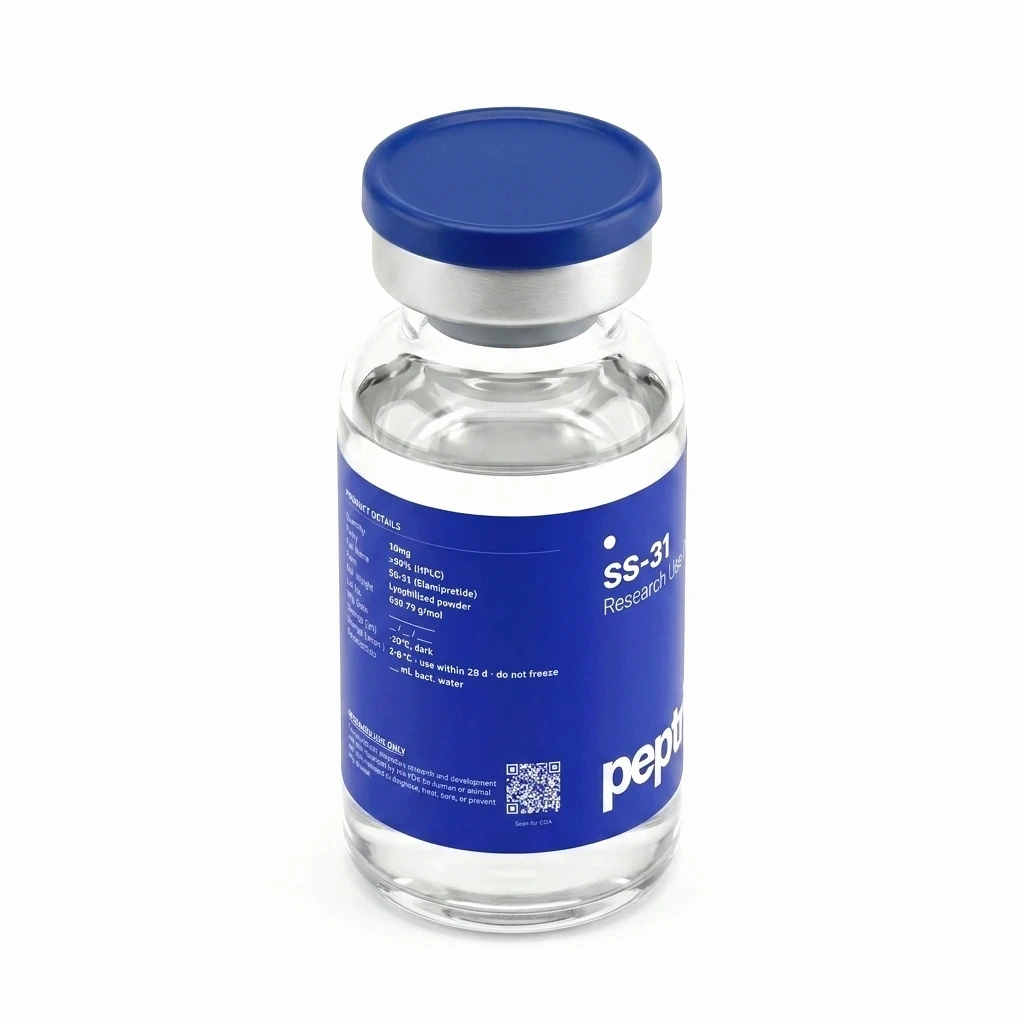
SS-31
The same mitochondria-targeting tetrapeptide cited across the Stealth BioTherapeutics Phase III trials in this review. Lab-verified identity and purity for in-vitro cardiolipin and mitochondrial-function assays.
September 2025: the FDA accelerated approval.
In September 2025, the FDA granted accelerated approval to Forzinity™ for improving muscle strength in Barth syndrome patients weighing 30 kg or more. It's the third FDA-approved peptide we cover, after tesamorelin and bremelanotide. And it's the first approved treatment for Barth syndrome ever.
The Shirley 2025 review in Drugs (Shirley, 2025) walks through the regulatory history. The approval rests on TAZPOWER plus the 168-week extension, with supporting biomarker data.
What does “accelerated approval” mean? The FDA can approve a drug based on a surrogate endpoint (like walking distance) that's likely to predict real clinical benefit. The catch: Stealth must run confirmatory trials after launch. If those trials don't pan out, the FDA can pull the drug.
What Barth syndrome is — and why elamipretide fits.
Barth syndrome is the textbook case for a mitochondrial peptide. Mutations in the TAZ gene break the enzyme that finishes building cardiolipin. The result: malformed cardiolipin, collapsed mitochondrial structure, weak heart muscle, weak skeletal muscle, and low white blood cell counts.
It's an X-linked disease, so it almost always affects boys. Symptoms usually appear in infancy. Without treatment, kids historically didn't live long. Better cardiac care extended survival, but nothing addressed the underlying mitochondrial defect.
The disease is rare: about 1 in 300,000-400,000 live male births. Before Forzinity, treatment meant managing symptoms. Nothing more.
SS-31 doesn't fix the broken TAZ gene. It binds the malformed cardiolipin that the broken enzyme produces. By stabilizing what's there, it preserves enough mitochondrial function to drive measurable strength gains. That's what TAZPOWER showed.
The Barth syndrome story in one sentence: a cardiolipin-binding peptide developed for broad mitochondrial diseases turned out to work cleanest in the one disease where cardiolipin damage is the genetic root cause. A 168-week extension in 8 patients was enough to win FDA approval.
The aging study that didn't move biological age.
A 2025 paper in Aging Cell (Mitchell et al., 2025) tested SS-31 in aged mice for 8 weeks. The peptide reduced frailty. It improved cardiac function. It boosted skeletal muscle endurance.
But it didn't move the molecular clocks. DNA methylation age and transcriptomic age both stayed put.
Read that result two ways. First, it's a reality check on “biological age reversal” marketing. Functional improvements are not the same as turning back a methylation clock. Second, it raises a fair question: are those molecular clocks even the right way to measure aging interventions? Maybe what matters is whether the animal lives better, not whether a software readout drops by a year.
Where this falls short: grey-market SS-31 vs prescription Forzinity.
What the data doesn't show. The clinical evidence supports SS-31 in specific rare mitochondrial diseases. It does not support daily use by healthy adults for athletic performance or general “mitochondrial health.” The FDA-approved label covers exactly one indication: Barth syndrome in patients ≥30 kg. Everything else is investigational or grey-market.
The marketing positioning of “SS-31” as a longevity or performance peptide runs well past the supportive evidence. The Phase III trials targeted rare diseases with specific genetic profiles. None of that data transfers to healthy adults seeking better workouts.
Grey-market “SS-31” sourced from research-chemical vendors is not equivalent to prescription Forzinity. The quality control, dosing specifications, and clinical context all differ.
For genuine mitochondrial-disease indications, Stealth BioTherapeutics has multiple Phase III studies in active enrollment as of mid-2026; clinical trial enrollment represents the appropriate pathway for investigated therapeutic use.
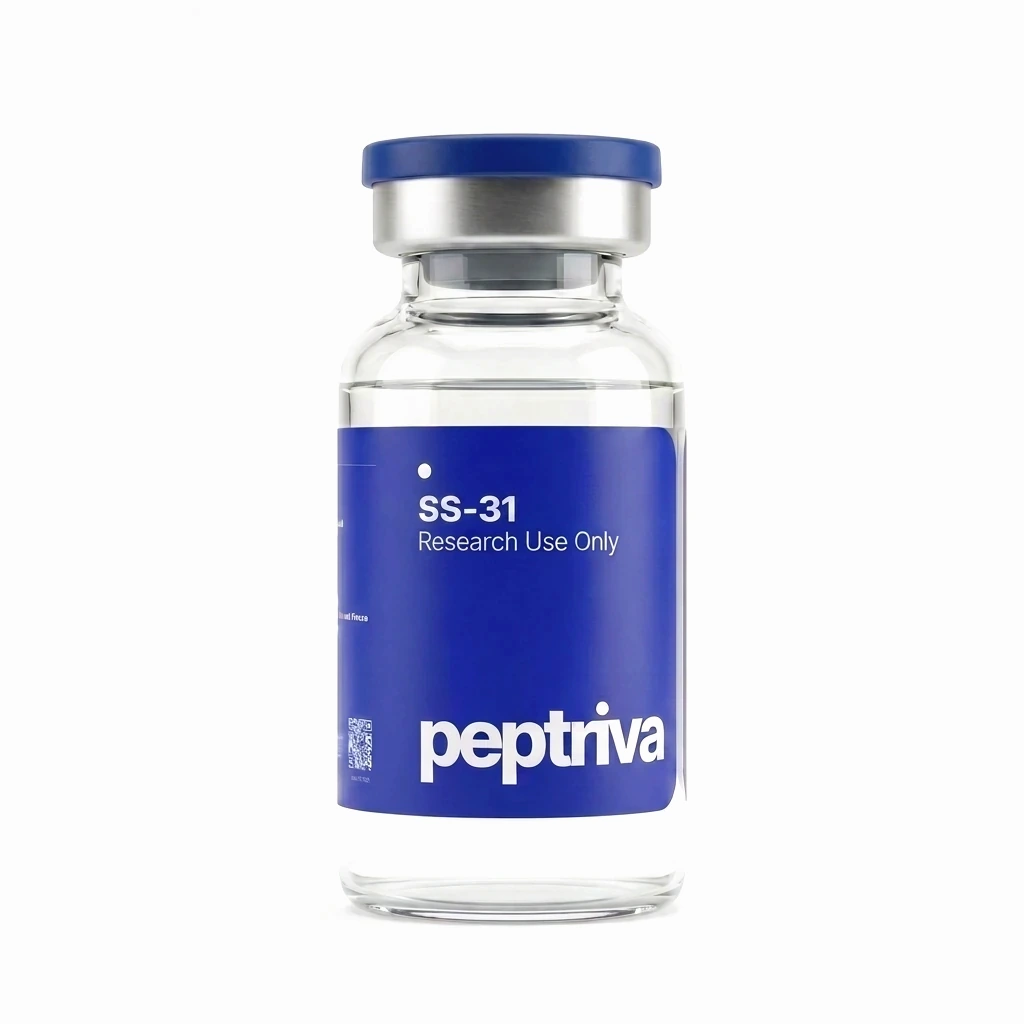
SS-31
D-Arg-Dmt-Lys-Phe-NH₂ · mitochondria-targeting tetrapeptide. The same reference compound used across the cited preclinical and Phase III studies. COA available with each lot.
The safety profile.
Stealth has dosed over 3,500 subjects across the elamipretide program. That's a large database by peptide standards. The most common side effect is injection-site reactions, which is normal for subcutaneous shots. No safety signal has triggered a regulatory hold.
The 168-week TAZPOWER extension supports long-term safety past three years of daily dosing. We should note the limits, though. Cohort sizes for any single indication are small compared with cardiology or cancer trials. Post-marketing surveillance is where the real-world profile will firm up over the next few years.
Clinical and research considerations for elamipretide.
The published literature and regulatory documentation highlight several key parameters for evaluating Forzinity in a clinical or research context:
- Confirmed TAZ gene mutation: Forzinity's approved label is specific to Barth syndrome, a TAZ-linked cardiolipin-remodeling disease.
- Weight threshold (≥30 kg): The approved indication covers patients meeting this threshold; smaller pediatric patients are outside the approved population.
- Access pathway: Specialty pharmacy with insurance pre-authorization. Formal health-economic assessments were not yet published as of mid-2026.
- Off-label PMM use: The NuPOWER Phase III is prospectively testing the MMPOWER-3 responder hypothesis in mtDNA-maintenance disorders; trial enrollment is the evidenced pathway for PMM investigation.
- Mechanism matching for other indications: SS-31 acts through cardiolipin binding. Investigational use in conditions not involving cardiolipin damage lacks a direct mechanistic rationale based on current data.
Where SS-31 goes from here.
Accelerated approval comes with strings attached. Stealth has to run confirmatory trials. So the Forzinity picture will keep evolving through 2028.
The active Phase III programs will report out over the next two years: NuPOWER in PMM, ReCLAIM in dry AMD, and PROGRESS-HF in heart failure. Those results will tell us how broadly the cardiolipin-stabilization mechanism translates beyond Barth syndrome.
For the peptide field overall, SS-31 is the clearest example we have of what real clinical translation looks like. Mechanism work, Phase III trials, a primary endpoint failure handled honestly, a follow-up trial designed from the data, FDA approval through the right pathway. That's the model. The grey-market “peptide as longevity supplement” story isn't.
What to know now
- Identity: four-residue mitochondria-targeting tetrapeptide (D-Arg-Dmt-Lys-Phe-NH₂), MW ~640 g/mol. Developed by Stealth BioTherapeutics.
- Mechanism: selectively concentrates in inner mitochondrial membrane and binds cardiolipin, stabilizing the scaffolding that holds energy-producing machinery in place.
- FDA approval: September 2025 accelerated approval as Forzinity™ for muscle strength in Barth syndrome patients ≥30 kg.
- Key trials: TAZPOWER (Barth) + 168-week extension supported approval; MMPOWER-3 (PMM) missed primary endpoint; NuPOWER (PMM mtDNA disorders) ongoing; PROGRESS-HF (heart failure); ReCLAIM (dry AMD).
- Aging biology: 2025 mouse study showed functional improvements without changes in molecular age markers, uncoupling function from epigenetic clocks.
- Safety: over 3,500 subjects dosed. Injection-site reactions are the most common adverse event. No regulatory holds.
- Grey-market vs prescription: grey-market SS-31 is not the same product as Forzinity. The clinical evidence supports narrow rare-disease use, not healthy-adult longevity.
What we're watching
Four things over the next 24 months. First, the NuPOWER Phase III readout in PMM mtDNA-maintenance disorders. This is the prospective test of the MMPOWER-3 responder hypothesis. Second, the ReCLAIM dry AMD program. A retinal indication would broaden the clinical use significantly. Third, the post-marketing confirmatory work for Barth syndrome. The long-term clinical-benefit endpoint will decide whether Forzinity stays on the market. Fourth, EMA review. Stealth's European pathway has trailed the US, and an EMA decision will affect global access.
References
- Shirley, M. (2025). Elamipretide: First approval. Drugs, 86(3), 377–383. https://doi.org/10.1007/s40265-025-02269-8
- Karaa, A., Haas, R., Goldstein, A., Vockley, J., & Cohen, B. (2023). Efficacy and safety of elamipretide in individuals with primary mitochondrial myopathy: The MMPOWER-3 randomized clinical trial. Neurology. https://doi.org/10.1212/WNL.0000000000207402
- Karaa, A., Bertini, E., Carelli, V., et al. (2024). Genotype-specific effects of elamipretide in patients with primary mitochondrial myopathy: A post hoc analysis of the MMPOWER-3 trial. Orphanet Journal of Rare Diseases, 19(1), 431. https://doi.org/10.1186/s13023-024-03421-5
- TAZPOWER OLE Investigators. (2024). Long-term efficacy and safety of elamipretide in patients with Barth syndrome: 168-week open-label extension results of TAZPOWER. Genetics in Medicine. https://doi.org/10.1016/j.gim.2024.101138
- Tung, C., Varzideh, F., Farroni, E., et al. (2025). Elamipretide: A review of its structure, mechanism of action, and therapeutic potential. International Journal of Molecular Sciences, 26(3), 944. https://doi.org/10.3390/ijms26030944
- Mitchell, W., Pharaoh, G., Tyshkovskiy, A., et al. (2025). The mitochondria-targeted peptide therapeutic elamipretide improves cardiac and skeletal muscle function during aging without detectable changes in tissue epigenetic or transcriptomic age. Aging Cell, 24(6), e70026. https://doi.org/10.1111/acel.70026
- Obi, C., Smith, A. T., Hughes, G. J., & Adeboye, A. A. (2022). Targeting mitochondrial dysfunction with elamipretide. Heart Failure Reviews, 27(5), 1925–1932. https://doi.org/10.1007/s10741-021-10199-2
- Rowe, L. W., Akotoye, C., Harris, A., & Ciulla, T. A. (2025). Beyond the injection: Delivery systems reshaping retinal disease management. Expert Opinion on Pharmacotherapy, 26(8), 939–952. https://doi.org/10.1080/14656566.2025.2496424
- Gandhi, S., Sweeney, H. L., Hart, C. C., Han, R., & Perry, C. G. R. (2024). Cardiomyopathy in Duchenne muscular dystrophy and the potential for mitochondrial therapeutics to improve treatment response. Cells, 13(14), 1168. https://doi.org/10.3390/cells13141168
- Nashine, S. (2021). Potential therapeutic candidates for age-related macular degeneration (AMD). Cells, 10(9), 2483. https://doi.org/10.3390/cells10092483