NAD+ has been widely marketed as a molecule that reverses aging. This review examines what the published human RCTs actually demonstrate.
NAD+ is a small electron-carrier molecule that cells use to run metabolism, repair DNA, and signal stress. Tissue NAD+ levels decline with age. Published human trial evidence supports oral precursors (NMN, NR) over direct IV administration. Four RCTs of oral NMN reported small, measurable gains in walking speed and grip strength. IV NAD+ lacks RCT support for the marketed claims.
NAD+ stands for nicotinamide adenine dinucleotide. It functions as a cellular electron carrier, shuttling electrons between reactions and powering the enzymatic machinery central to aerobic metabolism.
The longevity story started around 2000 with David Sinclair at Harvard and Shin-ichiro Imai at Washington University. Their labs showed that an aging-regulator enzyme family (the sirtuins, which we'll come back to) extends lifespan in yeast, worms, and flies when fed enough NAD+.
By 2015, the “NAD+ decline hypothesis” was geroscience's hottest idea. The premise: tissue NAD+ falls with age, so restoring it might restore cellular function. By 2026, that hypothesis had translated into a $500 IV drip on clinic menus.
That gap matters. NAD+ levels do fall with age. Aging enzymes do depend on NAD+. But the jump from “NAD+ matters” to “a 90-minute infusion reverses cellular age” is not one the published literature supports. The strongest human data points to small functional gains from oral precursors taken over months, not dramatic transformations from brief infusions.
What is NAD+ actually doing in the cell?
Two big jobs. First, electron transfer. Second, signaling.
For electron transfer, NAD+ picks up a pair of electrons and becomes NADH. The ratio of these two forms reflects the cell's redox energy state. Glycolysis requires it. The citric acid cycle requires it. Mitochondria require NADH to synthesize ATP. Without NAD+, cells cannot sustain aerobic metabolism.
The molecule itself is tiny. Its molecular weight is just 663 g/mol. But it sits at the center of how cells generate energy.
For signaling, NAD+ feeds three different enzyme families. The aging-regulator family (sirtuins) burns it. The DNA-repair family (PARPs, short for poly-ADP-ribose polymerases) burns it too. And one immune-cell surface enzyme called CD38 also chews through it.
That last one is the troublemaker. CD38 activity ramps up 3–4× with age, so older tissues burn through NAD+ faster than younger ones can make it. The enzyme that builds new NAD+ from scratch (called NAMPT) drops over the same window. We see consumption climb while production falls. Net result: NAD+ levels slide.
NAD+ depletion is a hallmark of aging that compromises mitochondrial bioenergetics, sirtuin signaling, and the DNA-damage response. The therapeutic question is not whether NAD+ matters. It does. The question is whether exogenous NAD+ or its precursors can restore tissue levels meaningfully.
— Yi et al., GeroScience, 2023
That last clause is what the field is still working through. The setup looks clean. Tissue NAD+ falls with age, so restoring it should restore function. The catch: NAD+ itself is a charged molecule that can't easily cross into cells from the outside.
The practical research question becomes: which precursor, what dose, what route? And does the blood-NAD+ rise observed in lab measurements actually reflect elevated NAD+ in the target tissue of interest?
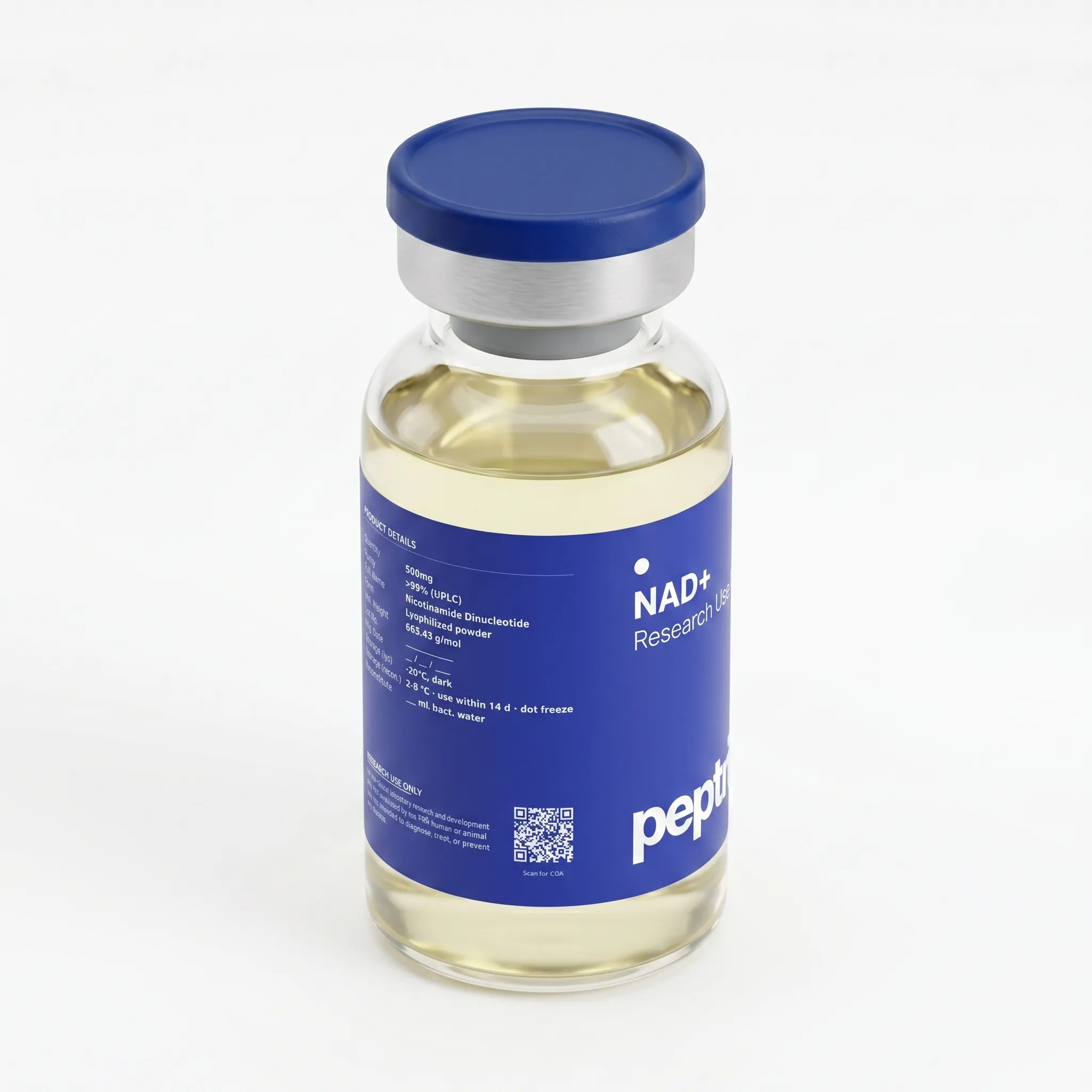
NAD+
The same coenzyme cited across the precursor and IV trials in this review. Lab-verified identity and purity for in-vitro redox and sirtuin work.
The NAD decline hypothesis: real signal, lots of marketing.
The decline is the most solid piece of this story. Across muscle, liver, brain, and skin, NAD+ levels drop measurably with age. The drop runs roughly 30–50% lower at age 60 than at age 20 across most studied tissues.
The mechanism is two-sided. Consumption rises. The DNA-repair enzymes work harder as damage piles up. The build-it-from-scratch enzyme falls off. More demand, less supply. In aged mice, restoring NAD+ with oral NMN or NR rescues mitochondrial function, blood-vessel function, and insulin sensitivity. That mouse foundation is real.
The jump to humans is where things get thin. A 2025 review by Tung and colleagues called the translation “more complicated than the cell-biology elegance suggested.” Doses that work in mice scale awkwardly to people. Aging biomarkers in rodents don't map cleanly to validated human endpoints.
The deepest question remains open: does raising blood NAD+ in human subjects actually raise NAD+ inside aged neurons, cardiomyocytes, or slow-twitch muscle fibers? Tissue-level pharmacodynamics have not been definitively established.
None of that invalidates the hypothesis. It does mean the IV-clinic marketing claims (“reverse cellular aging,” “regenerate your mitochondria,” “feel 20 years younger”) are running well ahead of any published trial.
Where this falls short: the case for NAD+ leans heavily on mouse data. Restoring NAD+ in aged mice produces dramatic rescue. Restoring it in middle-aged humans produces a few extra meters of walking distance in a six-minute test. Oral NAD+ itself doesn't survive digestion (only the precursors NMN and NR do). IV NAD+ may not raise tissue NAD+ at all, since the intact molecule struggles to cross the cell membrane. And MIB-626 (a leading NR-derived drug candidate from MetroBiotech) missed primary endpoints in its first Phase II readouts. The biology is real. The clinical translation is partial at best.
Oral NMN: what the human RCTs actually show.
NMN stands for nicotinamide mononucleotide. It is one biosynthetic step away from NAD+ in the salvage pathway. Orally administered NMN is converted to NAD+ intracellularly by NMNAT enzymes. NMN is the focus of this section because it has accumulated the most rigorous human trial data of any NAD+ precursor.
The headline study is the 2023 GeroScience dose-response trial from Yi and colleagues. Yi et al. randomized 80 healthy middle-aged adults to placebo, 300, 600, or 900 mg of NMN once daily for 60 days.
The results were consistent across endpoints. Blood NAD+ rose significantly in all NMN groups by day 30 and stayed elevated at day 60, with the biggest jump at 900 mg/day. Six-minute walking distance increased significantly versus placebo at every dose.
Biological age (a blood-based algorithm called Aging.Ai 3.0) rose in the placebo group and held flat in the NMN groups. Quality-of-life scores improved on NMN. Insulin sensitivity didn't move. The trial was well tolerated with no safety signals at 900 mg/day.
That's the cleanest dose-response signal we've seen in the NMN literature. It's also worth being honest about what it doesn't prove. The walking gain was measured in meters, not minutes. The biological-age marker is an algorithm, not a mortality endpoint. The trial ran 60 days, not 60 months. Still, it's a real RCT with a real pharmacodynamic signal, which is more than most peptides in our library can claim.
The 2024 GeroScience trial by Morifuji et al. ran 250 mg/day of NMN for 12 weeks in 60 older adults. The primary endpoint (a stepping test) didn't hit significance. The 4-meter walk time did improve. So did sleep quality on the Pittsburgh Sleep Quality Index.
The 2022 NPJ Aging trial by Igarashi et al. used 250 mg/day in older men. Blood NAD+ rose. Gait speed and grip strength edged up. The 2023 arterial-stiffness trial in Scientific Reports by Katayoshi et al. ran 500 mg/day for 12 weeks. Serum nicotinamide rose. Pulse-wave-velocity changes didn't reach significance.
The NMN evidence in one sentence: four RCTs across ~230 adults show that oral NMN at 250–900 mg/day reliably raises blood NAD+ and produces small, measurable gains in walking speed, grip strength, and sleep, with a clean safety profile.
Nicotinamide riboside: the other precursor with human data.
NR stands for nicotinamide riboside. It's the other NAD+ precursor with real human evidence. ChromaDex sells it as the supplement NIAGEN.
NR has been through multiple Phase II trials. The arterial-stiffness protocol published by Freeberg and colleagues in 2022 ran 500 mg twice daily for 3 months in 94 adults with mildly elevated blood pressure. The primary outcome was casual systolic blood pressure, with 24-hour SBP and aortic stiffness as secondary endpoints.
The MIB-626 program at Washington University (led by Imai's collaborators) has run additional NR trials in metabolic-syndrome and pre-frailty populations. The picture is consistent with the NMN story: oral NR raises blood NAD+ in a dose-dependent way, tolerability is good, and functional endpoints move modestly in the predicted direction.
Researchers evaluating NR versus NMN should note two relevant distinctions. First, the regulatory context differs: the FDA rejected NMN as a dietary-supplement ingredient in 2022 on grounds it is being investigated as a drug; NR remains available as a supplement. Second, no head-to-head RCT has directly compared the two in matched populations, so trial-cohort characteristics remain the most useful guide to selecting a comparator.
The mechanistic difference between precursors is small. NR converts to NMN, which converts to NAD+. No published head-to-head RCT has demonstrated clinical superiority for either precursor.
IV NAD+ infusions: the pharmacology problem.
This is where the gap between marketing and evidence is widest. IV NAD+ infusions are offered at $500–$1,000 per session at IV-therapy clinics. They are marketed for anti-aging, addiction recovery, neuro-regeneration, and energy. As of mid-2026, PubMed contains essentially no published RCTs supporting any of those specific indications.
The pharmacology is the problem. NAD+ carries a strong electric charge. Charged molecules don't cross cell membranes well. Smaller, neutral precursors like NR slip across easily. Intact NAD+ probably doesn't.
There's a long-running debate about whether a transporter called slc12a8 ferries intact NAD+ into cells. Some labs report it. Others can't reproduce it. We think the most likely fate of an IV dose is rapid breakdown in plasma to nicotinamide and other small fragments, which then enter cells the way they always have.
What is settled: IV NAD+ has produced acute reactions in reported study participants and clinical observations. Chest tightness. Facial flushing. Headache. Anxiety. These tolerability concerns are why infusions typically span 2–4 hours of slow administration. The RCT support for the advertised indications is essentially zero. And it is not pharmacologically established that IV NAD+ delivers more NAD+-boosting effect than oral NMN or NR formulations.
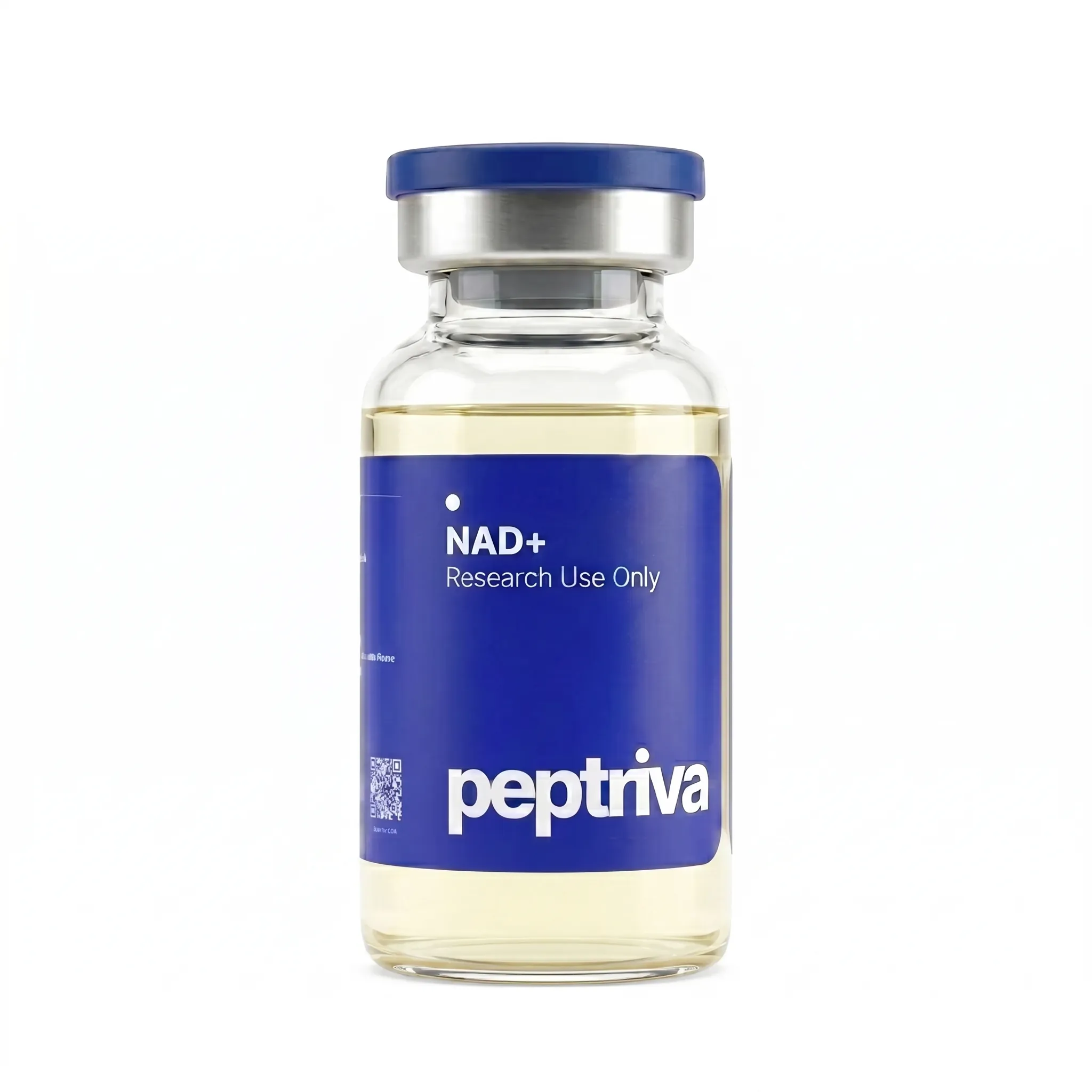
NAD+
β-Nicotinamide adenine dinucleotide (oxidized form). The same reference compound used across the cited preclinical assays: sirtuin activity, electron-transport assembly, redox cycling. COA available with each lot.
What NAD+ is genuinely good for, in the lab.
For research, NAD+ as the intact coenzyme is essential, not optional. Aging-enzyme activity assays need it as substrate. Electron-transport-chain reconstitution work uses it as the electron acceptor in Complex I.
DNA-repair enzyme kinetics studies measure how fast NAD+ disappears. Redox cycling work in mitochondrial preparations runs on it. NAD+/NADH ratio measurements are the standard readout for metabolic state in cultured cells, and we can't do those without a pure reference standard.
That's why research-grade NAD+ is a staple reagent in any biochemistry, cell-biology, or mitochondrial-research lab. The IV-drip market is a separate, much messier conversation that lives downstream of the real research use.
Key methodological questions in NAD+ research.
Evaluating NAD+ research — whether precursor supplementation trials, direct IV administration studies, or in-vitro work — benefits from asking the following:
- Is the study testing NAD+ itself, or a precursor? The published RCT evidence is for oral NMN and NR. Direct IV NAD+ has distinct pharmacology and far less trial data.
- What does the endpoint actually measure? Rising blood NAD+ is a pharmacodynamic marker, not a clinical outcome. Walking-speed and grip-strength gains observed in RCTs have been small in absolute terms.
- How long was the trial? Most NMN RCTs ran 8–12 weeks. Long-term safety data past one year is limited for both oral precursors and IV NAD+.
- How does intervention cost compare to evidence quality? IV infusion programs carry substantially higher cost relative to the available supporting RCT evidence compared with oral precursor protocols.
- What is the source and purity documentation? NMN was rejected by the FDA as a dietary-supplement ingredient in 2022 on grounds it is being investigated as a drug. Research-grade material should ship with HPLC certificates of analysis.
- Are there theoretical proliferation concerns? NAD+ powers both DNA repair and rapid cell division. Long-term oncology safety has not been characterized in formal trials.
Sirtuins, mitochondria, and the longevity story in context.
We think the reason NAD+ has consumed so much funding and consumer attention is that the underlying biology is genuinely interesting. The aging-regulator enzymes do regulate metabolism. Caloric restriction does extend lifespan in multiple species through NAD+-dependent signaling.
The mitochondrial-dysfunction-of-aging hypothesis has held up well across lines of evidence. NAD+ sits at the crossroads of energy metabolism, DNA repair, and chromatin regulation. Those are three of the canonical “hallmarks of aging.”
What has not held up is the claim that raising blood NAD+ via IV infusions extends healthspan. The most rigorous human data consists of the four NMN RCTs described above. Those trials reported small, measurable functional gains in middle-aged and older study participants over multi-week treatment periods.
That's a real and useful clinical signal. It isn't a transformation. And it's a very different conversation than the one happening on the IV-clinic menu.
What to know now
- Identity: NAD+ is a dinucleotide coenzyme, not a peptide. It's the central electron-transfer molecule in cellular metabolism and a fuel for aging, DNA-repair, and immune-surface enzymes.
- Decline with age: well-documented across multiple human and rodent tissues. Driven by rising consumption and falling synthesis.
- Best human evidence: four RCTs of oral NMN at doses of 250–900 mg/day in approximately 230 study participants. Studies reported blood NAD+ elevation and modest improvements in walking speed, grip strength, and sleep quality. Tolerability was generally favorable in reported cohorts.
- NR (nicotinamide riboside): sold as NIAGEN. Multiple Phase II trials with broadly similar findings to NMN.
- IV NAD+: widely sold at IV-therapy clinics. No published RCTs supporting anti-aging, addiction-recovery, or energy claims. Whether intact NAD+ enters cells is contested.
- Regulatory: NAD+ itself has no FDA approval. NMN was rejected as a supplement ingredient in 2022 on grounds it's being investigated as a drug. NR is sold as a supplement. Niacin and nicotinamide are GRAS.
- Research use: intact NAD+ is essential reference reagent for activity assays, electron-transport-chain reconstitution, and NAD+/NADH ratio measurements.
What we're watching
Four things we'll track over the next 24 months. First, whether any IV NAD+ RCT for a specific approved indication (addiction recovery, cardiovascular endpoints, neurodegenerative disease) reaches publication. As of mid-2026, that literature is still essentially absent. Second, the readout of larger Phase II/III NR and NMN trials with validated functional endpoints. The MIB-626 program and the multicenter chronic-insomnia NMN trial are both worth following. Third, whether the FDA's 2022 NMN ruling shifts. The drug-investigation rationale is a meaningful signal that real Phase III work is moving. Fourth, the cancer-safety question for chronic NAD+ boosting in older adults. The DNA-repair argument is reassuring on one side. The cell-proliferation argument is concerning on the other. Long-term data will sort it out.
References
- Yi, L., Maier, A. B., Tao, R., et al. (2023). The efficacy and safety of β-nicotinamide mononucleotide (NMN) supplementation in healthy middle-aged adults: A randomized, multicenter, double-blind, placebo-controlled, parallel-group, dose-dependent clinical trial. GeroScience, 45(1), 29–43. https://doi.org/10.1007/s11357-022-00705-1
- Katayoshi, T., Uehata, S., Nakashima, N., et al. (2023). Nicotinamide adenine dinucleotide metabolism and arterial stiffness after long-term nicotinamide mononucleotide supplementation: A randomized, double-blind, placebo-controlled trial. Scientific Reports, 13(1), 2786. https://doi.org/10.1038/s41598-023-29787-3
- Igarashi, M., Nakagawa-Nagahama, Y., Miura, M., et al. (2022). Chronic nicotinamide mononucleotide supplementation elevates blood nicotinamide adenine dinucleotide levels and alters muscle function in healthy older men. NPJ Aging, 8(1), 5. https://doi.org/10.1038/s41514-022-00084-z
- Morifuji, M., Higashi, S., Ebihara, S., & Nagata, M. (2024). Ingestion of β-nicotinamide mononucleotide increased blood NAD levels, maintained walking speed, and improved sleep quality in older adults in a double-blind randomized, placebo-controlled study. GeroScience, 46(5), 4671–4688. https://doi.org/10.1007/s11357-024-01204-1
- Freeberg, K. A., Craighead, D. H., Martens, C. R., et al. (2022). Nicotinamide riboside supplementation for treating elevated systolic blood pressure and arterial stiffness in midlife and older adults. Frontiers in Cardiovascular Medicine, 9, 881703. https://doi.org/10.3389/fcvm.2022.881703
- Gao, X., Li, J., Xu, S., et al. (2023). Oral nicotinamide mononucleotide (NMN) to treat chronic insomnia: Protocol for a multicenter, randomized, double-blinded, placebo-controlled trial. Trials, 24(1), 340. https://doi.org/10.1186/s13063-023-07351-8
- Imai, S., & Guarente, L. (2014). NAD+ and sirtuins in aging and disease. Trends in Cell Biology, 24(8), 464–471. https://doi.org/10.1016/j.tcb.2014.04.002
- Rajman, L., Chwalek, K., & Sinclair, D. A. (2018). Therapeutic potential of NAD-boosting molecules: The in vivo evidence. Cell Metabolism, 27(3), 529–547. https://doi.org/10.1016/j.cmet.2018.02.011
- Covarrubias, A. J., Perrone, R., Grozio, A., & Verdin, E. (2021). NAD+ metabolism and its roles in cellular processes during ageing. Nature Reviews Molecular Cell Biology, 22(2), 119–141. https://doi.org/10.1038/s41580-020-00313-x