TB-500 is the most-asked-about peptide where the product sold under the name often isn't the molecule in the research. Where to buy TB-500 in 2026 turns on one question. Is the vial full-length Thymosin β4, or the synthetic 7-amino-acid LKKTETQ fragment? The 2026 Sports Medicine review treats them as related but distinct. Mass-spec on the CoA is the only way to know which one you got.
"TB-500" is a marketing name. It can refer to full-length Thymosin β4 (a 43-amino-acid human peptide, MW ~4963 Da) or a synthetic 7-amino-acid fragment with the active actin-binding sequence (Ac-LKKTETQ, MW 889.0 g/mol). It's legal to buy in the U.S. as a research compound. It's on the WADA Prohibited List under Section S2, banned year-round. Research-grade pricing runs $50–$120 per 5 mg vial. A credible CoA says which form is in the vial, shows HPLC purity ≥98%, and reports mass-spec at the declared molecular weight.
Quick answer. Research-grade TB-500 should cost $50–$120 per 5 mg vial. It should ship lyophilized (freeze-dried powder). The Certificate of Analysis (a one-page lab report) should come from an ISO 17025–accredited lab. It should tell you exactly which molecule is in the vial: full-length Tβ4 (~4963 Da) or the Ac-LKKTETQ heptapeptide (889.0 g/mol). HPLC purity ≥98% with chromatogram. If the vendor can't tell you which molecule they shipped, walk away.
What you're actually buying
We see this as the central identity problem. Thymosin β4 (Tβ4) is a 43-amino-acid peptide your body already makes. It accounts for 70–80% of all β-thymosins in the human body (Ying et al., 2023). It circulates in plasma. That's different from purely synthetic research peptides.
"TB-500" is something else. We treat it as a marketing name. It refers either to full-length Tβ4 or to a synthetic fragment containing the active LKKTETQ sequence — the part of the molecule that binds actin (the protein that builds cell scaffolding). The 2026 Sports Medicine review by Mendias and Awan explicitly distinguishes Tβ4 (full-length, 43 residues) from TB-500 (a fragment).
The most commonly sold synthetic form is the acetylated heptapeptide Ac-Leu-Lys-Lys-Thr-Glu-Thr-Gln. That's the LKKTETQ core, formula C38H68N10O14, MW 889.0 g/mol, CAS 885340-08-9.
A key identity distinction: the biology typically cited in vendor literature — G-actin binding, angiogenesis, cell migration, Ac-SDKP cleavage, endothelial repair (Zhang et al., 2025) — is predominantly the biology of full-length Tβ4, not the LKKTETQ fragment. The fragment retains the actin-binding motif but does not necessarily reproduce every downstream effect of the full molecule. Researchers should verify which form is present in the vial before extrapolating mechanistic claims from the full-length Tβ4 literature.
The published review literature consistently notes that full-length Tβ4 has a substantive clinical research record. The synthetic fragment most commonly sold as "TB-500" is mechanistically partial relative to the full-length molecule. Researchers should account for this distinction when selecting a reference compound for a given experimental model.
How to verify research-grade TB-500
The standard eight vendor criteria apply. Four are sharper for TB-500.
1. Confirm the form: fragment or full-length
This is the check that matters most. It's also the one most vendors skip. The 2026 Sports Medicine review explicitly notes that "TB-500" in the research-chemical market can be full-length Tβ4, the LKKTETQ heptapeptide, or something unrelated (Mendias & Awan, 2026).
The molecular weights are dramatically different. Tβ4 is ~4963 Da. The fragment is 889.0 g/mol. Mass-spec on the CoA settles it in one number. If the CoA lists "TB-500" without a molecular weight, it's failing the most basic identity check.
2. WADA S2 — banned year-round
TB-500 is on the WADA Prohibited List under Section S2 (Peptide Hormones, Growth Factors, Related Substances and Mimetics). Section S2 substances are banned both in-competition and out-of-competition. There's no permitted window for athletes (WADA Prohibited List).
The 2026 AJSM review notes that TB-4 and TB-500 promoted angiogenesis and tissue repair in preclinical models but remain banned in sport. Validated LC-MS detection methods exist in standard anti-doping panels (Mayfield et al., 2026). Research-context purchase is legal. Competitive-athlete use isn't.
3. Storage — the actin-binding motif oxidizes
The LKKTETQ sequence and the methionine residues in full-length Tβ4 are vulnerable to oxidation. Oxygen, light, and moisture all degrade activity. Lyophilized powder stored at −20°C lasts years. Pre-reconstituted liquid loses activity over weeks, even refrigerated.
If a vendor ships pre-reconstituted TB-500 at room temperature, they're shipping a degraded product. The lyophilized form is the only form a research-grade supplier should sell.
4. Pricing — $50–$120 per 5 mg vial
Synthesis cost diverges sharply between the two forms. The LKKTETQ heptapeptide (7 residues plus one acetylation) is one of the cheapest peptides to make. Full-length Tβ4 (43 residues) costs meaningfully more. Vendors who sell both at the same price are charging the same markup regardless of underlying cost. Below $40 per 5 mg, ask about purification standards. Above $150 per 5 mg, you're paying retail markup — unless the vendor is genuinely shipping authenticated full-length Tβ4.
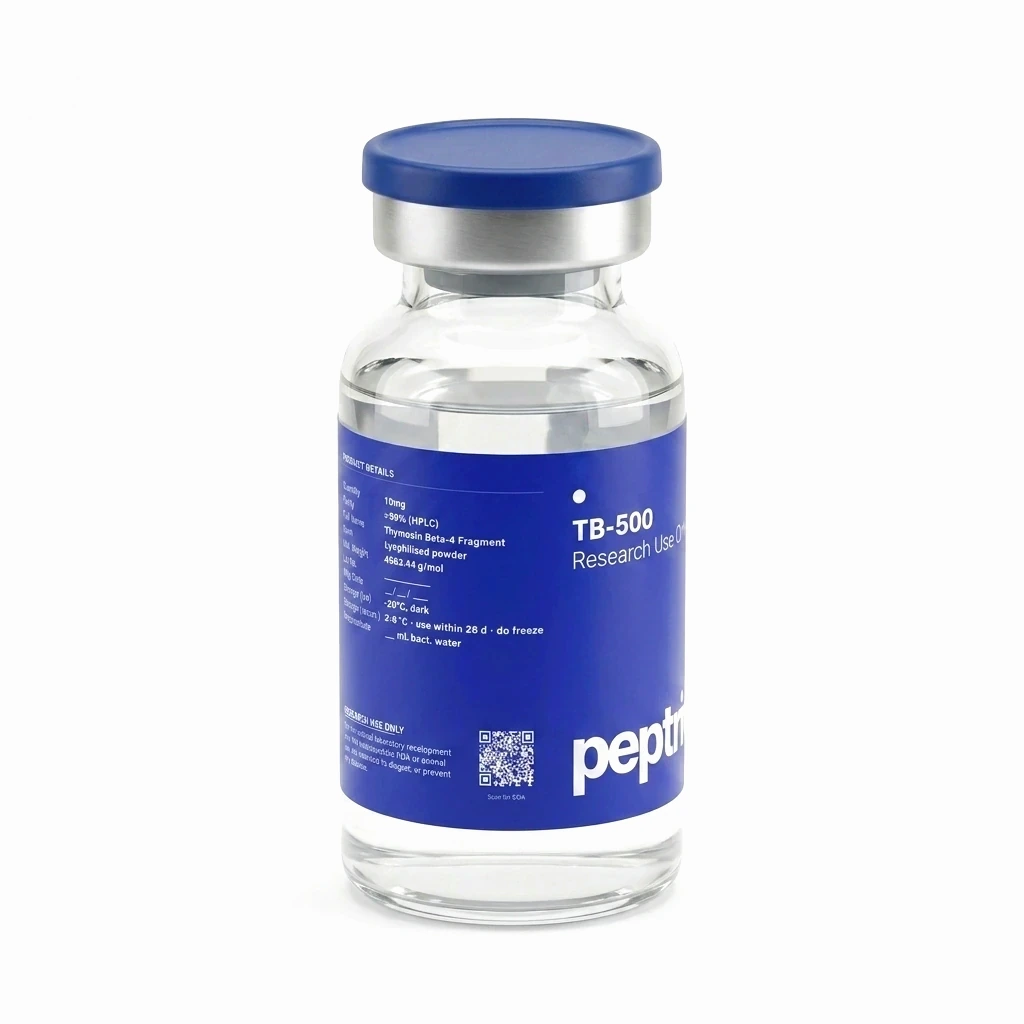
TB-500
The Ac-LKKTETQ heptapeptide fragment cited across the actin-binding mechanism literature aggregated in the 2023 Ying et al. review and the 2025 European Heart Journal endothelial repair study. CAS 885340-08-9, MW 889.0 g/mol, ≥99% HPLC purity, ISO 17025 third-party CoA on every lot.
What research-grade TB-500 costs in 2026
TB-500 retail pricing varies more than most peptides we cover. The reason is simple. "TB-500" covers two molecules with very different synthesis costs.
- 5 mg vial (LKKTETQ fragment): $50–$100 ($10–$20/mg). The most common retail size.
- 5 mg vial (full-length Tβ4): $80–$120 ($16–$24/mg). A premium for the longer peptide — if the vendor actually ships it.
- 10 mg vial: $90–$180 ($9–$18/mg). Better per-mg value than the 5 mg.
- Multi-vial discounts: 10–25% off for 3- or 6-packs at most vendors.
Below $40 per 5 mg? Ask about purification standards. The HPLC purification step is what separates crude TB-500 (with synthesis impurities) from ≥98% research-grade material. Above $25 per mg, you're paying retail markup, not synthesis cost. The exception: authentic full-length Tβ4, if a vendor genuinely ships it, sits at the higher end for legitimate reasons.
Where this falls short. Zero published human TB-500 trials. The Sikiric-group BPC-157 literature has a decades-long preclinical record. TB-500 doesn't, despite identical marketing. Even the case data is thin: the most-cited BPC-157 + TB-500 series covers 4 patients with no controls. Most of the biology vendors quote (G-actin binding, Ac-SDKP, mitochondrial transfer) belongs to full-length Tβ4. The fragment people typically buy keeps the actin-binding motif but may not reproduce the rest.
Legal status — RUO with a WADA wrinkle
No Tβ4 or TB-500 product is FDA-approved for any indication. Tβ4 is in clinical trials for dry eye disease and neurotrophic keratopathy, plus cardiovascular research, but no product has been approved as of 2026 (Xing et al., 2021). The closest FDA-approved thymosin is thymalfasin (Zadaxin), which is thymosin α1 — a different molecule (Quagliata et al., 2024).
The regulatory implications for research buyers:
- Research-compound sale is legal. TB-500 ships lawfully in the U.S. under Research Use Only labeling (21 CFR § 809.10(b)(9)). It isn't a controlled substance.
- Selling for human use isn't. A vendor marketing TB-500 as a treatment for tendon injuries, joint pain, or recovery has crossed into FDA jurisdiction.
- WADA prohibition is year-round. Section S2 bans both in-competition and out-of-competition. There's no permitted window.
- Major sports leagues prohibit it. TB-500 is in standard anti-doping panels across professional sports.
The 2026 Sports Medicine review identifies TB-500 as an unapproved peptide where rigorous human safety data are scarce and the unregulated supply creates potential for serious harm (Mendias & Awan, 2026). U.S. law permits purchase as a research reference compound labeled for laboratory use; administration to humans is outside the permitted scope of RUO sale.
Red flags to watch for
- CoA that just says "TB-500" with no MW. A research-grade CoA must distinguish full-length Tβ4 (~4963 Da) from the LKKTETQ fragment (889.0 g/mol). Vendors who can't answer shouldn't be selling.
- Mass-spec that doesn't match the declared form. CoA claims full-length Tβ4 but mass reads near 889 Da? You got the fragment. CoA claims the fragment but mass reads near 4963 Da? Something else is in the vial.
- Pre-reconstituted liquid without cold chain. The actin-binding motif oxidizes. Lyophilized powder stored cold retains activity. Pre-reconstituted shipped at room temp is degraded before you open it.
- "TB-500 Stable," "TB-500 Plus," or branded variants. If the structure isn't published, the product isn't research-grade for literature-matching purposes.
- Clinical or athletic claims on the product page. "TB-500 heals tendons." "TB-500 for recovery." That's FDA enforcement territory and WADA radar.
- Missing CAS number. The LKKTETQ fragment is CAS 885340-08-9. Absence on the CoA is a red flag.
- Capsules, sprays, or transdermal patches. No published research validates these for either form. The injectable lyophilized peptide is what the literature uses.
TB-500
Ac-LKKTETQ heptapeptide, CAS 885340-08-9, MW 889.0 g/mol. The same reference compound used across the cited preclinical studies. COA with HPLC trace and mass-spec identity confirmation ships with every order.
"TB-500" sold in the research-chemical market may contain full-length Tβ4, the LKKTETQ heptapeptide fragment, or an unrelated product. The molecular weights are dramatically different — 4963 Da versus 889 g/mol — and mass-spec on the CoA settles the question in one number.
— Mendias & Awan, Sports Medicine, 2026
Frequently asked questions
Is TB-500 legal to buy?
TB-500 is legal to purchase in the U.S. as a research reference compound labeled for laboratory use only. No Thymosin β4 product is FDA-approved for any indication, and TB-500 is not a controlled substance. Selling it for human consumption is illegal; purchasing it as research material is not. TB-500 appears on the WADA Prohibited List under Section S2, prohibited both in-competition and out-of-competition (WADA Prohibited List).
How much does TB-500 cost?
Roughly $50–$120 per 5 mg vial in 2026. 10 mg vials run $90–$180. The wide range reflects whether the vendor shipped the cheap Ac-LKKTETQ heptapeptide (7 residues) or full-length Tβ4 (43 residues). Vendors often don't tell you which form is in the vial. Mass-spec on the CoA resolves it. The price tag rarely does.
Is TB-500 the same as Thymosin β4?
No. Tβ4 is the full-length 43-amino-acid peptide (MW ~4963 Da). "TB-500" is a marketing name for either full-length Tβ4 or a synthetic 7-residue fragment with the active LKKTETQ sequence (MW 889 g/mol). The 2026 Sports Medicine review by Mendias and Awan explicitly distinguishes the two (Mendias & Awan, 2026). Mass-spec on the CoA is the only reliable check.
What should a TB-500 CoA show?
The CoA should name the form. Either the Ac-LKKTETQ heptapeptide (CAS 885340-08-9, MW 889.0 g/mol, formula C38H68N10O14) or full-length Tβ4 (MW ~4963 Da). HPLC purity ≥98% with chromatogram. Mass-spec matching the declared MW within 0.5 Da. Karl Fischer water content 2–8% for lyophilized material. The lab should be ISO/IEC 17025 accredited.
Why is TB-500 WADA-banned?
It falls under WADA Section S2 (Peptide Hormones, Growth Factors, Related Substances and Mimetics). The basis is Tβ4's documented angiogenic and tissue-repair activity. WADA categorizes substances that promote tissue regeneration beyond physiological norms. Validated LC-MS detection methods exist in standard anti-doping panels (Mayfield et al., 2026). Positive test results under anti-doping programs carry sanctions per applicable sport federation rules.
TB-500 vs BPC-157 — which one for research?
Different mechanisms, different evidence bases. BPC-157 has a larger preclinical literature in tissue-repair models, mostly from the Sikiric group in Zagreb. Tβ4 (the molecule behind TB-500) has more diverse mechanistic biology: G-actin sequestration, CCN5 signaling, Ac-SDKP endothelial repair, mitochondrial transfer via tunneling nanotubes. It is also the subject of ongoing clinical research in ophthalmology. The two have been co-investigated in preclinical studies because the pathways are complementary rather than overlapping. Detailed comparison: BPC-157 vs TB-500.
What to know now
- CAS 885340-08-9, MW 889.0 g/mol. That's the LKKTETQ heptapeptide. Full-length Tβ4 is ~4963 Da. The CoA must specify which.
- $50–$120 per 5 mg vial. Wide range because two molecules trade under the same name.
- WADA S2 year-round. No in/out-of-competition split. Athletes face sanctions if detected.
- Lyophilized injectable only. The actin-binding motif oxidizes. Pre-reconstituted liquid degrades.
- Mass-spec is the identity check. If the CoA doesn't show a mass matching the declared form, the molecule isn't what the label says.
- Evidence base is uneven. Strong mechanistic biology for full-length Tβ4. Zero published human TB-500 trials for athletic, orthopedic, or anti-aging use.
What we’re watching
Two developments to track. First, whether any sponsor runs a controlled human trial of TB-500 (or full-length Tβ4) for the orthopedic indications the marketing has implied for two decades. The 2026 Sports Medicine and AJSM reviews both flag the absence. Second, whether vendors converge on labeling that distinguishes the heptapeptide fragment from full-length Tβ4 explicitly. Until that happens, the CoA mass-spec line is the buyer's only protection against identity ambiguity. Separately, Tβ4 clinical research in ophthalmology continues to advance — but that's on the endogenous human peptide, not on the "TB-500" product as marketed.
References
- Ying, Y., Lin, C., Tao, N., Hoffman, R. M., Shi, L., Chen, Z., Zhang, S., Gu, J., & Wang, X. (2023). Thymosin β4 and actin: Binding modes, biological functions and clinical applications. Current Protein & Peptide Science, 24(1), 78–88. https://doi.org/10.2174/1389203724666221201093500
- Mendias, C. L., & Awan, T. M. (2026). Safety and efficacy of approved and unapproved peptide therapies for musculoskeletal injuries and athletic performance. Sports Medicine. https://doi.org/10.1007/s40279-026-02437-0
- Mayfield, C. K., Bolia, I. K., Feingold, C. L., Bogdanov, J., Eberlin, C. T., Liu, J. N., & Petrigliano, F. A. (2026). Injectable peptide therapy: A primer for orthopaedic and sports medicine physicians. The American Journal of Sports Medicine, 54(1), 223–229. https://doi.org/10.1177/03635465251357593
- Xing, Y., Ye, Y., Zuo, H., & Li, Y. (2021). Progress on the function and application of thymosin β4. Frontiers in Endocrinology, 12, 767785. https://doi.org/10.3389/fendo.2021.767785
- Zhang, Q., Li, H., Zhuang, T., Wang, X., Wu, J., Wang, J., Wang, B., Hu, T., Yu, Z., Dong, X., Bao, L., Wang, W., Cao, R., Pu, J., Liu, S., Sun, J., Tomlinson, B., Tian, M., Zhang, L., & Chen, X. (2025). CCN5 suppresses injury-induced vascular restenosis by inhibiting smooth muscle cell proliferation and facilitating endothelial repair via thymosin β4 and Cd9 pathway. European Heart Journal, 46(17), 1645–1658. https://doi.org/10.1093/eurheartj/ehae911
- Quagliata, M., Papini, A. M., & Rovero, P. (2024). Therapeutic applications of thymosin peptides: A patent landscape 2018–present. Expert Opinion on Therapeutic Patents, 33(12), 865–873. https://doi.org/10.1080/13543776.2023.2298833
- World Anti-Doping Agency. (2026). The World Anti-Doping Code International Standard: Prohibited List 2026. https://www.wada-ama.org/en/prohibited-list
- International Organization for Standardization. (2017). ISO/IEC 17025:2017 — General requirements for the competence of testing and calibration laboratories. https://www.iso.org/standard/66912.html