Semaglutide is the most-demanded molecule in the history of the peptide market, and the most-faked. Where to buy semaglutide in 2026 is really three questions stacked on top of each other. Which channel are you actually in — pharmacy, the wound-down compounding lane, or research supply? Is the vial the molecule and the milligrams the label claims? And is the vendor treating a lab reagent as a lab reagent, or quietly selling an unlicensed drug?
Get new research first
Research updatesOne short email when new peptide research drops or a new ISO 17025-verified batch lands — written from primary sources, no filler.
You’re on the list — check your inbox for a confirmation.
Could not save your email. Try again in a moment.
Semaglutide is a 31-amino-acid acylated GLP-1 analog. CAS number 910463-68-2. Molecular weight 4113.58 g/mol. It is an FDA-approved prescription drug (Ozempic, Wegovy, Rybelsus) — and, separately, a legal research reference compound when sold as lyophilized powder labeled for laboratory use only. The compounding channel that supplied millions of vials during the 2022–2024 shortage wound down in mid-2025, and gray-market sellers moved into the vacuum. A credible Certificate of Analysis shows mass-spec identity at ~4113.6 Da, HPLC purity ≥98–99%, measured net peptide content, and endotoxin below 1.0 EU/mg. The two semaglutide-specific failure modes: vials whose actual content is far off the label, and outright counterfeits — both documented in the published record.
- CoA. Certificate of Analysis. A one-page lab report showing the specific lot's identity, purity, content, and contamination testing.
- ISO/IEC 17025. The international quality standard for testing labs. A 17025-accredited lab has been audited by a third party for technical competence.
- 503A / 503B. The two U.S. compounding tiers — 503A pharmacies fill individual prescriptions; 503B outsourcing facilities produce larger batches under FDA registration. Both compounded semaglutide legally only while the approved drug was in shortage.
- RUO. Research Use Only. A labeling category for laboratory materials that are not drugs, not for human or veterinary use, and carry no medical claims.
- LC-MS. Liquid chromatography–mass spectrometry. The identity test that confirms the molecule's mass — the single most direct check on what's actually in a vial.
Quick answer. ISO 17025-verified research-grade semaglutide should cost roughly $60–$130 per 10 mg vial and $90–$180 at the 15 mg size. It should ship as lyophilized powder — never as a pre-filled pen — under the actual name “semaglutide,” with a third-party CoA reporting mass-spec identity near 4113.6 Da, measured content, and endotoxin. It is a lab reagent. It is not a substitute for a prescription, and any vendor blurring that line is a vendor to avoid.
What you're actually buying
Semaglutide is a synthetic analog of GLP-1, the incretin gut hormone that signals satiety and stimulates glucose-dependent insulin release. Novo Nordisk's design team took the native hormone and made three changes: an Aib substitution at position 8 that blocks cleavage by the DPP-4 enzyme, an arginine at position 34, and a C18 fatty di-acid chain attached to the lysine at position 26 through a short spacer. That fatty-acid chain makes the peptide bind reversibly to albumin in circulation, which is what stretches its half-life to roughly 165 hours — about seven days — and made once-weekly administration possible in the clinical programs (Lau et al., 2015).
The clinical record is why demand for this molecule dwarfs every other peptide. The STEP-1 trial randomized 1,961 adults with overweight or obesity and reported a 14.9% mean body-weight reduction at 68 weeks in the semaglutide 2.4 mg arm versus 2.4% with placebo (Wilding et al., 2021). The SELECT cardiovascular outcomes trial followed 17,604 adults with established cardiovascular disease and reported a 20% relative reduction in major adverse cardiovascular events (Lincoff et al., 2023) — on top of the earlier SUSTAIN-6 cardiovascular signal in type 2 diabetes (Marso et al., 2016) and the PIONEER program that produced the oral formulation (Husain et al., 2019).
That evidence base belongs to the approved drug products. For a research buyer the relevant identity facts are narrower: a genuine research vial contains the same 31-residue acylated peptide, CAS 910463-68-2, formula C187H291N45O59, theoretical mass 4113.58 Da, supplied as white lyophilized powder. Everything else on a vendor's page is marketing until a third-party CoA confirms it.
In 1,961 adults with overweight or obesity, once-weekly semaglutide 2.4 mg produced a mean body-weight change of −14.9% at 68 weeks, compared with −2.4% for placebo — with gastrointestinal events the most common adverse effects.
— Paraphrased from Wilding et al., New England Journal of Medicine, 2021 (STEP-1)
The four places people buy semaglutide
Semaglutide moves through four channels in 2026. They are not interchangeable, and two of them are not legitimate at all.
1. Prescription semaglutide (Ozempic, Wegovy, Rybelsus)
The only legal channel for human use. Ozempic (type 2 diabetes, approved 2017), Wegovy (chronic weight management, 2021), and Rybelsus (oral, 2019) are FDA-approved finished drug products, manufactured under cGMP, dispensed by licensed pharmacies against a prescription. U.S. cash list pricing for Wegovy has run around $1,350 per month, moderated by insurance coverage and manufacturer cash-pay programs. If the goal is therapy, this channel is the answer and this article ends here.
2. Compounded semaglutide — the channel that closed
This was the dominant sourcing story of 2023–2025. When the approved products went onto FDA's drug shortage list in 2022, federal law temporarily allowed 503A pharmacies and 503B outsourcing facilities to compound their own semaglutide — and a telehealth-plus-compounding industry grew to millions of patients on the back of that exception. Along the way, FDA flagged a corner-cutting practice inside that boom: some compounders were sourcing semaglutide sodium and semaglutide acetate salt forms, which the agency said in 2023 were different active ingredients from the semaglutide base in the approved drugs and fell outside federal compounding rules.
Then the shortage ended. FDA declared the semaglutide shortage resolved in February 2025 and set wind-down deadlines: 503A pharmacies had until April 22, 2025, and 503B facilities until May 22, 2025, to stop producing copies. Court challenges failed to stall the deadlines. What remains is a narrow case-by-case pathway requiring a documented clinical reason a specific patient cannot use the approved product. As a routine channel, compounded semaglutide is gone — and vendors still marketing “compounded semaglutide” subscriptions in 2026 are operating outside FDA guidance.
3. Research-supply vendors (the RUO channel)
This is the channel this guide is about, and it needs to be described plainly. Research-supply vendors sell semaglutide as lyophilized bulk peptide, labeled Research Use Only, for laboratory work — receptor assays, analytical method development, stability studies, reference-standard comparisons. This is lab-reagent supply. It is not a pharmacy, it is not a workaround to the wind-down, and it is not a substitute for a prescription. The material carries no prescriber oversight, no sterile fill-finish for human administration, and no FDA finished-drug review.
Documentation separates the credible end of this channel from the rest: a batch-matched CoA from an ISO 17025-accredited third-party lab, mass-spec identity, HPLC purity ≥98–99%, measured content, and endotoxin testing. The checks specific to semaglutide are in the next section.
4. The counterfeit and no-questions-asked channel
The demand vacuum left by the wind-down did not go unfilled. A 2024 market-surveillance study mapped the no-prescription online semaglutide market and the numbers are stark: of 317 online-pharmacy links surfaced by search engines, 42.3% led to illegal operations, and the top 30 affiliated domains drew over 4.7 million visits in a single quarter of 2023 (Ashraf et al., 2024). When the authors test-purchased semaglutide from six of these sellers, three orders never arrived — non-delivery scams — and all three delivered vials were judged probable substandard or falsified products.
The counterfeit problem extends into legitimate-looking supply. U.S. and EU regulators seized counterfeit branded semaglutide pens from real distribution chains in 2023–2024, the WHO issued a global alert on falsified semaglutide in 2024, and some falsified pens in Europe turned out to contain insulin rather than semaglutide. A 2026 analysis of the EudraVigilance pharmacovigilance database found 234 individual case safety reports tied to suspected counterfeit semaglutide, with 89.3% of the suspected adverse reactions classified as serious and hypoglycemia disproportionately reported versus genuine product (Zinzi et al., 2026) — exactly the signature you'd expect from insulin-substituted fakes. No other compound in the peptide market has a documented counterfeit record like this.
The semaglutide-specific checks
The standard eight criteria for any peptide vendor apply. Four are sharper for semaglutide, because the failure modes documented for this compound are different from the rest of the market.
1. Mass-spec identity at ~4113.6 Da
Semaglutide's theoretical mass is 4113.58 g/mol. The CoA's LC-MS line should report an observed mass within about 1 Da of 4113.6. That single number rules out most substitutions: tirzepatide sits near 4813 Da, liraglutide near 3751 Da, and a vial of filler or the wrong peptide entirely won't come close. Our tirzepatide sourcing guide covers the same check from the other direction — gray vendors have been caught shipping cheaper semaglutide under tirzepatide labels, and the 700 Da gap is impossible to miss on a competent instrument. A CoA with no mass-spec line cannot rule out substitution at all.
2. Quantitation: the label number vs the vial number
This is the check that matters more for semaglutide than for any other SKU, because the documented gray-market failure is not usually “wrong molecule” — it's “wrong amount.” In the 2024 test-purchase study, every delivered vial contained real semaglutide, but the measured content exceeded the label claim by 28.6–38.7%, and measured purity ran significantly below specification (Ashraf et al., 2024). Content that misses the label in either direction wrecks any quantitative research use — a reference compound whose actual mass is unknown is not a reference compound. The CoA should state measured net peptide content per vial, not merely repeat the label claim.
3. Salt form: base, sodium, and the acetate counter-ion
“Semaglutide” on a label can hide three different chemistry stories. The approved drugs use semaglutide base. The shortage-era compounding market was flooded with semaglutide sodium — a salt form FDA explicitly flagged as a different active ingredient that didn't qualify for compounding. And legitimately synthesized research peptide typically ships as an acetate salt, which is normal for solid-phase synthesis — provided the CoA says so and quantifies it. The seed spec for verified material caps acetate counter-ion at 12% w/w; counter-ion plus residual water is exactly why gross vial weight overstates net peptide, and why quantitation (check #2) has to be measured rather than assumed. A vendor who cannot tell you which form they sell, or whose CoA is silent on counter-ion, has not characterized their own product.
4. Endotoxin and the pen rule
The same test-purchase study found endotoxin in every delivered gray-market sample, at levels of 2.2–9.0 EU/mg against the standard specification of <1.0 EU/mg. Endotoxin contamination invalidates cell-based and in-vivo work regardless of peptide purity, so the LAL line on the CoA is not optional. And one bright-line rule: research-supply semaglutide is lyophilized powder in a sealed vial. Pre-filled “semaglutide pens” sold outside a pharmacy are not research material — pens are finished pharmaceutical articles, and the gray pen trade is where the worst counterfeits, including the insulin-substituted ones, have been found.
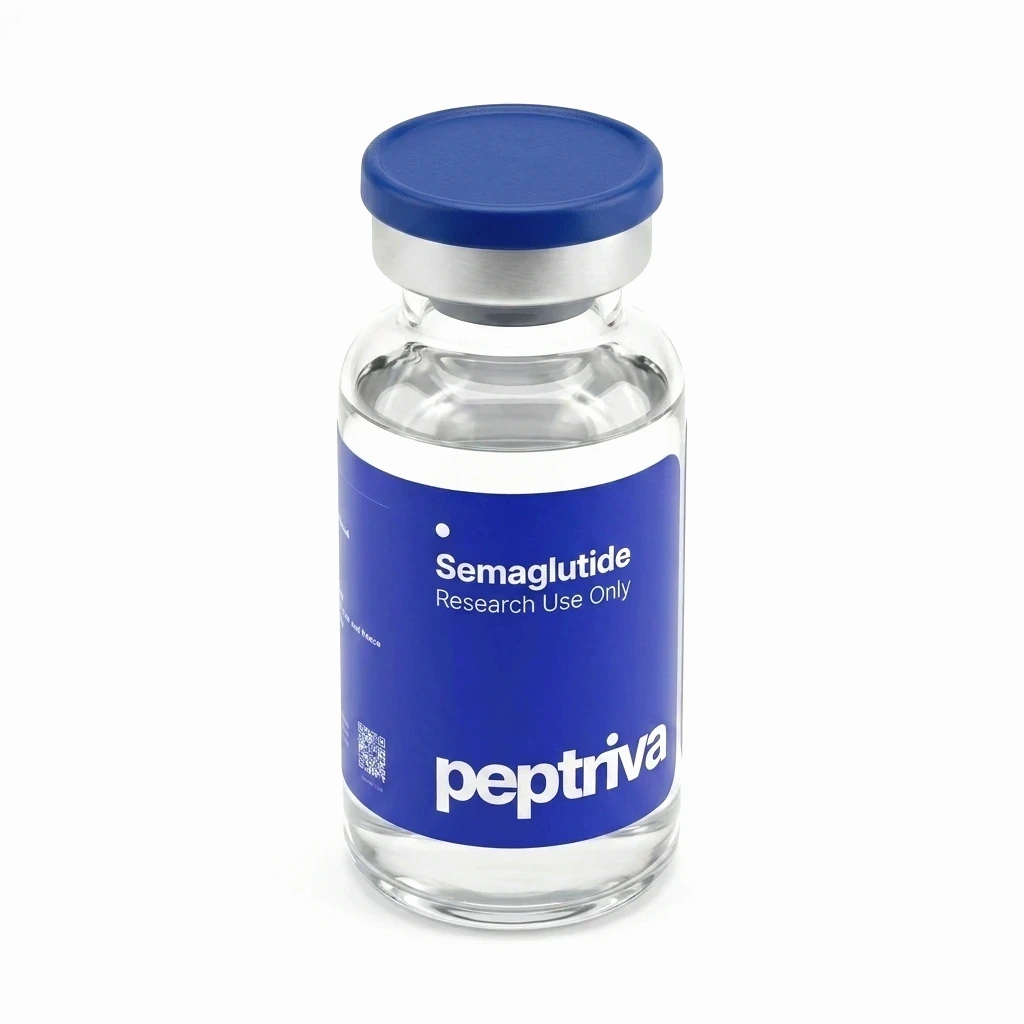
Semaglutide
The same 31-residue acylated GLP-1 analog studied across the STEP, SUSTAIN, and SELECT programs cited in this guide. CAS 910463-68-2, LC-MS identity at 4113.6 Da, ≥99% HPLC purity, quantified acetate counter-ion, and a batch-matched ISO 17025 third-party CoA on every lot.
2026 pricing benchmarks
Semaglutide is a long, modified peptide — 31 residues plus a fatty di-acid chain and spacer chemistry — but it is synthesized at enormous scale in 2026, and research-market pricing reflects that. Where ISO 17025-verified retail should sit:
- 5 mg vial: $35–$70 ($7–$14/mg). Entry size, less common as demand consolidated on larger vials.
- 10 mg vial: $60–$130 ($6–$13/mg). The most common retail size across the market.
- 15 mg vial: $90–$180 ($6–$12/mg). Better per-mg value; the standard size for quantitative work.
- Multi-vial packs: 10–25% off on 3-packs and 6-packs at most reputable suppliers.
Context for those numbers: the pricing gap against the pharmaceutical channel — roughly $1,350/month list for Wegovy versus tens of dollars for a gray vial — is the single force that built the illegitimate semaglutide market. That arbitrage is why the counterfeit problem concentrated on this compound, and why the cheapest listings attract the worst material: the 2024 test-purchase study deliberately bought from the lowest-price tier of no-prescription sellers, and every delivered vial failed. See our GLP-1 class comparison for how pricing stacks across the whole incretin class.
Below roughly $40 per 10 mg, stop and ask why. Synthesis at scale is cheap, but HPLC purification, third-party ISO 17025 testing, endotoxin screening, and quantitation are not free — the bottom of the market skips those steps rather than out-engineering them. Above ~$18/mg you are paying retail markup, not chemistry.
Legal status: an approved drug sold as a lab reagent
Semaglutide's legal position is unusual for this library: unlike most research peptides, it is an approved drug. That cuts both ways for a research buyer:
- United States (FDA): Approved as Ozempic, Wegovy, and Rybelsus — prescription-only for human use. The raw peptide may be legally sold as a research reference compound labeled for laboratory use only, the same framework that covers other analytical reference standards (FDA RUO labeling). Selling research material for human consumption is illegal.
- Compounding: The shortage-era allowance ended in 2025. Routine compounded semaglutide is no longer a lawful channel.
- European Union (EMA): Approved as a prescription medicine; the falsified-medicines directive framework is what EU counterfeit seizures were run under.
- WADA: Not explicitly named on the Prohibited List; GLP-1 receptor agonists have drawn monitoring attention in athletic contexts (WADA Prohibited List for current categorizations).
- Customs: Import of finished drug products (pens) without a prescription is a seizure risk in most jurisdictions; research-labeled bulk peptide is treated as a laboratory chemical but remains subject to national rules.
Said as plainly as we can: RUO supply is lab-reagent supply. The wind-down of compounding did not convert research vendors into pharmacies, and a research vial is not a route to therapy. Vendors who market research-grade semaglutide as a cheaper Wegovy are misbranding a drug, and buying from them attaches your research to their legal exposure.
Where this falls short. The honest caveat about this entire market: research-grade semaglutide demand in 2024–2026 was overwhelmingly driven by human-use intent, not laboratory research, and vendors' RUO labels have often functioned as legal wallpaper over that reality. The clinical evidence base — STEP, SUSTAIN, PIONEER, SELECT — belongs to pharmaceutical products with prescriber oversight and cGMP manufacturing. A lyophilized research vial inherits none of that, and the published audits of the gray channel show exactly what fills the gap when buyers pretend otherwise.
Red flags specific to semaglutide
- Pre-filled pens sold as “research” product. Pens are finished pharmaceuticals. Outside a pharmacy they are, at best, diverted — and the documented counterfeit epicenter, including falsified pens that contained insulin.
- No quantitation on the CoA. Label-vs-content mismatch of 29–39% is the published gray-market norm, not a tail risk. A CoA that only restates the label claim has not measured the vial.
- No mass-spec line, or a mass far from 4113.6 Da. If the mass is wrong, the molecule is wrong — in either direction of the semaglutide/tirzepatide substitution trade.
- Salt-form silence. “Semaglutide sodium” sold as if it were the base compound, or a CoA with no named form and no counter-ion quantitation.
- “Compounded semaglutide, no prescription needed.” Post-wind-down, that sentence describes an illegal product twice over.
- Pricing far below the floor. Sub-$40 per 10 mg listings cluster exactly where the failed test purchases came from.
- Weight-loss marketing on a research listing. Outcome claims, before/after imagery, or titration schedules copied from the drug label mean the vendor is selling an unapproved drug, not a reagent — FDA jurisdiction, not semantics.
- Missing endotoxin testing. Every audited gray-market sample exceeded the 1.0 EU/mg specification; a vendor who doesn't test can't know.
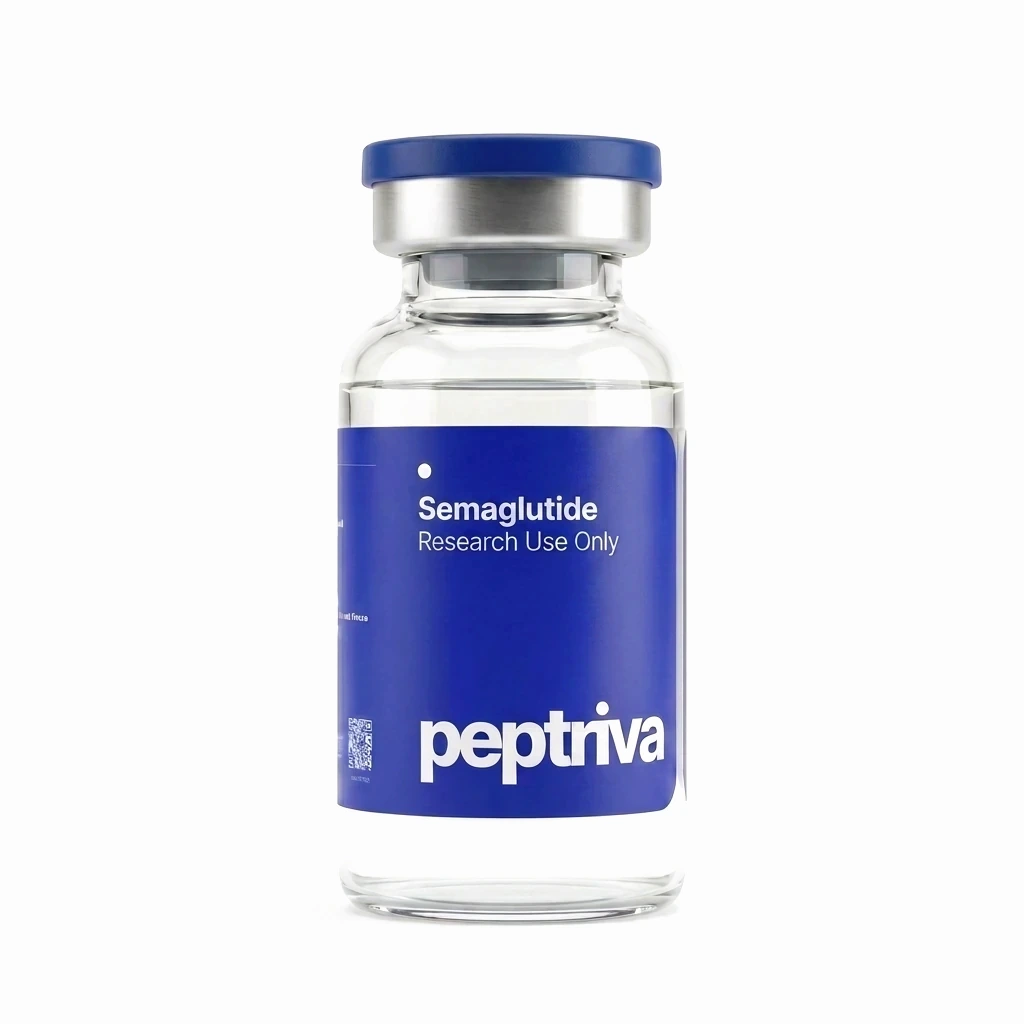
Semaglutide
31-aa GLP-1 analog with Aib-8 substitution and C18 di-acid acylation, CAS 910463-68-2. Batch-matched ISO 17025 third-party CoA with LC-MS identity, HPLC purity, endotoxin, and quantified acetate counter-ion on every lot. Research use only.
All purchased vials were considered probable substandard and falsified products. Semaglutide content substantially exceeded labeled amounts by 28.56–38.69%, and endotoxin was detected in all samples — while half the attempted orders were never delivered at all.
— Paraphrased from Ashraf et al., Journal of Medical Internet Research, 2024
Frequently asked questions
Is semaglutide legal to buy in the USA?
Two different questions hide in that one. As a medicine: yes, by prescription only — Ozempic, Wegovy, or Rybelsus through a licensed pharmacy. As research material: yes, lyophilized peptide labeled for laboratory use only is legal to buy and sell as a reference compound. Selling research-grade semaglutide for human consumption is illegal, and the RUO channel is not an alternative pharmacy.
Why did compounded semaglutide go away in 2025?
Because the legal basis for it was the shortage, and the shortage ended. FDA declared the semaglutide shortage resolved in February 2025; 503A pharmacies had until April 22, 2025 and 503B facilities until May 22, 2025 to stop producing copies, and court challenges did not stall the deadlines. The remaining lawful compounding pathway is narrow and case-by-case — not the subscription model that existed in 2023–2024.
What should a semaglutide CoA show?
Mass-spec identity near 4113.6 Da with CAS 910463-68-2 on the identity line, HPLC purity ≥98–99% with the chromatogram, measured net peptide content per vial, endotoxin <1.0 EU/mg by LAL, and a named, quantified counter-ion (typically acetate, under ~12% w/w). The testing lab should be ISO/IEC 17025-accredited and named on the report. Our CoA reading guide walks through each line.
Is research-grade semaglutide the same as Ozempic?
Chemically the same molecule when genuine; categorically different as a product. Ozempic is a sterile, cGMP-manufactured drug in a metered pen with FDA oversight of every batch. Research-grade semaglutide is bulk lyophilized peptide whose quality rests entirely on the vendor's synthesis partner and third-party testing. One is a medicine; the other is a reagent. Treating the second as the first is precisely the confusion this market's worst actors monetize.
What is semaglutide sodium, and should the vial say “base” or “acetate”?
Semaglutide sodium is the salt form FDA flagged in 2023 when compounders were caught sourcing it — a different active ingredient from the base form in the approved drugs. Research-grade synthetic peptide legitimately ships as an acetate salt; that's standard synthesis chemistry, not a red flag, provided the CoA names the form and quantifies the counter-ion so net peptide content is calculable. The red flag is silence: a vendor who can't say which form they sell hasn't characterized the product.
How does semaglutide compare to tirzepatide for research sourcing?
Semaglutide is the single-receptor GLP-1 benchmark; tirzepatide adds GIP agonism and outperformed semaglutide 1 mg on every endpoint in the SURPASS-2 head-to-head (Frías et al., 2021), while semaglutide holds the published SELECT cardiovascular-outcomes win. On the sourcing side, semaglutide is the cheaper synthesis — which is why it appears as the substituted compound in mislabeled tirzepatide vials. Full breakdown: tirzepatide vs semaglutide.
How common are semaglutide counterfeits, really?
Common enough to be documented at every level of the supply chain: regulator seizures of counterfeit pens from legitimate U.S. and EU distribution, a WHO global alert in 2024, 234 suspected-counterfeit case reports in the EU pharmacovigilance database with 89.3% of suspected reactions classified as serious, and a peer-reviewed test-purchase study in which 100% of delivered gray-market vials failed. No other peptide has a counterfeit literature like this — which is why identity and quantitation testing carry more weight for this compound than for anything else we cover.
What to know now
- CAS 910463-68-2, MW 4113.58 Da, C18-acylated 31-mer. The identity numbers a credible CoA must show — mass-spec within ~1 Da of 4113.6.
- Four channels, two legitimate. Prescription drugs for human use; RUO powder for laboratory use. Compounding wound down in mid-2025, and the no-prescription online channel is documented as majority-illegitimate.
- $60–$130 per 10 mg vial is the verified-market range ($90–$180 at 15 mg). Below ~$40 per 10 mg is where the failed test purchases live.
- Quantitation beats purity for this SKU. The published gray-market failure mode is content 29–39% off label with endotoxin present — demand measured content, not restated label claims.
- Salt form must be named. Base in the approved drugs; acetate salt is normal for research peptide when quantified; “semaglutide sodium” passed off as the base compound is the documented shortcut.
- RUO supply is lab-reagent supply. Not a pharmacy substitute, not a compounding workaround, and vendors who blur that line are the ones to walk away from.
What we’re watching
Three moving parts through 2027. First, enforcement: FDA warning letters against post-wind-down “compounded semaglutide” sellers and against research-labeled vendors making therapeutic claims are landing steadily, and each wave reshapes which gray operators survive. Second, the counterfeit arms race: the EudraVigilance signal study shows pharmacovigilance databases can now detect falsified-product patterns — expect more systematic surveillance publications, and expect the counterfeit trade to keep following the price gap as long as list prices stay four figures a month. Third, the class itself: oral semaglutide's expanding footprint, CagriSema's submission-stage data, and the next-generation multi-agonists covered in our GLP-1 class comparison will redistribute both clinical and research demand — and wherever demand goes, the sourcing problems documented here will follow it.
References
- Lau, J., Bloch, P., Schäffer, L., Pettersson, I., Spetzler, J., Kofoed, J., Madsen, K., Knudsen, L. B., McGuire, J., Steensgaard, D. B., Strauss, H. M., Gram, D. X., Knudsen, S. M., Nielsen, F. S., Thygesen, P., Reedtz-Runge, S., & Kruse, T. (2015). Discovery of the once-weekly glucagon-like peptide-1 (GLP-1) analogue semaglutide. Journal of Medicinal Chemistry, 58(18), 7370–7380. https://doi.org/10.1021/acs.jmedchem.5b00726
- Wilding, J. P. H., Batterham, R. L., Calanna, S., Davies, M., Van Gaal, L. F., Lingvay, I., McGowan, B. M., Rosenstock, J., Tran, M. T. D., Wadden, T. A., Wharton, S., Yokote, K., Zeuthen, N., & Kushner, R. F. (2021). Once-weekly semaglutide in adults with overweight or obesity. New England Journal of Medicine, 384(11), 989–1002. https://doi.org/10.1056/NEJMoa2032183
- Marso, S. P., Bain, S. C., Consoli, A., Eliaschewitz, F. G., Jódar, E., Leiter, L. A., Lingvay, I., Rosenstock, J., Seufert, J., Warren, M. L., Woo, V., Hansen, O., Holst, A. G., Pettersson, J., & Vilsbøll, T. (2016). Semaglutide and cardiovascular outcomes in patients with type 2 diabetes. New England Journal of Medicine, 375(19), 1834–1844. https://doi.org/10.1056/NEJMoa1607141
- Husain, M., Birkenfeld, A. L., Donsmark, M., Dungan, K., Eliaschewitz, F. G., Franco, D. R., Jeppesen, O. K., Lingvay, I., Mosenzon, O., Pedersen, S. D., Tack, C. J., Thomsen, M., Vilsbøll, T., Warren, M. L., & Bain, S. C. (2019). Oral semaglutide and cardiovascular outcomes in patients with type 2 diabetes. New England Journal of Medicine, 381(9), 841–851. https://doi.org/10.1056/NEJMoa1901118
- Lincoff, A. M., Brown-Frandsen, K., Colhoun, H. M., Deanfield, J., Emerson, S. S., Esbjerg, S., Hárdt-Lindberg, S., Hovingh, G. K., Kahn, S. E., Kushner, R. F., Lingvay, I., Oral, T. K., Michelsen, M. M., Plutzky, J., Tornoe, C. W., & Ryan, D. H. (2023). Semaglutide and cardiovascular outcomes in obesity without diabetes. New England Journal of Medicine, 389(24), 2221–2232. https://doi.org/10.1056/NEJMoa2307563
- Frías, J. P., Davies, M. J., Rosenstock, J., Pérez Manghi, F. C., Fernández Landó, L., Bergman, B. K., Liu, B., Cui, X., & Brown, K. (2021). Tirzepatide versus semaglutide once weekly in patients with type 2 diabetes. New England Journal of Medicine, 385(6), 503–515. https://doi.org/10.1056/NEJMoa2107519
- Ashraf, A. R., Mackey, T. K., Vida, R. G., Kulcsár, G., Schmidt, J., Balázs, O., Domián, B. M., Li, J., Csákó, I., & Fittler, A. (2024). Multifactor quality and safety analysis of semaglutide products sold by online sellers without a prescription: Market surveillance, content analysis, and product purchase evaluation study. Journal of Medical Internet Research, 26, e65440. https://doi.org/10.2196/65440
- Zinzi, A., Gaio, M., Ruggiero, R., Mascolo, A., Riemma, M. A., Cipriani, M., Laino, L. V., Berrino, L., Rossi, F., & Capuano, A. (2026). Unmasking counterfeit semaglutide: Analysis of real-world safety data from EudraVigilance. Frontiers in Pharmacology, 17, 1805842. https://doi.org/10.3389/fphar.2026.1805842
- U.S. Food and Drug Administration. (2024). Research Use Only (RUO) and Investigational Use Only (IUO) labeling under 21 CFR § 809.10(b)(9). https://www.fda.gov/medical-devices/ivd-regulatory-assistance/research-use-only-and-investigational-use-only-ruoiuo-labels
- International Organization for Standardization. (2017). ISO/IEC 17025:2017 — General requirements for the competence of testing and calibration laboratories. https://www.iso.org/standard/66912.html