PT-141 (bremelanotide) is unusual: it’s one of only two FDA-approved peptides in the modern research catalog. The FDA approved it as Vyleesi in 2019 for premenopausal sexual desire disorder, based on Phase III trials in ~2,500 women. Where to buy PT-141 in 2026 involves a real channel split: a $300 prescription for Vyleesi or a $40–$80 research-grade vial of the same molecule. This guide covers both channels and the mass-spec check that catches the most common counterfeit (melanotan II).
PT-141 (bremelanotide) is a synthetic 7-amino-acid cyclic peptide. CAS 189691-06-3. Molecular weight 1025.2 g/mol. FDA-approved as Vyleesi (2019) for premenopausal HSDD. Same molecule, same CAS number, same mass as the research-grade powder. Prescription Vyleesi runs $300 per dose. Research-grade pricing runs $40–$80 per 10 mg vial. The two specific traps: vendors swapping in melanotan II under a PT-141 label, and vendors making male-ED claims for an off-label use whose Phase III program was discontinued.
The 60-second answer: The prescription Vyleesi channel is the FDA-approved path for human therapeutic use. Research-grade PT-141 is lyophilized reference compound available from research vendors with a third-party CoA showing HPLC ≥98% and mass-spec at [M+H]+ 1026.2. Same molecule, different channel. The mass-spec check separates verified PT-141 from melanotan II.
Two channels for the same molecule
PT-141 has the cleanest channel split of any peptide in this guide because the FDA approved it. Two channels for the same molecule:
- Prescription Vyleesi: $300 per dose at cash pay. Pre-filled single-dose autoinjector with 1.75 mg of bremelanotide. Manufactured under cGMP. Dispensed by licensed pharmacies. Approved only for premenopausal HSDD (acquired, generalized hypoactive sexual desire disorder). The pharmacy channel is the legitimate path for human therapeutic use in the approved indication.
- Research-grade PT-141: $40–$80 per 10 mg vial. Lyophilized peptide powder. Sold under Research Use Only labeling. Same chemical entity as Vyleesi’s active ingredient. No prescription. Different regulatory framing, different manufacturing pathway, different intended use.
Unlike tirzepatide, there’s no meaningful 503A compounding-pharmacy channel for PT-141. Vyleesi is commercially available and not on the FDA Drug Shortage list, so the compounding exemption doesn’t apply.
What the research channel does not include: No prescription. No physician oversight. No insurance coverage. No FDA-regulated batch testing. No sterility-engineered autoinjector. No authorization for the same therapeutic use as Vyleesi. The pricing gap reflects all of that — it is not a difference in the molecule.
What you’re actually buying
PT-141 is a 7-residue cyclic peptide. Sequence: Ac-Nle-cyclo[Asp-His-D-Phe-Arg-Trp-Lys]-OH. It started life as a metabolite of melanotan II. Palatin Technologies isolated and developed it as a deliberate sexual-desire therapy after researchers noticed sexual side effects in melanotan II recipients.
The two molecules share the same cyclic core but differ at the end. Bremelanotide drops the C-terminal extension that melanotan II carries (Pfaus et al., 2022).
The FDA approved bremelanotide as Vyleesi in June 2019 for acquired, generalized hypoactive sexual desire disorder in premenopausal women. Approval rested on two 24-week Phase III placebo-controlled trials, RECONNECT-1 and RECONNECT-2, enrolling 1,247 and 1,202 women respectively (Simon et al., 2022).
“
Bremelanotide acts centrally on MC4R-expressing neurons to modulate dopaminergic signaling and sexual desire — mechanistically distinct from peripheral PDE5 inhibitors.
— Pfaus et al., 2022 (neurobiology review)
The four checks that matter for PT-141
The standard eight vendor criteria apply. Four are sharper here.
1. Channel match: Vyleesi vs research-grade
Bremelanotide is one of only two FDA-approved peptides in this library (alongside tesamorelin). That changes the rules.
A credible research vendor sells PT-141 as a Research Use Only reference compound. No clinical claims. No therapeutic dosing instructions. No marketing as a cheap Vyleesi substitute. The molecule is the same; the labeling and intended use aren’t. Vendors that conflate the two have crossed into FDA jurisdiction.
2. Mass-spec at 1025.2 Da
The theoretical mass is 1025.2 g/mol. The CoA mass-spec should land at [M+H]+ 1026.2 (within 0.5 Da). CAS 189691-06-3 should appear on the identity line.
The mass match is the single most important identity check. PT-141’s structurally close cousin (melanotan II) sits at 1024.2 Da — only 1 Da apart. A credible mass-spec instrument resolves the difference. A missing mass line is a deal breaker.
3. Melanotan II substitution risk
PT-141 and melanotan II are structurally adjacent. Both are 7-residue cyclic peptides. Both are non-selective melanocortin agonists. Both came from the same University of Arizona / Palatin Technologies program.
An LC-HRMS analytical study (a high-resolution mass-spec method) by Mestria and colleagues found PT-141 and melanotan II in adulterated grey-market products (Mestria et al., 2021). Sometimes the labeled identity didn’t match the measured identity. Treat mass-spec confirmation as non-optional for PT-141.
4. PT-141 is mechanistically distinct from sildenafil
A common misconception in grey-market contexts is that PT-141 operates via the same pathway as PDE5 inhibitors. Published mechanistic reviews describe a distinct mechanism.
Sildenafil and tadalafil act peripherally on smooth muscle in penile vasculature. PT-141 acts centrally, on MC4R neurons in a brain region called the hypothalamus, to modulate dopaminergic signaling (Sweeney et al., 2023).
Different stages of the response, different targets. That’s why the female-HSDD Phase III data doesn’t transfer cleanly to male-ED use. The Phase III program for male indications was discontinued.
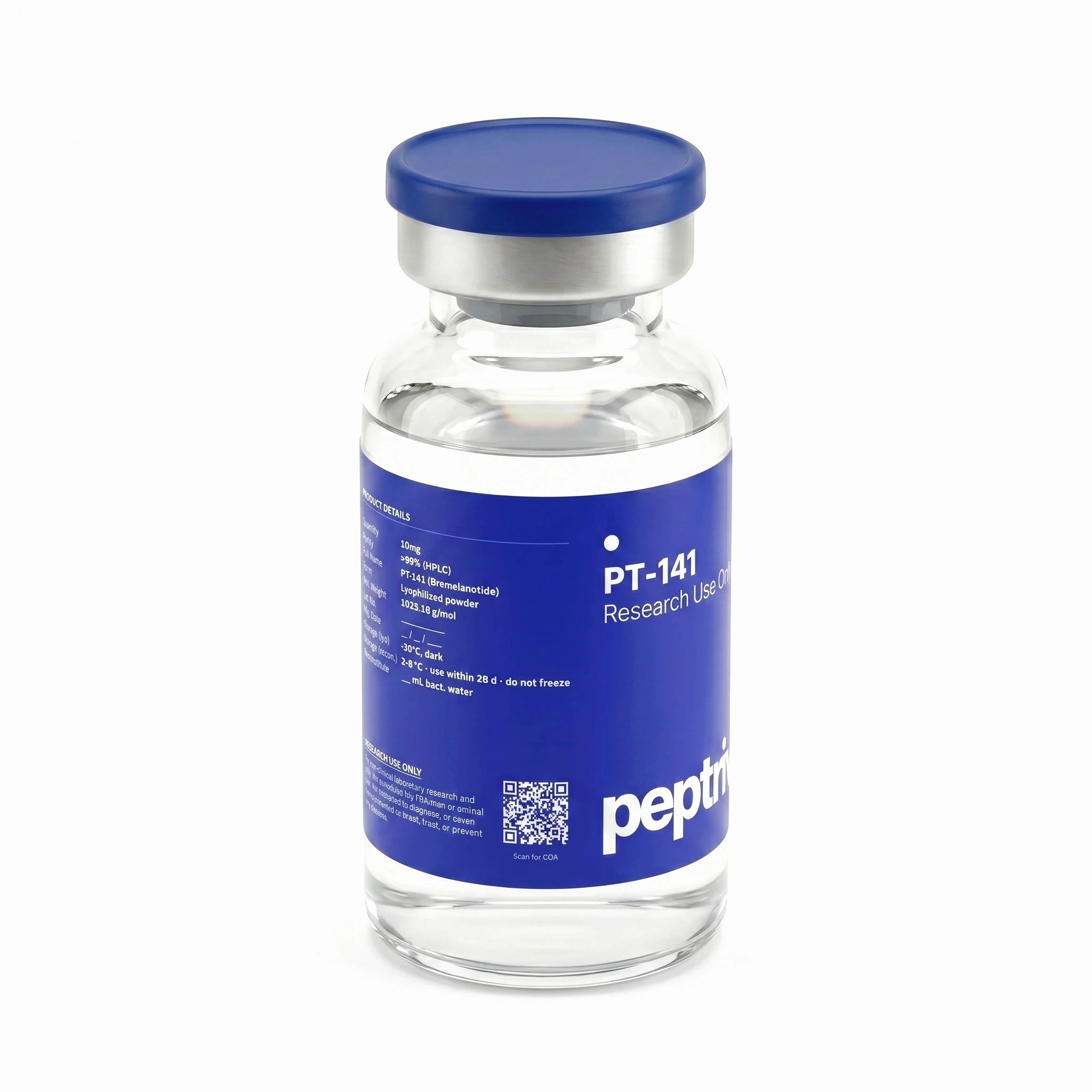
PT-141 (Bremelanotide)
The same cyclic heptapeptide cited across the RECONNECT Phase III trials, the Pfaus neurobiology review, and the Clayton pooled safety dataset. CAS 189691-06-3, observed mass [M+H]+ 1026.2, ≥99% HPLC purity, ISO 17025 third-party CoA on every lot.
Pricing benchmarks for 2026
PT-141 is a 7-residue cyclic peptide with one cyclization step and one D-amino acid (D-Phe). Moderate synthesis complexity. More demanding than BPC-157, less than tirzepatide. The 2026 retail map:
- 10 mg vial: $40–$80 ($4–$8/mg). Most common size.
- 5 mg vial: $30–$55 ($6–$11/mg). Worse per-mg value.
- Multi-vial discounts: 10–25% off for 3-pack or 6-pack purchases.
For comparison: prescription Vyleesi costs about $300 per single-dose autoinjector. That pricing gap covers cGMP manufacturing, sterile autoinjector engineering, prescriber consultation, insurance billing, and pharmacy preparation — not a different molecule.
Below $30 per 10 mg vial, the cyclization and D-amino acid synthesis steps represent real manufacturing cost that cannot be skipped. Sub-floor pricing is a documented indicator of skipped purification or substitution with cheaper analogs (most concerningly melanotan II).
The legal picture
PT-141 / bremelanotide is FDA-approved as Vyleesi for premenopausal HSDD. That changes the regulatory picture:
- Vyleesi requires a prescription. The pharmacy channel is legitimate for human use in the approved indication. Some telehealth services prescribe it when clinical criteria are met.
- Research-compound sales are legal. PT-141 ships in the US as a Research Use Only reference compound. Same way other approved drug molecules are sold as analytical reference standards.
- Off-label male use is outside the approval. The male-indication Phase III program was discontinued. Selling PT-141 as research material without therapeutic claims is legal. Selling it as a male-ED treatment is not.
Red flags specific to PT-141
- Mass-spec at the wrong mass. Anything materially off from 1026.2 [M+H]+ means the vial doesn’t contain PT-141. Melanotan II substitution is documented in grey-market analytical work (Mestria et al., 2021).
- Clinical claims for male ED. “Treats male ED.” “Better than Viagra.” The male-indication Phase III program was discontinued. FDA jurisdiction.
- Therapeutic administration instructions on the product page. Prescribing-schedule language mirroring the Vyleesi label indicates a vendor positioning the compound for human use rather than laboratory research.
- Marketed as a Vyleesi substitute. Same molecule, different channel. A vendor pitching cheap Vyleesi is selling an unapproved version of an FDA drug.
- Missing CAS 189691-06-3 on the CoA. The unique identifier. Its absence is a red flag.
- Pre-mixed nasal sprays or transdermal patches. The Vyleesi format is a subcutaneous autoinjector. Pre-formulated alternatives aren’t validated in any published controlled study.
- Internal QC only, no third-party ISO 17025 lab. The standard is an outside accredited lab on the report.
PT-141 (Bremelanotide)
Cyclic heptapeptide, CAS 189691-06-3, theoretical MW 1025.2 g/mol. The same reference compound used across the RECONNECT Phase III dataset and the Clayton pooled safety analysis. COA with HPLC trace and mass-spec ships with every order — the mass-line confirmation that separates verified PT-141 from melanotan II substitution.
Frequently asked questions
Is PT-141 the same as Vyleesi?
Chemically, yes. Both are the same cyclic 7-residue peptide. Same CAS number, same mass. What differs: regulatory framing, supply chain, manufacturing quality, and dosage form. Vyleesi is the FDA-approved finished product made under cGMP, dispensed by pharmacies with a prescription. Research-grade PT-141 is lyophilized powder under Research Use Only labeling.
How much does PT-141 cost vs Vyleesi?
Vyleesi: about $300 per single-dose autoinjector at cash pay. Research-grade PT-141: $40–$80 per 10 mg vial. The research-grade price doesn’t include the prescription, the autoinjector engineering, pharmacy prep, or the cGMP overhead.
Is PT-141 legal without a prescription?
Yes, as a research reference compound. Same as other approved drug molecules sold as analytical reference standards. Selling PT-141 as a therapeutic without a prescription is illegal. Buying it from a supplier that labels and ships it Research Use Only isn’t.
PT-141 vs melanotan II, which one is which?
PT-141 is the FDA-approved one (as Vyleesi, 2019). Melanotan II has never been approved anywhere and has documented serious adverse events from grey-market use. Both are cyclic 7-residue peptides. Both are non-selective melanocortin agonists. PT-141 weighs 1025.2 Da. Melanotan II weighs 1024.2 Da. The 1-Da difference is easily resolved on a credible mass-spec instrument.
What does PT-141 do mechanistically?
Published studies have investigated PT-141 as a non-selective melanocortin receptor agonist with primary activity at MC4R in the hypothalamus. MC4R activation has been reported to increase dopaminergic signaling in preclinical and clinical models. Mechanistic reviews note this is distinct from PDE5 inhibition, which acts peripherally on vascular smooth muscle rather than centrally on CNS signaling. See PT-141 MC4R CNS mechanism.
What should a PT-141 CoA show?
CAS 189691-06-3. HPLC purity ≥98% with chromatogram. Mass-spec at [M+H]+ 1026.2. Water content 2–8% via Karl Fischer titration. Counterion content (usually trifluoroacetate, 5–15% by mass). An ISO 17025-accredited lab named on the report. The mass-spec line is the primary identity check against melanotan II substitution.
What to know now
- CAS 189691-06-3, MW 1025.2, [M+H]+ 1026.2. The identity parameters a research-grade CoA should confirm.
- $40–$80 per 10 mg vial. Moderate synthesis complexity (cyclic 7-mer with one D-amino acid).
- FDA-approved as Vyleesi (2019). Same molecule, different channel. Prescription Vyleesi runs $300 per dose.
- Mass-spec is non-optional. Melanotan II substitution is documented in grey-market analytical work.
- CNS-active, not a peripheral vasodilator. Mechanistic reviews characterize MC4R-mediated central dopaminergic signaling as distinct from PDE5 inhibition. The Phase III male-indication program was discontinued.
- Male Phase III program was discontinued. The FDA approval covers premenopausal HSDD only.
What we’re watching
Two PT-141 developments worth tracking. First: whether any group revisits the male sexual-function indication with a new Phase III program. The original program was discontinued. A fresh trial would either close the off-label evidence gap or confirm that the female-HSDD data does not transfer. Second: whether grey-market analytical surveillance continues to document PT-141 substitution. The 2021 Mestria LC-HRMS analysis is the canonical reference. Until newer data publishes, mass-spec identity confirmation remains the non-optional quality check for this peptide.
References
- Pfaus, J. G., Sadiq, A., Spana, C., & Clayton, A. H. (2022). The neurobiology of bremelanotide for the treatment of hypoactive sexual desire disorder in premenopausal women. CNS Spectrums, 27(3), 281–289. https://doi.org/10.1017/S109285292100002X
- Simon, J. A., Kingsberg, S. A., Portman, D., et al. (2022). Prespecified and integrated subgroup analyses from the RECONNECT Phase 3 studies of bremelanotide. Journal of Women’s Health, 31(3), 391–400. https://doi.org/10.1089/jwh.2021.0225
- Clayton, A. H., Kingsberg, S. A., Portman, D., et al. (2022). Safety profile of bremelanotide across the clinical development program. Journal of Women’s Health, 31(2), 171–182. https://doi.org/10.1089/jwh.2021.0191
- Sweeney, P., Gimenez, L. E., Hernandez, C. C., & Cone, R. D. (2023). Targeting the central melanocortin system for the treatment of metabolic disorders. Nature Reviews Endocrinology, 19(9), 507–519. https://doi.org/10.1038/s41574-023-00855-y
- Mestria, S., Odoardi, S., Frison, G., & Strano Rossi, S. (2021). LC-HRMS characterization of melanotan II and bremelanotide sold on the black market of performance and image enhancing drugs. Drug Testing and Analysis, 13(4), 876–882. https://doi.org/10.1002/dta.2986
- U.S. Food and Drug Administration. (2019). Vyleesi (bremelanotide injection) prescribing information. https://www.accessdata.fda.gov/drugsatfda_docs/label/2019/210557s000lbl.pdf
- International Organization for Standardization. (2017). ISO/IEC 17025:2017 — General requirements for the competence of testing and calibration laboratories. https://www.iso.org/standard/66912.html