The PT-141 HSDD Vyleesi trials matter not just because they produced an FDA approval. They show, in unusually clean form, the gap between a statistically significant Phase III result and a clinically transformative therapy.
Two pivotal trials (RECONNECT-1, n=1,247; RECONNECT-2, n=1,202) tested bremelanotide for 24 weeks in premenopausal women with HSDD. Both met their primary endpoints. But the Spielmans re-analyses found 72.7% of protocol outcomes went unpublished, effect sizes ranged "from nil to small," and more women on placebo than on drug chose to continue into the open-label extension. Nausea was reported in 40% of study participants.
The RECONNECT program was the registration-grade evidence base for bremelanotide as a treatment for premenopausal hypoactive sexual desire disorder (HSDD, a clinical diagnosis we'll define below). The trials ran in parallel and enrolled in 2014-2016. The FDA approved Vyleesi in June 2019 on the basis of this data.
The molecule has been on the US market for six years now. The post-approval period has produced its own evidence base: re-analyses of the original trial data, plus real-world prescribing patterns.
This article walks through what the RECONNECT trials measured, what they found, what they didn't publish, and what the follow-up methodological work uncovered. The agency reviewed the full package and approved on pre-specified primary endpoints met. The goal here is to present the full picture of what "Phase III approved" actually means in this case.
What is HSDD, and how was it defined for these trials?
Hypoactive sexual desire disorder (HSDD) is a clinical diagnosis. It's defined by deficient or absent sexual desire and fantasies that causes marked personal distress, and isn't better explained by another condition.
For RECONNECT, the population was tighter. It was premenopausal women with acquired HSDD (onset after a period of normal sexual functioning) that was generalized, not partner-specific or situation-specific.
This is much narrower than the loose marketing framing of "women with low libido." Excluded: postmenopausal women, women with lifelong HSDD (never had typical desire), women whose HSDD was situation- or partner-specific, and women whose low desire was better explained by depression, medication side effects, or relationship issues.
The narrow population is what made the trial design work. It's also the boundary of the FDA-approved indication.
Diagnosis was made by trained clinical investigators using a structured interview. The primary efficacy outcomes were two patient-reported measures:
- Female Sexual Function Index (FSFI) desire domain. A validated 2-item subscale that asks about frequency and intensity of sexual desire over the past 4 weeks. Higher scores mean more desire.
- Female Sexual Distress Scale - Desire/Arousal/Orgasm (FSDS-DAO) Item 13. A single-item measure of distress: "bothered by low sexual desire." Lower scores mean less distress.
What did the trials actually find?
The principal RECONNECT publication and the Simon 2022 integrated subgroup analyses reported statistically significant improvements with bremelanotide versus placebo on both primary endpoints. That held across age, weight, BMI, contraceptive use, and testosterone subgroups. The headline efficacy claim is real.
Effect size matters as much as statistical significance. On the FSFI desire domain, healthy women without sexual concerns typically score in the 4-5 range. HSDD scores typically run around 2. The mean improvement with bremelanotide over 24 weeks was about 0.3-0.4 points greater than placebo.
The placebo arm itself improved substantially. That's consistent with the large placebo response well-documented in female sexual dysfunction trials. The drug-minus-placebo delta was modest by the conventional benchmarks for "clinically meaningful improvement."
Cipriani's 2023 evaluation in Expert Opinion on Pharmacotherapy and the Pettigrew & Novick 2021 review both flag the structural problem: the field has "dramatic challenges in conducting well-designed clinical trials for female sexual dysfunction." Both land on the same framing as the FDA's: a real but modest effect, statistically significant, with a meaningful tolerability burden.
What did the Spielmans re-analyses uncover?
This is where the story gets more complicated. Glen Spielmans published a 2021 methodological re-analysis in the Journal of Sex Research. He compared the principal publications against the pre-specified protocols registered on ClinicalTrials.gov.
Three findings emerged.
First, outcome under-reporting. 72.7% of protocol-listed outcomes weren't reported in the principal publication. Of the outcomes that were reported, 15 secondary measures weren't pre-listed in the study protocol. They got added after the fact. Selective outcome reporting and post-hoc measure addition are both recognized publication problems. Both can inflate the apparent strength of a drug's signal.
Second, adverse-event-driven discontinuation. The odds ratio for discontinuation due to adverse events on bremelanotide vs placebo was 11.98. The number-needed-to-harm was 6. That means for every 6 study participants in the treatment arm, one discontinued due to side effects that were not observed at the same rate in the placebo arm. That is a substantial tolerability burden.
Third, the open-label extension preference signal. This one's the most striking. After completing the 24-week double-blind trial, participants were offered the option to continue into an open-label extension. The odds ratio for choosing extension was 0.30 for bremelanotide vs placebo, with a number-needed-to-harm of 4.
In plain English: more women on placebo than on the drug chose to keep taking what they'd been on.
More participants randomized to placebo than to bremelanotide elected to continue into the open-label extension after completing the trial — a striking signal of patient preference that runs counter to the marketed claim of clinically meaningful improvement.
— Spielmans, Journal of Sex Research, 2021
The extension preference signal is the most uncomfortable finding for the marketing narrative. If bremelanotide were simply preferred by recipients, drug-arm participants would be expected to be more likely to want continued access. The opposite was observed.
The simplest read: drug-arm participants found the tolerability burden (mostly nausea) bad enough to outweigh whatever benefit they got.
Where this falls short
The Spielmans re-analyses are critical work, but they're not perfect. They reframe the published evidence; they don't generate new data. The placebo response in female sexual dysfunction trials is genuinely large, so a "small drug-minus-placebo delta" doesn't necessarily mean the drug produces no effect in any subpopulation. The 8 percentage-point response delta in the FSFI chart above is real and statistically significant. Methodological re-analysis establishes that the trial's framing was selective. It cannot establish that the compound never produces a response in individual study participants.
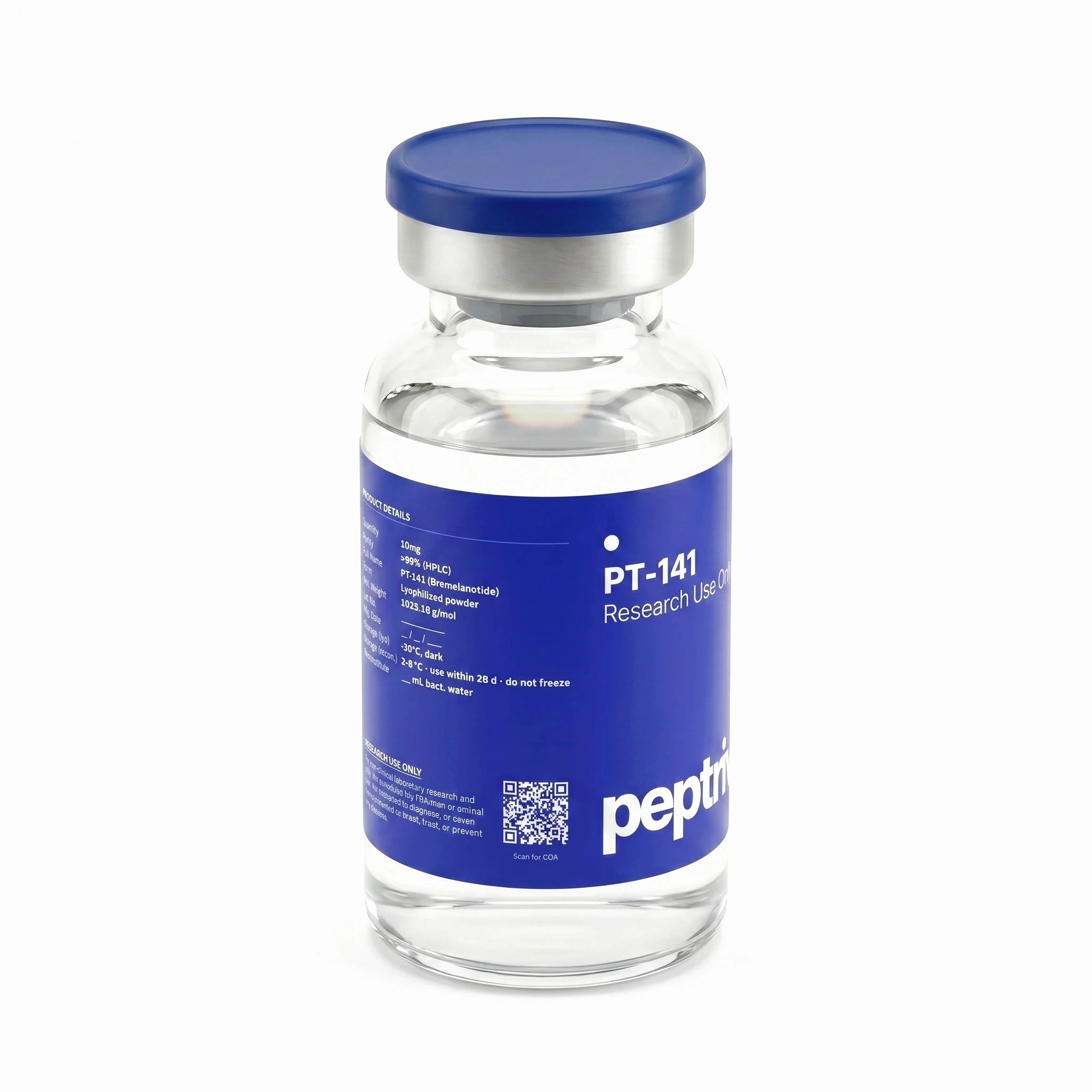
PT-141 (Bremelanotide)
The same compound cited across the RECONNECT Phase III trials in this review. Lab-verified identity and purity.
What did the 2024 follow-up add?
Spielmans and Ellefson published a follow-up analysis in 2024 in the same journal. They examined 11 ClinicalTrials.gov-specified efficacy outcomes from RECONNECT, eight of which had been previously unpublished. The follow-up was made possible by post-approval transparency rules forcing additional data release.
The findings matched the 2021 re-analysis. Effect sizes across the 11 outcomes ranged "from nil to small," with measurement-validity concerns for the primary outcomes used. The authors specifically flagged the FSFI desire domain. They argued it has measurement-validity issues that complicate interpretation of the statistically significant signal.
The 2024 follow-up didn't overturn the underlying conclusion that bremelanotide produces a measurable effect. It just constrained the magnitude more narrowly than the principal publications had suggested. The paper's conclusion is concise: "Small effects, questionable outcomes."
What does the safety data look like?
Clayton's pooled safety analysis aggregated Phase 1-3 data across 43 studies and 3,500 subjects, plus the 18-month open-label extension. The signal is dominated by one thing: nausea.
The pooled bremelanotide safety profile
Nausea 40.0% vs placebo 1.3%. This is the dominant adverse event and dominant cause of discontinuation.
Flushing 20.3% vs 1.3%. Headache 11.3% vs 1.9%. Injection-site reactions 5.4% vs 0.5%.
Small but statistically significant transient blood-pressure elevations on ambulatory monitoring.
Focal hyperpigmentation was rare at label dosing (max 8 doses/month). At extended dosing (up to 16 consecutive daily doses in sub-studies), over one-third of subjects developed hyperpigmentation.
The nausea profile shaped real-world prescribing outcomes. In the Phase III studies, onset was reported within the first hour post-dose. Events peaked early and resolved within 2-4 hours in most cases. The majority were rated mild to moderate, but the cumulative burden across repeat dosing was high.
That matches the discontinuation-rate signal Spielmans identified. Post-approval observational data suggests that many subjects initiated treatment, found the nausea sufficient to make repeat dosing aversive, and discontinued after a small number of doses.
The transient blood-pressure elevation is the basis for the label's caution against use in uncontrolled hypertension or known cardiovascular disease. The magnitude is small (a few mmHg systolic). In healthy premenopausal women, the clinical significance is modest. In patients with pre-existing cardiovascular risk, the calculus changes.
The hyperpigmentation signal matters most for off-label users dosing more often than the label allows. At the label cap of 8 doses per month, hyperpigmentation was rare. In Phase III sub-studies that examined daily dosing for 16 days, over one-third of subjects developed focal hyperpigmentation. The risk scales with dosing frequency.
What about post-marketing surveillance?
Vyleesi has been on the US market since 2019. FDA Adverse Event Reporting System (FAERS) data and manufacturer surveillance have continued to characterize the safety profile.
Commercial uptake has been modest by FDA-approved-drug standards. The molecule hasn't become a blockbuster. That limits the volume of post-marketing data relative to comparable drugs, but the signals so far have been consistent with the Phase III profile. Nausea remains dominant. Transient blood-pressure changes haven't produced major cardiovascular signals in the approved population. Hyperpigmentation reports match the dose-frequency dependence seen in Phase III.
One post-approval observation matters: the commercial under-performance of Vyleesi tracks closely with the tolerability burden. Multiple commentaries from women's health and sexual medicine communities have noted the gap between "statistically significant Phase III efficacy" and "drug that women actually want to keep using." That gap maps neatly onto the nausea profile and the Spielmans preference signal. It's part of why the molecule remains a niche product six years after approval.
What does the off-label literature look like?
Most actual grey-market consumption of PT-141 isn't Vyleesi prescriptions to women. It's research-grade bremelanotide used off-label, mostly by men for erectile function or libido enhancement. The evidence base for that use case is structurally different.
The bremelanotide development program in men was discontinued. Phase III evidence in men is significantly thinner than the female HSDD data. The trials run in men didn't produce the regulatory case Palatin (the manufacturer) needed for an FDA submission in male indications.
The Mestria 2021 analytical study characterized PT-141 and melanotan II content in adulterated performance-enhancing drug products sold on the black market. Grey-market PT-141 products were found to vary substantially in identity and purity — a chain-of-custody limitation inherent to material sourced outside the FDA-approved pharmaceutical supply chain, where product quality is determined by the specific vendor rather than pharmaceutical-grade quality controls.
Suzuki and colleagues' 2024 in-vitro study documented bremelanotide-induced cell death in glioblastoma cell lines via MC3R/MC4R signalling (the melanocortin receptors PT-141 binds). That's drug-repurposing lab work, not clinical evidence for any oncology indication. It does reinforce that the receptor family bremelanotide engages has biological reach beyond the sexual-desire indication.
PT-141 (Bremelanotide)
Cyclic heptapeptide · non-selective MCR agonist. The same reference compound used across the cited Phase III studies. COA available with each lot.
How does this compare to flibanserin?
Flibanserin (Addyi) is the other FDA-approved drug for premenopausal HSDD. It was approved in 2015, four years before bremelanotide. The comparison is informative because both drugs target the same indication with different mechanisms.
Flibanserin is a daily oral serotonin-receptor modulator. It targets the 5-HT1A and 5-HT2A receptors. The dosing pattern is chronic rather than as-needed. The side effects are dominated by dizziness, somnolence, and a documented interaction with alcohol that produces low blood pressure.
The flibanserin development program also showed statistically significant but modest improvements on pre-specified primary endpoints. The post-approval period has also seen methodological re-analyses raising similar concerns about effect size and outcome under-reporting.
Both FDA-approved HSDD drugs have similar issues. The field as a whole struggles to produce large-effect-size data in this indication. That's partly because of the heterogeneity of the patient population. It's partly because of measurement-validity problems with subjective desire scales as primary endpoints.
The honest framing for either drug: "modestly effective for a specific phenotype, with meaningful tolerability tradeoffs." Not "transformative therapy for low libido."
Key methodological considerations for interpreting the RECONNECT data
The Spielmans re-analyses and related commentaries identified several factors that researchers and clinicians should weigh when interpreting the RECONNECT results:
- Engagement with the methodological literature. The Spielmans re-analyses represent substantive independent scrutiny of the trial data beyond the principal publications and marketing materials.
- Narrow enrollment criteria. The RECONNECT population was restricted to acquired, generalized HSDD — not situational or partner-specific presentations, and not cases better explained by medication effects or comorbidities.
- Competing explanations for low desire. Depression, sleep disruption, medication side effects (SSRIs, hormonal contraceptives), and relationship factors were exclusion criteria precisely because they represent alternative explanations with their own evidence-based management pathways.
- Outcome measurement challenges. The Spielmans 2024 follow-up flagged measurement-validity concerns for the FSFI desire domain as a primary endpoint; modest trial-level effect sizes complicate individual-level response interpretation.
- Tolerability burden in the discontinuation data. Adverse-event-driven discontinuation (NNH 6) was dominated by nausea. The Spielmans open-label extension preference signal (OR 0.30) tracks with this pattern in the post-approval prescribing literature.
- Flibanserin as a comparator. Studies have also investigated the alternative FDA-approved agent (flibanserin / Addyi) for the same indication — a different mechanism, chronic daily dosing pattern, and distinct adverse-event profile.
What to know now
- FDA approval basis: RECONNECT-1 (n=1,247) and RECONNECT-2 (n=1,202), 24-week double-blind placebo-controlled trials in premenopausal women with acquired generalized HSDD.
- Pre-specified primary endpoints: FSFI desire domain and FSDS-DAO Item 13. Both met statistical significance with modest effect sizes (delta of ~0.3-0.4 on FSFI scale). Placebo arm also improved substantially.
- Outcome under-reporting: Spielmans found 72.7% of protocol outcomes unpublished. 15 reported measures weren't pre-listed.
- Adverse-event discontinuation: OR 11.98 vs placebo, NNH 6 (one extra discontinuation per 6 study participants in the treatment arm).
- Open-label extension preference: more placebo-arm than drug-arm participants chose to continue (OR 0.30 for bremelanotide vs placebo, NNH 4).
- Spielmans 2024 follow-up: 11 outcomes (8 previously unpublished) showed effect sizes "from nil to small."
- Safety dominant signal: 40% nausea, 20% flushing, 11% headache. Transient blood-pressure elevation. Hyperpigmentation at extended dosing.
- Off-label male use: Phase III male program discontinued. No FDA-approved male indication. Grey-market quality varies.
What we're watching
Three things in the bremelanotide post-marketing period. First, whether more selective MC4R agonists with reduced MC3R activity come into clinical development for HSDD. The tolerability gap between bremelanotide and a hypothetically better-tolerated selective MC4R agonist is the most plausible commercial path forward in this space. Second, the post-marketing data on real-world adherence and study-participant preference. The Spielmans preference signal should be observable in commercial prescribing data over a long enough window. Third, whether any new male-indication trial program for bremelanotide or a related molecule emerges. The discontinued male program remains the largest evidence gap in the field, and a well-designed Phase II would be consequential.
References
- Simon, J. A., Kingsberg, S. A., Portman, D., et al. (2022). Prespecified and integrated subgroup analyses from the RECONNECT Phase 3 studies of bremelanotide. Journal of Women's Health, 31(3), 391–400. https://doi.org/10.1089/jwh.2021.0225
- Clayton, A. H., Kingsberg, S. A., Portman, D., et al. (2022). Safety profile of bremelanotide across the clinical development program. Journal of Women's Health, 31(2), 171–182. https://doi.org/10.1089/jwh.2021.0191
- Spielmans, G. I. (2021). Re-analyzing Phase III bremelanotide trials for "hypoactive sexual desire disorder" in women. Journal of Sex Research, 58(9), 1085–1105. https://doi.org/10.1080/00224499.2021.1885601
- Spielmans, G. I., & Ellefson, E. M. (2024). Small effects, questionable outcomes: Bremelanotide for hypoactive sexual desire disorder. Journal of Sex Research, 61(4), 540–561. https://doi.org/10.1080/00224499.2023.2175192
- Cipriani, S., Alfaroli, C., Maseroli, E., & Vignozzi, L. (2023). An evaluation of bremelanotide injection for the treatment of hypoactive sexual desire disorder. Expert Opinion on Pharmacotherapy, 24(1), 15–21. https://doi.org/10.1080/14656566.2022.2132144