The key fact about the PT-141 MC4R mechanism: bremelanotide acts on brain circuits that generate sexual desire, not on blood vessels in the genitals. Studies have investigated this distinction to understand why it targets a phenotype that Viagra-class drugs do not address.
Bremelanotide is a non-selective melanocortin receptor agonist. Its main therapeutic effect comes from activating MC4R (one of five melanocortin receptors) on neurons in the medial preoptic area, a sexual-motivation hub in the hypothalamus. That activation triggers dopamine release in nearby reward circuits. Side effects come from the same molecule hitting related receptors: nausea from MC3R/MC4R cross-talk in the brainstem, focal skin darkening from MC1R cross-reactivity on pigment cells. Viagra (a PDE5 inhibitor) works on the plumbing. PT-141 works on the wanting.
- MC1R-MC5R. Five melanocortin receptors, all related, all sensitive to a small family of natural signaling peptides. Each lives on different tissues and does different jobs.
- Hypothalamus. A small region near the base of the brain that controls hormones, appetite, body temperature, and motivated behaviors like sex and hunger.
- Medial preoptic area (mPOA). A specific zone inside the hypothalamus. Mapped since the 1960s as the brain's primary sexual-motivation hub.
- Dopamine. The brain's main "wanting" chemical. Drives motivated behavior toward food, sex, drugs, novelty.
- PDE5 inhibitor. Drugs like Viagra and Cialis that relax penile blood vessels by blocking the enzyme that shuts that response off.
This article reviews the PT-141 pharmacology in plain language, walking through five receptors. The central observation: the same molecule produces desire, nausea, and pigmentation because it engages three different receptors in three different tissues.
There are five melanocortin receptors: MC1R through MC5R. All respond to natural signaling peptides made from a parent protein called POMC. Each receptor resides on different tissues and performs different functions.
MC1R resides on pigment cells in skin and controls tanning. MC2R resides on the adrenal cortex and receives ACTH, the body's stress-axis signal. MC3R and MC4R reside in the brain and control appetite and motivated behaviors. MC5R handles glands that secrete fluids.
Bremelanotide is a non-selective agonist (a drug that activates a receptor) at this whole family. It engages four of the five with different binding strengths. Its therapeutic effect on desire comes mostly from MC4R in one brain region. The same non-selectivity drives the side effects. The following sections map which receptor is responsible for which effect.
What MC4R does in the medial preoptic area
The mPOA sits in the middle of the brain, just above the optic chiasm (where the optic nerves cross). It has been characterised as the brain's primary sexual-motivation zone since the 1960s. Lesioning it in rodent models stops copulatory behavior; stimulating it elicits the full sexual response.
MC4R sits on a specific group of cells inside the mPOA. These cells signal onto dopamine-releasing neurons downstream. Here's the cascade Pfaus and colleagues describe in their 2022 CNS Spectrums review. Bremelanotide binds MC4R. That triggers an internal cell signal that boosts neurotransmitter release. More dopamine in the reward circuits follows.
Dopamine is the unifying chemistry. The mPOA's sexual-output circuit runs on dopamine. So does our brain's response to food, drugs, and most rewards. The bremelanotide story we're telling is "upstream nudge to the dopamine system, gated by MC4R." It's a familiar pharmacological pattern applied to one specific motivation.
Activation of MC4R on presynaptic neurons in the medial preoptic area increases dopamine release in downstream excitatory circuits, providing the central mechanistic basis for bremelanotide's effects on sexual motivation in premenopausal HSDD.
— Pfaus et al., CNS Spectrums, 2022
Why this is different from Viagra
PDE5 inhibitors — sildenafil (Viagra), tadalafil (Cialis), vardenafil — work on plumbing. They block an enzyme called PDE5 that degrades a small molecule called cGMP in penile blood vessels. Block PDE5, cGMP accumulates, blood vessels relax, blood flows in, erection follows. One crucial caveat: only if arousal is already happening upstream.
So PDE5 inhibitors don't initiate desire. They help the body act on desire that's already present. They have limited utility for study participants whose central problem is missing motivation rather than inadequate blood flow. That's the population bremelanotide is FDA-approved for. Premenopausal hypoactive sexual desire disorder, or HSDD, is defined by missing central drive. The two drug classes target different stages of the same response.
Why does it cause nausea?
Nausea was the dominant tolerability problem documented in Phase III trials of bremelanotide. 40% of subjects in the Phase III safety dataset reported it. The proposed mechanism: MC3R and MC4R cross-activation on brainstem circuits that connect with the area postrema, the brain's "vomit center."
Receptor selectivity matters here. A more selective MC4R drug that didn't hit MC3R could in principle produce the same desire effect with less nausea. Setmelanotide is a related MC4R drug used for rare genetic obesity. It's more selective and has a different tolerability profile. But it's also dosed differently for a different goal (appetite suppression). Bremelanotide's non-selectivity is partly historic. Our pharmacology toolkit for selective design was less mature when bremelanotide was developed.
The nausea documented in trials was also short-lived. Onset occurred within the first hour of administration, peaked early, and resolved within 2–4 hours. This time course tracks the compound's plasma levels, indicating a peak-concentration effect rather than a sustained tolerability problem.
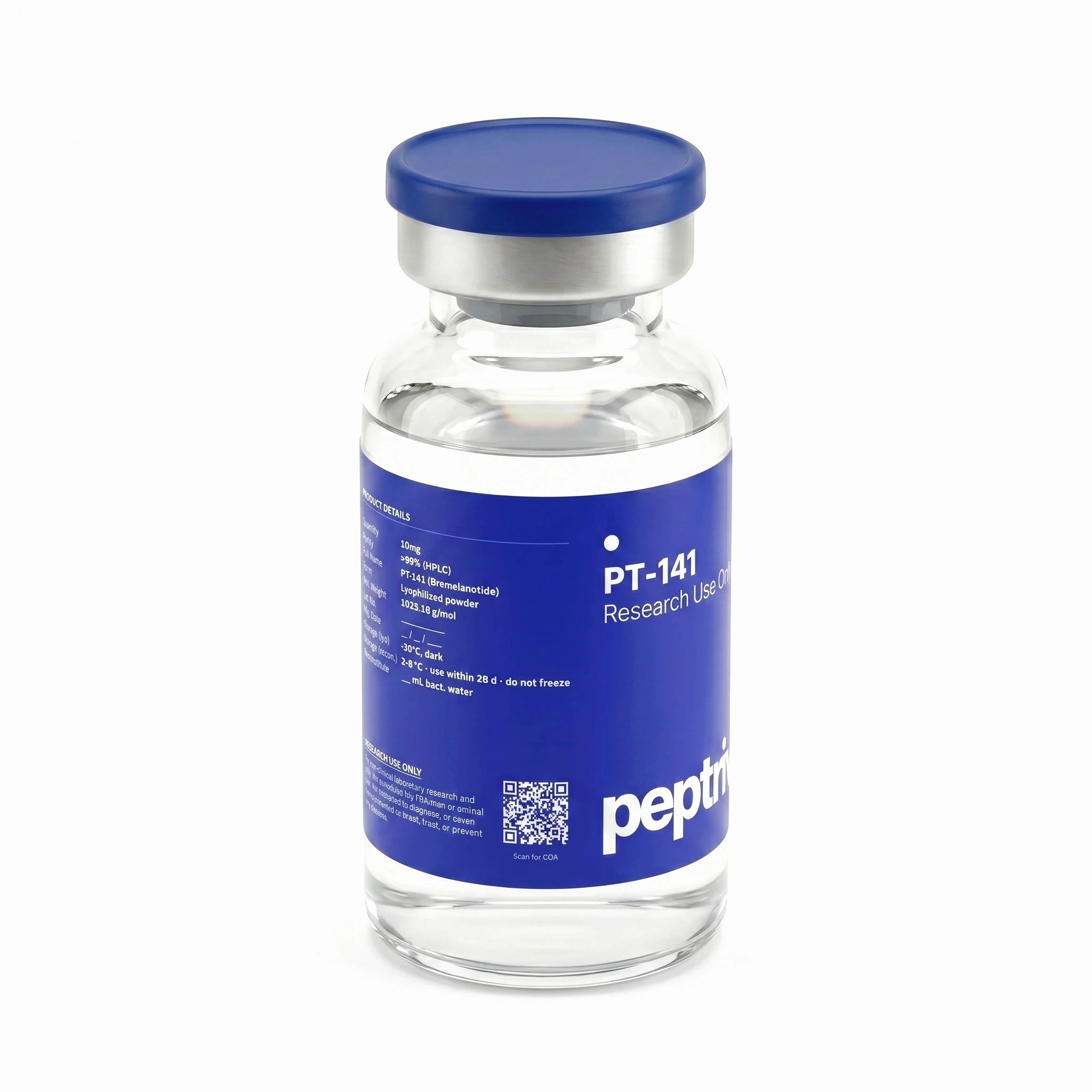
PT-141 (Bremelanotide)
The same compound cited across the mechanistic studies in this article. Lab-verified identity and purity.
What about appetite suppression?
MC4R is also one of the brain's main appetite controllers. The receptor is densely expressed in a region called the paraventricular nucleus. Activate it there and food intake drops. That's the basis for setmelanotide's approval in a rare genetic obesity caused by upstream defects in this pathway.
For bremelanotide, appetite suppression is theoretically present but has not been a prominent clinical effect in trials. The approved administration schedule is intermittent, so blood levels rise and fall quickly. That pattern does not produce the sustained appetite suppression observed with daily oral setmelanotide. Some study participants reported reduced appetite for a few hours following administration — this is not a labeled effect.
Sweeney and colleagues argue in their Nature Reviews Endocrinology review that the central melanocortin system is one of the most promising target families for metabolic disease. Bremelanotide sits in that family. Its therapeutic positioning is different, but the receptors it engages are at the center of a wave of metabolic-disease drug development.
Why does it cause skin hyperpigmentation?
The skin-darkening side effect reported in Phase III trials arises from MC1R cross-reactivity. MC1R resides on melanocytes, the cells that produce pigment in skin. When MC1R is activated — by the natural signal α-MSH, bremelanotide, or the structurally related melanotan II — those cells produce more eumelanin, the brown-black pigment responsible for tanning.
This is the same biology that made melanotan II a grey-market tanning agent in the 1980s. Bremelanotide's MC1R activity is weaker than melanotan II's, but it is not negligible. The Phase III safety data show the effect is dose-frequency dependent. At the approved dosing schedule, pigmentation was rare. In extended-dosing sub-studies running up to 16 consecutive daily doses, over one-third of research subjects developed focal pigmented spots.
The pigmentation reported was characteristically patchy — dark spots, generally on sun-exposed skin or near administration sites. This differed from the more uniform pigmentation classically produced by melanotan II. Some spots resolved after discontinuation; others persisted.
The Phase III extended-dosing sub-studies document that the hyperpigmentation risk scales with administration frequency — the effect was uncommon at the approved schedule and substantially more prevalent in the extended-dose cohorts.
The hyperpigmentation signal, in one line. At the approved administration schedule, pigmentation was rare. At 16 consecutive daily doses in Phase III sub-studies, over one-third of research subjects developed it. The risk scales with administration frequency, as documented in the Phase III safety dataset.
What about the other family members?
MC5R sits on glands that secrete fluids. Bremelanotide does bind it, but no clinical effect from that has been clearly documented in the Phase III dataset.
MC2R is the ACTH receptor. ACTH is the body's signal that tells the adrenal glands to dump cortisol into the bloodstream. Bremelanotide doesn't meaningfully activate MC2R at therapeutic doses. That's a key point: bremelanotide doesn't stimulate the stress axis. Its desire effect isn't mediated by cortisol.
What does the genetics data add?
Bardhan and colleagues' 2025 review surveys the genetics of melanocortin receptor variation. Two findings matter for bremelanotide. MC4R gene variants are linked to variable response to MC4R-targeted drugs in general. And MC1R variants (the ones that produce red hair and pale skin) may dampen the pigmentation side effect.
Individuals with red hair typically carry MC1R variants with reduced signaling at baseline — the same mechanism underlying limited tanning capacity. Bremelanotide's pigmentation effect is expected to be attenuated in this group, though no dataset has been large enough to predict outcomes at the individual level.
Sex specificity: what the mechanism indicates and what trials showed
The brain circuits bremelanotide engages exist in both sexes. Sexual motivation is centrally generated regardless of biological sex. The mPOA is present in both; MC4R is expressed there in both. The mechanism is not female-specific.
What is sex-correlated is how central motivation interfaces with the rest of the sexual response. In male research subjects, a central-motivation deficit commonly co-occurs with vascular, hormonal, or psychological factors that have stronger evidence-based pharmacological targets. Male trials of bremelanotide did not produce a clean regulatory result, and the male presentation does not isolate the central-motivation phenotype as cleanly as premenopausal HSDD does.
The mechanistic rationale for bremelanotide in male subjects is plausible. The Phase III evidence in men was insufficient for regulatory approval. Suzuki et al.'s 2024 in-vitro study on bremelanotide and glioblastoma cell lines is a reminder that this receptor family has biological reach beyond sexual motivation — though cell-line data is not clinical efficacy.
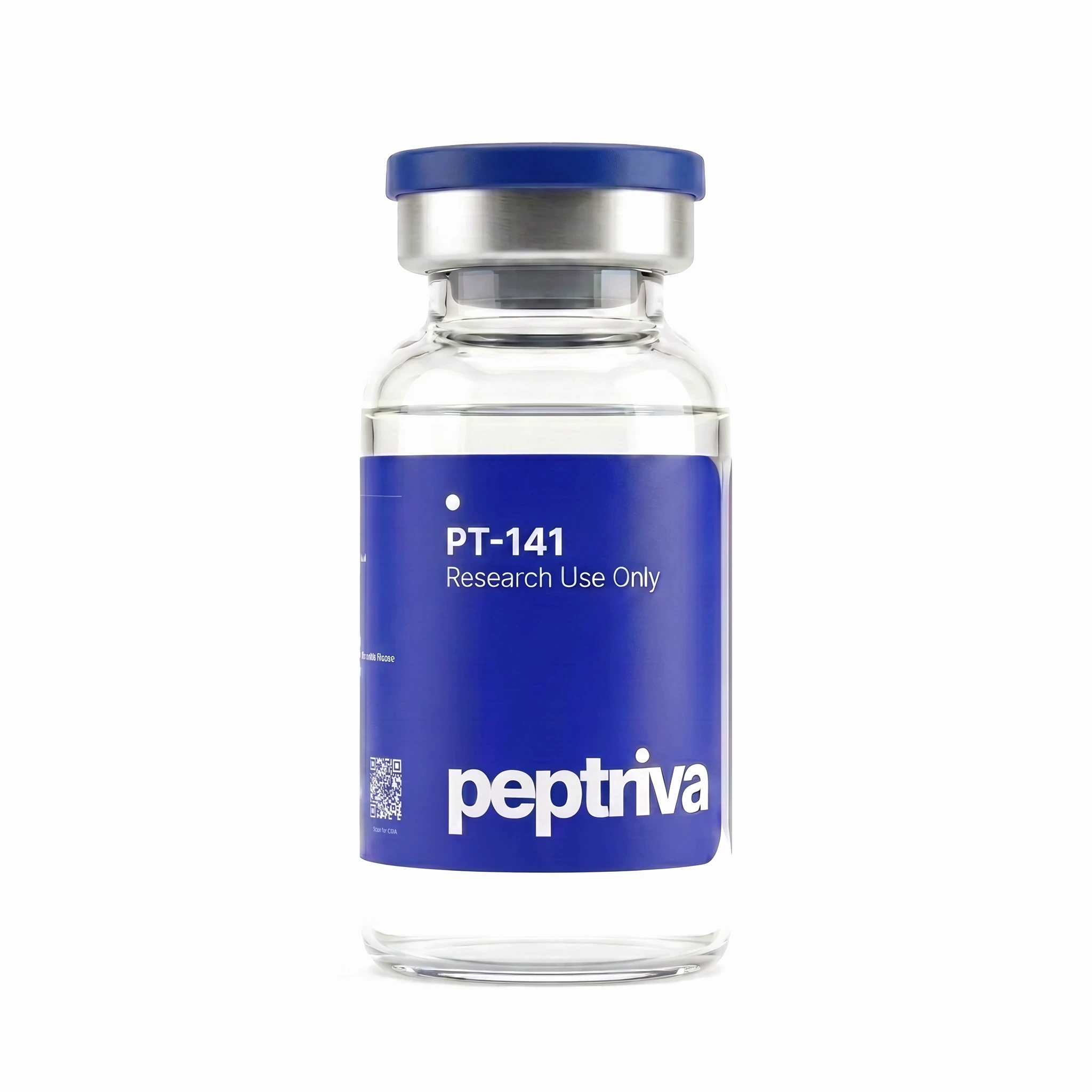
PT-141 (Bremelanotide)
Cyclic heptapeptide · non-selective MCR agonist. The same reference compound used across the cited mechanistic studies. COA available with each lot.
What the mechanism doesn't explain
The MC4R/dopamine story explains how bremelanotide is proposed to work. It doesn't fully explain why the Phase III effect size was modest, why the open-label extension's subject-preference signal favored placebo, or why the drug's commercial reception has been narrower than pre-launch projections suggested.
One reading: central sexual motivation in HSDD is more complex than a single-receptor, single-region model captures. Mood, attachment, hormonal status, life circumstances all feed in. A drug that nudges one circuit, even an important one, can produce a real but bounded effect on the overall phenotype. Spielmans and colleagues' re-analyses of the Phase III data fit this read. The effect is real. It's also small.
For the next generation of melanocortin drugs, the bremelanotide story is instructive in what it didn't achieve as much as in what it did. Researchers have pointed to improved receptor selectivity, optimised dosing schedules, and co-investigation with PDE5 inhibitors, hormonal context, and behavioural interventions as plausible directions for the field.
What to know now
- Primary mechanism: MC4R activation on presynaptic neurons in the medial preoptic area of the hypothalamus → increased dopamine release in excitatory sexual-motivation circuits.
- CNS-mediated, not peripheral: fundamentally different from PDE5 inhibitors (sildenafil, tadalafil), which act on penile vascular smooth muscle in response to existing arousal.
- Nausea (40% incidence): attributed to MC3R/MC4R cross-effects on brainstem chemoreceptor trigger zone circuits; rapid onset, peaks early, resolves within hours.
- Hyperpigmentation: MC1R cross-reactivity on skin melanocytes; rare at the approved administration schedule, reported in 33%+ of research subjects at extended dosing (16 consecutive daily doses in Phase III sub-studies).
- Appetite suppression: theoretically present (MC4R is a major central appetite regulator), not clinically prominent at the intermittent administration frequencies studied in trials.
- HPA axis: bremelanotide does NOT meaningfully activate MC2R (the ACTH receptor) — no cortisol stimulation despite structural lineage from ACTH.
- MC1R polymorphism: red-hair-associated MC1R variants may attenuate hyperpigmentation risk.
- Sex specificity: mPOA mechanism is not sex-specific, but Phase III evidence in male subjects was insufficient for regulatory approval; extension from female HSDD is mechanistically plausible, not RCT-validated in men.
What we're watching
Three things to track in the melanocortin-mechanism space. First, whether more selective MC4R agonists (setmelanotide-class) produce better tolerability for central-motivation indications — the trade-off between selectivity and side-effect burden is the central engineering problem in this receptor family. Second, whether the MC4R polymorphism research matures into a clinically actionable framework for predicting responders versus non-responders to bremelanotide-class drugs. Third, the central melanocortin system's broader therapeutic landscape — the Sweeney Nature Reviews Endocrinology argument that this is one of the most promising target families for metabolic disease has been driving substantial commercial interest, and bremelanotide sits in the same family as molecules that may end up far better-known commercially.
References
- Pfaus, J. G., Sadiq, A., Spana, C., & Clayton, A. H. (2022). The neurobiology of bremelanotide for the treatment of hypoactive sexual desire disorder in premenopausal women. CNS Spectrums, 27(3), 281–289. https://doi.org/10.1017/S109285292100002X
- Sweeney, P., Gimenez, L. E., Hernandez, C. C., & Cone, R. D. (2023). Targeting the central melanocortin system for the treatment of metabolic disorders. Nature Reviews Endocrinology, 19(9), 507–519. https://doi.org/10.1038/s41574-023-00855-y
- Clayton, A. H., Kingsberg, S. A., Portman, D., et al. (2022). Safety profile of bremelanotide across the clinical development program. Journal of Women's Health, 31(2), 171–182. https://doi.org/10.1089/jwh.2021.0191
- Suzuki, S., Kitanaka, C., & Okada, M. (2024). Melanocortin receptor agonist bremelanotide induces cell death and growth inhibition in glioblastoma cells. Anticancer Research, 44(9), 3875–3883. https://doi.org/10.21873/anticanres.17214
- Bardhan, M., Anand, A., Javed, A., et al. (2025). Polymorphism of melanocortin receptor genes — association with inflammatory traits and diseases. Diseases, 13(9), 305. https://doi.org/10.3390/diseases13090305