PT-141 (bremelanotide) sits in an unusual position in the research literature. It is one of only two peptides in this library with a genuine FDA approval. But grey-market analytical studies document that the majority of research use involves an indication the FDA never approved, and whose Phase III program was discontinued. This guide maps where the published evidence actually stands.
Bremelanotide is FDA-approved as Vyleesi® for premenopausal hypoactive sexual desire disorder (HSDD). Approval was based on two Phase III trials, RECONNECT-1 and RECONNECT-2, enrolling ~2,500 women. Headline efficacy was statistically significant. But Spielmans's re-analyses showed effect sizes ranging "from nil to small," 72.7% of pre-specified outcomes went unpublished, and more women on placebo than on the drug chose to continue into the open-label extension. Nausea was observed in 40% of study participants in the active arm. The published literature presents a picture of a real regulatory approval, modest measured effect sizes, and a significant adverse-event burden.
Bremelanotide started as a metabolite of melanotan II. Melanotan II was a tanning peptide developed in the 1980s. Some users reported an unexpected side effect: spontaneous erections and changes in sexual desire. Palatin Technologies took the metabolite, the cyclic 7-amino-acid peptide we now call PT-141, and built it into a deliberate sexual-desire drug.
The FDA approved it in June 2019 for premenopausal women with acquired, generalized HSDD. Five years on, Vyleesi remains a niche product commercially. But PT-141 has become one of the most actively traded research peptides in the grey market. Almost all of that use is off-label in men.
That gap between what bremelanotide is approved for and the observed off-label use patterns is the structural problem in any honest discussion. The Phase III evidence is in premenopausal women with HSDD. Off-label use documented in the literature and grey-market surveillance has been predominantly in men investigating erectile or libido effects. The evidence does not transfer cleanly. And the side-effect profile (nausea, brief blood-pressure spikes, skin darkening at frequent dosing) becomes more relevant, not less, the further observed use drifts from the approved label.
What does bremelanotide actually do?
Bremelanotide is a synthetic cyclic 7-amino-acid peptide. It binds the melanocortin family of brain targets (MC1R through MC5R) without preference. The therapeutic effect on sexual desire is mostly attributed to MC4R activation in the medial preoptic area of the hypothalamus. That's a small brain region near the middle. It's the best-mapped center for sexual motivation.
The neurobiology review by Pfaus and colleagues describes the cascade in 3 steps. The peptide activates MC4R neurons in the medial preoptic area. Those neurons increase dopamine release downstream. That dopamine drives the subjective experience of desire and arousal.
This is fundamentally different from how Viagra-style drugs work. Sildenafil and tadalafil act on smooth muscle in the penis to help an erection when arousal already exists. Bremelanotide acts in the brain on the regions that create desire in the first place.
The distinction has clinical relevance documented in the comparative pharmacology literature. Research subjects with adequate desire but vascular erectile dysfunction fall within the pharmacological scope of PDE5 inhibitors. The HSDD population — characterized by loss of motivation or interest — was the target population for the bremelanotide development program. The two drug classes target different stages of the same response pathway, not the same target by different routes.
Bremelanotide is the first centrally-acting agent for the treatment of HSDD. It modulates the excitatory pathways in the medial preoptic area that drive sexual motivation, rather than the peripheral vascular pathways targeted by existing therapies.
— Pfaus et al., CNS Spectrums, 2022
Bremelanotide isn't selective for MC4R alone. That's where the main side effects come from. MC1R activation on skin pigment cells causes darkening, which is the original reason melanotan II was a tanning compound. That same activity explains the skin darkening (focal hyperpigmentation) that appears with frequent dosing.
MC3R activation in the hypothalamus has metabolic and appetite-blunting effects. The 40% nausea rate in the Phase III trials traces back to combined MC3R/MC4R activation in brainstem regions that share circuits with the body's vomiting reflex center.
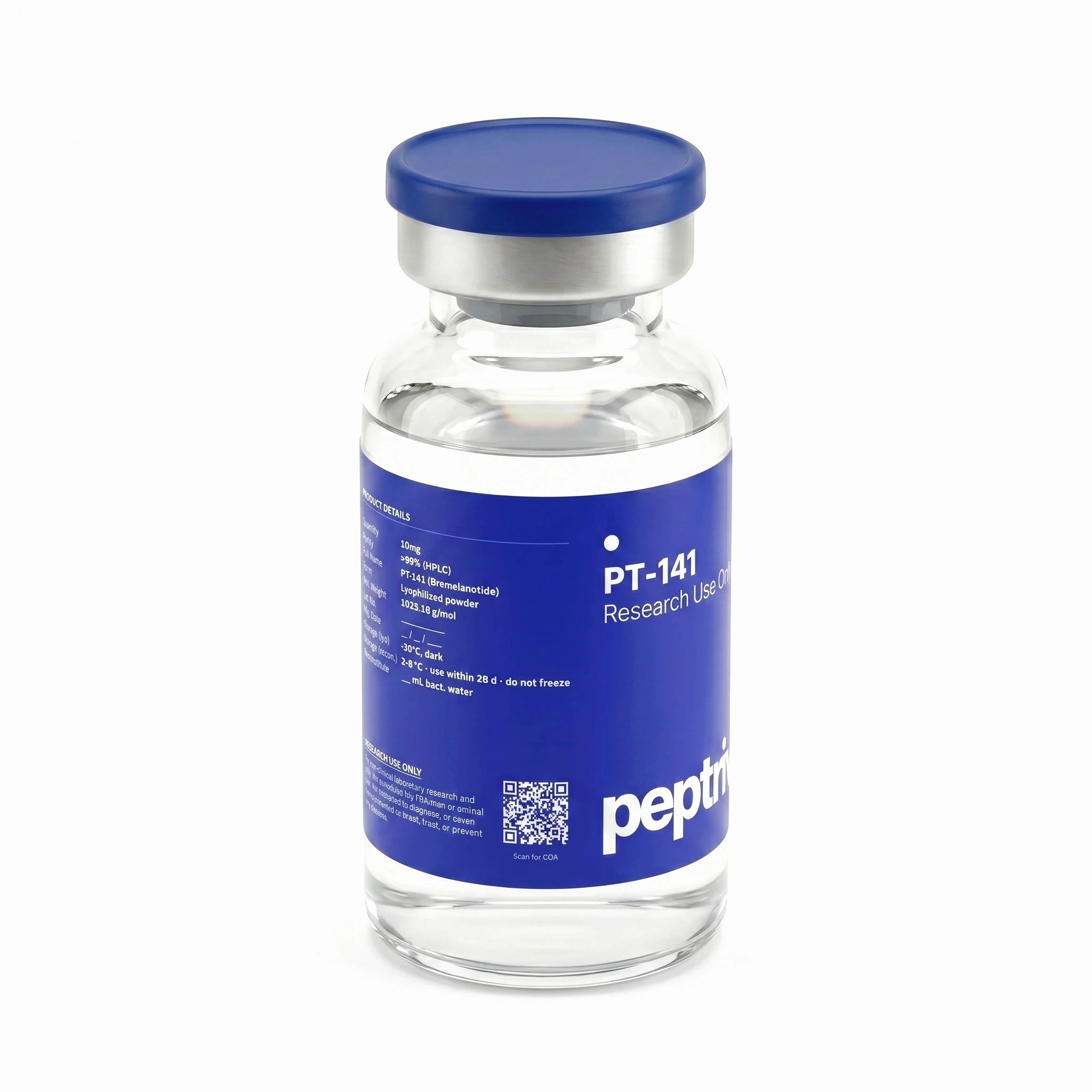
PT-141 (Bremelanotide)
The same compound cited across the Phase III RECONNECT trials and the cited safety analyses. Lab-verified identity and purity.
What did the RECONNECT Phase III trials actually show?
FDA approval rests on two 24-week double-blind placebo-controlled trials. RECONNECT-1 enrolled 1,247 women. RECONNECT-2 enrolled 1,202. All had diagnosed acquired, generalized HSDD. Subjects self-injected 1.75 mg of bremelanotide or placebo about 45 minutes before sex, capped at one dose per 24 hours and eight doses per month.
Primary outcomes were two patient-reported measures: the Female Sexual Function Index desire score, and Item 13 of the Female Sexual Distress Scale. Simon and colleagues reported statistically significant improvements on bremelanotide versus placebo across age, weight, BMI, hormonal contraception, and testosterone subgroups. The headline efficacy finding is statistically supported.
What the principal publications didn't foreground is what Spielmans's methodological re-analyses surfaced. He compared the published outcomes against the pre-specified protocol on ClinicalTrials.gov. The picture changes.
Where this falls short. Spielmans found that 72.7% of pre-specified outcomes weren't reported in the main publication. 15 reported secondary measures were added post-hoc. Drop-out from side effects was much higher on the drug (odds ratio 11.98; the number-needed-to-harm for one additional discontinuation was approximately 6). And the most striking finding: more women on placebo than on the drug chose to continue into the open-label extension.
The participant-preference signal is the most uncomfortable finding for the marketing story. A clearly preferred drug would be expected to produce higher open-label extension uptake among drug-arm participants relative to placebo-arm participants. The observed pattern was the reverse.
Spielmans and Ellefson's 2024 follow-up analyzed 11 protocol-specified efficacy outcomes (8 previously unpublished) and concluded effect sizes ran "from nil to small." They also raised concerns about whether the primary outcome measures captured what they claimed to.
None of this invalidates the FDA approval. The agency reviewed the full data package, accepted the pre-specified primary endpoints, and approved on that basis. But it changes how the efficacy evidence should be read by clinicians and researchers evaluating the literature. Bremelanotide produced a real, statistically significant, but modest improvement on patient-reported desire and distress scales in the trial population. The pre-marketing characterization of the drug overstated that effect relative to what the full dataset showed.
What is the side-effect profile?
The pooled Phase 1–3 safety dataset by Clayton and colleagues covered 3,500 subjects across 43 studies, plus an 18-month open-label extension. The dominant signal is nausea.
- Nausea: 40.0% vs 1.3% placebo. The most common adverse event and the top reason study participants discontinued. Onset was rapid (within an hour of injection in trial protocols). Most cases were mild to moderate, but a meaningful proportion were sufficient to make continued participation aversive.
- Flushing: 20.3% vs 1.3%. Transient. Peaked alongside the nausea window. Generally resolved within 2–4 hours.
- Headache: 11.3% vs 1.9%. Mild-to-moderate in the trial population.
- Injection-site reactions: 5.4% vs 0.5%. Tolerability of the autoinjector was generally acceptable in the trial population.
- Brief blood-pressure spike. Ambulatory monitoring documented small but real increases. The approved label warns against use with uncontrolled high blood pressure or known heart disease.
- Skin darkening (focal hyperpigmentation). Rare at label-recommended dosing frequency (8 doses/month cap in the approved indication). Over a third of research subjects given 16 consecutive daily doses in a sub-study developed pigmentation changes.
The hyperpigmentation signal from the extended-dosing sub-study is the most relevant finding for off-label use patterns documented in the grey-market surveillance literature. The 8-doses/month cap reflects the approved indication; the 16-consecutive-daily-doses subgroup data represents a distinct research context that the main Phase III program did not validate.
What about off-label use in men?
This is the question most grey-market PT-141 buyers actually want answered. And the answer is uncomfortable: the bremelanotide development program in men was discontinued. Phase III RCT evidence for male sexual dysfunction is significantly thinner than the female HSDD data. The trials that ran didn't produce the regulatory case Palatin needed. There's no FDA-approved label for any male use.
Off-label male use rests on three lines of reasoning:
- Mechanism isn't sex-specific. The hypothalamic brain circuit the drug targets exists in both sexes.
- Anecdotal and case-series reports describe libido and erectile effects in men that look qualitatively similar to what the female HSDD trials reported.
- The regulatory absence in men reflects commercial strategy and trial design more than a clean negative efficacy signal.
None of those three lines equals RCT evidence. Off-label male use therefore represents extrapolation from a contested female-HSDD evidence base to an indication the drug was tested for and did not achieve regulatory approval in. The nausea, transient blood-pressure spike, and skin-darkening risk documented in the female HSDD trials are relevant to any use of the compound.
PT-141 (Bremelanotide)
Cyclic heptapeptide · non-selective MCR agonist. The same reference compound used across the cited Phase III studies. COA available with each lot.
Does bremelanotide interact with other drugs?
The Phase III safety analyses found two clinically meaningful drug interactions. Bremelanotide reduces blood levels of indomethacin (an anti-inflammatory) and naltrexone (used to block opioids). Both reductions make sense mechanically. Bremelanotide slows stomach emptying through MC4R brain effects, which delays the absorption of oral drugs.
The clinical significance varies. Indomethacin's anti-inflammatory effect may drop. Naltrexone's opioid blockade may partly lift. That last one matters for people using naltrexone for alcohol or opioid use disorder.
The label also flags caution with blood-pressure drugs, given the brief BP spike. And caution with alcohol, though that isn't formally a metabolic interaction. The drug's brain dopamine effects make theoretical interactions with dopamine-blocking drugs (antipsychotics, anti-nausea meds) plausible. Those haven't been formally studied.
What is the regulatory status outside the US?
Bremelanotide is FDA-approved in the United States only. The European Medicines Agency has not approved Vyleesi. Palatin made the commercial decision not to pursue EMA approval rather than risk a negative determination. WADA has not explicitly listed bremelanotide on the Prohibited List, though peptides in the broader melanocortin family are sometimes evaluated under S0 (non-approved substances). Status verification with individual governing bodies is standard practice for any research compound in athletic contexts. The drug is not explicitly prohibited by major professional sports leagues as of the date of this review.
Clinical context and research gaps
Within the approved indication, bremelanotide represents one of two FDA-approved pharmacological options for premenopausal women with acquired, generalized HSDD. The other is flibanserin (Addyi), a daily oral agent with a distinct mechanism and its own tolerability profile. The Phase III dataset for bremelanotide is real, the side-effect profile is documented, and the patient-preference signal from the open-label extension represents a genuine methodological finding that literature reviews have highlighted.
For off-label use in men investigating erectile or libido effects, the literature identifies several key evidence gaps that researchers and clinicians have noted:
- Standard-of-care context. Published clinical guidance for male sexual dysfunction identifies vascular, hormonal, and psychological factors as the predominant contributors, with established evidence-based interventions. Central desire-pathway dysfunction as a primary etiology is rarely the first clinical consideration in male populations.
- Methodological critiques. The Spielmans re-analyses (2021, 2024) are the most comprehensive independent assessments of the RECONNECT dataset and their conclusions differ substantially from the sponsor-funded publications — a distinction relevant to any evidence evaluation.
- Cardiovascular safety signals. The transient blood-pressure elevation documented in the Phase III safety dataset and flagged in the label is not limited to the approved indication by mechanism; it is an on-target pharmacological effect.
- Extended-dosing hyperpigmentation data. The sub-study reporting skin-darkening rates above the approved dosing frequency represents the primary available safety signal for higher-frequency use patterns, regardless of indication.
- Purity and identity verification. Multiple analytical studies (Mestria et al., 2021) have documented bremelanotide and melanotan II in adulterated grey-market products of uncertain purity and identity — a compound-integrity issue independent of the pharmacological evidence.
Bremelanotide demonstrated statistically significant improvements in desire and distress in pre-specified Phase III subgroup analyses, but the effect sizes are modest and the discontinuation rate due to nausea is substantial. These tradeoffs are relevant context for any clinical evaluation of the compound relative to available alternatives.
— Clayton et al., Journal of Women's Health, 2022
What is the rest of the melanocortin family doing in oncology?
An emerging strand of bremelanotide research has nothing to do with sexual medicine. Suzuki and colleagues at a Japanese oncology group showed in 2024 that bremelanotide reduces survivin (a cancer-survival protein) in glioblastoma cell lines via MC3R/MC4R signaling. It triggered cancer cell death and made cells more sensitive to temozolomide and osimertinib without harming normal cells.
This is drug repurposing in test tubes, not a clinical recommendation. But it's a reminder that the brain circuits bremelanotide engages have a wider biological reach than the sexual-desire approval suggests.
The polymorphism review by Bardhan and colleagues surveys melanocortin variants in inflammatory traits and chronic diseases. Sweeney and colleagues' 2023 review in Nature Reviews Endocrinology argues the brain melanocortin system is one of the most promising targets for metabolic drugs. That's especially true now that setmelanotide (a related MC4R-targeting peptide) has been FDA-approved for rare genetic obesity. Bremelanotide sits in the same family, with different selectivity and a different commercial path.
What to know now
- FDA approval: Vyleesi® (2019) for premenopausal HSDD. The second peptide on this site with a real FDA label.
- Phase III data: RECONNECT-1 (n=1,247) and RECONNECT-2 (n=1,202) showed statistically significant improvement on the desire scale and distress scale.
- Methodological caveats: Spielmans re-analyses found 72.7% of protocol outcomes unpublished, modest effect sizes, and more placebo-arm than drug-arm participants choosing the open-label extension.
- Mechanism: brain MC4R activation in the medial preoptic area drives dopamine release in sexual-motivation circuits. Centrally acting, not peripheral.
- Nausea: 40% incidence. The dominant adverse event and the leading reason for study discontinuation in the trial population.
- Skin darkening: rare at the approved dosing frequency (8/month). Over a third of research subjects given 16 consecutive daily doses in a sub-study developed focal hyperpigmentation — the primary safety signal for above-label dosing frequency.
- Off-label male use: Phase III development was discontinued in men. Extrapolating from the female HSDD data isn't RCT-grade evidence in men.
- Drug interactions: reduces indomethacin and naltrexone blood levels. Caution with blood-pressure drugs.
What we're watching
Three things to track over the next 24 months. First, whether any new Phase III work in male sexual dysfunction reaches a registered trial. Discontinuation of the original male program is the most consequential evidence gap in the field. Second, whether the cancer-repurposing data (glioblastoma in test tubes) produces any registered trial follow-up. The signal is intriguing but a long way from clinical use. Third, post-marketing surveillance data on skin darkening in real-world Vyleesi prescribers. The 8-doses/month cap is conservative, and the FDA Adverse Event Reporting System should produce more granular safety data over time.
References
- Pfaus, J. G., Sadiq, A., Spana, C., & Clayton, A. H. (2022). The neurobiology of bremelanotide for the treatment of hypoactive sexual desire disorder in premenopausal women. CNS Spectrums, 27(3), 281–289. https://doi.org/10.1017/S109285292100002X
- Simon, J. A., Kingsberg, S. A., Portman, D., et al. (2022). Prespecified and integrated subgroup analyses from the RECONNECT Phase 3 studies of bremelanotide. Journal of Women's Health, 31(3), 391–400. https://doi.org/10.1089/jwh.2021.0225
- Clayton, A. H., Kingsberg, S. A., Portman, D., et al. (2022). Safety profile of bremelanotide across the clinical development program. Journal of Women's Health, 31(2), 171–182. https://doi.org/10.1089/jwh.2021.0191
- Spielmans, G. I. (2021). Re-analyzing Phase III bremelanotide trials for "hypoactive sexual desire disorder" in women. Journal of Sex Research, 58(9), 1085–1105. https://doi.org/10.1080/00224499.2021.1885601
- Spielmans, G. I., & Ellefson, E. M. (2024). Small effects, questionable outcomes: Bremelanotide for hypoactive sexual desire disorder. Journal of Sex Research, 61(4), 540–561. https://doi.org/10.1080/00224499.2023.2175192
- Cipriani, S., Alfaroli, C., Maseroli, E., & Vignozzi, L. (2023). An evaluation of bremelanotide injection for the treatment of hypoactive sexual desire disorder. Expert Opinion on Pharmacotherapy, 24(1), 15–21. https://doi.org/10.1080/14656566.2022.2132144
- Pettigrew, J. A., & Novick, A. M. (2021). Hypoactive sexual desire disorder in women: Physiology, assessment, diagnosis, and treatment. Journal of Midwifery & Women's Health, 66(6), 740–748. https://doi.org/10.1111/jmwh.13283
- Sweeney, P., Gimenez, L. E., Hernandez, C. C., & Cone, R. D. (2023). Targeting the central melanocortin system for the treatment of metabolic disorders. Nature Reviews Endocrinology, 19(9), 507–519. https://doi.org/10.1038/s41574-023-00855-y
- Suzuki, S., Kitanaka, C., & Okada, M. (2024). Melanocortin receptor agonist bremelanotide induces cell death and growth inhibition in glioblastoma cells. Anticancer Research, 44(9), 3875–3883. https://doi.org/10.21873/anticanres.17214
- Mestria, S., Odoardi, S., Frison, G., & Strano Rossi, S. (2021). LC-HRMS characterization of melanotan II and bremelanotide sold on the black market of performance and image enhancing drugs. Drug Testing and Analysis, 13(4), 876–882. https://doi.org/10.1002/dta.2986
- Bardhan, M., Anand, A., Javed, A., et al. (2025). Polymorphism of melanocortin receptor genes — association with inflammatory traits and diseases. Diseases, 13(9), 305. https://doi.org/10.3390/diseases13090305