Here’s the part of GHK-Cu collagen synthesis most reviews skip: the copper is doing chemistry the peptide alone cannot do. The tripeptide functions as a delivery vehicle; the copper is the catalytic cargo. Separating those two roles is necessary to understand the mechanism.
Studies have described three coupled mechanisms for GHK-Cu. Preclinical models reported upregulation of fibroblast collagen-gene expression. The copper(II) chelate has been investigated as a lysyl-oxidase cofactor that enables new collagen to cross-link into mature fibre. And in vitro assays reported reduced expression of matrix-degrading MMPs. The copper-delivery role is what distinguishes this molecule from peptide signalers that lack a metal-cofactor function.
Most peptides in dermatology are signalers. They bind a receptor on the cell surface, fire a cascade inside the cell, and shift gene expression. Matrixyl works that way. So do the palmitoyl pentapeptides.
GHK-Cu’s more interesting. The peptide carries a signal, sure. But it’s also a chelate, a molecule that grips copper tightly and ferries it where it’s needed. That cargo matters as much as the message.
What does collagen synthesis actually require?
Before we trace what GHK-Cu does, the basic biology. Collagen-building is an assembly line. Not a single step.
Inside a fibroblast (a connective-tissue cell that builds the dermis), genes called COL1A1 and COL1A2 get copied to messenger RNA. The cell builds two protein chains, pro-alpha1 and pro-alpha2. Specific amino acids get tagged with hydroxyl groups (vitamin C runs this step). Three chains twist into a triple helix called procollagen. It’s shipped out of the cell, trimmed, and cross-linked into mature fibre by an enzyme called lysyl oxidase.
That last step is the one that matters here. Lysyl oxidase is a copper enzyme. It carries a single copper ion at its active site and stops working without it. No copper, no cross-links. No cross-links, no mature collagen. Just soft, soluble strands that any enzyme can chew through.
Aged dermis loses both fibroblast output and lysyl oxidase activity at the same time. Any active that boosts collagen production without supporting cross-linking gives you immature collagen that never integrates into the matrix. That’s why the copper piece of GHK-Cu matters. It covers both ends of the assembly line at once.
How does GHK-Cu drive the fibroblast response?
This is the better-studied half of the story. Loren Pickart’s lab and independent groups since the 1980s have shown GHK-Cu in cultured fibroblasts switches on a coherent set of collagen-related genes.
Specifically: COL1A1 and COL1A2 (the two type I collagen genes), decorin (a small protein that organises collagen fibres as they assemble), and several GAG biosynthesis genes. They go up together. That’s what you’d want for real matrix-building.
The 2020 review by Dou and colleagues summarises the fibroblast literature. GHK-Cu makes fibroblasts proliferate. It pulls them toward injury sites. It increases protein synthesis broadly. In animal wound-healing models, those in-vitro effects translate to faster closure.
A 2023 paper by Lee and colleagues embedded GHK in a hyaluronic-acid hydrogel and saw the expected fibroblast response plus VEGF-driven angiogenesis (new blood-vessel growth). The angiogenesis matters because collagen synthesis is energy-expensive. More capillaries means more oxygen and amino acids reach the working fibroblasts.
What we don’t know: the exact receptor. Insulin binds the insulin receptor. GLP-1 binds GLP-1R. GHK-Cu has no clean “copper peptide receptor.” The fibroblast response runs through several pathways at once. Likely copper-handling proteins inside the cell, plus direct effects on gene expression.
GHK-Cu modulates collagen, glycosaminoglycan production, and angiogenesis in fibroblasts and at sites of tissue injury. The molecule binds copper(II) with exceptionally high affinity, and the chelate is the typical bioactive form.
— Dou et al., Aging Pathobiology & Therapeutics, 2020
Why does the copper matter for lysyl oxidase?
This is the half most marketing skips. It’s also the more interesting half.
Lysyl oxidase (LOX) handles the final cross-linking step in collagen and elastin assembly. It clips a chemical group off certain lysine amino acids inside young collagen strands, turning them into reactive aldehydes. Those groups then snap together with neighbouring lysines to form the covalent bonds that lock collagen into mature fibre.
Without working LOX, dermal collagen stays immature and soluble. Any enzyme can dissolve it. That’s what you see in genetic LOX deficiencies and in scurvy.
One copper ion per LOX active site. The copper isn’t optional. Animals on copper-deficient diets lose LOX activity and develop weak, fragile connective tissue. So any agent that gets bioavailable copper into dermal tissue boosts LOX activity directly. That’s independent of any effect on fibroblast gene expression.
GHK-Cu, in this context, is a copper-delivery vehicle. The peptide grips one Cu(II) ion with very high affinity. It carries the copper through the skin barrier, into the fibroblast neighbourhood, and hands it off to copper-binding proteins inside the cell.
The tight grip matters. Free copper in tissue is toxic; it generates reactive oxygen species (rogue molecules that damage proteins and DNA). The GHK cage holds copper in a safe, transportable form until it’s released at the right place.
That’s also why GHK-Cu behaves differently from copper salts (copper gluconate, copper sulfate). Free Cu(II) from a salt gets grabbed by blood proteins like albumin and ceruloplasmin almost immediately. GHK steers copper toward active matrix-building cells instead of letting it scatter through the bloodstream. The targeting is the whole point.
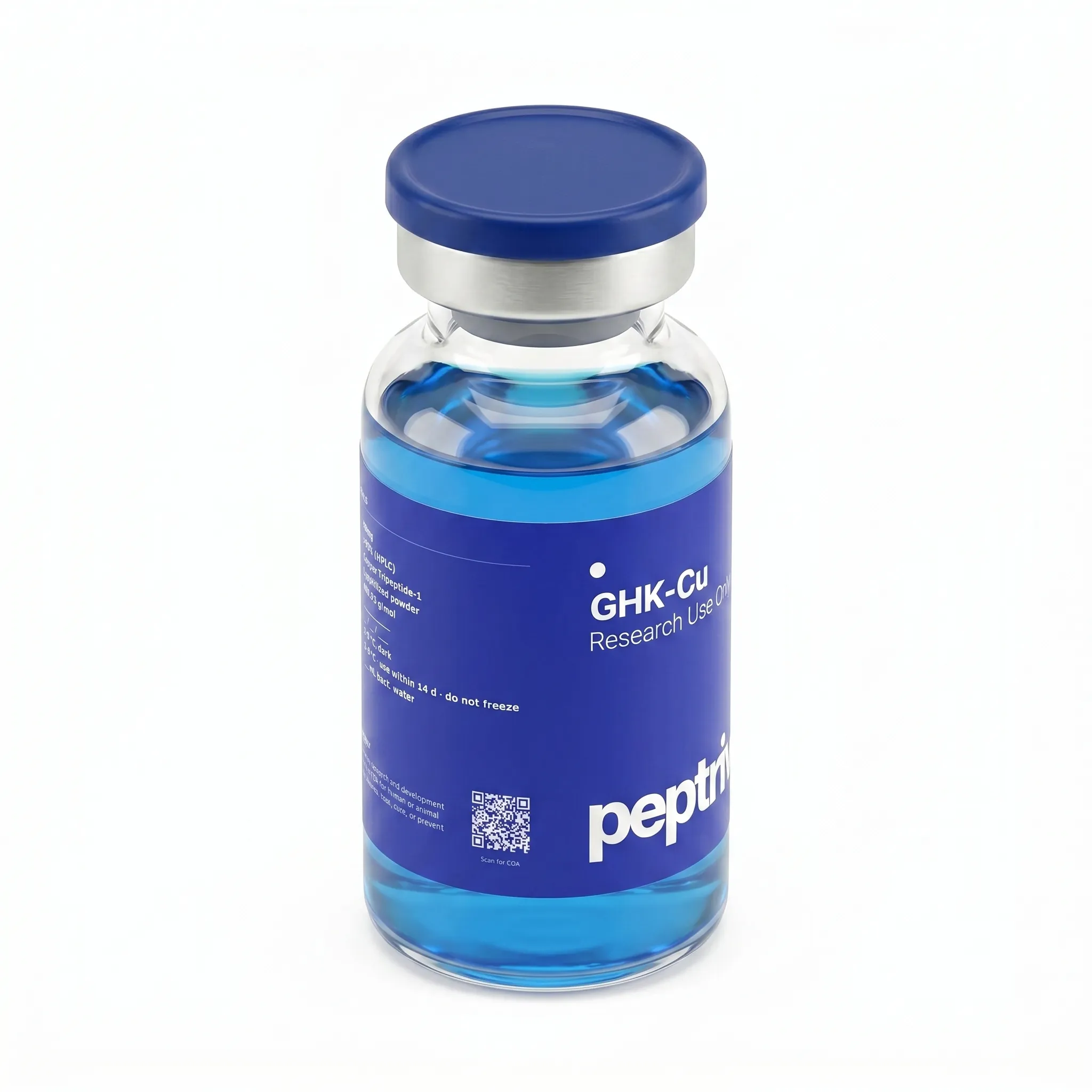
GHK-Cu
The same endogenous copper tripeptide cited across the fibroblast, lysyl-oxidase, and matrix-biology studies in this mechanism review. Lab-verified identity and purity.
What about glycosaminoglycans?
Glycosaminoglycans (GAGs) are long sugar molecules that fill the space between collagen fibres. The big ones in skin are hyaluronic acid, chondroitin sulfate, dermatan sulfate, and heparan sulfate. They hold water and keep the dermis plump and springy.
Aged dermis loses GAGs alongside collagen. A lot of the “thinness” of older skin is GAG loss, not collagen loss.
GHK-Cu turns up GAG production in cultured fibroblasts, especially hyaluronic acid and dermatan sulfate. That’s been replicated across multiple labs since Pickart’s group first described it. We don’t fully understand the upstream signal that ties GHK-Cu exposure to GAG production. The effect itself is reproducible.
Combining collagen stimulation, copper-cofactor delivery, and GAG upregulation in one molecule is what makes GHK-Cu a broader matrix tool than peptides that work on collagen alone. Dermis is collagen plus GAGs. Hitting one without the other gives you half a result.
What does GHK-Cu do to matrix-degrading enzymes?
Matrix metalloproteinases (MMPs) are the enzymes that break collagen down. MMP-1 cuts intact type I collagen at a specific weak spot. MMP-9 finishes off partially denatured collagen. MMP-2 has broader appetite. UV exposure, oxidative stress, and aging all crank up MMP activity. That’s a major driver of wrinkles.
GHK-Cu reduces MMP-2 and MMP-9 expression in fibroblast assays, though that data’s less consistent than the collagen-synthesis data. A 2023 paper by Dymek and colleagues reported ~49% inhibition of human leukocyte elastase by GHK-Cu in vitro. Elastase chews up elastin, the protein that lets skin snap back after a stretch.
So GHK-Cu pushes on multiple sides of the equation at once. It tells fibroblasts to make more collagen. It hands over the copper that turns new collagen into mature fibre. It increases GAGs. And it slows the enzymes that tear all of that back down.
Where this falls short. The clean fibroblast-culture story doesn’t fully translate to skin in vivo. GHK-Cu doesn’t penetrate intact stratum corneum well on its own, which is why most cosmetic formulations use liposomes or hydrogel carriers. Published clinical effect sizes on dermal density at 8–12 weeks are modest compared to retinoids. The mechanism is real. The delivered dose at the right depth in human skin is the open variable.
How does this compare to other collagen-stimulating peptides?
Several peptides on the cosmetic shelf claim to stimulate collagen. Each works differently.
- Matrixyl (palmitoyl pentapeptide-4): a signaler. Mimics a fragment of broken collagen, which fibroblasts read as a damage cue and respond by ramping up new collagen.
- Argireline (acetyl hexapeptide-8): not a collagen stimulator at all. Blocks the SNARE complex involved in muscle-nerve signalling, mimicking botulinum toxin at a milder scale.
- Snap-8: similar mechanism to argireline.
- Palmitoyl tripeptide-1 / tripeptide-5: designed to mimic TGF-beta signalling, which drives collagen production.
The one thing none of these does is deliver a metal cofactor. They tell fibroblasts to make collagen but don’t support the cross-linking step. That’s the GHK-Cu differentiator.
The honest counter-point: retinoids (tretinoin, retinol, retinaldehyde) outperform any peptide active for photoaging. They work through nuclear retinoic-acid receptors and the mechanism is exceptionally well-mapped. Most cosmetic dermatologists combine a retinoid with a copper peptide rather than choosing between them.
Open variables in the research literature
Several mechanistic and translational questions remain active areas of investigation in published studies.
- Formulation and delivery. Bare GHK-Cu has limited stratum-corneum penetration in isolation. Published efficacy studies have used liposomal encapsulation, hyaluronic-acid carriers, or microemulsions as the delivery vehicle; researchers have noted that carrier choice substantially affects the observed effect.
- Co-administration with retinoids. Retinoids and copper peptides operate at different nodes of collagen biology; studies have investigated combinations, noting they are biochemically non-overlapping pathways.
- Relationship to ascorbate. Vitamin C is required for prolyl hydroxylase activity (an upstream collagen-assembly step), while copper is required for lysyl oxidase (a downstream cross-linking step). Researchers have described these as biochemically complementary cofactor roles.
- Study endpoint duration. Published dermal-density and fine-line outcome studies have used 8–12-week observation windows; shorter periods in the literature primarily capture surface hydration from the carrier rather than matrix-level changes.
- Copper-handling disorders. In vitro and animal studies have not specifically modelled GHK-Cu administration in copper-dysregulation models (e.g., Wilson disease analogues); this remains an uninvestigated safety variable in the literature.
GHK-Cu
Glycyl-L-Histidyl-L-Lysine·Cu²⁺ copper chelate · the same reference compound used across the cited fibroblast, lysyl-oxidase, and matrix-biology studies. COA available with each lot.
What to know now
- Three coupled mechanisms. Fibroblast stimulation, copper-cofactor delivery to lysyl oxidase, and MMP/elastase slowdown. GAG synthesis is a fourth coordinated effect.
- The copper isn’t optional. Lysyl oxidase doesn’t work without it. Bioavailable Cu(II) delivery is functionally as important as the fibroblast-stimulation arm.
- ~49% elastase inhibition in vitro (Dymek 2023). Slows elastin breakdown alongside the collagen effects.
- Coherent gene-expression response. COL1A1, COL1A2, decorin, and GAG biosynthesis genes all go up together in cultured fibroblasts.
- Distinct from peer peptides. Matrixyl, argireline, snap-8, palmitoyl tripeptide-1/5 are all signalers. None delivers a metal cofactor. That’s the copper-peptide differentiator.
- Study endpoint duration. Published dermal-collagen outcome studies have used 8–12-week observation windows; shorter periods primarily reflect carrier-driven surface hydration rather than matrix-level changes.
- Biochemically non-overlapping with other actives. Preclinical literature has co-investigated GHK-Cu alongside retinoids, ascorbate, and hyaluronic acid; each operates at a distinct node in the collagen-assembly pathway.
What we’re watching
Two open mechanism questions. First, the upstream signalling that connects GHK-Cu exposure to the coordinated gene-expression response in fibroblasts. We know what turns on. We don’t fully know how the signal travels. Second, whether modern liposomal carriers can push enough copper-peptide deep enough into aged skin to actually move lysyl-oxidase activity. The fibroblast biology is settled; the in-vivo delivery is the next decade of work.
References
- Dou, Y., Lee, A., Zhu, L., Morton, J., & Ladiges, W. (2020). The potential of GHK as an anti-aging peptide. Aging Pathobiology & Therapeutics, 2(1), 58–61. https://doi.org/10.31491/apt.2020.03.014
- Lee, S., Lee, S. M., Lee, S. H., et al. (2023). In situ photo-crosslinkable hyaluronic acid-based hydrogel embedded with GHK peptide nanofibers for bioactive wound healing. Acta Biomaterialia, 172, 159–174. https://doi.org/10.1016/j.actbio.2023.10.011
- Dymek, M., Olechowska, K., Hąc-Wydro, K., & Sikora, E. (2023). Liposomes as carriers of GHK-Cu tripeptide for cosmetic application. Pharmaceutics, 15(10), 2485. https://doi.org/10.3390/pharmaceutics15102485
- Ogórek, K., Nowak, K., Wadych, E., Ruzik, L., Timerbaev, A. R., & Matczuk, M. (2025). Are we ready to measure skin permeation of modern antiaging GHK-Cu tripeptide encapsulated in liposomes? Molecules, 30(1), 136. https://doi.org/10.3390/molecules30010136
- Chen, H., Yang, P., Xue, P., et al. (2025). Food-derived tripeptide-copper self-healing hydrogel for infected wound healing. Biomaterials Research, 29, 0139. https://doi.org/10.34133/bmr.0139
- Bian, Y., Deng, M., Liu, J., et al. (2024). The glycyl-l-histidyl-l-lysine-Cu tripeptide complex attenuates lung inflammation and fibrosis in silicosis by targeting peroxiredoxin 6. Redox Biology, 75, 103237. https://doi.org/10.1016/j.redox.2024.103237