A pre-mixed BPC-157 + TB-500 vial bundles the two most-studied tissue-repair peptides into one lyophilized cake — and doubles the verification work. Where to buy the BPC-157 + TB-500 blend in 2026 turns on a question the single-compound guides never have to ask: can the vendor prove not just what is in the vial, but how much of each? A blend's ratio is invisible without quantitative mass-spec, and that invisibility is exactly what attracts the market's worst vendors.
Get new research first
Research updatesOne short email when new peptide research drops or a new ISO 17025-verified batch lands — written from primary sources, no filler.
You’re on the list — check your inbox for a confirmation.
Could not save your email. Try again in a moment.
The blend is a mixture of two defined molecules, and a mixture has no CAS number of its own. Constituent one: BPC-157, CAS 137525-51-0, a 15-amino-acid synthetic peptide, mass 1419.6 g/mol. Constituent two: “TB-500,” a marketing name that can mean either the Ac-LKKTETQ heptapeptide fragment (CAS 885340-08-9, mass 889.0 g/mol) or full-length thymosin β4 (~4963 Da). ISO 17025-verified 1:1 blend vials (10 mg + 10 mg) run $140–$260 in 2026. A credible Certificate of Analysis (CoA, the one-page lab report) shows two identity lines, per-constituent purity ≥98% each, and a quantitative content result confirming the stated ratio — not one blended “purity” number.
- CoA. Certificate of Analysis. A one-page lab report showing the specific lot's identity, purity, and content. For a blend, it must cover each constituent separately.
- ISO/IEC 17025. The international quality standard for testing labs. A 17025-accredited lab has been audited by a third party for technical competence.
- Co-lyophilized. Both peptides dissolved together in solution, then freeze-dried into one homogeneous cake. The ratio is fixed throughout the cake.
- Co-vialed. Two separately produced powders combined in one container. Dry powders don't self-mix; the ratio is whatever the filling line delivered.
- Quantitative assay. A test that measures how much of a compound is present, not just whether it is present. The only way to verify a blend's ratio.
Quick answer. ISO 17025-verified 1:1 blend material (10 mg BPC-157 + 10 mg TB-500, 20 mg total) should cost $140–$260 per vial and ship as a single co-lyophilized cake. The CoA must show mass-spec identity for both constituents, per-constituent HPLC purity, and a measured content figure for the stated ratio. A blend CoA with one purity number and no ratio verification is a single-compound report stretched over a two-compound product — walk away.
What you're actually buying
A “BPC-157 + TB-500 blend” is not a new molecule. It's a fixed-ratio mixture of two well-characterized ones, sold in one vial so a fixed-ratio preparation takes one reconstitution step instead of two. That's the entire product concept — convenience, not new pharmacology.
BPC-157 is a synthetic 15-amino-acid peptide (sequence Gly-Glu-Pro-Pro-Pro-Gly-Lys-Pro-Ala-Asp-Asp-Ala-Gly-Leu-Val) originally identified as a partial sequence of a protein in human gastric juice. Its proposed mechanism runs through VEGFR2 activation and Akt-eNOS nitric-oxide signaling — an angiogenesis-led repair story (McGuire et al., 2025). A 2025 systematic review counted 36 studies for orthopaedic indications — 35 preclinical, one clinical (Vasireddi et al., 2025).
TB-500 is a marketing name, not a chemical identity. The parent molecule, thymosin β4, is a naturally occurring 43-amino-acid peptide that makes up roughly 70–80% of all β-thymosins in human cells and works by sequestering G-actin one molecule at a time (Ying et al., 2023). Its cleavage product Ac-SDKP has separately been shown to promote endothelial repair after vascular injury (Zhang et al., 2025). What research-supply vendors ship under the TB-500 name is usually the synthetic Ac-LKKTETQ heptapeptide fragment carrying the actin-binding core — the 2026 Sports Medicine review explicitly distinguishes the full-length peptide from the fragment (Mendias & Awan, 2026). That single-compound ambiguity transfers into every blend that contains it.
Two manufacturing formats trade under the same “blend” label, and they are not equivalent:
- Co-lyophilized (single cake). Both peptides are dissolved together, sterile-filtered, and freeze-dried in the vial. The cake is homogeneous, so any reconstituted volume carries the stated ratio. This is the defensible format for a fixed-ratio product, and the CoA should test the finished cake.
- Co-vialed (two powders). Two separately made powders dispensed into one vial. Lyophilized powders do not blend themselves; the actual ratio depends on two independent fill steps, and a sampling from the vial may not represent the whole. Vendors rarely disclose which format they use — ask, and expect the CoA to answer.
One more identity fact worth knowing: a mixture doesn't get its own CAS Registry Number. A legitimate blend CoA therefore lists two CAS numbers — 137525-51-0 for BPC-157 and 885340-08-9 for the TB-500 fragment — one per constituent. A vendor advertising a single “blend CAS” is improvising paperwork.
TB-4 and its derivative TB-500 promoted angiogenesis and tissue repair in preclinical models, but human orthopaedic data are lacking, and both remain banned substances in sports.
— Mayfield et al., American Journal of Sports Medicine, 2026
The three places people buy the blend
1. Research-supply vendors (the main channel)
Nearly all blend purchasing happens here: lyophilized vials labeled “for laboratory research use only.” Legal under U.S. law; not legal for human use; the vendor is not a pharmacy. The documentation bar is higher than for singles — a third-party CoA from an ISO 17025-accredited lab covering both constituents' identity, per-constituent purity, and the measured ratio. Most vendor CoAs in this market fail at least one of those three, which is the useful filter.
2. Compounding pharmacies (channel closed)
A 503A compounding pharmacy (a U.S. pharmacy licensed to prepare custom prescriptions for individual patients) cannot realistically supply this blend. FDA placed BPC-157 on its 503A Category 2 list in 2023 — flagged for safety risks — which shut down compounding access to the blend's larger constituent. No thymosin β4 product is FDA-approved either. A pharmacy-branded “Wolverine” or “repair stack” blend offered today deserves more scrutiny, not less.
3. The two-vial route (buying the singles)
The third channel is not buying the blend at all: purchase BPC-157 and TB-500 as separate verified vials and combine at preparation time. Each vial arrives with its own single-compound CoA — the verification problem stays simple — and the ratio is whatever the research design calls for rather than what the packaging locked in. The costs are a second reconstitution step, a second set of handling and dilution calculations, and usually a somewhat higher total price for the same mass. The trade-offs section below takes this seriously, because for some buyers the singles are the right answer.
The blend-specific verification checks
The standard eight criteria for any peptide vendor apply. Four are unique to blends — and they're the reason blends attract the market's least careful sellers.
1. Two identity lines, two masses
A blend CoA must confirm each constituent by mass-spectrometry separately. For a 1:1 BPC-157 + TB-500 vial that means an observed mass at 1419.6 g/mol (BPC-157; [M+H]+ 1420.6) and an observed mass at 889.0 g/mol (Ac-LKKTETQ fragment; [M+H]+ 890.0) — each within 0.5 Da of theoretical. One mass confirmed is a single-compound identity check; a blend needs both. A CoA that reports a single “identity: pass” line for a two-compound product hasn't identified the product.
2. The ratio is invisible without a quantitative assay
This is the check that separates blends from everything else. Standard qualitative mass-spec answers “is this molecule present?” It does not answer “how much?” A vial labeled 10 mg + 10 mg that actually contains 16 mg BPC-157 and 4 mg TB-500 passes both identity checks and can still show ≥98% chromatographic purity — both molecules are present and the vial contains little else. Only a quantitative result — per-constituent content by validated HPLC peak-area assay or quantitative MS against reference standards — verifies the label ratio. The economics make this check non-optional: TB-500 costs more per mg to source than BPC-157, so the profitable direction of ratio drift is always the same. Under-fill the expensive constituent and no buyer can tell by eye, by weight, or by a qualitative CoA.
3. Which “TB-500” is in the blend
The single-compound identity problem — fragment or full-length? — carries straight into the blend. The heptapeptide fragment is 889.0 g/mol; full-length Tβ4 is ~4963 Da. Those masses differ by a factor of five and mass-spec settles the question in one number, but only if the CoA declares which form the blend was built with. The mechanism literature the blend's marketing leans on mostly describes the full-length parent (Ying et al., 2023); the marketed material is usually the fragment. A blend CoA that just says “TB-500” with no molecular weight is failing the most basic identity check twice over.
4. Per-constituent purity, not one blended number
“Purity” of a mixture is an ambiguous statistic. A blend chromatogram has two main peaks by design, so a single “≥98% pure” claim can only mean “98% of the material is either peptide” — which says nothing about synthesis quality of each constituent or about the ratio. The credible format reports purity per compound (e.g., ≥98% for the BPC-157 peak and ≥98% for the TB-500 peak, each against its own related-substance profile), plus the usual lot-level tests on the finished cake: water content by Karl Fischer titration (typically 2–8% for lyophilized material), counterion content, and endotoxin. The 2025 HSS systematic review flagged unregulated manufacturing and contamination as plausible sources of harm separate from the molecules themselves (Vasireddi et al., 2025) — and a blend passes through more manufacturing steps than either single.
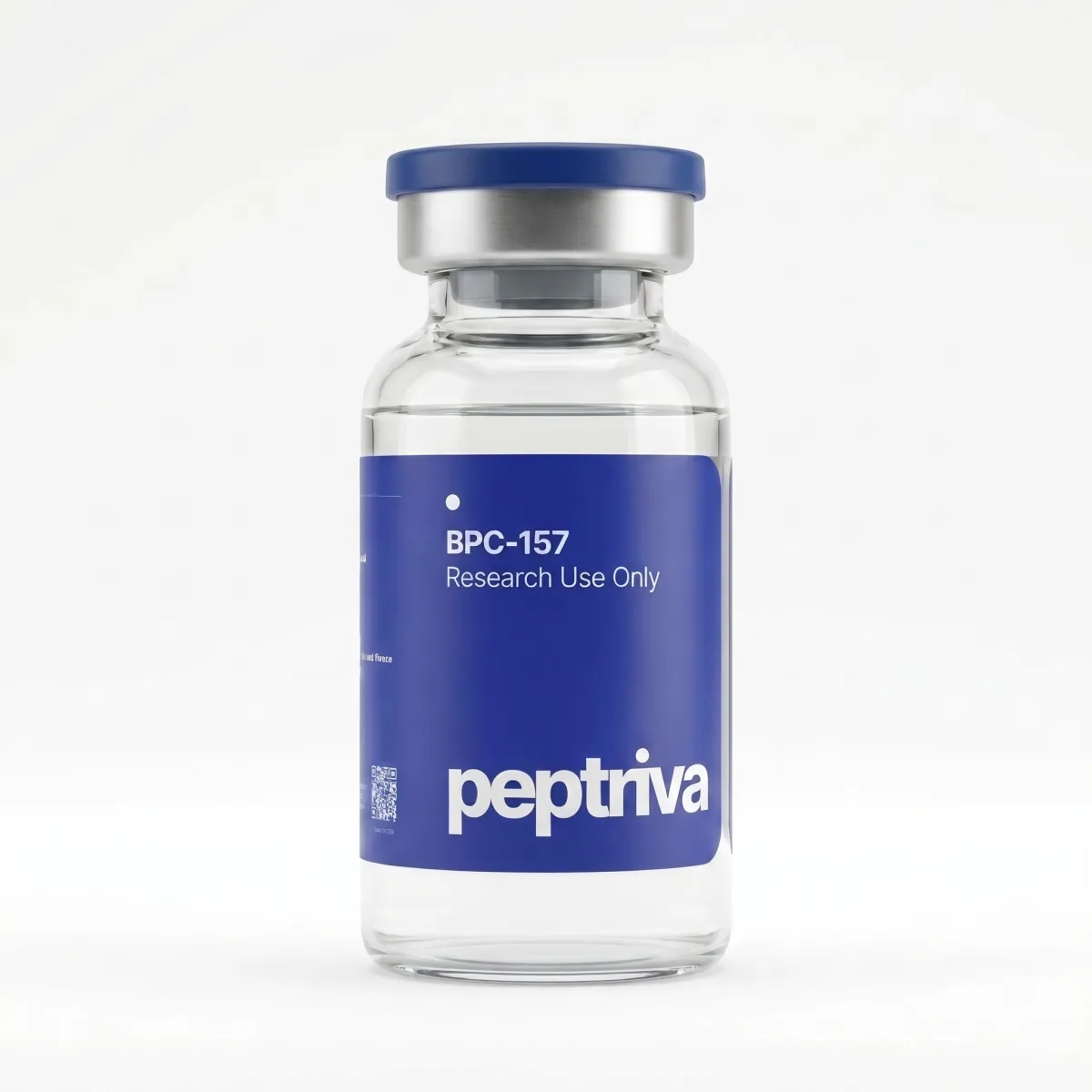
Wolverine Blend
The same two compounds cited across the reviews above — the pentadecapeptide from the 2025 HSS systematic review and the Ac-LKKTETQ fragment the 2026 Sports Medicine review distinguishes from full-length Tβ4 — co-lyophilized 1:1 in a single cake. Both identities confirmed by MS (1419.6 and 889.0), per-constituent ≥99% HPLC purity, ISO 17025 third-party CoA on every lot.
2026 pricing benchmarks
Blend pricing is anchored by the singles. In 2026, ISO 17025-verified BPC-157 runs $80–$150 per 10 mg vial and TB-500 runs $90–$180 per 10 mg vial, so assembling a 1:1, 20 mg preparation from two verified singles costs roughly $170–$330. A legitimate pre-mixed blend prices at a modest discount to that sum — one vial, one fill, one lot's worth of testing overhead:
- 20 mg 1:1 blend vial (10 mg + 10 mg): $140–$260 ($7–$13 per mg). The standard verified format.
- 10 mg 70/30-style blend vial (7 mg + 3 mg): $70–$140. The community-convention format; smaller total mass, similar per-mg math.
- Multi-vial discounts: 10–20% off on 3-packs at most vendors, same as the singles market.
Below roughly $100 per 20 mg blend vial, the arithmetic stops working: that price sits under the plausible cost of two properly purified constituents plus per-constituent testing. Something was skipped — usually the HPLC purification of one constituent, the quantitative ratio assay, or the more expensive TB-500 mass itself. Suspiciously cheap blends are not efficiency breakthroughs; they are unverified ratios. Above ~$20 per mg you're paying retail markup rather than synthesis and testing cost.
One structural note: because the ratio is invisible without quantitative testing, price-shopping blends on a per-vial basis rewards exactly the vendors who cut the invisible corner. Compare per-mg against the singles, and price in the CoA's scope — a blend CoA with a measured ratio is the product; the powder is just the substrate.
Unregulated manufacturing and contamination are plausible sources of harm separate from the molecule itself — a caution the systematic-review authors attached to a single-compound product, and one that compounds when two syntheses share a vial.
— Paraphrasing Vasireddi et al., HSS Journal, 2025
Legal status: FDA, WADA, and the combination
The blend has no regulatory identity of its own — it inherits the status of both constituents, and the inheritance is restrictive on every axis:
- United States (FDA): Neither BPC-157 nor any thymosin β4 / TB-500 product is approved for any indication, and the combination has no separate status. Legal to buy and sell as research reference material labeled for laboratory use only; selling for human consumption is illegal. FDA's 2023 placement of BPC-157 on the 503A Category 2 list closes the compounding channel.
- European Union (EMA): Neither constituent approved.
- WADA: Both constituents prohibited — BPC-157 under S0 (Non-Approved Substances), effective January 2022 (Józwiak et al., 2025); thymosin β4 under S2 (Peptide Hormones, Growth Factors). One vial, two prohibited substances (WADA Prohibited List).
- Major sports leagues: Generally prohibited; thymosin β4 is included in standard anti-doping panels.
On the evidence side, the sourcing decision should be made with the record in view: the only published human exposure to the combination is a 4-patient subgroup inside the 2021 Lee & Padgett 17-patient retrospective knee series — uncontrolled, with no isolated combination outcome data (Lee & Padgett, 2021). There are zero published randomized trials of the combination, and the 2026 sports-medicine reviews treat it as a practice that has run ahead of its evidence (Mayfield et al., 2026).
Where this falls short. Each constituent's preclinical literature is real but lopsided — BPC-157's is concentrated in one Zagreb research group, and TB-500 has no published human studies for orthopedic or performance indications at all. The combination adds a further gap: no factorial study has ever tested blend-vs-singles in any model, so “synergy” remains a hypothesis. A blend vendor quoting the components' literature as if it validated the combination is stacking molecules, not evidence. Our complete blend guide and the mechanism-and-stacking deep-dive walk through that record in full.
Red flags specific to the blend
- One purity number for a two-compound product. A single “≥98% pure” line cannot describe a blend. Per-constituent purity or it's marketing copy.
- No quantitative ratio result on the CoA. The stated split (1:1, 70/30, anything) is unverifiable without a per-constituent content assay. This is the blend's defining check; its absence is the blend's defining red flag.
- Only one mass on the identity line. Both constituents must be confirmed — 1419.6 g/mol and the declared TB-500 mass. One mass means half the product is unidentified.
- “TB-500” with no molecular weight. Fragment (889.0 g/mol) and full-length Tβ4 (~4963 Da) are different molecules with different literatures. The CoA must say which one the blend contains.
- A “blend CAS number.” Mixtures don't get CAS registry numbers. Two constituents, two CAS numbers — anything else is invented paperwork.
- Undisclosed co-vialing. Two powders dropped in one vial is not a co-lyophilized cake. If the vendor can't say how the blend was made, assume the cheaper process.
- Clinical claims on the product page. “Heals tendon and muscle at the same time.” “The synergy stack.” No trial has tested the combination; a vendor making combination-efficacy claims has crossed into territory no published study supports — and into FDA jurisdiction.
- Pricing below the sum of its parts' costs. A 20 mg blend vial meaningfully under $100 implies an unpurified or under-filled constituent. The discount is the missing verification.
Blend or two singles? The honest trade-offs
Both formats contain the same two molecules; the differences are operational, and they cut both ways.
- Cost. The blend usually wins. A verified 20 mg 1:1 vial at $140–$260 undercuts the $170–$330 it takes to assemble the same masses from two verified singles — one vial, one shipment, one lot's testing overhead.
- Ratio control. The singles win, unconditionally. A pre-mix locks one ratio for the life of the vial. Research designs that titrate the constituents independently, on different schedules or at a non-standard split, can only be run from separate vials.
- Degradation profiles. The singles win on shelf discipline. The two constituents do not age identically — the TB-500 component is the more oxidation-sensitive of the pair, so a reconstituted blend's in-use window is set by its least stable constituent. Kept separate, the BPC-157 material isn't constrained by its vial-mate's clock.
- Handling error. The blend wins. One reconstitution, no second dilution calculation, no mis-weighing a second compound into a fixed-ratio preparation.
- Verification burden. A tie with a twist: two singles mean two simple CoAs; the blend means one harder CoA that most vendors get wrong. If the blend CoA meets the two-identity-plus-ratio standard, the burden argument dissolves — if it doesn't, the singles were the safer purchase all along.
On ratios themselves: the market sells both 1:1 formats (10 mg + 10 mg) and the older 70/30 community convention (7 mg + 3 mg). No published trial validated either — a stated ratio is a packaging decision, and the honest framing is that a blend buys convenience at a locked ratio, not a validated protocol. Our BPC-157 vs TB-500 comparison covers how the two molecules differ when the question is which one, rather than both.
Wolverine Blend
10 mg BPC-157 + 10 mg TB-500 co-lyophilized in a single sterile cake — same compounds and same lots as the standalone vials. ISO 17025 third-party CoA per lot with both identities confirmed by MS, per-constituent HPLC purity, endotoxin, and counterion content on the finished cake.
A blend's label makes two promises — two identities and one ratio — and qualitative testing can only ever check the first. Every unverified-ratio vial on the market is priced as if the second promise were free.
— Our reading of the 2026 blend market
Frequently asked questions
Is the BPC-157 + TB-500 blend legal to buy in the USA?
Yes, as research reference material labeled for laboratory use only — the same footing as its two constituents. Neither constituent is FDA-approved, the combination has no separate regulatory status, and selling it for human consumption is illegal. Buying it as research material is not.
What should a blend Certificate of Analysis show?
Five things: mass-spec identity for both constituents (1419.6 g/mol and the declared TB-500 mass), per-constituent HPLC purity ≥98% with chromatogram, a quantitative content result confirming the stated ratio, both CAS numbers (137525-51-0 and 885340-08-9) on the identity lines, and lot-level tests on the finished cake — Karl Fischer water content (2–8% typical), counterion, endotoxin. The testing lab should be ISO/IEC 17025-accredited and named on the report.
What's the difference between co-lyophilized and co-vialed?
Co-lyophilized means both peptides were dissolved together and freeze-dried into one homogeneous cake — the ratio holds everywhere in the vial. Co-vialed means two separately made powders were dispensed into one container; powders don't self-mix, so the ratio is whatever two independent fill steps delivered. For a fixed-ratio product, the single-cake format tested as a finished cake is the defensible standard.
Should researchers buy the blend or two separate vials?
Fixed-ratio work favors the blend: cheaper per mg than assembling the singles, one reconstitution step, no second-compound weighing error. Designs that titrate the constituents independently — different ratios, different schedules — require the singles, and the singles also keep the more oxidation-sensitive TB-500 constituent's shorter in-use window from constraining the BPC-157 material. No published human trial supports either format as more effective; the choice is operational.
Why do blend ratios vary between vendors?
Because no trial ever set one. The 1:1 format (10 mg + 10 mg) and the 70/30 community convention (7 mg + 3 mg) are both packaging choices with post-hoc rationales, not evidence-derived optima. A stated ratio only means something when the CoA verifies it quantitatively — which is also why the ratio is where low-quality vendors economize.
Is the blend banned in sport?
Twice over. BPC-157 sits on the WADA Prohibited List under S0 (since January 2022) and thymosin β4 / TB-500 under S2 — one vial, two prohibited substances, and Tβ4 is part of standard anti-doping panels. Athletes subject to testing should verify current status with WADA directly.
Does the blend have its own CAS number?
No. CAS Registry Numbers identify single chemical substances; a mixture doesn't receive one. A legitimate blend CoA lists one CAS number per constituent. A vendor quoting a “blend CAS” has invented it.
What to know now
- Two CAS numbers, two masses. BPC-157: CAS 137525-51-0, 1419.6 g/mol. TB-500 fragment: CAS 885340-08-9, 889.0 g/mol (full-length Tβ4 is ~4963 Da). A mixture has no CAS of its own.
- $140–$260 per 20 mg 1:1 vial. Anchored by the singles market ($170–$330 for the same masses in two verified vials). Meaningfully under $100 means something was skipped.
- The ratio is the product. Identity checks prove presence; only a quantitative per-constituent assay proves the label's 10 mg + 10 mg. This is the check most blend CoAs are missing — and the corner the market's worst vendors cut.
- Co-lyophilized beats co-vialed. One homogeneous cake, tested as a finished cake. Undisclosed two-powder filling is a red flag.
- The regulatory posture stacks. Neither constituent FDA-approved; BPC-157 on the 503A Category 2 list since 2023; WADA-prohibited twice over (S0 + S2).
- The evidence doesn't stack. 36 orthopaedic studies for BPC-157 alone, zero published RCTs for the combination, and a 4-patient uncontrolled subgroup as the entire human co-exposure record. Buy the convenience, not a synergy claim.
What we’re watching
Two developments would change this guide. First, a factorial study — vehicle, BPC-157 alone, TB-500 alone, combination — in any tissue model would give the blend its first dedicated evidence and, incidentally, its first evidence-based ratio; nothing of the kind has published as of August 2026. Second, movement on quantitative-testing norms in the research-supply market: per-constituent content assays are routine in pharmaceutical QC but still rare on research-vendor CoAs, and the first vendors to make measured ratios standard will make the blend category's central verification problem visible by contrast. The 2026 sports-medicine reviews (Mendias & Awan; Mayfield et al.) both frame combination peptide practice as running ahead of its evidence — whether the literature closes that gap or the market keeps widening it is the thing to watch.
References
- Vasireddi, N., Hahamyan, H., Salata, M. J., et al. (2025). Emerging use of BPC-157 in orthopaedic sports medicine: A systematic review. HSS Journal, 21(4). https://doi.org/10.1177/15563316251355551
- McGuire, F. P., Martinez, R., Lenz, A., Skinner, L., & Cushman, D. M. (2025). Regeneration or risk? A narrative review of BPC-157 for musculoskeletal healing. Current Reviews in Musculoskeletal Medicine, 18(12), 611–619. https://doi.org/10.1007/s12178-025-09990-7
- Ying, Y., Lin, C., Tao, N., et al. (2023). Thymosin β4 and actin: Binding modes, biological functions and clinical applications. Current Protein and Peptide Science, 24(1), 78–88. https://doi.org/10.2174/1389203724666221201093500
- Mendias, C. L., & Awan, T. M. (2026). Safety and efficacy of approved and unapproved peptide therapies for musculoskeletal injuries and athletic performance. Sports Medicine. https://doi.org/10.1007/s40279-026-02437-0
- Mayfield, C. K., Bolia, I. K., Feingold, C. L., et al. (2026). Injectable peptide therapy: A primer for orthopaedic and sports medicine physicians. American Journal of Sports Medicine, 54(1), 223–229. https://doi.org/10.1177/03635465251357593
- Józwiak, M., Bauer, M., Kamysz, W., & Kleczkowska, P. (2025). Multifunctionality and possible medical application of the BPC 157 peptide—Literature and patent review. Pharmaceuticals (Basel), 18(2), 185. https://doi.org/10.3390/ph18020185
- Zhang, Q., Li, H., Zhuang, T., et al. (2025). CCN5 suppresses injury-induced vascular restenosis by inhibiting smooth muscle cell proliferation and facilitating endothelial repair via thymosin β4 and Cd9 pathway. European Heart Journal, 46(17), 1645–1658. https://doi.org/10.1093/eurheartj/ehae911
- Lee, E., & Padgett, B. (2021). Intra-articular injection of BPC 157 for multiple types of knee pain. Alternative Therapies in Health and Medicine, 27(4), 8–13. https://pubmed.ncbi.nlm.nih.gov/34324435/
- U.S. Food and Drug Administration. (2024). Research Use Only (RUO) and Investigational Use Only (IUO) labeling under 21 CFR § 809.10(b)(9). https://www.fda.gov/medical-devices/ivd-regulatory-assistance/research-use-only-and-investigational-use-only-ruoiuo-labels
- International Organization for Standardization. (2017). ISO/IEC 17025:2017 — General requirements for the competence of testing and calibration laboratories. https://www.iso.org/standard/66912.html