The tesamorelin stabilized-GHRH mechanism is the cleanest pharmacology story in the entire growth-hormone-releasing-hormone family. One small chemical edit at the front of a natural peptide. That edit is the difference between a molecule plasma enzymes degrade within minutes and an FDA-approved daily-injection drug. Tesamorelin is the only peptide in this category with both an FDA approval and a real RCT evidence base.
Tesamorelin is the natural human hormone GHRH (growth hormone-releasing hormone) with a trans-3-hexenoyl fatty acid conjugated to the N-terminus. That modification blocks the DPP-4 enzyme that normally cleaves native GHRH within minutes. The modification extends plasma half-life to ~26 minutes, compared to sermorelin's ~10 minutes — long enough for once-daily subcutaneous administration to produce a sustained GH pulse. FDA-approved in 2010 for HIV-associated lipodystrophy; multiple Phase III RCTs have documented selective visceral adipose tissue reduction. Use outside the approved HIV-lipodystrophy indication is not supported by RCT evidence.
This article unpacks how one small chemical modification turns a natural hormone into a real drug. It covers the DPP-4 problem, the half-life math, the Massachusetts General Hospital trial program, the 2024 update for study participants on modern antiretrovirals, and the boundaries of what tesamorelin's evidence base actually supports.
The DPP-4 problem tesamorelin solves
Native GHRH is a 44-amino-acid hormone released by the hypothalamus to signal the pituitary gland to release growth hormone. Its physiological role is tight, controlled, on-demand GH release. Once released into circulation, native GHRH survives for less than 10 minutes.
The rapid clearance is driven by an enzyme called DPP-4 (dipeptidyl peptidase-4). DPP-4 is present on vascular endothelium and circulates in plasma. Its substrate specificity targets the first two amino acids of any peptide whose N-terminus begins with Tyr-Ala. Since native GHRH starts with Tyr-Ala, DPP-4 cleaves it almost immediately. Without those first two residues, GHRH can no longer bind its receptor.
Physiologically, this rapid degradation serves as a regulatory mechanism — it constrains GH release to tightly controlled pulses. For therapeutic development of GHRH as a daily medication, however, the same kinetics present the central formulation problem: a once-daily injection of a molecule with a ~7-minute half-life cannot sustain meaningful receptor occupancy.
Earlier GHRH analogs attempted to extend this window. Sermorelin (a shortened version of GHRH) achieved approximately a 10-minute half-life — sufficient for diagnostic stimulation testing but insufficient for sustained therapeutic use.
Tesamorelin's solution is one small chemical modification. The team at Theratechnologies conjugated a small fatty acid (trans-3-hexenoic acid) to the N-terminus of the molecule. That fatty acid sterically blocks DPP-4 from recognizing the peptide's front end, without disrupting the receptor-binding domain. One modification. Whole new drug.
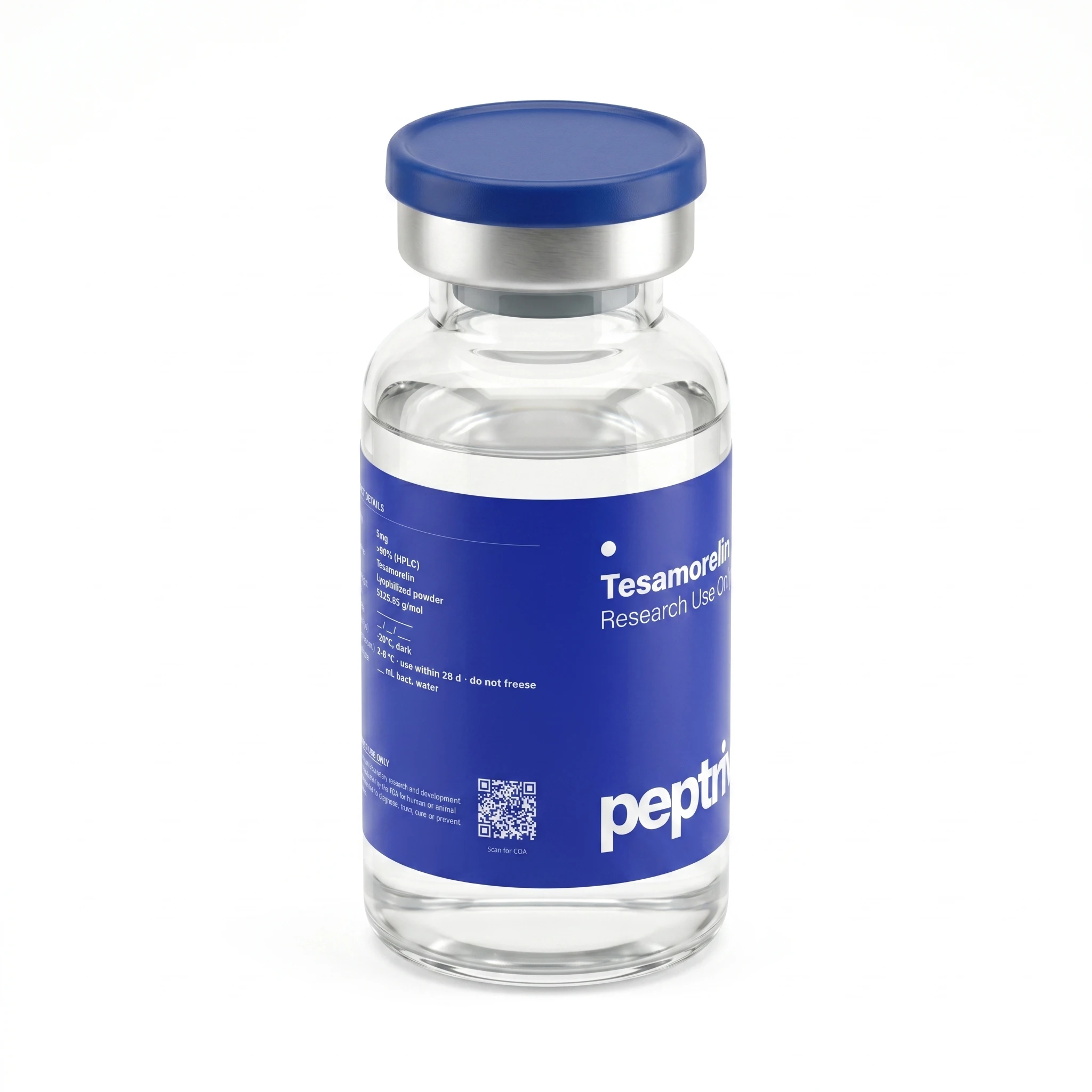
Tesamorelin
The same compound cited across the GHRH-mechanism reviews and Massachusetts General Hospital trial program in this article. Lab-verified identity and purity; the same molecule as FDA-approved Egrifta.
The half-life math: why 16 extra minutes matters
The half-life difference is small in absolute terms but pharmacologically decisive. Native GHRH: ~7 minutes. Sermorelin: ~10 minutes. Tesamorelin: ~26 minutes.
That extra 16 minutes over sermorelin is what makes daily subcutaneous dosing work. It's enough time for the molecule to reach the pituitary, bind enough GHRH receptors on the GH-producing cells (somatotrophs), trigger a real GH pulse, and produce the downstream IGF-1 release that drives the therapeutic effect.
The receptor pharmacology is unchanged from native GHRH. Tesamorelin binds the same GHRH-R, activates the same cAMP signaling cascade, and produces the same pulsatile GH release observed with endogenous GHRH. What changed is exposure time: the receptor encounters sufficient agonist for long enough to complete a full physiological pulse rather than a truncated one.
Critically, tesamorelin preserves the physiological pulsatile GH pattern. That is the key mechanistic distinction between GHRH analogs and injected recombinant GH. Pituitary somatotrophs continue to control the timing and magnitude of GH secretion. Hypothalamic negative feedback remains intact. The resulting IGF-1 response from the liver is physiological in shape rather than pharmacological. Studies have attributed tesamorelin's comparatively favorable safety profile — relative to bolus GH replacement — to this preserved regulatory architecture. GH-axis adverse effects including insulin resistance have been reported, but at lower rates than observed with exogenous GH administration.
Why tesamorelin reduces belly fat but not arm fat
The feature that drove tesamorelin's FDA approval was selective reduction of visceral adipose tissue (VAT — deep intra-abdominal fat surrounding the organs) compared to subcutaneous adipose tissue (SAT). The approved indication is HIV-associated lipodystrophy, in which antiretroviral therapy has been shown to drive pathological VAT accumulation.
The mechanism operates through the GH/IGF-1 axis. Growth hormone is among the most potent lipolytic hormones in endocrine physiology, and studies have consistently shown it preferentially targets visceral adipose depots over subcutaneous fat. Tesamorelin-induced GH pulses have been associated with increased fat oxidation and reduced VAT mass over weeks to months in clinical trials. This visceral selectivity is not a tesamorelin-specific design choice — it is a well-characterized property of GH biology. The durability of the effect across multiple Phase III trials distinguishes tesamorelin from every other GHRH analog in the literature.
The 2024 Russo paper in AIDS tested tesamorelin specifically in study participants with HIV on integrase inhibitors, the modern antiretroviral class linked to metabolic side effects. In the 38-participant subgroup, tesamorelin reduced VAT by a median 25 cm² (vs +14 cm² on placebo), cut hepatic fat by 4.2%, and improved trunk-to-limb fat ratio. The effect held in study subjects on contemporary regimens.
Tesamorelin reduced visceral adipose tissue, hepatic fat, and the trunk-to-appendicular fat ratio in people with HIV on integrase inhibitors. Adverse events including hyperglycemia were similar between groups.
— Russo et al., AIDS, 2024
The Mass General data: tesamorelin does more than burn fat
The richest mechanism data for tesamorelin comes from one research group at Massachusetts General Hospital. They ran a 12-month double-blind RCT in 61 study participants with HIV-associated fatty liver disease (NAFLD), then published multiple secondary analyses from the same trial. The list: paired liver biopsies, plasma proteomics, transcriptomics, immune-marker profiling.
The 2020 Fourman JCI Insight paper reported that tesamorelin turned up oxidative-phosphorylation genes (the energy-production machinery) and turned down genes involved in inflammation and tissue repair in liver tissue.
The 2021 Fourman Scientific Reports paper showed reductions in three pro-inflammatory plasma proteins (VEGFA, TGFB1, CSF1) that correlated with improved liver scores. The 2021 Stanley Clinical Infectious Diseases paper documented reductions in 13 plasma proteins tied to immune-cell activation.
The picture across these substudies is consistent. Tesamorelin's effects extend beyond simple GH/IGF-1 fat-burning into liver gene-expression rewiring, anti-inflammatory immune modulation, and reduction of profibrotic signals. The data is impressive. The caveat: it's all from one coordinating research group. Independent replication is the open question.
Where the evidence runs out
Tesamorelin's evidence base is the deepest in this peptide library, but only within a narrow indication. The approved use is HIV-associated lipodystrophy and HIV-NAFLD. Off-label use for general body recomposition, anti-aging, or muscle building doesn't have RCT validation.
The 2025 Ellis Journal of Infectious Diseases paper tested tesamorelin for neurocognitive impairment in study participants with HIV and abdominal obesity. The waist circumference effect held: 2.7 cm reduction vs standard of care. But the cognitive endpoint missed.
That trial result illustrates what the literature shows when tesamorelin is tested outside its approved indication. The metabolic effect carried over reliably; the cognitive endpoint did not follow automatically from GH/IGF-1 activation. Whether other off-label applications would replicate the same pattern — a positive metabolic readout alongside a neutral primary endpoint — remains an open question that grey-market use-case literature does not address.
What tesamorelin's evidence base supports vs doesn't:
- Supported by multiple Phase III RCTs: visceral fat reduction in HIV-associated lipodystrophy.
- Supported by RCT secondary analyses: liver fat reduction in HIV-NAFLD; immune marker improvements.
- Failed for an off-approval indication: the 2025 neurocognition phase II missed its endpoint.
- Not RCT-validated: general body recomposition, anti-aging, athletic performance, muscle building in healthy adults.
- In development: non-HIV NASH; Phase III trials anticipated.
Where this falls short. Tesamorelin's evidence base is impressive, but it's narrow. All the Phase III data comes from HIV-associated conditions. The mechanistic depth (Mass General proteomics, transcriptomics, immune markers) is concentrated in a single coordinating group. The 2025 neurocognition trial demonstrated what occurs when tesamorelin is evaluated beyond its approved indication: the body-composition effect held, but the off-target primary endpoint missed. Off-label use for general body recomposition or anti-aging in healthy adults is not validated by any published RCT. The FDA approval is evidence for the approved indication — not a generalizable endorsement of all downstream GH effects.
Tesamorelin
Synthetic 44-aa stabilized GHRH analog with the trans-3-hexenoyl N-terminal modification — the same molecule as FDA-approved Egrifta. The reference compound across the cited Phase III and mechanism studies. COA available with each lot.
Reading the tesamorelin literature
The chemistry papers establish the DPP-4 story. That single N-terminal modification is what separates tesamorelin from every other GHRH analog in the literature. The Mass General trial program (Fourman, Stanley, Lake, Ellis) represents the deepest mechanistic body of work on any GHRH analog, with the caveat that a single coordinating group warrants independent replication before its findings are generalized. The 2024 Russo subanalysis provides the most contemporary efficacy data point. Indications outside HIV-associated lipodystrophy and HIV-NAFLD remain unvalidated. The 2025 neurocognition result serves as the clearest available example of what occurs when tesamorelin is evaluated beyond its approved use.
For context: tesamorelin serves as the calibration standard for the entire GHRH-analog category. It represents what an FDA-approved, RCT-validated, mechanism-characterized peptide therapy looks like. Other GHRH analogs in the literature — CJC-1295, sermorelin, modified GRFs — are missing some combination of the trial evidence, the regulatory tier, or the mechanistic depth that tesamorelin has accumulated.
What to know now
- trans-3-hexenoyl modification: the fatty acid stuck on the front. Blocks DPP-4, extends half-life to ~26 min.
- Half-life math: 26 min vs sermorelin's 10 min. That gap is what makes daily injection clinically workable.
- Preserves pulsatile GH: tesamorelin works through pituitary somatotroph machinery, preserving physiological negative-feedback regulation.
- Visceral fat selectivity: reduces deep belly fat preferentially, not subcutaneous fat. A GH-biology feature, not a tesamorelin design choice.
- FDA-approved 2010: Egrifta (then SV reformulation in 2019). The only GHRH analog with FDA approval.
- Mass General data: the deepest mechanism work. Single coordinating group, awaiting independent replication.
- Off-label use unvalidated: the 2025 cognition trial demonstrates the pattern when tesamorelin is tested outside its approved indication — metabolic effect holds, primary endpoint misses.
What we're watching
Two questions over the next 18 months. First, will the tesamorelin Phase III program in non-HIV NASH deliver data that would expand the approved indication beyond HIV populations? The mechanism is plausible there, but the trial evidence has to come from non-HIV patients. Second, will another research group independently replicate the Mass General proteomic and transcriptomic findings? Those immune-modulation and hepatic gene-expression effects are the most novel mechanistic claims, and they haven't been reproduced outside the original trial cohort.
References
- Russo, S. C., Ockene, M. W., Arpante, A. K., et al. (2024). Efficacy and safety of tesamorelin in people with HIV on integrase inhibitors. AIDS, 38(12), 1758–1764. https://doi.org/10.1097/QAD.0000000000003965
- Fourman, L. T., Billingsley, J. M., Agyapong, G., et al. (2020). Effects of tesamorelin on hepatic transcriptomic signatures in HIV-associated NAFLD. JCI Insight, 5(16). https://doi.org/10.1172/jci.insight.140134
- Stanley, T. L., Fourman, L. T., Wong, L. P., et al. (2021). Growth hormone-releasing hormone reduces circulating markers of immune activation in parallel with effects on hepatic immune pathways in individuals with HIV-infection and nonalcoholic fatty liver disease. Clinical Infectious Diseases, 73(4), 621–630. https://doi.org/10.1093/cid/ciab019
- Fourman, L. T., Stanley, T. L., Billingsley, J. M., et al. (2021). Delineating tesamorelin response pathways in HIV-associated NAFLD using a targeted proteomic and transcriptomic approach. Scientific Reports, 11(1), 10485. https://doi.org/10.1038/s41598-021-89966-y
- Lake, J. E., La, K., Erlandson, K. M., et al. (2021). Tesamorelin improves fat quality independent of changes in fat quantity. AIDS, 35(9), 1395–1402. https://doi.org/10.1097/QAD.0000000000002897
- Ellis, R. J., Vaida, F., Hu, K., et al. (2025). Effects of tesamorelin on neurocognitive impairment in persons with HIV and abdominal obesity. Journal of Infectious Diseases, 231(5), 1230–1238. https://doi.org/10.1093/infdis/jiaf012
- Fourman, L. T., & Grinspoon, S. K. (2022). Approach to the patient with lipodystrophy. Journal of Clinical Endocrinology and Metabolism, 107(6), 1714–1726. https://doi.org/10.1210/clinem/dgac079
- Gattu, A. K., & Fourman, L. T. (2025). Metabolic dysfunction-associated steatotic liver disease in people with HIV. Current Opinion in HIV and AIDS, 20(4), 350–358. https://doi.org/10.1097/COH.0000000000000952
- Chege, D., et al. (2024). Tesamorelin reverses obesogenic metabolic effects of cART regimens combined with low-protein high-calorie diets. PLOS ONE. https://doi.org/10.1371/journal.pone.0298752