A 2012 pilot suggested tesamorelin might help cognition in older adults. A 2025 trial in HIV patients said no. Both are true. Here's how to read the gap.
The 2012 Baker pilot tested tesamorelin in older adults with mild cognitive impairment. It found small but statistically significant improvements in executive function and verbal memory. Promising, but a single-center pilot. The 2025 Ellis trial enrolled 73 HIV patients with abdominal obesity and ran for 6 months. Tesamorelin shrank waist circumference by 2.7 cm versus standard of care — but did not improve cognition. Both readings matter. The Baker signal is why the question keeps coming back. The Ellis null is why the FDA approval hasn't been extended.
Cognition is where one can see the gap between mechanism and outcome most clearly. The biological logic for investigating a GHRH analog in cognitive aging is solid. Growth hormone (GH) and IGF-1 both decline with age. Both matter for new neuron growth and brain plasticity in animals. Animal models show clear effects on memory tasks. The mechanism is strong enough that the trials are worth running.
Whether that mechanism actually translates to better thinking in humans is the question the trials test. The answer has been mixed.
Why study GHRH analogs for cognition at all?
Growth hormone and IGF-1 decline steadily with age, a pattern sometimes called "somatopause." By age 70, GH secretion is a fraction of what it was at 25. IGF-1 levels follow. Whether that decline causes any of the cognitive changes observed in normal aging has been an open question for decades.
Both GH and IGF-1 receptors are present in the hippocampus, cortex, and cerebellum — the brain regions that handle memory, executive function, and motor coordination. In animal models, GH and IGF-1 signaling supports new neuron growth in the adult hippocampus, modulates synaptic plasticity, and protects neurons in stroke and Alzheimer's models. Researchers hypothesized that restoring younger-adult GH activity in older subjects might support cognition.
Tesamorelin is mechanistically well-suited to that question. As a GHRH analog, it stimulates the pituitary to release GH in natural pulses, rather than the continuous high-level GH that recombinant GH produces. Pulsatile dynamics are thought to matter for the downstream signaling pathways studied in these contexts.
Tesamorelin reduced waist circumference but did not significantly improve neurocognitive outcomes over 6 months.
— summary of Ellis et al., Journal of Infectious Diseases, 2025
The 2012 Baker pilot — what the signal was
The Baker trial was a randomized double-blind placebo-controlled study of tesamorelin in older adults with mild cognitive impairment (MCI), plus healthy aging controls. It ran for 20 weeks at a single academic center. The cognitive battery covered executive function, verbal memory, and visual memory.
The headline result: tesamorelin produced statistically significant improvements on executive function and verbal memory composites, in both the MCI group and the healthy aging group. Effects were modest. Nobody's memory was restored to 25-year-old performance. But they passed pre-specified primary endpoints.
What Baker did right: randomized, double-blind, placebo-controlled. Validated cognitive instruments. A priori statistical plan. IGF-1 measurement as a pharmacodynamic biomarker confirming the drug was actually doing what it should.
What Baker did less well, mostly by being a pilot: modest sample size, single center, short duration, no independent replication. Those limits are intrinsic to pilot work. They don't invalidate the signal. They mean the signal needed confirmation before changing clinical practice.
For more than a decade after Baker, replication attempts in unrelated aging populations were limited. The signal sat in the literature as "promising but unreplicated." The 2025 Ellis trial is the most rigorous recent follow-up — in a very different patient population.
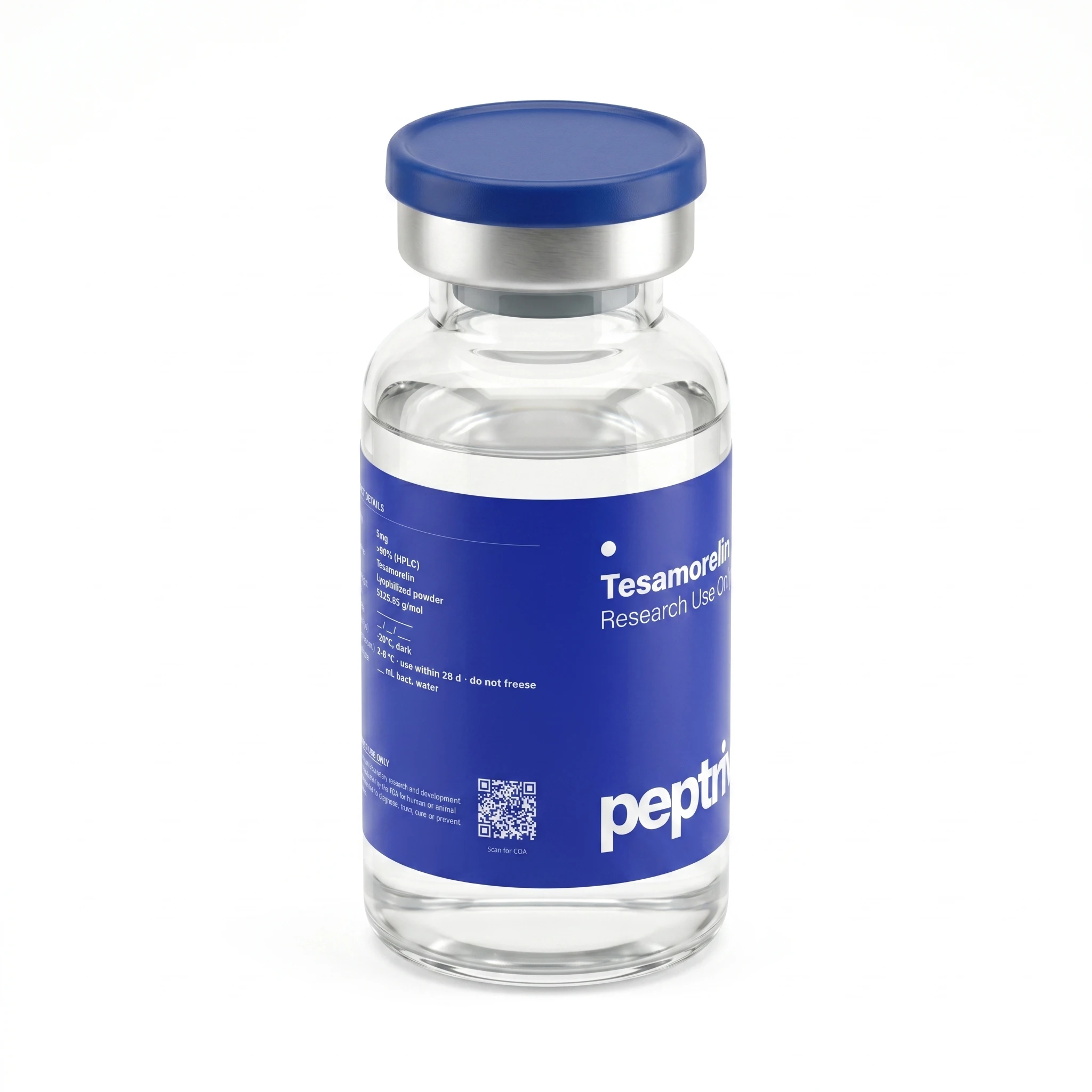
Tesamorelin
The same compound cited across the Baker MCI pilot and the Ellis HIV cognition trial discussed in this article. Lab-verified identity and purity.
The 2025 Ellis trial — the most rigorous recent test
The Ellis trial was a Phase II open-label randomized comparison of tesamorelin versus standard of care in 73 HIV patients with abdominal obesity and neurocognitive impairment, over 6 months. The primary endpoint was a standardized HIV-related cognitive impairment battery.
The result: tesamorelin reduced waist circumference by 2.7 cm versus standard of care, consistent with its established fat-reducing mechanism in HIV lipodystrophy. But it did not improve cognition. No clinically meaningful cognitive change, despite measurable body-composition effects and presumed IGF-1 elevation (Ellis et al., 2025, DOI).
This is the most informative cognition readout since Baker, and it's null. Here's how to interpret it:
- The population differs from Baker. Ellis enrolled HIV patients with abdominal obesity and HIV-associated neurocognitive disorder (HAND), not non-HIV adults with classical MCI. HAND involves chronic inflammation, viral persistence in brain tissue, and long-term antiretroviral therapy effects — mechanisms that overlap only partially with aging-related cognitive decline.
- Trial duration was short. Six months is enough to detect a robust cognitive effect if one exists. Subtle cognitive benefits in aging decline often need longer trials to show up.
- Open-label design. Ellis wasn't blinded. That matters in cognitive trials because expectancy effects can bias both subjective and objective cognitive testing.
- The body-fat effect held. Tesamorelin did what it was supposed to do on fat. It didn't extend that benefit to cognition. That's exactly the kind of dissociation that disconfirms "mechanism predicts outcome" thinking.
How to read Baker positive and Ellis null together
We have one positive pilot and one larger null trial, in different populations, with different methods. That's not a strong evidence base in either direction. What it is: a useful illustration of why translational research is hard.
What the cognition evidence supports in 2026: tesamorelin remains a mechanistically interesting candidate for cognitive intervention in aging. The small 2012 positive pilot hasn't been replicated. The most rigorous recent test was null. That doesn't prove tesamorelin doesn't work — populations and endpoints differ. It does mean clinical use for cognitive indications isn't supported by the current published evidence.
The natural next step would be a pre-registered double-blind larger-sample trial in non-HIV aging populations. As of 2026, we don't see any such trial in active enrollment on ClinicalTrials.gov. That's itself meaningful information about how the broader research community weighs the existing data.
What this tells us about mechanism vs. outcome
The tesamorelin cognition story illustrates a recurrent pattern in peptide-therapy research. The mechanism is plausible. The biomarker change is real (IGF-1 elevation). The pilot signal is encouraging. The larger rigorous trial is null.
This same sequence has played out repeatedly across the GH and IGF-1 axis intervention literature — in growth hormone therapy for aging, in IGF-1 supplementation for sarcopenia, and now in tesamorelin for HIV cognition. What the pattern suggests: biomarker effects on the GH and IGF-1 axis don't reliably translate to clinical outcomes in healthy or quasi-healthy aging populations.
The biology is more complex than "more GH equals more brain function." Compensatory feedback, regional tissue sensitivity, and the multi-step distance between biomarker change and clinical endpoint all contribute to the translation gap. For tesamorelin specifically, the labeled indication (HIV lipodystrophy) is the population where the fat-reduction mechanism has the most direct path to a meaningful endpoint. Cognition requires the GH effect to propagate through additional biological steps, and that translation appears less reliable.
Tesamorelin
44-aa stabilized GHRH analog. The same reference compound used across the cited preclinical and clinical studies. COA available with each lot.
The broader IGF-1 story in brain biology
Even with the Ellis null, the underlying biology that motivated the cognition question hasn't gone away. IGF-1's role in brain function is well-established at the cellular level: supporting new neuron growth in the adult hippocampus, modulating synaptic plasticity, and helping neurons survive injury and degeneration. The honest question is whether a GHRH analog is the right way to engineer that biology in adult humans.
Here's an alternative framing: the GH and IGF-1 axis in aging may be a marker of cellular health, not a lever for restoring it. The decline of GH and IGF-1 with age may be downstream of underlying aging processes rather than a primary cause. If that's true, restoring the biomarker pharmacologically wouldn't address the actual biology driving decline. That framing is consistent with the mixed translational results across the broader GH intervention literature.
The 2026 Mavrych review of therapeutic peptides in gerontology discusses tesamorelin among the GH-axis interventions considered for healthy aging, while noting the evidence base for cognitive endpoints remains preliminary.
Regulatory and clinical context in 2026
Tesamorelin's FDA-approved indication is HIV lipodystrophy. Cognitive improvement is not an approved indication. The FDA's progressive tightening of 503A compounding eligibility for GHRH peptides has further narrowed off-label access channels. Published literature from some longevity-medicine practices has referenced the Baker signal in the context of GH-axis interventions, though this use is not supported by the current approved labeling.
The evidence summary: the most rigorous recent randomized data (Ellis 2025) did not demonstrate a cognitive benefit in the population studied. The Baker 2012 pilot positive signal remains unreplicated in an independent cohort. Taken together, the published record does not support cognitive improvement as an established tesamorelin endpoint. Known adverse-event considerations in the clinical literature include effects related to GH-axis stimulation; these are documented in the product labeling and the referenced studies.
What to know now
- Baker 2012 pilot: randomized double-blind placebo-controlled trial in older adults with mild cognitive impairment showed statistically significant improvements in executive function and verbal memory — small effect sizes, single-center, unreplicated.
- Ellis 2025 trial: open-label randomized comparison in 73 HIV patients with abdominal obesity and neurocognitive impairment. Tesamorelin reduced waist circumference (-2.7 cm) but did not improve cognitive outcomes over 6 months.
- Mechanistic story: GH/IGF-1 receptors widely expressed in hippocampus, cortex, cerebellum; biology supports the question even where clinical trials have been mixed.
- Populations differ: Baker enrolled non-HIV aging-related MCI; Ellis enrolled HIV-associated neurocognitive disorder. The pathologies overlap only partially.
- Translational gap: biomarker effects on the GH/IGF-1 axis don’t reliably translate to clinical cognitive outcomes — a recurrent pattern across GH-axis intervention literature.
- Regulatory status: tesamorelin's FDA-approved indication is HIV lipodystrophy; cognitive improvement is not an approved endpoint, and the most rigorous available trial data has not demonstrated a cognitive benefit.
What we’re watching
Three things to track over the next 18 months. First, whether any registered Phase II/III tesamorelin cognition trial appears on ClinicalTrials.gov in non-HIV aging populations — a pre-registered double-blind replication of the Baker signal would be the most informative readout in this space. Second, whether secondary analyses of the Ellis trial population identify subgroups that did benefit cognitively — that would refine the question rather than simply close it. Third, whether the broader GH-axis intervention field (including newer secretagogues and IGF-1 modulators) produces any rigorously positive cognitive readout that would reopen the question of GH-axis intervention as a cognitive aging strategy.
References
- Ellis, R. J., Vaida, F., Hu, K., et al. (2025). Effects of tesamorelin on neurocognitive impairment in persons with HIV and abdominal obesity. Journal of Infectious Diseases, 231(5), 1230–1238. https://doi.org/10.1093/infdis/jiaf012
- Mavrych, V., Shypilova, I., & Bolgova, O. (2026). Therapeutic peptides in gerontology: mechanisms and applications for healthy aging. Frontiers in Aging, 7, 1790247. https://doi.org/10.3389/fragi.2026.1790247
- Fourman, L. T., & Grinspoon, S. K. (2022). Approach to the patient with lipodystrophy. Journal of Clinical Endocrinology and Metabolism, 107(6), 1714–1726. https://doi.org/10.1210/clinem/dgac079
- Gattu, A. K., & Fourman, L. T. (2025). Metabolic dysfunction-associated steatotic liver disease in people with HIV. Current Opinion in HIV and AIDS, 20(4), 350–358. https://doi.org/10.1097/COH.0000000000000952
- Sinha, D. K., Balasubramanian, A., Tatem, A. J., et al. (2020). Beyond the androgen receptor: the role of growth hormone secretagogues in the modern management of body composition in hypogonadal males. Translational Andrology and Urology, 9(Suppl 2), S149–S159. https://doi.org/10.21037/tau.2019.11.30
- Mendias, C. L., & Awan, T. M. (2026). Safety and efficacy of approved and unapproved peptide therapies for musculoskeletal injuries and athletic performance. Sports Medicine. https://doi.org/10.1007/s40279-026-02437-0