KPV is a three-amino-acid fragment of α-MSH. The animal data on inflammation is real. The human trial count is zero.
KPV is the tail end of α-MSH (the hormone your body uses to dial down inflammation). The sequence is just Lys-Pro-Val. It keeps the parent hormone's anti-inflammatory punch without the skin-pigment side effects. Colitis studies in mice and rats look promising. Western human trials? Zero RCTs (PubMed 2020–2026). That gap is the whole story.
If you came here looking for a clean summary of human trials, we don't have one. We searched PubMed for KPV studies between 2020 and 2026 and found 4 papers (PubMed 2020–2026). None are randomized controlled trials in people.
What we do have is a small but coherent stack of preclinical work. Most of it comes from Chinese pharmaceutics groups testing oral nanoparticle versions of KPV for inflammatory bowel disease (IBD, the umbrella term for ulcerative colitis and Crohn's). There's also a thin trail of older topical studies in atopic dermatitis from the early 2000s.
This review covers the biology, the animal evidence, and the gap between "mechanism we can measure in preclinical models" and "therapy supported by human trial data." KPV is genuinely interesting science. It's also the compound where grey-market marketing has run furthest ahead of the published data.
What is KPV, and why does it get attention?
KPV is shorthand for Lysine-Proline-Valine. Those three amino acids sit at the tail end of α-MSH, a 13-amino-acid hormone your body makes by cleaving a bigger protein called POMC. The full hormone runs five different signaling pathways at once (the MC1R through MC5R receptors). That's too many jobs for one drug.
Here's the trick. The tail piece keeps most of the inflammation-calming activity. It loses the pigment-darkening and blood-pressure effects. That kind of clean split is what makes drug chemists curious. Researchers have been studying it since the 1990s. The current focus is IBD.
The other big draw is size. KPV weighs 342 daltons (Da, the standard mass unit for peptides). That's tiny. Most peptide drugs, including insulin and the 15-residue BPC-157, are degraded by stomach enzymes when administered orally, which is why parenteral delivery is required for those compounds. A three-residue molecule offers more delivery options — it can be encapsulated in a protective vehicle and delivered through the gut.
What does KPV actually do at the cellular level?
The short answer: it quiets inflammation. The longer answer is messier than for most peptides, and the literature owns that. A 2023 review by Gravina and colleagues groups KPV with related fragments of the melanocortin system, including ACTH, α-MSH, and KdPT.
The mechanism story has three pieces that keep showing up:
- NF-κB inhibition. NF-κB is the master switch your cells use to turn on inflammation. KPV dampens it. That blocks the production of TNF-α, IL-6, and IL-1β (three inflammatory signaling proteins called cytokines).
- Wound repair in epithelial tissue. KPV speeds up the migration of cells that line the colon, the surface that gets damaged in IBD.
- Broad cytokine modulation. Across the studies, the inflammatory cascade gets dialed down, not just one piece of it.
The unsettled part is the receptor. The parent hormone α-MSH binds five well-mapped melanocortin receptors. KPV's target is genuinely contested. Some studies argue it slips inside the cell and acts on nuclear receptors directly. Others argue for a non-classical melanocortin pathway. The evidence is suggestive, not settled.
KPV retains the anti-inflammatory effects of the parent α-MSH peptide while lacking the pigmentary effects, but its mechanism is less clearly linked to specific melanocortin receptors than the parent hormone. Some evidence suggests intracellular mechanisms or non-classical receptor pathways.
— Gravina et al., Cells, 2023
Honest gloss: KPV calms inflammation reliably in animal models. The pathway is NF-κB-suppressive. The exact receptor target is unclear. That's unusual for a peptide whose parent hormone is so well mapped.
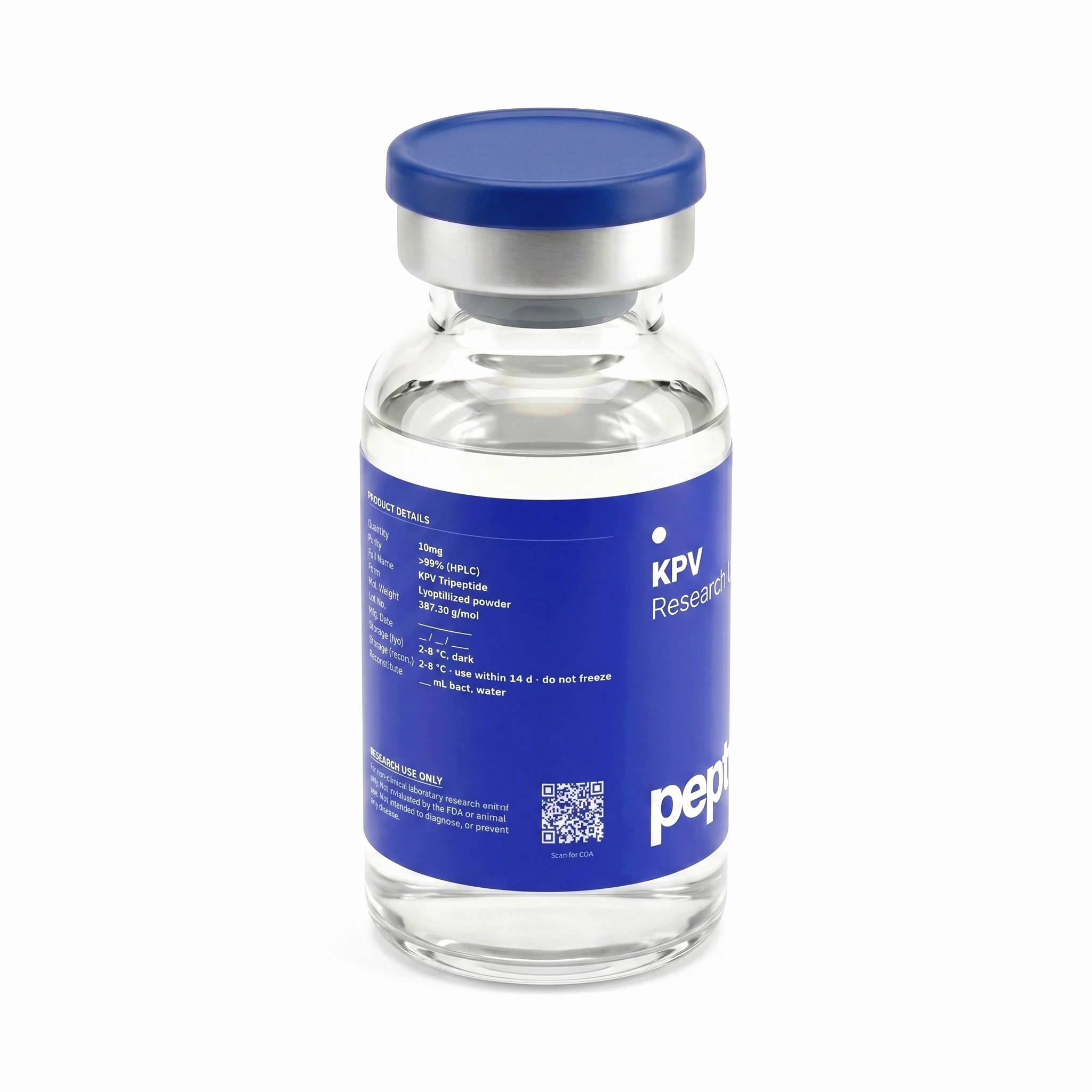
KPV
The same C-terminal α-MSH tripeptide cited across the preclinical IBD and anti-inflammatory studies in this review. Lab-verified identity and purity.
What does the IBD preclinical evidence show?
The KPV IBD literature is small but concrete. This is where the molecule's real research case lives.
The story starts in 2008. Two groups, Dalmasso at Emory and Kannengiesser in Germany, published in close succession on oral nanoparticle delivery of KPV in mice with DSS colitis (a standard rodent model of ulcerative colitis). They wrapped KPV in pH-sensitive shells that survived the stomach and dissolved in the colon. The peptide reduced colitis severity, dropped cytokine levels, and improved the tissue under the microscope.
The 2021 work by Sun and colleagues pushed this further. The team built a sticky gel (a thiolated polyglutamic acid hydrogel) that holds KPV in the rectum and releases it slowly. Bare KPV gets shredded by enzymes within minutes. The gel keeps it intact long enough to work.
The results in a TNBS-colitis rat model were measurable. Disease activity index dropped (rats, 2021). Colon shortening was prevented. Myeloperoxidase fell (a marker of neutrophil influx, 2021). TNF-α and IL-6 expression decreased (2021). The epithelial barrier looked normal again on histology.
A 2020 study by Can and colleagues tested KPV on inflamed cartilage cells. It worked, but less powerfully than dedicated receptor-targeting drugs in the same panel.
The IBD preclinical summary, in one paragraph
In mice with DSS colitis and rats with TNBS colitis, KPV wrapped in colon-targeted delivery vehicles drops disease activity scores, lowers TNF-α and IL-6, restores the gut barrier, and quiets neutrophil recruitment. The signal replicates across independent groups. The catch: every reproducible study used a delivery vehicle, not bare peptide.
What about antimicrobial and rosacea claims?
The antimicrobial story is thin. Older work (pre-2020) showed KPV could fight Candida albicans and some gram-positive bacteria at high concentrations. It probably works by punching small holes in microbe membranes, like other small cationic peptides do. There's almost no recent follow-up.
The rosacea pitch is louder. Grey-market sellers point at rosacea's inflammatory component and the fact that KPV is anti-inflammatory. The logic is plausible. The data is small open-label work, not controlled trials.
What does the human evidence actually say?
The PubMed-indexed evidence base includes 0 RCTs (PubMed 2020–2026) of KPV in people for any indication. Older topical work in atopic dermatitis from the 1990s used small samples and weak controls. Systemic, oral, and injectable KPV claims circulating in grey-market channels lack controlled human-trial backing.
This gap is especially significant for IBD, where approved therapies with robust Phase III evidence already exist. The published standard of care includes:
- 5-aminosalicylates like mesalamine (the first-line drug for mild ulcerative colitis).
- Biologics that block specific inflammatory signals, including infliximab and adalimumab (anti-TNF), vedolizumab (anti-integrin), and ustekinumab (anti-IL-12/23).
- Small-molecule pills like tofacitinib and upadacitinib (JAK inhibitors) and ozanimod (an S1P modulator).
Each of those has Phase III trials in thousands of study participants. KPV has 0 Phase III trials (any indication). The preclinical evidence for KPV does not approach the clinical evidence base for approved IBD therapies.
Researchers and clinicians evaluating KPV against the IBD standard of care should note several unresolved questions in the literature:
- Comparative efficacy data are absent. 5-ASAs, biologics, JAK inhibitors, and S1P modulators all have Phase III data. No head-to-head study of KPV versus any approved IBD agent has been published.
- Delivery vehicle is critical, not solved. Bare KPV is broken down by enzymes rapidly in vivo. The studies reporting positive outcomes used engineered nanoparticle or hydrogel delivery systems. Bare-peptide formulations have not replicated those results.
- Pharmacokinetic endpoints are undefined in humans. Published preclinical IBD studies used calprotectin, endoscopic scoring, and CRP-equivalent markers as endpoints. No published human PK/PD data exist for any KPV formulation.
- Source and purity standards vary. Research-grade KPV reference compounds are produced for in vitro and preclinical use with published COA data. Compound sourcing and purity documentation should be verified before any research use.
KPV
Lys-Pro-Val tripeptide · C-terminus of α-MSH. The same reference compound used across the cited preclinical colitis and anti-inflammatory studies. COA available with each lot.
Why does the oral-delivery story matter?
If anything in the KPV literature is going to become a real drug, this is the part. Getting medicine to the inflamed lining of the colon is one of the hardest problems in IBD pharmacology. Many of the best biologics still need to be injected, and they don't always reach the colon at high enough concentrations.
An oral tripeptide wrapped in a pH-sensitive shell that opens in the colon is a familiar architecture. Mesalamine products like Asacol and Pentasa use the same trick. The 2008 mouse work showed it can work for KPV. The 2021 Sun hydrogel extended the idea to rats and rectal delivery.
What's missing is a registered Phase I or II trial in people with ulcerative colitis. The catch is patent economics. Tripeptides themselves are hard to protect; the delivery system has to carry the patent. The IBD market is big enough to make that worth doing. Nobody has filed yet.
Where this falls short
Most preclinical KPV findings come from a small set of overlapping author groups. The 2008 Emory and German papers are foundational but old. The 2021 hydrogel work is from a single Chinese pharmaceutics lab. There's no Western RCT, no published pharmacokinetic data for bare KPV in humans, and no head-to-head against mesalamine or a biologic. Anyone claiming KPV "treats IBD" today is selling well past the evidence.
Honest framing: KPV is most plausibly useful as an oral colon-targeted IBD drug, not as a generic injectable anti-inflammatory. That's where the literature points. Any future regulatory filing will be built on delivery-engineered formulations, not bare peptide in a vial.
What to know now
- Identity: KPV is the C-terminal tripeptide of α-MSH — sequence Lys-Pro-Val, molecular weight 342 Da.
- Mechanism: NF-κB inhibition, cytokine suppression (TNF-α, IL-6, IL-1β), epithelial cell migration. Receptor target is unclear and contested.
- Why it matters: retains anti-inflammatory activity of α-MSH while shedding pigmentation and cardiovascular effects. Small enough at 3 aa for plausible oral delivery.
- Strongest preclinical data: the 2008 Dalmasso and Kannengiesser oral nanoparticle delivery papers in DSS-colitis mice, and the 2021 Sun TNBS-colitis hydrogel rat study — consistent, replicated, reduced disease activity index and cytokine production.
- Human evidence: zero PubMed-indexed RCTs for IBD or any other indication in the 2020–2026 window. Older topical work in atopic dermatitis was small and limited.
- Evidence gap vs. approved IBD therapies: mesalamine, biologics (anti-TNF, anti-integrin, anti-IL-12/23), JAK inhibitors, and S1P modulators all have rigorous Phase III evidence bases. No published data positions KPV at a comparable evidence tier.
- Regulatory status: not FDA- or EMA-approved for any indication. Not explicitly listed by WADA.
What we're watching
Three things to track. First: any pharma or biotech registers a Phase I or II trial of an oral colon-targeted KPV formulation in ulcerative colitis. Second: independent labs outside the original Chinese pharmaceutics groups replicate the colitis findings. Third: someone settles the receptor question. Is KPV working through a classical melanocortin receptor, an intracellular path, or a nuclear receptor? That open question is part of what makes the pharmacology interesting.
References
- Sun, J., Xue, P., Liu, J., et al. (2021). Self-cross-linked hydrogel of cysteamine-grafted γ-polyglutamic acid stabilized tripeptide KPV for alleviating TNBS-induced ulcerative colitis in rats. ACS Biomaterials Science & Engineering, 7(10), 4859–4869. https://doi.org/10.1021/acsbiomaterials.1c00792
- Gravina, A. G., Pellegrino, R., Durante, T., et al. (2023). The melanocortin system in inflammatory bowel diseases: Insights into its mechanisms and therapeutic potentials. Cells, 12(14), 1889. https://doi.org/10.3390/cells12141889
- Can, V. C., Locke, I. C., Kaneva, M. K., et al. (2020). Novel anti-inflammatory and chondroprotective effects of the human melanocortin MC1 receptor agonist BMS-470539 dihydrochloride and human melanocortin MC3 receptor agonist PG-990 on lipopolysaccharide activated chondrocytes. European Journal of Pharmacology, 872, 172971. https://doi.org/10.1016/j.ejphar.2020.172971
- Dalmasso, G., Charrier-Hisamuddin, L., Nguyen, H. T., Yan, Y., Sitaraman, S., & Merlin, D. (2008). PepT1-mediated tripeptide KPV uptake reduces intestinal inflammation. Gastroenterology, 134(1), 166–178. PMID 18061177
- Kannengiesser, K., Maaser, C., Heidemann, J., et al. (2008). Melanocortin-derived tripeptide KPV has anti-inflammatory potential in murine models of inflammatory bowel disease. Inflammatory Bowel Diseases, 14(3), 324–331. PMID 18092346
- Mendias, C. L., & Awan, T. M. (2026). Safety and efficacy of approved and unapproved peptide therapies for musculoskeletal injuries and athletic performance. Sports Medicine. https://doi.org/10.1007/s40279-026-02437-0