Five decades after Loren Pickart isolated it from human plasma, the GHK-Cu wound-healing literature is one of the more honestly mixed evidence bases in peptide dermatology — replicated in vitro biology on one end, overconfident grey-market extrapolations on the other.
Topical GHK-Cu has the strongest wound-healing evidence: five decades of cosmetic-dermatology research, replicated in vitro findings across independent labs, and a small body of controlled human trials in pressure ulcers and diabetic foot ulcers. The 2023 hydrogel-delivery literature revived the field with rigorous formulations. The injectable/systemic wound-healing claims that drive grey-market marketing rest almost entirely on rodent models. The human RCT evidence for systemic GHK-Cu is essentially zero.
Chronic wounds (pressure ulcers, diabetic foot ulcers, venous leg ulcers) are an expensive problem the wound-care industry hasn’t solved. Roughly 2.5% of the US population lives with a chronic wound at any given time. Diabetic foot ulcers alone cost about $9–13 billion annually in US healthcare.
Standard care (debridement, offloading, moist dressings) produces closure in many study populations but leaves a long tail of non-responders. That long tail is where bioactive peptides keep getting reintroduced into the conversation.
GHK-Cu is the oldest of those bioactive peptides. Older than the modern era of growth-factor wound dressings. Older than the commercial cosmetic-peptide industry it largely launched. This review addresses the question the literature doesn’t always answer cleanly: which wound-healing claims for GHK-Cu are supported by controlled evidence, and which are extrapolations?
What Pickart actually discovered.
The story starts in 1973 at UC San Francisco. Loren Pickart isolated a copper-binding tripeptide from human plasma fractions that restored a healthier growth phenotype to aged rat liver cells. The peptide was glycyl-L-histidyl-L-lysine, or GHK. Its bioactivity hinged on its high-affinity binding of copper(II). Pickart spent the next half-century characterizing the molecule, and his body of work is the foundation everything else in the field builds on.
The most-cited single property: endogenous GHK levels in human plasma decline with age. From roughly 200 ng/mL at age 20 to about 80 ng/mL by age 60. A roughly 60% drop. That decline is the biological hook the entire wound-healing claim hangs from.
The Dou et al. 2020 review in Aging Pathobiology & Therapeutics summarized the mechanistic case. GHK-Cu binds at sites of tissue injury, where it modulates collagen synthesis, glycosaminoglycan production, blood-vessel growth, and fibroblast recruitment.
The copper coordination is mechanistically important, not incidental. Copper is a required cofactor for lysyl oxidase, the enzyme that cross-links new collagen. A copper-binding peptide that delivers Cu²⁺ into fibroblasts at injury sites has a plausible mechanism for the collagen effect — not just an empirical observation that it works.
What the in vitro evidence shows.
The lab-dish literature is where the GHK-Cu wound-healing claim is most reproducibly supported. Across independent labs, GHK-Cu has shown:
- Fibroblast proliferation and migration. The cells that lay down collagen respond to GHK-Cu by proliferating more and moving more directly toward injury cues.
- Collagen and glycosaminoglycan synthesis. In skin fibroblast cultures, GHK-Cu upregulates the matrix synthesis that supports wound closure.
- VEGF-driven blood-vessel growth. New capillary formation is one of the most reproducible findings — and one of the most relevant to chronic non-healing wounds where poor vascularization is part of the problem.
- Elastase inhibition. Dymek et al. 2023 reported approximately 49% inhibition of human leukocyte elastase by GHK-Cu in vitro. That matters because uncontrolled elastase activity is a feature of chronic non-healing wounds.
None of those findings is in doubt. The question lab-dish work can’t answer is the one the clinic cares about: does any of this translate into a clinically meaningful difference in real human wound closure rates?
GHK forms an exceptionally stable complex with Cu(II), and the resulting chelate is the typical bioactive form. Endogenous GHK is a naturally occurring component of human serum, with circulating levels averaging 200 ng/mL at age 20 and declining to approximately 80 ng/mL by age 60.
— Dou et al., Aging Pathobiology & Therapeutics, 2020
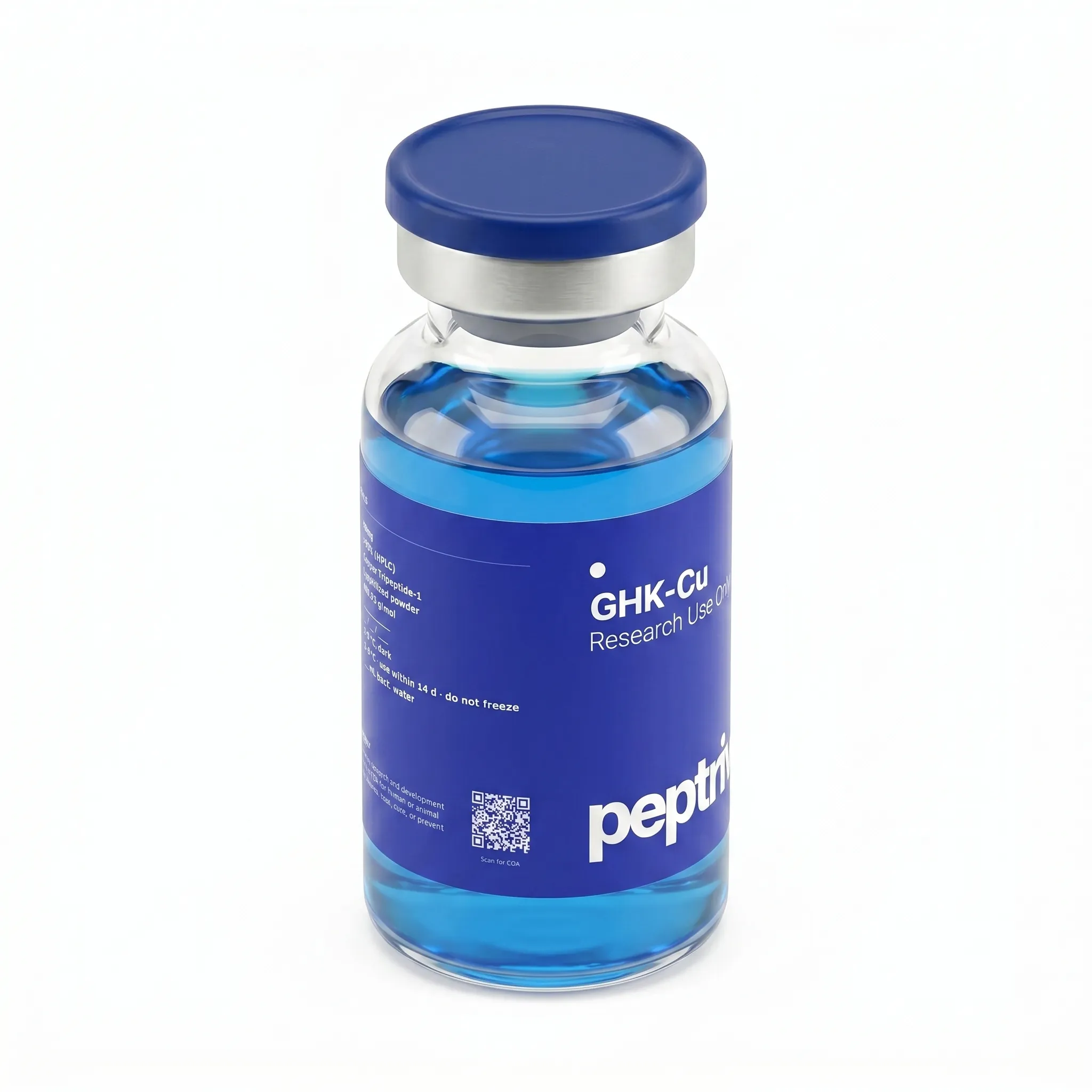
GHK-Cu
The same compound cited across the wound-healing trials and reviews in this article. Lab-verified identity and purity.
The controlled human trials in chronic wounds.
This is where the picture gets honestly more complicated. The most-cited human wound-healing data for GHK-Cu comes from a series of small controlled trials in the 1990s and early 2000s using a specific topical formulation (Iamin). The trials in pressure ulcers, diabetic foot ulcers, and venous leg ulcers produced positive signals, but they were small, often single-center, and methodologically heterogeneous.
The strongest of those trials reported faster closure rates for pressure-ulcer wounds on topical GHK-Cu versus vehicle controls, with effect sizes large enough to suggest the mechanism translates. The weaker trials produced smaller effects or non-significant differences. Our read, consistent with the 2020 Dou review: the controlled-trial base supports topical use with meaningful but not dramatic effect sizes. Not the “heals everything” framing you see in consumer marketing.
The contemporary literature has revived the controlled-trial conversation through advanced delivery formulations. The 2023 paper from Lee and colleagues demonstrated that a photo-crosslinkable hyaluronic-acid hydrogel embedded with GHK peptide nanofibers accelerated wound healing through VEGF-driven blood-vessel growth, collagen remodeling, and fibroblast proliferation in animal models. A 2025 paper from Chen and colleagues showed a self-healing hydrogel loaded with GHK-Cu had antibacterial, anti-inflammatory, and pro-blood-vessel-growth effects in infected wound-healing models.
These modern studies make clear something the older literature understated: GHK-Cu has a delivery problem. The molecule is hydrophilic, has poor stratum corneum permeation, and degrades quickly in topical formulations without protective excipients. Ogórek et al. 2025 addressed the skin-permeation challenge with liposomal encapsulation. The signal across that work: when GHK-Cu is delivered effectively, the wound-healing biology holds up. When it isn’t, results are noisy.
What about diabetic ulcers specifically?
Diabetic foot ulcers are the wound-care indication most often invoked in consumer GHK-Cu marketing. They’re also where the evidence base is most uneven. The mechanistic case is strong. Diabetic wounds suffer from impaired blood-vessel growth, reduced fibroblast function, and chronic low-grade inflammation. Exactly the cellular failures GHK-Cu’s preclinical mechanisms address.
The clinical case is weaker. The published human trials of topical GHK-Cu in diabetic ulcers are small, dated, and often combined with other interventions. That makes the GHK-Cu-specific signal hard to isolate. The 2020 Dou review flagged the absence of large multi-center RCTs as a meaningful gap. The 2025 Chen and Lee hydrogel papers explicitly addressed infected and chronic wound contexts in animal models, with results that warrant clinical follow-up. But neither has produced human RCT data yet.
Where this falls short. The 1990s–2000s topical pressure-ulcer trials are the most-cited controlled human wound-healing data for GHK-Cu. Small, mostly positive, methodologically heterogeneous. The 2023–2025 hydrogel literature revives the mechanism in animal models. Large modern RCTs in diabetic foot ulcers or chronic venous ulcers are still missing — that’s the trial the field needs most.
What about burns?
Burn wound healing is the third clinical category where GHK-Cu sees repeated invocation. The preclinical case is mechanistically similar to chronic wounds: blood-vessel growth, fibroblast recruitment, collagen remodeling, and the anti-inflammatory signaling characterized in the 2025 Mao colitis paper where the SIRT1/STAT3 pathway emerged as a target.
The published human burn-wound evidence for GHK-Cu is essentially nil. Case reports, observational data from cosmetic-dermatology contexts, and extrapolations from the general wound-healing literature. But zero PubMed-indexed RCTs of topical or systemic GHK-Cu in burn patients in the 2020–2026 window. The 2026 Sports Medicine review by Mendias and Awan flagged the absence of rigorous human safety data as a concern for grey-market peptide use here.
Translational gap: topical versus systemic evidence.
For surface-wound and cosmetic post-procedure contexts, the topical case is the best-supported in the published literature. The mechanism is plausible. The in vitro evidence is consistent across independent labs. The cosmetic safety record of topical GHK-Cu at conventional concentrations spans decades of use.
In studies of serious chronic wounds — pressure ulcers, diabetic foot ulcers, venous leg ulcers, and post-surgical dehiscence — topical GHK-Cu was investigated as an adjunct to, not a replacement for, standard wound-care protocols. Standard care (debridement, offloading, compression, antibiotic management, glycemic control) has a stronger and more consistent evidence base than GHK-Cu alone.
Key variables the clinical literature has flagged in evaluating GHK-Cu wound research:
- Standard-of-care comparator. Debridement, dressings, offloading, and infection control were the baseline in the controlled trials; GHK-Cu was tested on top of these, not instead of them.
- Formulation and delivery vehicle. Delivery matters significantly. The 2023–2025 hydrogel studies outperformed earlier simple-carrier formulations in preclinical models, suggesting that encapsulation quality drives much of the observed variance.
- Underlying systemic confounders. Impaired wound healing in diabetic and vascular disease cohorts is driven by glycemic, nutritional, and perfusion factors that topical peptides do not address mechanistically.
- Injectable versus topical route. The human evidence base for injectable or systemic GHK-Cu in wound healing is essentially zero. The controlled-trial literature is exclusively topical.
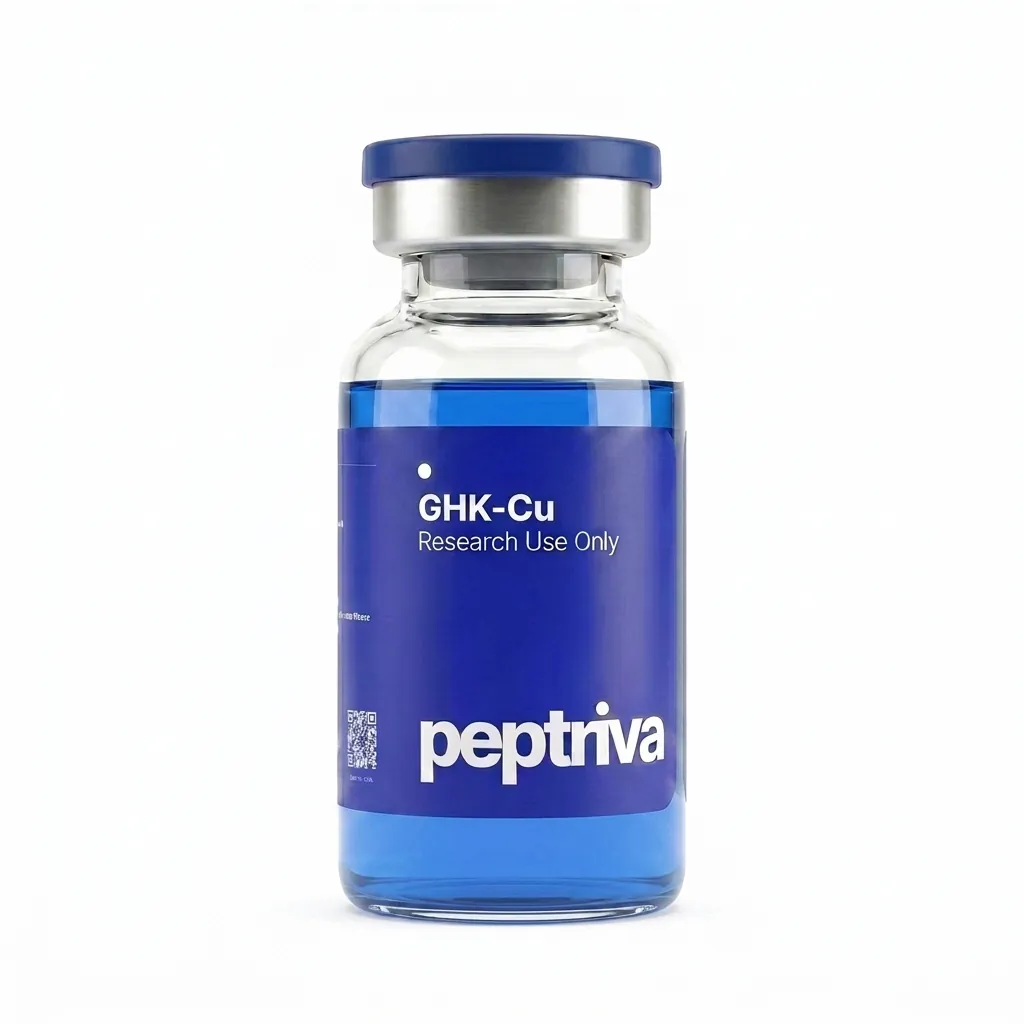
GHK-Cu
Endogenous copper tripeptide · 3 aa, glycyl-L-histidyl-L-lysine. The same reference compound used across the cited wound-healing studies. COA available with each lot.
The injectable claim.
Grey-market marketing has positioned injectable GHK-Cu as a systemic wound-healing accelerator for internal injuries, post-surgical recovery, and tissue repair. That narrative is built almost entirely on extrapolation from rodent models and cell-culture work. There are zero published RCTs of injectable or systemic GHK-Cu in humans for any wound-healing indication.
The mechanistic argument that “if topical works, injectable should work better” is not supported by the pharmacology. GHK-Cu is cleared from systemic circulation rapidly. The topical concentrations that drive measurable effects in skin are not what subcutaneous injection achieves at depth. The 2026 Mendias and Awan review grouped injectable GHK-Cu with grey-market peptides where rigorous human safety data is scarce — a characterization consistent with the absence of human RCT evidence.
What to know now
- Topical evidence: 50 years of cosmetic-dermatology research, replicated in vitro findings, controlled trials in pressure and diabetic ulcers with meaningful but modest effect sizes.
- Modern delivery: 2023–2025 hydrogel-encapsulation work revived the mechanism in animal models. Clinical translation is the next step.
- Endogenous decline: plasma GHK falls ~60% between age 20 and age 60. The biological hook for the entire wound-healing claim.
- Injectable evidence: zero published RCTs of injectable or systemic GHK-Cu in humans for any wound-healing indication.
- Delivery matters: hydrophilic peptide with poor stratum corneum permeation. Formulation quality drives whether the biology translates.
- Adjunct, not replacement: in the controlled trials, debridement, offloading, compression, and glycemic control formed the study baseline; GHK-Cu was investigated on top of these, not in lieu of them.
What we’re watching
Three things to track in the next 24 months. First, whether the 2023–2025 hydrogel work translates into human pressure-ulcer or diabetic-ulcer RCTs. The formulations are ready for clinical follow-up. Second, whether any group attempts a modern multi-center RCT in diabetic foot ulcers with GHK-Cu as an adjunct to standard care. That’s the trial the field needs most. Third, whether the FDA addresses the cosmetic-vs-research-grade distinction more clearly. The gap between marketed cosmetic concentrations and grey-market injectable use is a regulatory gray zone.
References
- Dou, Y., Lee, A., Zhu, L., Morton, J., & Ladiges, W. (2020). The potential of GHK as an anti-aging peptide. Aging Pathobiology & Therapeutics, 2(1), 58–61. https://doi.org/10.31491/apt.2020.03.014
- Lee, S., Lee, S. M., Lee, S. H., et al. (2023). In situ photo-crosslinkable hyaluronic acid-based hydrogel embedded with GHK peptide nanofibers for bioactive wound healing. Acta Biomaterialia, 172, 159–174. https://doi.org/10.1016/j.actbio.2023.10.011
- Chen, H., Yang, P., Xue, P., et al. (2025). Food-derived tripeptide-copper self-healing hydrogel for infected wound healing. Biomaterials Research, 29, 0139. https://doi.org/10.34133/bmr.0139
- Dymek, M., Olechowska, K., Hąc-Wydro, K., & Sikora, E. (2023). Liposomes as carriers of GHK-Cu tripeptide for cosmetic application. Pharmaceutics, 15(10), 2485. https://doi.org/10.3390/pharmaceutics15102485
- Ogórek, K., Nowak, K., Wadych, E., et al. (2025). Are we ready to measure skin permeation of modern antiaging GHK-Cu tripeptide encapsulated in liposomes? Molecules, 30(1), 136. https://doi.org/10.3390/molecules30010136
- Mao, S., Huang, J., Li, J., et al. (2025). Exploring the beneficial effects of GHK-Cu on an experimental model of colitis and the underlying mechanisms. Frontiers in Pharmacology, 16, 1551843. https://doi.org/10.3389/fphar.2025.1551843
- Mendias, C. L., & Awan, T. M. (2026). Safety and efficacy of approved and unapproved peptide therapies for musculoskeletal injuries and athletic performance. Sports Medicine. https://doi.org/10.1007/s40279-026-02437-0