Comparing retatrutide vs tirzepatide? The honest answer starts with a warning: this is the most structurally unfair head-to-head in modern obesity pharmacotherapy research, and understanding why matters before reading the numbers.
Tirzepatide is the more extensively studied option. It is FDA-approved, has Phase III data in 2,539 study participants (22.5% weight loss at 72 weeks), and is marketed as Mounjaro and Zepbound. Retatrutide adds a third receptor (glucagon) and reported larger weight-loss figures in Phase II: 24.2% mean weight loss in 338 participants at 48 weeks. Phase II data typically regresses in Phase III — the field projects an adjusted range of 18 to 22%. The mechanism difference is real. The regulatory gap is substantial. Retatrutide remains investigational, with an estimated approval window of 3 to 4 years.
Tirzepatide holds advantages on every currently verifiable axis: larger evidence base, FDA approval, global supply, and a head-to-head win over semaglutide (SURPASS-2). Retatrutide's case rests on the headline Phase II number and its novel triple-receptor mechanism — both of which Phase III trials are still evaluating.
Below, the comparison is examined on five axes — mechanism, magnitude, tolerability, regulatory status, and timing — with explicit flags where the cross-trial comparison is methodologically sound and where it is not.
Quick comparison table
| Attribute | Retatrutide | Tirzepatide |
|---|---|---|
| Receptor profile | Triple agonist: GIP, GLP-1, glucagon | Dual agonist: GIP, GLP-1 |
| Molecular scaffold | 39 aa linear peptide, C20 fatty-diacid acyl chain | 39 aa linear peptide, C20 fatty-diacid acyl chain |
| Trial administration route | Once-weekly SC injection (clinical trial route) | Once-weekly SC injection (clinical trial route) |
| Peak Phase II/III weight loss | 24.2% (Phase II, 48 weeks, 12 mg, n=338) | 22.5% (Phase III, 72 weeks, 15 mg, n=2,539) |
| ≥15% threshold response | 83% (12 mg, Phase II) | 71% (15 mg, Phase III) |
| ≥20% threshold response | 63% (12 mg, Phase II) | 57% (15 mg, Phase III) |
| GI adverse-event rate | ~80–85% at highest dose | ~60–80% at highest dose |
| Distinctive safety signal | Dose-dependent heart-rate increase, peaked at week 24 | No comparable signal |
| Cardiovascular outcomes | No CVOT yet | SURMOUNT-MMO ongoing |
| FDA approval status | Investigational. Phase III TRIUMPH ongoing. | Mounjaro (T2D, 2022), Zepbound (obesity, 2023) |
| Realistic approval window | 2028–2029 | Already approved |
| Maintenance / discontinuation data | Not yet published | SURMOUNT-4: 14% regain on switch to placebo |
| Head-to-head data | Not yet published | SURPASS-2: outperformed semaglutide on every dose |
Mechanism: two receptors vs three
This is the real conceptual difference. Tirzepatide targets two gut hormones — GIP and GLP-1 — which together reduce energy intake and improve insulin response. Retatrutide adds a third receptor target: glucagon. Glucagon activity does something neither of the others does: it increases basal energy expenditure.
GIP and GLP-1 are both satiety-signaling hormones — they reduce appetite but do not substantially accelerate metabolism. Glucagon's role is thermogenic energy mobilization. That is the mechanistic rationale for the triple agonist: reducing intake (GLP-1 + GIP) while increasing expenditure (glucagon). The Phase II weight-loss data were consistent with that prediction.
The trade-off is the heart-rate signal. Retatrutide's Phase II saw a dose-related heart-rate bump that peaked at week 24 and then drifted back down. We think glucagon causes it. Tirzepatide doesn't produce anything comparable. Whether the heart-rate effect stays transient at Phase III scale, or stays elevated, is the central question for TRIUMPH.
The glucagon receptor component also raises a distinct indication hypothesis: hepatic steatosis. Glucagon promotes hepatic fatty acid oxidation, which is the relevant mechanism in MASH (metabolic dysfunction-associated steatohepatitis). If retatrutide demonstrates superiority over tirzepatide on MASH endpoints in Phase III, that would establish a separate indication where the triple-receptor design offers mechanistic advantage beyond body-weight reduction alone.
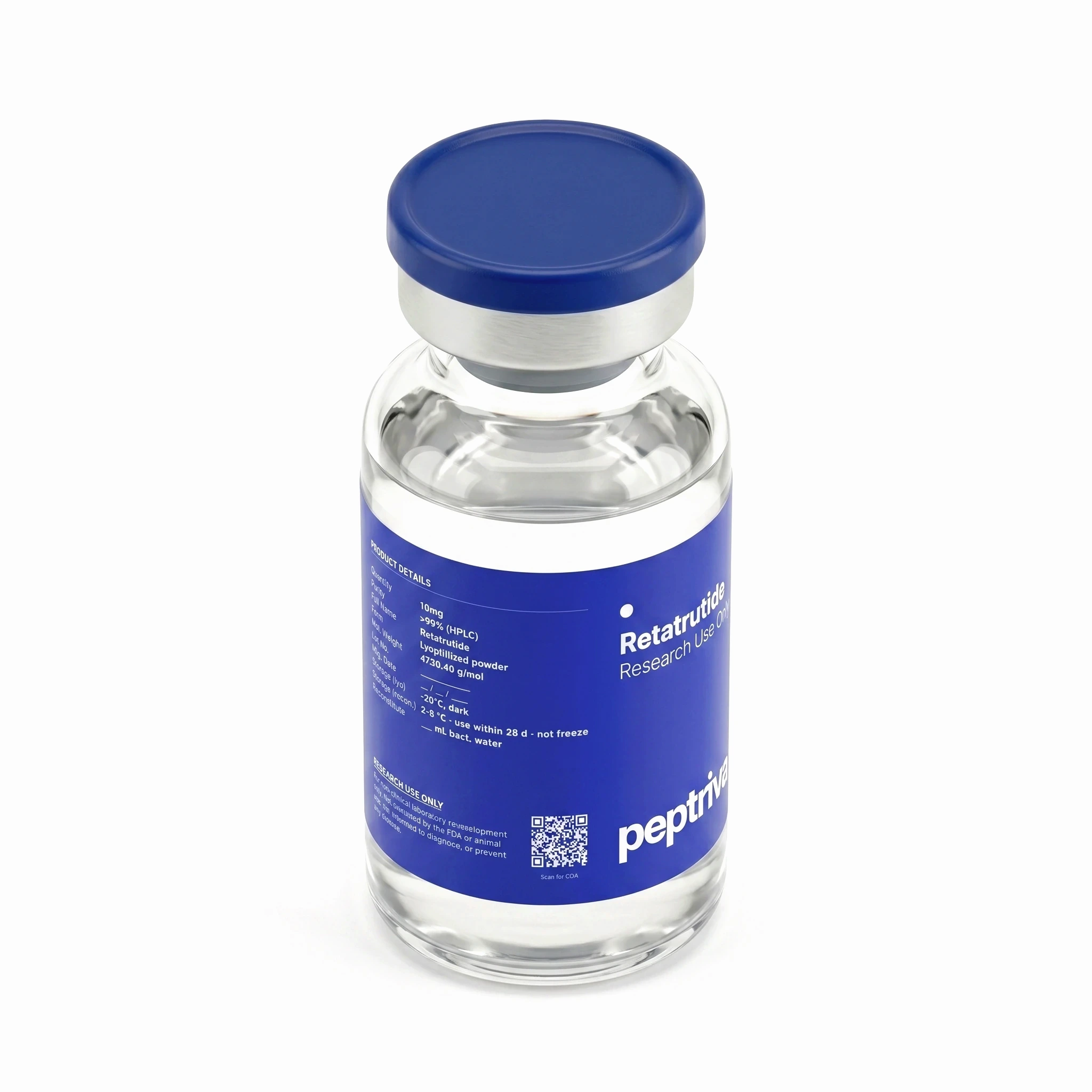
Retatrutide
The same compound cited across the 5 trials and reviews in this comparison. Lab-verified identity and purity.
Weight loss: apples and oranges
The headline figures favor retatrutide. 24.2% at 48 weeks vs 22.5% at 72 weeks. On the threshold response (participants achieving at least 15% weight reduction), retatrutide reported 83% at 12 mg and tirzepatide 71% at 15 mg. At the 20% threshold, the figures are 63% vs 57%.
Those numbers do not represent a methodologically equivalent comparison.
Cross-trial methodological limits. Phase II data almost always over-report effect magnitude relative to Phase III. Three contributing factors: smaller samples (338 vs 2,539) allow high-responders to inflate the mean; Phase II sites typically operate with more intensive adherence monitoring than community-based Phase III sites; and early-trial recruitment tends to favour highly motivated participants. The projected range for retatrutide TRIUMPH Phase III is 18 to 22% — still potentially class-leading, but a narrower margin than the cross-trial headline comparison suggests.
A study-duration mismatch further complicates the comparison. Retatrutide Phase II ran 48 weeks; SURMOUNT-1 ran 72 weeks. Tirzepatide's weight-loss curve appears largely plateaued between weeks 60 and 72. Retatrutide's curve had not visibly plateaued at the 48-week end point, leaving the true 72-week asymptote undetermined until TRIUMPH data are available.
The methodologically sound comparison would be a head-to-head trial: matched doses, matched duration, matched participant population. No such trial has been published. Until one is, any comparison involves reading across non-equivalent study designs.
Side effects: similar shape, different magnitudes
Both compounds produced the same class of adverse events: nausea, vomiting, diarrhea, constipation — most pronounced during dose escalation and typically attenuating with continued exposure. The "any GI adverse event" rates at peak doses were approximately 80 to 85% for retatrutide 12 mg and 60 to 80% for tirzepatide 15 mg in their respective trials.
Discontinuation due to adverse events provides a more interpretable cross-trial metric. SURMOUNT-1 reported 4 to 7% discontinuation for tirzepatide. Retatrutide Phase II saw 6 to 16%. The retatrutide rate is higher, though Phase II discontinuation figures are subject to significant noise, and TRIUMPH's titration schedule may refine these outcomes.
The retatrutide-specific signal is the heart-rate increase. Dose-related. Peaked at week 24. Drifted back down. Tirzepatide doesn't do this. Whether it matters depends entirely on what Phase III sees — transient bump (fine) or sustained elevation (problem).
Adding glucagon to the mechanism gives retatrutide the extra weight loss and the heart-rate signal. Phase III will tell us whether both effects hold up at scale.
— Melson et al., International Journal of Obesity, 2024 (paraphrased)
Regulatory status: the variable that decides it
Tirzepatide is FDA-approved as Mounjaro (type 2 diabetes, 2022) and Zepbound (obesity, 2023). It is available via prescription in the US, EU, Canada, and most major markets. Supply stabilized following the 2023–2024 shortage period.
Retatrutide remains investigational. It has received neither FDA nor EMA approval. The TRIUMPH Phase III programme is ongoing; the realistic FDA submission window is 2027–2028, with approval projected for 2028–2029, contingent on Phase III outcomes.
This regulatory asymmetry is the defining feature of the comparison. Retatrutide is not yet a clinical option — it is a research subject currently advancing through Phase III evaluation.
What about heart outcomes?
Neither compound has a published dedicated cardiovascular outcomes trial equivalent to SELECT (semaglutide). Tirzepatide's SURPASS-CVOT (type 2 diabetes population) and SURMOUNT-MMO (obesity population) are currently enrolling or ongoing. Cardiometabolic risk-factor improvements observed in SURMOUNT-1 are suggestive of cardiovascular benefit, but dedicated outcomes data are awaited from 2026–2027 readouts.
Retatrutide is substantially further from any CVOT readout. A cardiovascular outcomes programme would require Phase III completion, regulatory approval, and a separate large-scale outcomes study — a realistic timeline of 5 to 7 years. The Phase II heart-rate signal means cardiovascular monitoring will be a prominent secondary endpoint across TRIUMPH.
For researchers studying cardiovascular endpoints in incretin pharmacology, tirzepatide's CVOT programme will generate interpretable data well before retatrutide reaches that stage.
Pipeline timing: what to watch
The next 24 to 36 months will decide how this comparison plays in practice. Six milestones to track:
- Tirzepatide SURMOUNT-MMO. Heart outcomes data, likely 2026 or 2027.
- Retatrutide TRIUMPH-1 obesity readout. Phase III primary endpoint, likely 2026 or 2027.
- Retatrutide TRIUMPH MASH and T2D readouts. Indications where the glucagon arm matters most. Likely 2027 or 2028.
- Retatrutide FDA submission. Likely 2027 or 2028, contingent on Phase III.
- Retatrutide FDA approval. Realistic window 2028 to 2029.
- Competition. Oral incretins (orforglipron Phase III), more triple agonists, amylin combinations (CagriSema is at FDA submission stage).
In the current research landscape, the comparison of retatrutide vs tirzepatide is effectively a comparison between an established, approved compound and an investigational one projected for approval in 3 to 4 years. Studies have suggested that response patterns to GLP-1/GIP dual agonism may predict responsiveness to triple agonism, though head-to-head data confirming this have not been published.
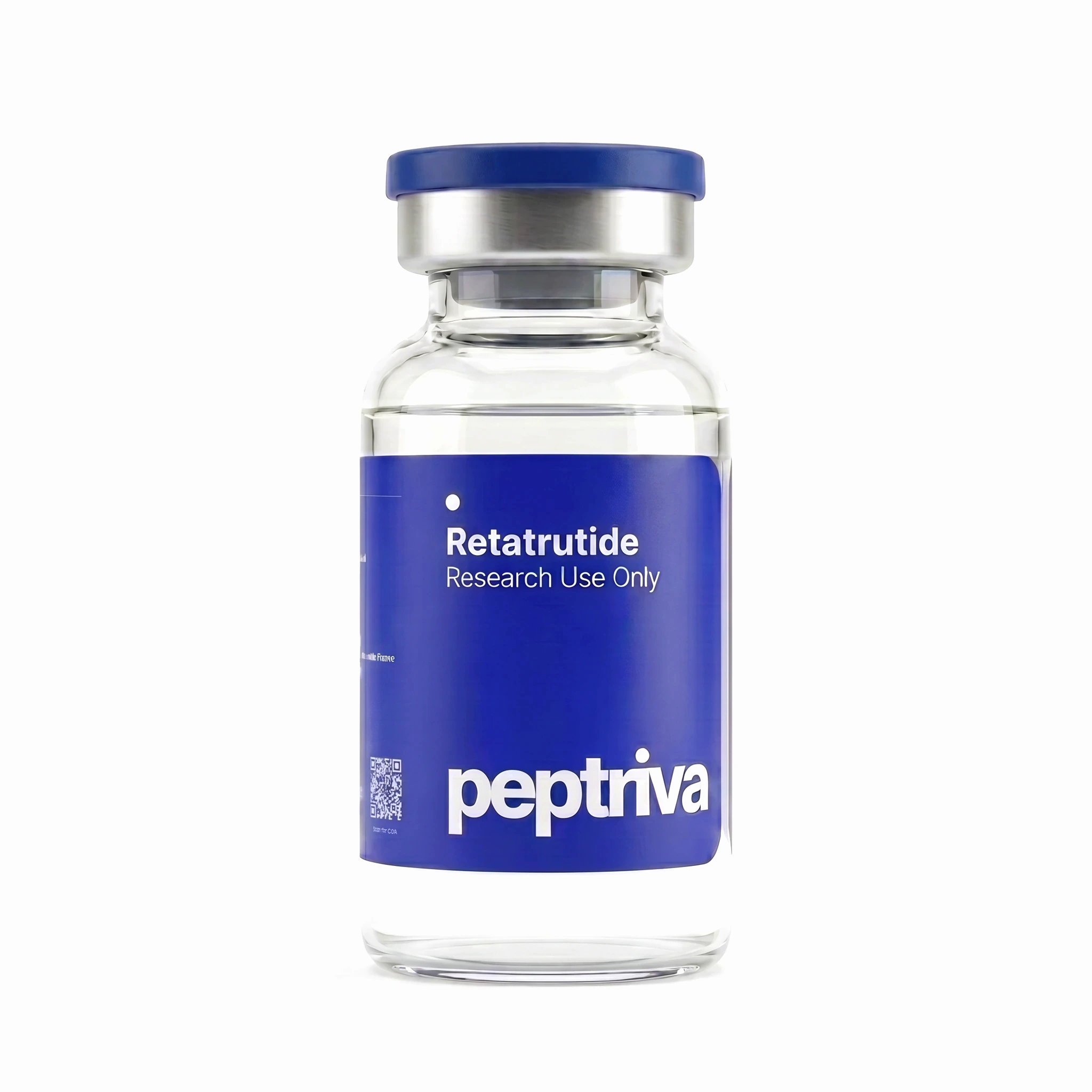
Retatrutide
39-aa triple agonist with C20 fatty-diacid acyl chain. The same reference compound used across the cited Phase II trial. COA available with each lot.
Key research considerations by indication
The published evidence base suggests several indication-specific distinctions relevant to preclinical and translational research design:
- Obesity pharmacotherapy models. Tirzepatide has Phase III data across a broad population (n=2,539). Retatrutide Phase II data (n=338) are a useful comparator but should be interpreted with the Phase II-to-Phase III attrition caveat in mind.
- MASH / hepatic steatosis models. The glucagon receptor component of retatrutide has mechanistic relevance for hepatic lipid metabolism. Published preclinical and Phase II data support investigation in MASH-relevant models; dedicated TRIUMPH MASH readouts are anticipated 2027–2028.
- Cardiovascular risk-factor endpoints. Tirzepatide CVOT data are projected earlier (2026–2027). Retatrutide Phase II reported a transient, dose-dependent heart-rate elevation that merits monitoring in cardiovascular model contexts.
- Type 2 diabetes / insulin secretion models. Both compounds have demonstrated glucose-lowering in clinical trials. Tirzepatide has FDA approval in T2D (Mounjaro, 2022). Retatrutide T2D TRIUMPH readouts are ongoing.
- Receptor selectivity studies. Retatrutide's triple agonist profile (GIP/GLP-1/glucagon) provides a useful tool for dissecting individual receptor contributions when paired against tirzepatide's dual-agonist profile.
What the evidence shows
- Mechanism. Retatrutide adds glucagon receptor agonism (increases energy expenditure) on top of tirzepatide's dual GIP + GLP-1 design.
- Magnitude. Phase II reported 24.2% mean weight loss at 48 weeks (retatrutide) vs Phase III 22.5% at 72 weeks (tirzepatide). Cross-trial comparisons of this type typically narrow at Phase III scale.
- Tolerability. Both compounds produced class-typical GI adverse events. Retatrutide discontinuation rates were slightly higher in Phase II. A dose-related transient heart-rate elevation was specific to retatrutide.
- Regulatory status. Tirzepatide is FDA-approved (Mounjaro 2022, Zepbound 2023). Retatrutide remains investigational; projected approval window 2028–2029.
- Cardiovascular outcomes. Neither compound has published SELECT-equivalent CVOT data. Tirzepatide's cardiovascular outcomes trials are expected to read out earlier.
- Comparative research utility. The dual-agonist vs triple-agonist distinction makes these compounds useful paired tools for dissecting incretin receptor contributions in preclinical models.
- Hepatic steatosis / MASH. Retatrutide's glucagon component is mechanistically relevant to hepatic lipid metabolism. TRIUMPH MASH readouts are anticipated 2027–2028.
What we’re watching
Four milestones over the next 24 months. First, retatrutide TRIUMPH-1 obesity readout — whether the Phase II 24.2% figure holds at Phase III scale or regresses into the projected 18–22% range. Second, tirzepatide SURMOUNT-MMO — whether the dual agonist demonstrates SELECT-equivalent cardiovascular benefit. Third, any head-to-head trial publication — whether matched doses at matched durations confirm or revise the cross-trial gap. Fourth, retatrutide MASH readouts — whether glucagon receptor activity produces hepatic outcomes that the dual-agonist mechanism cannot.
References
- Jastreboff, A. M., Kaplan, L. M., Frías, J. P., et al. (2023). Triple-hormone-receptor agonist retatrutide for obesity — A Phase 2 trial. New England Journal of Medicine, 389(6), 514–526. https://doi.org/10.1056/NEJMoa2301972
- Jastreboff, A. M., Aronne, L. J., Ahmad, N. N., et al. (2022). Tirzepatide once weekly for the treatment of obesity. New England Journal of Medicine, 387(3), 205–216. https://doi.org/10.1056/NEJMoa2206038
- Aronne, L. J., Sattar, N., Horn, D. B., et al. (2024). Continued treatment with tirzepatide for maintenance of weight reduction in adults with obesity: The SURMOUNT-4 randomized clinical trial. JAMA, 331(1), 38–48. https://doi.org/10.1001/jama.2023.24945
- Frías, J. P., Davies, M. J., Rosenstock, J., et al. (2021). Tirzepatide versus semaglutide once weekly in patients with type 2 diabetes. New England Journal of Medicine, 385(6), 503–515. https://doi.org/10.1056/NEJMoa2107519
- Melson, E., Ashraf, U., Papamargaritis, D., & Davies, M. J. (2024). What is the pipeline for future medications for obesity? International Journal of Obesity, 49(3), 433–451. https://doi.org/10.1038/s41366-024-01473-y