The retatrutide mechanism spans three separate hormone systems — including a surprising case for why the third one, glucagon, was investigated as part of a weight-loss compound at all.
Retatrutide is a 39-amino-acid peptide engineered to activate three distinct receptors. The first two are the incretin pair: GLP-1 (satiety and glucose-dependent insulin secretion) and GIP (postprandial insulin and adipose handling). The third is novel — the glucagon receptor, which has been reported to increase energy expenditure and promote hepatic lipid mobilization. Each arm contributes a complementary mechanistic role. The 2023 Phase II trial published in NEJM reported 24.2% mean weight reduction at the highest dose over 48 weeks — the largest magnitude documented for a pharmacological agent at the time of publication.
Most prior tries at combining glucagon with a GLP-1 drug failed. That history is part of why retatrutide is interesting. It's not the first compound to pair glucagon with GLP-1. It's the first to get the receptor-potency balance right enough that glucagon contributes without raising blood sugar to dangerous levels.
The sections below examine each of the three receptor arms in turn — what each does mechanistically, how each has been reported to contribute to metabolic outcomes in the literature, how they interact, and why retatrutide's receptor-potency balance succeeded where earlier glucagon co-agonists did not.
- Receptor. A protein on the surface of a cell that catches a specific signal molecule and tells the cell what to do.
- Agonist. A compound that binds a receptor and activates it. Retatrutide is a triple agonist because it activates three distinct receptors.
- Incretin. A family of gut hormones (GLP-1 and GIP) released by the small intestine after a meal to coordinate insulin secretion.
- Satiety. The appetite-suppression signal generated by central nervous system circuits. Greater satiety correlates with reduced caloric intake in study subjects.
- Energy expenditure. The rate at which an organism burns calories at rest, also termed basal metabolic rate.
Arm 1: the familiar incretin (GLP-1)
The first arm targets the most studied of the three hormone systems. GLP-1 is the receptor targeted by semaglutide, liraglutide, and related compounds. The endogenous hormone is released by the small intestine after a meal. It simultaneously signals pancreatic beta-cells to release insulin, slows gastric emptying, and activates central appetite circuits.
Activating this receptor produces several downstream effects:
- Insulin release on demand. Beta-cells release more insulin when blood sugar is high — the response is glucose-dependent, so it does not produce hypoglycemia during fasting.
- Less glucagon. Pancreatic alpha-cells release less glucagon at mealtimes, which cuts liver glucose output.
- Slower stomach emptying. Food sits longer, prolonging fullness and softening post-meal blood-sugar spikes.
- Brain satiety signal. Brain regions that control appetite get a "full" signal, cutting food intake.
Pure agonists of this receptor (semaglutide, the Ozempic and Wegovy family) produce about 15% mean weight loss in pivotal obesity trials. That's the ceiling for what one receptor alone can do.
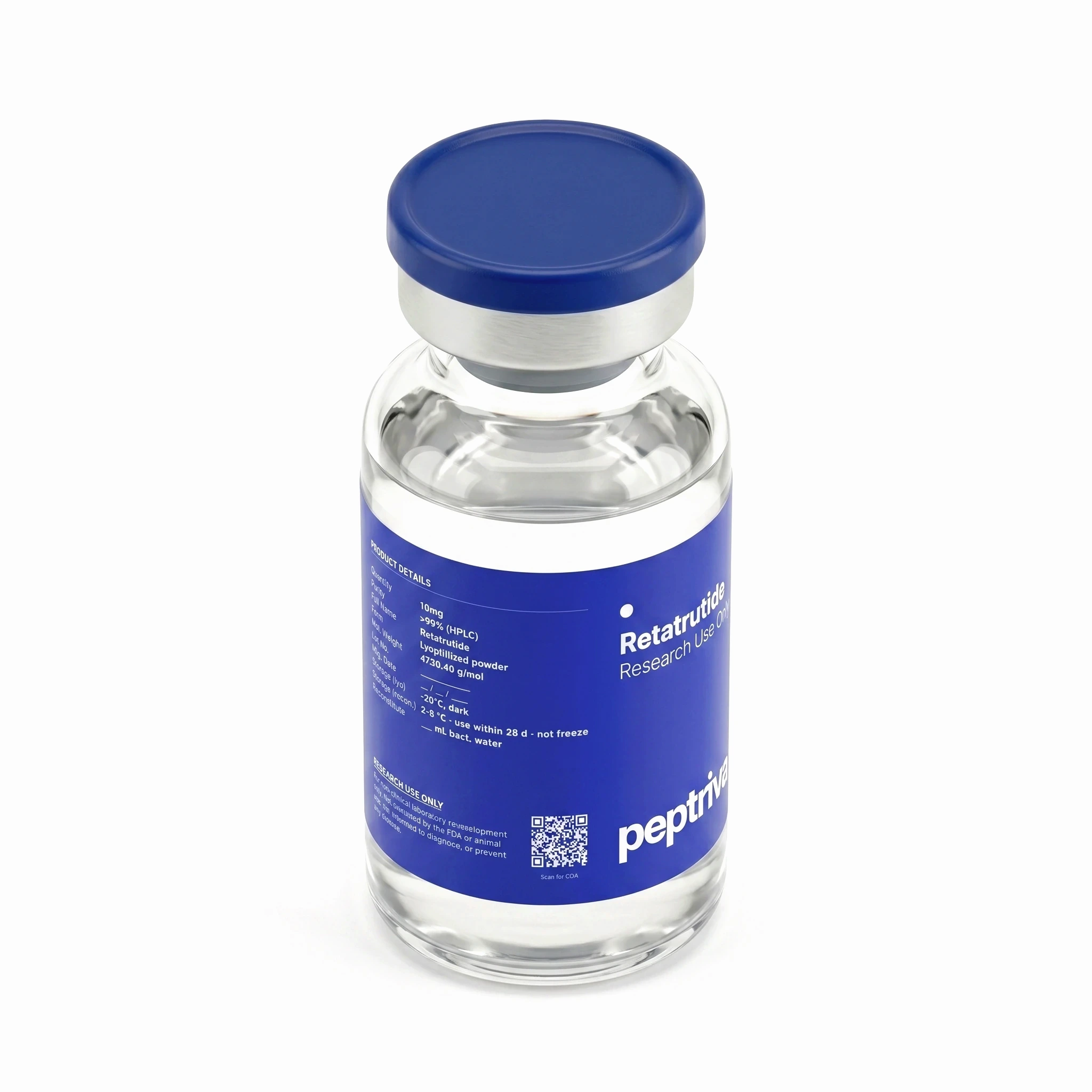
Retatrutide
The same compound cited across the Jastreboff Phase II trial and the Melson pipeline review in this article. Lab-verified identity and purity.
Arm 2: the second incretin
The second arm targets the glucose-dependent insulinotropic polypeptide receptor. GIP is a gut hormone released postprandially, and it binds a separate receptor expressed on beta-cells, adipocytes, bone, and brain.
For decades, scientists thought this second hormone played second fiddle. Tirzepatide (Mounjaro, Zepbound) changed that. Tirzepatide is a dual agonist hitting both incretin receptors. It produces more weight loss than the older single-receptor drugs. Several pathways may explain why:
- Extra insulin response. The second incretin adds to the satiety arm's effect for tighter blood-sugar control after meals.
- Better fat-tissue handling. Fat cells with this receptor store and release fat more efficiently.
- Extra satiety. Brain appetite centers get a "full" signal through different pathways than the first arm uses.
- Possibly less nausea. Some evidence suggests this arm may reduce gut side effects the first arm causes alone. Still under investigation.
The SURPASS-2 head-to-head trial against semaglutide showed the dual combination consistently outperformed the single-receptor drug at matched doses. That's the empirical evidence for the second arm adding weight loss on top of the first.
Arm 3: glucagon (the surprising piece)
Glucagon is the hormone that opposes insulin. Pancreatic alpha-cells release it when blood glucose falls. Its primary function is to raise blood glucose by stimulating hepatic glycogenolysis and gluconeogenesis. The rationale for including glucagon receptor agonism in an anti-obesity compound is therefore non-obvious — elevated blood glucose is precisely the adverse effect a diabetes-adjacent drug must avoid.
The case for adding glucagon comes from a different set of glucagon effects, ones unrelated to that emergency blood-sugar response:
- Elevated resting metabolic rate. Glucagon receptor activation has been reported to increase basal energy expenditure in preclinical and early clinical models.
- Hepatic lipid mobilization. Glucagon signaling promotes hepatic fatty acid oxidation, reducing liver fat accumulation in study models.
- Peripheral fat breakdown. Glucagon receptors expressed in non-hepatic tissues have been shown to facilitate lipolysis and fat utilization for fuel.
- Possible brown adipose activation. Preclinical data suggest glucagon agonism may promote white-to-brown adipose conversion, increasing thermogenesis — though this mechanism requires further study.
The combination of "less in" (GLP-1 and GIP cutting food intake) plus "more out" (glucagon raising energy burn) is what makes the triple mechanism theoretically stronger than the dual. The 2023 trial's 24.2% weight loss is consistent with that theory.
The hypothesis behind retatrutide is that simultaneous engagement of GIP, GLP-1, and glucagon receptors produces additive or synergistic weight-loss effects beyond what any single or dual agonist achieves. Each receptor contributes complementary metabolic effects: GLP-1 for satiety, GIP for postprandial handling, glucagon for energy expenditure.
— Melson et al., International Journal of Obesity, 2024 (paraphrased summary)
Why most prior glucagon co-agonists failed
Several compounds investigated before retatrutide attempted to combine GLP-1 agonism with glucagon activity: oxyntomodulin analogues, cotadutide, and efinopegdutide among others. Most either failed to advance in clinical development or produced weight-reduction outcomes indistinguishable from single-receptor controls.
The central challenge is receptor-potency balance. When the glucagon arm is over-potent relative to the incretin arms, net glycemic effects are adverse. When the glucagon arm is under-potent, it contributes no meaningful energy expenditure, yielding an incretin agonist with additional tolerability liability but no added efficacy.
The balance problem in plain English. The glucagon arm needs to be strong enough to raise calorie burn in fat tissue and liver. It also needs to be weak enough that the incretin-driven insulin response fully counters the blood-sugar-raising effect. Retatrutide's binding profile lands in that narrow window. The 2023 Phase II trial showed no clinically meaningful blood-sugar rise in non-diabetic participants. That's the engineering win that separates it from the failed predecessors.
Retatrutide is reported to have roughly balanced potency across all three receptors. The published pharmacology details are still being refined. The empirical signal from the trial is that the balance works.
How the three arms interact
The arms aren't simply additive. They interact in biologically interesting ways. The two incretins both signal beta-cells to release insulin in a blood-sugar-dependent way. Their effects are mostly complementary, not redundant. The combined insulin response is enough to offset the glucagon-driven liver glucose output, keeping blood sugar stable in non-diabetic users.
On the appetite side, the two incretins activate overlapping but distinct brain pathways. The combined satiety signal is bigger than either alone. That's the basis for tirzepatide's dual-agonist advantage. The glucagon arm doesn't add much direct satiety, but it interacts with appetite signaling through liver-to-brain feedback.
On the energy-burn side, glucagon is the main contributor. The incretins alone don't meaningfully raise basal metabolic rate. Glucagon-driven thermogenic pathways are what give retatrutide a fundamentally different metabolic profile than tirzepatide. "Burn more" plus "eat less," not just "eat less."
The clinical signal of this interaction is the heart-rate effect documented in the Phase II trial. Heart rate rose dose-dependently, peaked at week 24, then declined. That pattern is consistent with glucagon-driven metabolic-rate effects, and represents the class of signal that has prompted careful cardiovascular monitoring in the Phase III program design.
What the mechanism predicts about heart and liver outcomes
Two mechanistic implications have been highlighted in the published literature as warranting follow-up investigation.
Cardiovascular outcomes
The mechanism is consistent with cardiovascular benefits proportional to weight reduction — substantial weight loss has well-established associations with reduced cardiovascular risk in the literature. The Phase II heart-rate signal introduces an offsetting variable, however: if the effect persists at scale, it could attenuate the cardiovascular benefit. The Phase II pattern of dose-dependent increase peaking at week 24 then declining is consistent with a transient effect, but 338 study participants over 48 weeks is insufficient to characterize long-term cardiovascular outcomes — that determination awaits Phase III data at scale.
Liver outcomes
The glucagon arm's mechanism predicts differentiated hepatic outcomes relative to dual agonists. Glucagon-driven hepatic fatty acid oxidation — the same pathway implicated in the weight-reduction signal — would also be expected to reduce liver fat in study subjects with MASH (metabolic dysfunction-associated steatohepatitis, formerly NASH). Dedicated MASH-indication trials are the test of whether this mechanistic prediction holds at the level of clinical endpoints.
Retatrutide
39-aa triple agonist with C20 fatty-diacid acyl chain. The same reference compound used across the cited preclinical and Phase II studies. COA available with each lot.
Open mechanistic questions in the literature
Retatrutide remains investigational. Several mechanistic questions have been identified in the published literature as warranting further study as the Phase III TRIUMPH program progresses:
- Dual vs. triple receptor-arm trade-off. Studies have investigated whether the additional weight-reduction magnitude observed with triple agonism is reliably offset by the cardiovascular monitoring requirements introduced by glucagon-driven heart-rate effects.
- Heart-rate signal characterization. The dose-dependent heart-rate increase documented in the Phase II readout has prompted researchers to assess whether analogous signals appear across the broader incretin class.
- MASH-specific outcomes. Given the glucagon arm's hepatic mechanism, preclinical and early clinical data suggest retatrutide may produce differentiated outcomes in study cohorts with hepatic steatosis — a hypothesis being tested in dedicated MASH-indication trials.
- Incretin response predictivity. Researchers have noted that the relationship between GLP-1 or dual-agonist response and predicted triple-agonist response remains an active area of investigation, with empirical data still accumulating.
Evidentiary limitations. Phase II is not Phase III. The Phase II trial enrolled 338 participants over 48 weeks. Cardiovascular outcomes cannot be characterized at this scale. This article describes a mechanism supported by Phase II evidence and a biologically coherent model. Retatrutide is an investigational compound — it has not received regulatory approval, and long-term safety data in humans are not yet available.
What to know now
- Three receptors: GLP-1 (satiety, glucose-dependent insulin), GIP (postprandial insulin, adipose handling), glucagon (energy expenditure, hepatic lipid mobilization).
- Mechanism complementarity: each arm contributes a non-redundant piece — appetite suppression, postprandial handling, energy expenditure.
- Receptor-potency balance is the engineering achievement: the glucagon arm potent enough to drive energy expenditure, weak enough to be glucose-neutral via GLP-1 and GIP counterbalance.
- Energy expenditure pathway: glucagon arm drives thermogenesis and hepatic fatty acid oxidation — the “burn more” complement to GLP-1’s “eat less.”
- Heart rate signal: dose-dependent increase peaking at week 24 then declining; consistent with glucagon mechanism, requires Phase III characterization.
- MASH differentiation: mechanism strongly predicts hepatic steatosis reduction beyond what dual agonists deliver; dedicated MASH trials are the test.
What we’re watching
Three things over the next 24 months. First, whether Phase III TRIUMPH confirms the receptor-balance hypothesis at scale — meaningful weight-loss benefit without clinically problematic hyperglycemia in larger non-diabetic populations. Second, the cardiovascular monitoring data on the heart-rate signal — whether peak-then-decline at week 24 holds up in 5,000+ participants over multi-year follow-up. Third, MASH-specific trial readouts — whether retatrutide produces differentiated hepatic outcomes vs. tirzepatide, which would establish triple-agonism as more than just “more of the same.”
References
- Jastreboff, A. M., Kaplan, L. M., Frías, J. P., et al. (2023). Triple-hormone-receptor agonist retatrutide for obesity — A Phase 2 trial. New England Journal of Medicine, 389(6), 514–526. https://doi.org/10.1056/NEJMoa2301972
- Melson, E., Ashraf, U., Papamargaritis, D., & Davies, M. J. (2024). What is the pipeline for future medications for obesity? International Journal of Obesity, 49(3), 433–451. https://doi.org/10.1038/s41366-024-01473-y
- Jastreboff, A. M., Aronne, L. J., Ahmad, N. N., et al. (2022). Tirzepatide once weekly for the treatment of obesity. New England Journal of Medicine, 387(3), 205–216. https://doi.org/10.1056/NEJMoa2206038
- Aronne, L. J., Sattar, N., Horn, D. B., et al. (2024). Continued treatment with tirzepatide for maintenance of weight reduction in adults with obesity: The SURMOUNT-4 randomized clinical trial. JAMA, 331(1), 38–48. https://doi.org/10.1001/jama.2023.24945