In peptide research, the diluent chosen for reconstituting a lyophilized vial is not a neutral carrier. The choice between bacteriostatic water, sterile water, and saline determines whether the vial remains sterile for 28 days or must be discarded after a single aliquot.
Bacteriostatic water for injection (BWFI) is sterile water plus 0.9% benzyl alcohol, a mild preservative. That preservative provides a 28-day in-use window at fridge temperature without bacterial overgrowth. Sterile water for injection (SWFI) has no preservative and is single-use only. Saline (0.9% NaCl) is a third option, but it clashes with some peptide classes. Selecting the wrong diluent risks microbial contamination of the working solution or waste of research material.
Most research-grade peptide vials are shipped as freeze-dried powder under vacuum or inert gas. Reconstitution — adding water back to the lyophilized cake — is required before the compound can be used in solution-phase work. The dried powder is stable for months at room temperature because the absence of water prevents microbial growth and hydrolysis. Once water is added, two clocks begin simultaneously: slow chemical degradation of the peptide, and vulnerability to contamination at each septum puncture.
The standard fix for the contamination clock is BWFI. The benzyl alcohol inside it stops bacteria from replicating. This guide covers what that preservative actually does, when SWFI or saline is the better call, and the six steps that keep a reconstituted vial sterile for the full 28 days.
What does 0.9% benzyl alcohol actually do?
Benzyl alcohol is an aromatic alcohol (C₆H₅CH₂OH) that pharma has used as a preservative for decades. At 0.9% in BWFI, it produces a bacteriostatic environment. Bacteriostatic means bacteria that fall into the solution can't replicate. They aren't necessarily killed outright. That's the slower, gentler form of antimicrobial action.
The mechanism is membrane disruption. Benzyl alcohol partitions into bacterial cell membranes and disrupts the membrane processes required for cell division. Gram-negative bacteria, with their outer membranes, are most susceptible. Fungi (yeasts, molds) are less reliably inhibited. The 0.9% concentration is the established dose that stops bacterial replication while remaining compatible with parenteral use.
The pharmaceutical convention follows from that: a multi-dose vial reconstituted with BWFI remains suitable for use for 28 days when stored at 2–8°C, with sterile technique applied at each draw, and a visual inspection performed before each aliquot. The same 28-day rule applies to pharmaceutical preparations including insulin, growth hormone, and most injectable peptide drugs.
Bacteriostatic water for injection is sterile water for injection containing 0.9% benzyl alcohol added as a bacteriostatic preservative. It is provided in multiple-dose containers from which multiple withdrawals may be made over a period not exceeding 28 days after first use.
— United States Pharmacopeia monograph for BWFI
What about sterile water for injection?
Sterile water for injection (SWFI) is the same product without the preservative. Pyrogen-free water in a sealed ampule. It's the cleanest possible diluent and works with every peptide class, including the rare ones that react with benzyl alcohol.
The practical limitation is real. SWFI has no antimicrobial activity. From the moment the ampule is opened or the vial reconstituted, the sterile-window clock begins and cannot be extended. Standard pharmaceutical convention treats anything reconstituted with SWFI as single-use only. Any unused volume after the first aliquot is discarded.
SWFI is therefore not the appropriate default for multi-dose peptide work. Its use is indicated when a single-aliquot volume is being prepared and the remainder will be discarded, or when the specific peptide has a documented benzyl alcohol incompatibility (rare in research peptides; more common in certain growth-hormone preparations). For multi-dose vials, BWFI provides 27 additional days of in-use window.
What about saline (0.9% sodium chloride)?
Normal saline is the third option used in some protocols. Saline is isotonic, meaning it matches the osmotic pressure of biological fluids, which is cited in clinical literature as relevant for parenteral preparations. Some compounding and clinical protocols specify it for that reason.
The compatibility catch is real. Some peptides aggregate, change shape, or break down faster in high-salt solutions. Others are perfectly fine in saline. The pragmatic call: BWFI handles a wider range of research peptides as a universal default. Reach for saline only when the specific peptide's documentation says to.
One more wrinkle. Most saline ampules are preservative-free, which means the same single-use limit applies as with SWFI. Preserved saline exists but rarely shows up outside specific clinical settings.
The diluent decision, in one block: Use BWFI (0.9% benzyl alcohol) for any multi-dose vial. Stored at 2–8°C, the in-use window is 28 days. Use SWFI only when a single-aliquot volume is being prepared and the remainder discarded, or when a specific peptide has documented benzyl alcohol incompatibility. Use saline only when the peptide's own documentation calls for it. BWFI is the default; the other two are exceptions.
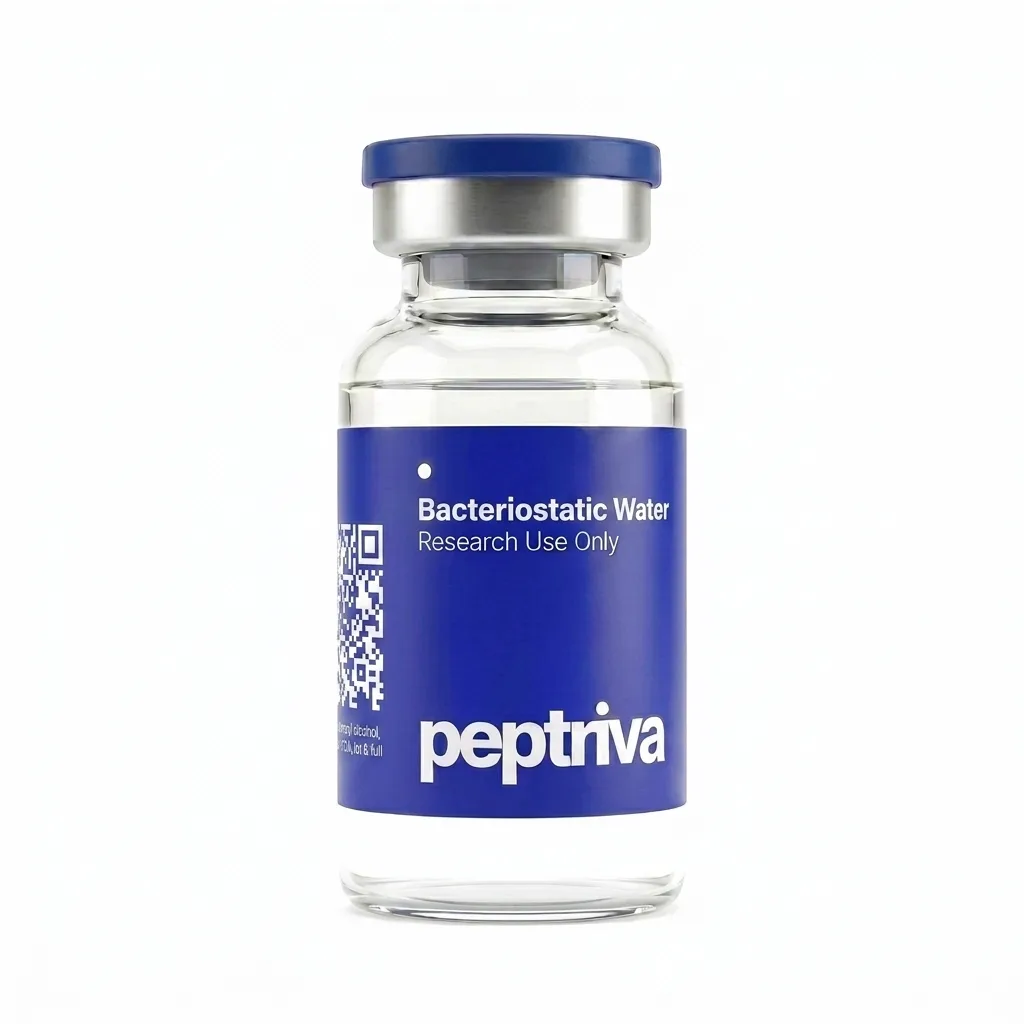
Bacteriostatic Water
The standard 0.9% benzyl alcohol diluent for reconstituting lyophilized peptide vials. The same reference preparation used across the protocols in this guide.
What does the reconstitution procedure look like?
The following covers the mechanical procedure for reconstituting a lyophilized research-peptide vial. Target concentration is determined by the specific compound and research protocol in use.
Required materials: the lyophilized peptide vial, a vial of BWFI (or the chosen diluent), a sterile syringe sized for the transfer volume, alcohol swabs, and refrigerated storage. Maintaining sterile technique throughout each step is the single most important variable in extending vial integrity.
- Bring cold vials to room temperature. Cold vials draw condensation, which can complicate the transfer. Inspect both vials for damage, particulates, or discoloration before proceeding.
- Swab both septa with 70% isopropyl alcohol and allow to dry. The septum is the primary contamination-entry point. Each penetration should be preceded by an alcohol wipe and a full dry time.
- Draw the diluent from the BWFI vial into the sterile syringe at the volume specified by the research protocol.
- Inject the diluent down the inside wall of the peptide vial, not directly onto the powder cake. Forceful direct delivery foams the solution and can denature the peptide. Wall-directed injection minimizes shear stress on the lyophilized material.
- Swirl gently. Roll the vial between the palms; do not shake. Most peptides dissolve within 30 seconds to a few minutes at room temperature.
- Check for clarity. A properly reconstituted solution is clear with no visible particulates. Cloudiness, floating material, or persistent foam indicates incomplete dissolution, an incompatible diluent, or a stability problem in the starting material.
- Label the vial with the reconstitution date and final concentration. The 28-day in-use clock begins at the moment of reconstitution, not the date the BWFI vial was first opened.
- Store at 2–8°C between aliquots. Most lyophilized peptides tolerate a single freeze-thaw cycle if necessary. Repeated freeze-thaw cycles degrade structural integrity of complex peptides.
Two laboratory-practice notes. First, peptides are biologically active research compounds. Syringes and needles should not be reused across different peptides without appropriate cleaning or replacement; cross-contamination between research compounds is a documented risk in shared-vial workflows. Second, the lyophilized cake should appear intact, dry, and uniformly colored before reconstitution. A collapsed, partially melted, or discolored cake indicates prior heat or moisture exposure — the vial should be discarded rather than reconstituted.
Does benzyl alcohol damage peptides?
For most research peptides, no. The 0.9% concentration in BWFI is chemically compatible with the vast majority of compounds you'll work with, and you'll see no measurable degradation over the 28-day window.
The exceptions are specific. Certain interferons, some growth-factor proteins, and a handful of larger protein therapeutics react with benzyl alcohol. The mechanism is either direct chemistry (benzyl alcohol interacting with reactive amino-acid side chains) or membrane-effect denaturation in structurally complex proteins. The small, simple peptides that dominate research catalogs aren't affected by this. The larger biologics are.
One safety signal is worth knowing about even though it's outside the research-peptide use case. Benzyl alcohol has caused toxicity in premature infants — the "gasping syndrome" — at high cumulative exposures. BWFI is contraindicated in neonates and infants. This is population-specific, not a general red flag, but it's the one well-documented adverse event linked to BWFI.
What's the typical vial size and storage?
The standard pharmaceutical preparation is a 30 mL multi-dose vial of BWFI, USP. That size handles multiple peptide reconstitutions over a working period. 10 mL and 50 mL preparations exist for niche cases.
Unopened BWFI vials are stable at room temperature for years; refrigeration is not required before initial puncture. After the septum is first punctured, the same 28-day convention applies and the vial is stored at 2–8°C between uses. A visual inspection before each reconstitution — looking for clarity, absence of particulates, and colorlessness — is standard practice. The preservative reduces contamination risk substantially, but visual inspection remains a low-cost verification step.
Bacteriostatic Water
USP-grade bacteriostatic water for injection · 10 mL multi-dose vial. The standard diluent for reconstituting lyophilized peptide vials over a 28-day in-use window.
Where this falls short: The 28-day window is a pharmaceutical baseline, not a peptide-specific stability claim. Specific compounds may degrade faster (heat-sensitive peptides, certain glycoproteins) or last longer with proper handling. Manufacturer stability data overrides the general rule. BWFI does not address compound identity or purity — those are verified through COA and lot-level testing, which is a separate quality chain. The preservative protects against microbial growth; it does not compensate for poor starting material.
Key diluent questions for research protocol design
When specifying a reconstitution protocol for a lyophilized peptide, the following diluent-related questions are relevant to the research design:
- Are there documented benzyl alcohol incompatibilities for this specific peptide? Most research peptides are compatible with BWFI, but incompatibilities have been reported for certain larger proteins and growth factors.
- What reconstitution volume achieves the target working concentration? This is peptide-specific and depends on the mass per vial specified in the COA.
- What is the actual in-use stability window for this compound? The 28-day USP rule is a microbial-contamination baseline. Peptide-specific chemical stability data from the manufacturer may mandate a shorter working window.
- What sterile-technique requirements apply to the workspace? Septum swabbing discipline, single-use needle policy, and refrigerated storage between aliquots all determine the effective sterility window in practice.
- What are the discard criteria? Standard discard indicators include cloudiness, visible particulates, discoloration, persistent foam, or any unexpected odor — all indicate contamination, aggregation, or degradation.
What to know now
- BWFI: sterile water + 0.9% benzyl alcohol. The default diluent for multi-dose vials.
- In-use window: 28 days at 2–8°C after reconstitution. USP standard.
- SWFI: no preservative, single-use only. Use when documented benzyl alcohol incompatibility exists.
- Saline (0.9% NaCl): specialized; compatibility varies by peptide class. Not a universal substitute.
- Technique: swab the septum, inject slowly down the inside wall, swirl gently (don't shake), inspect for clarity.
- Storage: 2–8°C between uses. Let it warm to room temp before each draw.
- Discard if: cloudy, particulates, discoloration, persistent foam, or any sign of contamination.
- Neonatal caution: benzyl alcohol is contraindicated in neonates and infants. Not relevant to adult research, but worth knowing.
What we're watching
Two things. First, the pharma shift toward single-dose prefilled syringes for specialty injectables. They sidestep the benzyl alcohol compatibility and population-restriction issues at the cost of per-aliquot disposables. Second, peptide-specific stability data from manufacturers. The 28-day rule is a microbial-contamination baseline; individual compounds may require shorter windows based on chemical stability, and manufacturer-supplied stability data should govern actual storage protocol decisions.
References
- United States Pharmacopeia. Bacteriostatic Water for Injection, USP. Monograph in current USP-NF. https://www.usp.org/usp-nf
- American Society of Health-System Pharmacists (ASHP). Handbook on Injectable Drugs: Benzyl alcohol preservative compatibility and stability data. https://www.ashp.org/products-and-services/database-tools/handbook-on-injectable-drugs
- Trissel, L. A. Handbook on Injectable Drugs (current edition). Bethesda, MD: ASHP. https://www.ashp.org/products-and-services/database-tools/handbook-on-injectable-drugs