No peptide in our library has a bigger gap between marketing and evidence than DSIP. It's a 9-amino-acid sequence isolated almost 50 years ago. Sellers still call it a sleep peptide. The published research has quietly walked away from that claim.
DSIP is a 9-amino-acid peptide (sequence: Trp-Ala-Gly-Gly-Asp-Ala-Ser-Gly-Glu). It was isolated in 1977 from rabbit brain blood collected during electrically-induced sleep. Despite the name, nearly 50 years of research have not found a DSIP receptor, confirmed a role in human sleep, or produced a single Western randomized trial. The most rigorous recent work is on stroke and heart-attack injury protection. And it carries a striking safety signal: when DSIP was given during the stroke instead of after, pilot studies saw 100% animal mortality.
DSIP's story is one of the longest unresolved questions in sleep neuroscience. In 1977, two Swiss researchers (Schoenenberger and Monnier) drew blood from rabbits whose brains had been electrically pushed into deep sleep. They isolated a peptide they thought triggered the sleep. They called it the "delta sleep-inducing peptide." Their hypothesis: this was the body's missing sleep signal.
Fifty years later, we're still calling it a hypothesis. No DSIP receptor has been identified. No clear role in mammalian sleep has been proven. The molecule does cross the blood-brain barrier, but poorly. It does have measurable effects in some lab tests. But the original claim — that DSIP is the body's natural sleep signal — has never been confirmed.
And yet we keep seeing DSIP marketed as a sleep peptide. The marketing leans on the 1977 paper and the name. The Western randomized-trial evidence base, as of 2026, is empty.
What is DSIP, structurally?
DSIP is a 9-amino-acid peptide. The sequence is Trp-Ala-Gly-Gly-Asp-Ala-Ser-Gly-Glu (WAGGDASGE). It has no chemical modifications, no cyclic structure, and no unusual amino acids. It dissolves easily in water. By peptide-pharmacology standards, the molecule is unremarkable.
The most important structural fact, from a pharmacology standpoint, is that DSIP crosses the blood-brain barrier poorly. Researchers have known this for decades. That limitation is central to interpreting any proposed CNS activity. Recent Russian and Chinese work uses engineered fusion peptides designed to address the barrier issue. That design choice is itself an acknowledgment: plain DSIP does not reach the brain at sufficient concentrations.
The original 1977 isolation came from dialyzing rabbit brain blood. The active fraction was a 75 ng/mL peptide that, when injected into other rabbits, increased deep (delta) sleep. The method was novel for 1977. The finding was striking. But replication has been spotty, and the field has spent five decades unable to find what receptor DSIP binds.
What does the modern research actually study?
We read the 2020 to 2025 DSIP literature, and one thing stands out. The most rigorous work isn't on sleep. It's on protecting brains and hearts from stroke and heart-attack damage. The Shemyakin-Ovchinnikov Institute in Moscow has the most active program, and its focus has shifted decisively to injury protection.
Tukhovskaya and colleagues published a 2021 study showing that intranasal DSIP, plus a tweaked analog called KND peptide, reduced stroke and heart-attack damage in rodents when given during reperfusion (the moment blood flow returns to a damaged tissue). The KND analog worked better than plain DSIP on some endpoints, suggesting that fixing the blood-brain barrier problem does improve the signal (Tukhovskaya et al., 2021).
The most important safety finding in the modern DSIP literature is buried in that paper's methods section. In pilot work before the main experiments, the team gave the peptide during the stroke itself instead of after. Every animal died. 100% mortality. That's not a footnote. That's a warning about timing.
Administering the studied peptides during ischemic occlusion resulted in 100% mortality in pilot experiments, indicating that timing of administration relative to reperfusion is critical and that off-window dosing may be actively deleterious.
— Tukhovskaya et al., Biomedicines, 2021
This timing-dependent toxicity signal is notable given DSIP's widespread grey-market use. FDA-approved sleep medications have characterized dose ranges, known adverse-event profiles, and documented worst-case data from clinical trials. The 100% mortality finding from off-window preclinical dosing is not routinely cited in grey-market product descriptions of DSIP.
A separate Tukhovskaya paper from 2021 reported that intranasal DSIP at 120 mcg/kg for 7 days after stroke improved rats' motor coordination on a rotarod test (Tukhovskaya et al., 2021). It didn't reduce the size of the stroke damage itself. That's the closest modern Russian work has come to a clear "neuroprotective" finding, and even here the effect is on function, not tissue.
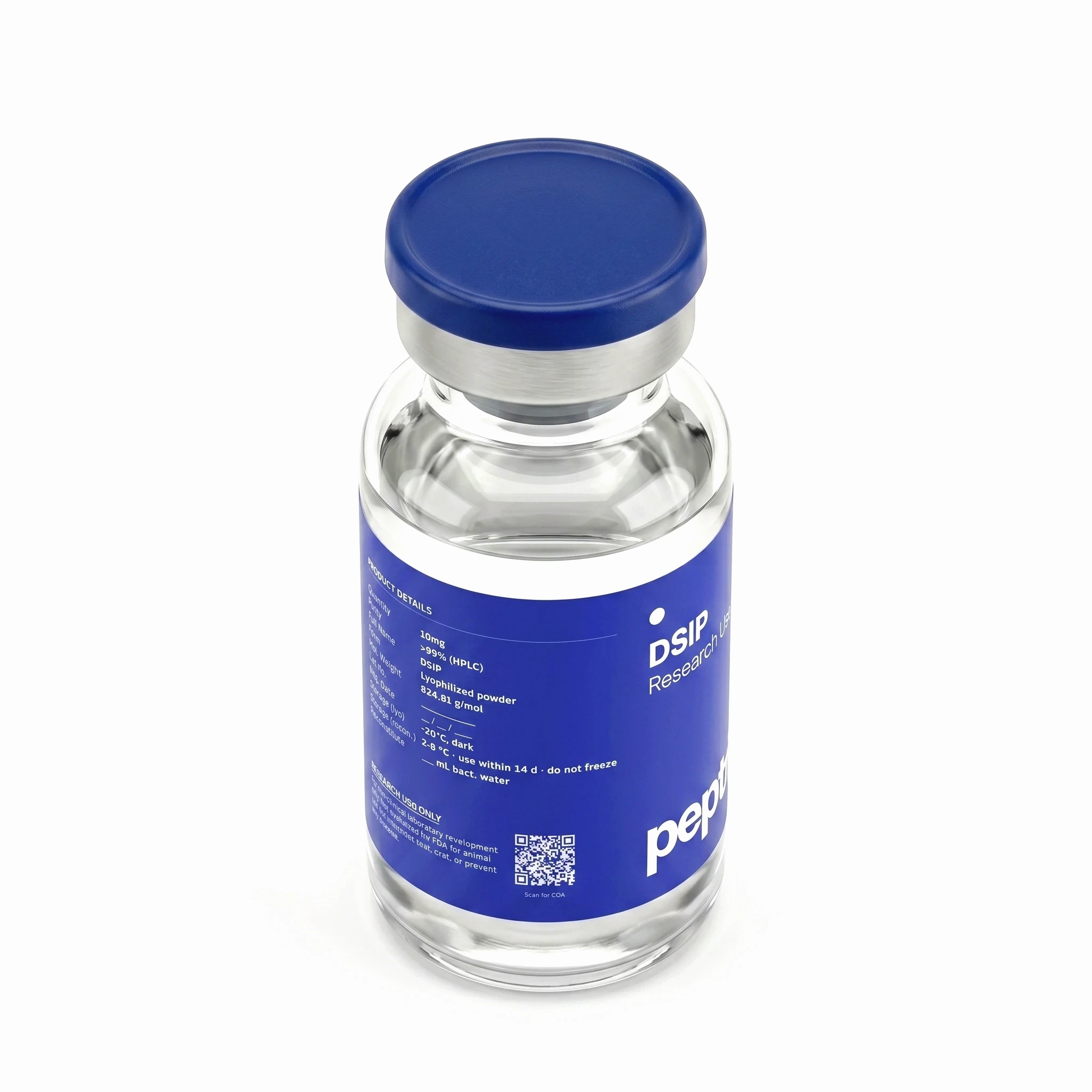
DSIP
The same compound cited across the modern preclinical studies in this review. Lab-verified identity and purity.
What does the recent sleep work show?
The closest recent study to DSIP's original purpose is a 2024 paper from Mu and colleagues in Frontiers in Pharmacology (Mu et al., 2024). They used a fusion peptide that combined DSIP with a "crossing-blood-brain-barrier peptide" tag. They tested it in a mouse insomnia model induced by PCPA (a drug that depletes serotonin and disrupts sleep).
The fusion peptide nudged 4 neurotransmitters (serotonin, glutamate, dopamine, melatonin) back toward normal in the insomnia model. The authors said it had a "better restorative effect than DSIP" on neurotransmitter balance. Two things stand out about this study. One: it's a serious modern attempt to test a DSIP-based intervention in a sleep-relevant model. Two: the authors openly acknowledged that plain DSIP works less well than the brain-barrier-engineered version. That matches our long-standing concern that plain DSIP just doesn't reach the brain in useful amounts.
The methodological implication is significant. The closest recent sleep-relevant study validates a different molecule — a fusion peptide. Plain DSIP is the version the same paper identifies as performing worse on neurotransmitter endpoints. The mechanistic case for plain DSIP as a sleep-relevant research compound therefore rests substantially on the 1977 foundational paper.
Why has the mechanism never been pinned down?
This is the unresolved question of the entire DSIP literature. Researchers have tried many angles over the decades. None has produced a definitive DSIP receptor or a validated mechanism for sleep induction.
Candidate mechanisms in the recent literature include effects on 4+ neurotransmitter systems (serotonin, glutamate, dopamine, melatonin per the 2024 Mu paper), possible stress-axis effects, antioxidant activity, and broad neuroprotection in stroke models. None is a single mechanism that explains the sleep effect from 1977.
The current assessment: DSIP appears to be a biologically active peptide with several small, scattered effects across neurotransmitter systems. None of the identified effects adds up to "sleep induction" in the way the 1977 model proposed. The molecule is real and measurably active in some assays — but whether those activities account for the original sleep-induction observation remains an open question after 50 years of study.
Where this falls short. Nearly 50 years after DSIP's discovery, zero specific receptors have been identified. No clear demonstration of a role in human sleep architecture has been published. The modern research focus has moved toward stroke and cardiac reperfusion injury rather than sleep. The closest recent sleep-relevant study used an engineered fusion variant rather than plain DSIP. The gap between the molecule's common characterization and its actual evidence base remains unresolved.
What human evidence exists?
Almost none, in any indication. Despite DSIP's 50-year history, there's zero contemporary randomized controlled trials documenting that exogenous DSIP works in humans for sleep, stress, or anything else.
That's unusual. Most research peptides with multi-decade histories have at least one small pilot human study on PubMed, even if it's flawed. DSIP doesn't. Russian-language clinical work on DSIP exists in the historical record, but it isn't Western-RCT-grade, isn't PubMed-indexed in the modern sense, and predates current methodology standards for sleep trials.
The claims we keep seeing in marketing copy ("natural sleep peptide," "promotes deep sleep," "supports recovery," "modulates stress") rest on the 1977 paper, a thin layer of Russian preclinical work that has shifted focus away from sleep, and zero modern human RCT evidence.
What about safety?
Modern human safety data for DSIP is essentially absent. The Russian preclinical work flagged the timing-dependent toxicity signal (the 100% animal death rate with mistimed stroke-model dosing). That's concerning given the predominant grey-market use case is indiscriminate evening dosing in healthy people.
Other safety considerations remain theoretical and untested. DSIP's effects on neurotransmitter systems raise plausible interaction concerns with antidepressants, antipsychotics, opioids, and sedatives. Modulation of the HPA stress axis raises theoretical considerations in the context of corticosteroid co-administration. None of these interactions has been formally characterized in published clinical data.
Long-term safety of repeated DSIP administration remains entirely unstudied — not because the signal is reassuring, but because no longitudinal trials have been conducted. Modern clinical safety data for chronic administration does not exist in the published literature.
What's the regulatory status?
DSIP is not approved by the FDA, the EMA, or any other major Western regulator for any condition. It has a Russian preclinical history but no broadly recognized therapeutic approval in Russia either. (Selank and Semax, by contrast, do have approved Russian indications.) DSIP is not explicitly named on the WADA Prohibited List, though competitive athletes should verify its status with their governing body. The compound is sold in the US grey market as a research peptide.
DSIP
Nonapeptide · 9 aa, endogenous sequence. The same reference compound used across the cited preclinical studies. COA available with each lot.
Evaluating DSIP against the current evidence base
Held against contemporary evidence standards, the case for plain DSIP as a sleep intervention remains essentially unsupported. The foundational sleep-induction claim is still unconfirmed after 50 years of study. Modern research programs have shifted focus away from sleep and toward stroke and cardiac reperfusion injury. A documented timing-dependent safety signal exists in the preclinical literature. No Western RCTs have been conducted in any indication. The molecule's poor blood-brain barrier penetration is acknowledged in recent publications that have moved to engineered fusion variants to address it.
For researchers situating DSIP within the broader sleep-intervention landscape, established pharmacological and behavioral approaches (CBT-I for chronic insomnia, validated melatonin formulations, characterized hypnotics) each carry substantially more human trial evidence than DSIP across any indication studied to date.
Key open questions in the literature include the following.
- Adequacy of the 1977 foundational study. The Schoenenberger and Monnier isolation represents the evidentiary foundation. The methodological standards of 1977 differ substantially from current RCT requirements for sleep endpoints.
- Timing-dependent toxicity in preclinical models. The 100% animal mortality observed with mistimed stroke-model administration (Tukhovskaya et al., 2021) represents the most consequential safety signal in the modern literature.
- Blood-brain barrier penetration of plain DSIP. Recent research programs have shifted to engineered fusion variants precisely because plain DSIP does not cross the barrier with sufficient efficiency — a point acknowledged in the primary literature.
- Absence of human pharmacokinetic data. No contemporary PK/PD studies for plain DSIP in human research subjects have been published in PubMed-indexed journals.
What to know now
- What it is: a 9-amino-acid peptide (Trp-Ala-Gly-Gly-Asp-Ala-Ser-Gly-Glu) isolated in 1977 from rabbit brain blood.
- Regulatory status: not approved anywhere, sold in the US as a research peptide.
- Mechanism: no receptor identified after 50 years; sleep claim still unconfirmed.
- Modern research focus: shifted to stroke and heart-attack injury protection, not sleep.
- Safety signal: 100% animal mortality when dosed during stroke onset instead of after.
- Brain barrier issue: plain DSIP crosses poorly; recent sleep work uses engineered fusion versions.
- Western RCT evidence: zero randomized trials in any indication, 2020 to 2026.
- Honest framing: real molecule with real preclinical history, but the sleep claim has not been substantiated.
What we're watching
Three signals to track over the next 24 months. First: whether any team identifies a DSIP receptor. The mechanistic case has been waiting on this for five decades, and modern receptor-finding techniques are far better than in 1977. Second: whether the fusion-peptide approach produces real human sleep data. That would tell us if the DSIP sequence has potential when delivery is fixed. Third: whether the stroke and heart-attack work matures into a registered clinical trial. That's currently the most active modern DSIP direction, and a real Phase I would be the field's most consequential new data point.
References
- Tukhovskaya, E. A., Shaykhutdinova, E. R., Ismailova, A. M., et al. (2021). DSIP-like KND peptide reduces brain infarction in C57Bl/6 and reduces myocardial infarction in SD rats when administered during reperfusion. Biomedicines, 9(4), 407. https://doi.org/10.3390/biomedicines9040407
- Tukhovskaya, E. A., Ismailova, A. M., Shaykhutdinova, E. R., et al. (2021). Delta sleep-inducing peptide recovers motor function in SD rats after focal stroke. Molecules, 26(17), 5173. https://doi.org/10.3390/molecules26175173
- Mu, X., Qu, L., Yin, L., Wang, L., Liu, X., & Liu, D. (2024). Pichia pastoris secreted peptides crossing the blood-brain barrier and DSIP fusion peptide efficacy in PCPA-induced insomnia mouse models. Frontiers in Pharmacology, 15, 1439536. https://doi.org/10.3389/fphar.2024.1439536