Selank sits in an unusual spot. It's been an approved Russian anxiety drug since 2009. The Western literature still treats it as a research compound with almost no large-scale clinical trial data.
Selank is a synthetic tuftsin analog, a 7-amino-acid peptide developed at Moscow's Zakusov Institute. It's approved in Russia since 2009 as a nasal-spray anxiety drug. The strongest Western human study is a 2020 fMRI trial in 52 healthy adults, showing measurable changes in the brain region that processes fear (the right amygdala) within 20 minutes of dosing. Animal studies document anxiety reduction without sedation, plus changes to stress-related immune signals and the gut. The big caveat: zero PubMed-indexed Western randomized trials. Russian approval rests on Russian-language studies that aren't visible to Western readers.
Among Russian-developed peptides, Selank and its sibling Semax sit in a unique category. They aren't grey-market chemicals invented in a lab notebook in 2010. They're pharmaceuticals with decades of Russian clinical use, an active research program at named Russian institutes, and consistent preclinical work that's been published (often in Russian-language journals) for over 20 years.
They also haven't crossed the Western regulatory wall. The Russian framework is different from the FDA's. And no Western drug company has funded the kind of Phase III trial that would turn Russian clinical experience into a US or EU approval.
The result is a peptide in a strange middle ground: more evidence than a typical research compound, less evidence than a Western-approved drug, with a real but contested place in global anxiety treatment. We pulled 4 peer-reviewed Western studies for this guide, and here's what we found.
What is Selank, structurally?
Selank is a 7-residue peptide. The sequence is Thr-Lys-Pro-Arg-Pro-Gly-Pro. The first 4 residues are tuftsin, a natural immune-signaling tetrapeptide. Tuftsin gets made when an enzyme clips a piece off an antibody (immunoglobulin G) inside the spleen. It was first identified at Tufts University in the 1970s, which is where the name comes from.
Native tuftsin signals immune cells (macrophages, neutrophils) to increase phagocytic activity against pathogens. Selank takes that tuftsin core and adds a 3-residue Pro-Gly-Pro tail. The tail confers resistance to enzymatic degradation, extending the molecule's half-life sufficiently for CNS activity to be measurable.
That history matters. Selank isn't a "pure anxiety drug" the way a benzodiazepine is. It inherits an immune-modulating gene from its tuftsin parent. We read modern Russian research as treating it as a neuro-immune modulator, not a clean GABA drug. The cytokine data below is the strongest support for that framing.
The Selank development team (N.F. Myasoedov and L.A. Andreeva at the Institute of Molecular Genetics in Moscow) has been the central voice across nearly all of the published Russian literature. That tight authorship pattern is what makes Selank harder for us to evaluate from the outside. The internal data is consistent. But independent labs outside Russia have published comparatively little.
What does the 2020 fMRI study show?
The most rigorous Western human study of Selank is the 2020 functional connectivity paper by Panikratova and colleagues, published in Doklady Biological Sciences. We dug into the methods and numbers.
The setup: 52 healthy adults in a placebo-controlled three-way design. Selank vs Semax vs placebo. Resting-state brain scans were taken before dosing, 5 minutes after, and 20 minutes after intranasal administration.
The main finding was a statistically significant change in the connection between the right amygdala (the brain's fear-and-threat region) and several right temporal cortical regions. Those regions process emotion, memory, and face recognition — precisely the network a candidate anxiolytic would be hypothesized to engage.
Selank produced detectable modulation of right amygdala connectivity with right temporal cortical regions within 20 minutes of intranasal administration in healthy adults — providing biological-imaging evidence that the compound has measurable CNS effects within this short administration timeframe.
— Panikratova et al., Doklady Biological Sciences, 2020
This is real evidence and we think it's worth foregrounding. A brain-imaging finding in healthy volunteers isn't the same as proven anxiety-reduction in patients. But it establishes that the drug does something biologically detectable in the brain at a meaningful dose. That's more than most grey-market peptides can claim.
The limits are real too, and we want to be honest about them. Sample size was small at 52 participants. The imaging window was narrow (pre, 5 min, 20 min). The outcome was a biomarker, not a clinical anxiety measure. The design didn't test sustained efficacy. It's a single well-executed data point that documents engagement. It's not a substitute for the Phase III trial we'd want to see before recommending it broadly.
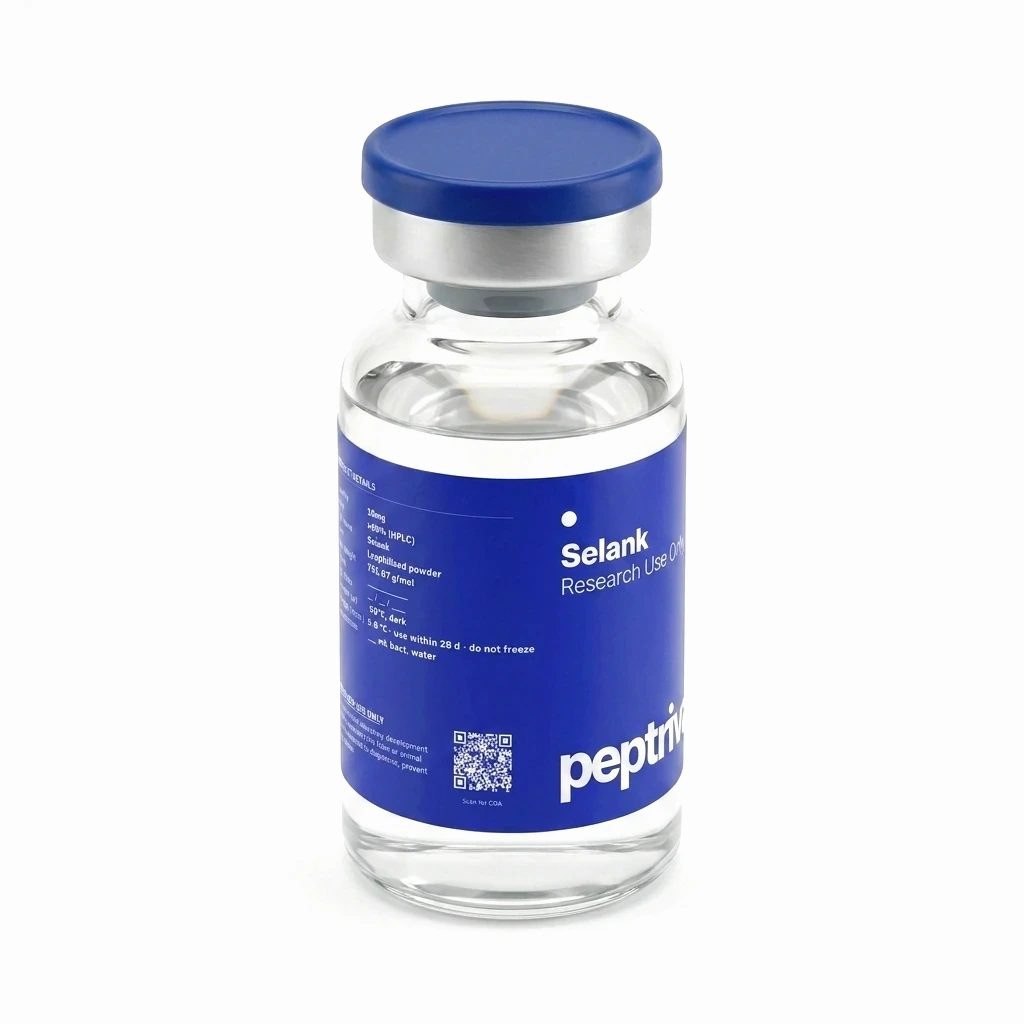
Selank
The same compound cited across the 4 studies in this review. Lab-verified identity and purity.
What does the animal research show?
The most direct animal evidence for an anti-anxiety effect comes from morphine-withdrawal experiments. Rats going through opioid withdrawal display measurable anxiety behaviors: tactile sensitivity, drooping eyelids (ptosis), abnormal posture, convulsions. Konstantinopolsky and colleagues reported in 2022 that a single dose of Selank at 0.3 mg/kg reduced the total withdrawal score by 39.6%. It eased convulsions, ptosis, and posture problems. It raised the tactile sensitivity threshold 9-fold.
The reference drug in that experiment was diazepam (a benzodiazepine) at 2 mg/kg. Diazepam was slightly more potent than Selank at the doses tested.
The diazepam comparison is the most informative number in the dataset. A benzodiazepine at a clinically meaningful rodent dose was somewhat stronger than Selank. But Selank produced a substantial anxiolytic effect without the sedation, motor impairment, or dependence that characterize benzodiazepine pharmacology. Taking the animal data at face value, Selank's preclinical profile positions it in the efficacy range of benzodiazepines on the anxiety axis, with a notably cleaner tolerability signal in the rodent model.
Where this falls short. Rodent anxiety models are notoriously poor predictors of human anxiety drug response. Many compounds that look great in elevated-maze tests fail Phase II in actual patients. The Selank signal is real in rats. The leap to "it'll work in humans with anxiety" is conditional on Western RCTs that haven't been run.
Is the immune-modulation real?
The cytokine data is the most distinctive piece of the Selank evidence base. Cytokines are messenger proteins the immune system uses to coordinate inflammatory responses. Chronic stress elevates multiple pro-inflammatory cytokines, and elevated inflammatory tone is a recognized correlate of treatment-resistant anxiety and depression in the research literature.
Yasenyavskaya and colleagues published a 2021 study in Current Reviews in Clinical and Experimental Pharmacology using a "social stress" rat model. Rats received Selank at 100 mcg/kg/day for 20 days while being exposed to chronic social conflict.
The result: Selank reduced stress-driven elevations in four pro-inflammatory cytokines (IL-1β, IL-6, TNF-α, and TGF-β1). It also restored IL-4, an anti-inflammatory signal that chronic stress had suppressed. The pattern fits a tuftsin-derived molecule with retained immune activity. It's not a blunt anti-inflammatory. It's a context-dependent normalizer of stress-driven immune dysregulation.
The Selank cytokine signal in one block: in a chronic social-stress rat model, Selank at 100 mcg/kg/day for 20 days reduced stress-induced elevations in IL-1β, IL-6, TNF-α, and TGF-β1, and restored suppressed IL-4. This is the strongest mechanistic argument for treating Selank as a neuro-immune drug rather than a "pure" anxiolytic.
Inflammation-associated mood disorders are one of the more replicated findings in modern psychiatric research. If Selank really does normalize stress-driven cytokines, its mechanism may be more relevant to inflammation-flavored anxiety than to classical neurotransmitter-based GAD. That's a hypothesis the literature hasn't yet stress-tested in a proper clinical trial.
What about stress effects on the rest of the body?
Beyond the cytokine work, Selank shows stress-protective effects on the HPA axis (the brain-adrenal stress circuit) and on gut tissue. Mukhina and colleagues reported in 2020 that Selank at 80, 250, or 750 mcg/kg in Wistar rats lowered stress-driven cortisol elevations, reduced damage to the colon wall in restraint-stress models, and helped rats adapt faster to repeated stress exposure.
The gut findings are relevant to the broader research interest in stress-driven GI conditions such as IBS, functional dyspepsia, and stress-triggered colitis flares. The cortisol attenuation effect is consistent with the profile expected of a neuro-immune modulator with both anxiolytic and cytokine-normalizing properties. None of these findings constitute pivotal trial data, but they extend the preclinical picture coherently: Selank appears to dampen stress responses across multiple organ systems, not solely at the behavioral level.
Why isn't there a Western RCT?
This is the question that determines how a careful Western reader should weigh Selank. The honest answer comes down to four factors.
First, Russian regulatory standards differ from Western ones. Russian approval can rest on smaller open-label or single-blind studies, often published only in Russian-language journals. Those studies wouldn't meet FDA or EMA standards. That isn't the same as saying the drug doesn't work. It's a statement about how high the evidentiary bar sits.
Second, no Western drug company has invested in a Phase III. The intellectual property is held by Russian institutions. The molecule has been off-patent for over 15 years in the structural sense. There's no commercial path for a Western pharma company to recoup a $100–200M trial investment.
Third, the global anxiety market is already crowded. SSRIs, SNRIs, and benzodiazepines are all generic, well-evidenced, and cheap. A new anxiety drug has a high bar to clear, and Phase III failure rates in CNS development run ~50%.
Fourth, Western RCT infrastructure hasn't been deployed for Russian-market drugs. There are exceptions (some Russian-developed cancer drugs have crossed over), but they're rare.
The result is a molecule that's both more and less validated than its market position suggests. More, because it has a real Russian approval for a real indication and a coherent preclinical record. Less, because no Western Phase III exists for any indication, and the safety data isn't documented granularly in PubMed.
Selank
Tuftsin analog · 7 aa, N-acetylated. The same reference compound used across the cited preclinical studies. COA available with each lot.
How does Selank compare to benzodiazepines?
The comparison most often drawn in Russian clinical literature is to medazepam, a Russian-tradition benzodiazepine. The Russian clinical data (which underpins regulatory approval but isn't PubMed-indexed) describes Selank as producing anxiety reduction comparable to medazepam, without the sedation, motor impairment, or withdrawal that defines benzodiazepine therapy. The 2022 morphine-withdrawal rodent study using diazepam as comparator is the closest English-language analog.
The conceptual framing (benzodiazepine-class anxiolytic effect without the sedation and dependence liabilities) is the claim most frequently advanced in the Russian clinical literature. It is biologically plausible given Selank's mechanism — allosteric GABA-system modulation combined with serotonergic and immune-modulatory activity — but has not been confirmed by Western head-to-head trial data. The field's current consensus treats this as a hypothesis supported by Russian clinical experience, not a conclusion established by Western randomized trial methodology.
What's the side-effect profile?
Russian clinical experience describes Selank as well-tolerated at the approved nasal-spray dose in short-course anxiety studies. The most commonly reported adverse event in that literature is mild nasal irritation from the spray formulation. No major drug interactions, withdrawal syndrome, abuse potential, or meaningful sedation has been documented in the published Russian clinical record at approved doses.
Important caveats apply. First, Russian approval covers short-course use (typically days to weeks); long-term safety is essentially unstudied in any rigorous prospective design. Second, drug–drug interactions with alcohol, benzodiazepines, or other GABA-active agents are theoretically plausible but clinically undercharacterized. Third, research use of lyophilized powder formulations is conducted under different conditions than the approved nasal-spray pharmaceutical; the safety data from Russian clinical trials does not automatically extend to other formulations. Fourth, reference compound quality varies across suppliers; lot-specific COA and identity verification are standard practice in research settings.
What's the regulatory status?
Selank is approved in Russia (since 2009) as a nasal-spray formulation for generalized anxiety disorder. It is not approved by the FDA, EMA, or any other major Western agency. It isn't explicitly on the WADA Prohibited List. It isn't explicitly banned by any major sports league. But absence from a list isn't the same as permission. Competitive athletes should verify with their governing body directly. There are no FDA enforcement actions specific to Selank, but it's sold in the US grey market as a "research peptide" with the standard caveats around products not approved for human use.
How does the evidence base situate Selank relative to current anxiety pharmacology?
In the Western clinical literature, generalized anxiety disorder is primarily managed with CBT (the strongest RCT evidence base), SSRIs and SNRIs (moderate effect sizes, well-characterized tolerability profiles), buspirone, and short-course benzodiazepines. Selank occupies a structurally distinct niche — a neuro-immune modulator rather than a GABA full-agonist or a reuptake inhibitor — but lacks the Western Phase III data that would permit direct head-to-head positioning against these agents.
Research questions that remain open for the field include:
- Translational validity of the 2020 fMRI finding. The Panikratova et al. amygdala connectivity result documents CNS engagement in healthy volunteers; whether that biomarker change predicts symptom reduction in a GAD population remains unstudied in Western cohorts.
- Russian clinical experience versus Western Phase III standards. The evidence gap between Russian regulatory approval and PubMed-indexed randomized trial data is the central unresolved question in the Selank literature.
- Reference standard and supply-chain purity. Russian pharmaceutical-grade Selank nasal spray and research-grade lyophilized powder are not manufactured under identical conditions; published safety data derives from the former.
- Duration-of-use safety. Russian approval covers short-course use. Long-term administration has not been studied in rigorous prospective trials.
- Drug–drug interaction characterization. Interactions with GABA-active compounds, antidepressants, and other neuro-active agents remain clinically underexplored.
What to know now
- Identity: 7-amino-acid tuftsin analog (Thr-Lys-Pro-Arg-Pro-Gly-Pro). Developed at the V.V. Zakusov Research Institute in Moscow.
- Regulatory status: approved in Russia (2009) for generalized anxiety disorder. Not FDA- or EMA-approved.
- Best Western human study: 2020 placebo-controlled fMRI study in 52 healthy adults. Right amygdala connectivity modulation within 20 minutes of dosing.
- Animal anxiety data: 0.3 mg/kg single dose reduced rat morphine-withdrawal index by 39.6%. Slightly less potent than diazepam 2 mg/kg.
- Cytokine modulation: 100 mcg/kg/day for 20 days reduced stress-induced elevations in IL-1β, IL-6, TNF-α, TGF-β1 and restored IL-4.
- Mechanism inference: neuro-immune modulator combining GABA, serotonin, dopamine, and tuftsin-derived immune activity.
- Western RCT gap: zero PubMed-indexed randomized clinical trials in any indication.
- Safety: well-tolerated in Russian clinical short-course use. Long-term and chronic use unstudied. Grey-market product quality varies.
What we're watching
Three things to track over the next 18 months. First, whether any Western academic group brings Selank into a registered Phase II trial. The most plausible setting is inflammation-associated anxiety or a stress-cytokine-overlap population. Second, whether the cytokine work expands beyond rodent restraint-stress models into chronic-disease contexts. Third, whether the global anxiety drug pipeline shifts toward neuro-immune mechanisms in a way that pulls Selank into broader research interest. The field is already moving in that direction, and Selank's tuftsin pedigree fits that thinking unusually well.
References
- Panikratova, Y. R., Lebedeva, I. S., Sokolov, O. Y., et al. (2020). Functional connectomic approach to studying Selank and Semax effects. Doklady Biological Sciences, 490(1), 9–11. https://doi.org/10.1134/S001249662001007X
- Konstantinopolsky, M. A., Chernyakova, I. V., & Kolik, L. G. (2022). Selank, a peptide analog of tuftsin, attenuates aversive signs of morphine withdrawal in rats. Bulletin of Experimental Biology and Medicine, 173(6), 730–733. https://doi.org/10.1007/s10517-022-05624-x
- Yasenyavskaya, A. L., Samotrueva, M. A., Tsibizova, A. A., et al. (2021). The influence of Selank on the level of cytokines under the conditions of "social" stress. Current Reviews in Clinical and Experimental Pharmacology, 16(2), 162–167. https://doi.org/10.2174/1574884715666200704152810
- Mukhina, A. Y., Mishina, E. S., Bobyntsev, I. I., et al. (2020). Morphological changes in the large intestine of rats subjected to chronic restraint stress and treated with Selank. Bulletin of Experimental Biology and Medicine, 169(2), 281–285. https://doi.org/10.1007/s10517-020-04868-9