Here’s the headline ratio on Epithalon’s Russian trials. Roughly 12 mortality-reduction studies from one Russian institute. Zero Western RCT replications. The consumer marketing leans on the first number. We think the evidence conversation has to start with the second.
Epithalon (also called Epitalon, sequence Ala-Glu-Asp-Gly or AEDG) is a 4-amino-acid synthetic peptide. Vladimir Khavinson’s group at the Saint Petersburg Institute of Bioregulation and Gerontology developed it in the 1980s. The trials you’ll see cited most often ran from 1990 through 2010, almost entirely from one institute, almost entirely in Russian-language journals, and Western groups haven’t replicated them. The most recent Western paper (Al-Dulaimi 2025, Brunel University London) confirmed telomerase upregulation in normal cells. It also flagged a cancer-cell concern the Russian work didn’t address.
Most grey-market peptides you’ll see have evidence problems in one direction. Weak human trials, or limited mechanism work, or single-lab authorship. Epithalon is unusual: the evidence problems stack along all three axes at once.
The vast majority of published work comes from one research consortium. The human trials are mostly Russian-language, mostly open-label, mostly small. The mechanism work has been replicated in cell culture, but it hasn’t been confirmed in humans through validated telomere-length protocols.
That triple concentration is why Epithalon claims feel substantial when you read them. Real trials. Real participants. Real-looking outcomes. They also feel less credible to Western clinicians, since the trials don’t meet the methodological bar a regulator or IRB would expect. Here’s how we’d walk through the provenance.
Who is Vladimir Khavinson?
The Khavinson group at the Saint Petersburg Institute of Bioregulation and Gerontology has been the dominant source of Epithalon research for over three decades.
Khavinson’s broader program is built around “short peptide bioregulators.” These are small peptides of 2 to 4 residues derived from organ-specific extracts. The proposed mechanism is gene-expression regulation in the tissues of origin. Epithalon is the flagship, derived from epithalamin, a bovine pineal-gland extract. Other Khavinson peptides include Pinealon, Cortagen, Vilon, and Livagen.
The institute is real. The publications are real. The researchers have standing within Russian gerontology. It’s just that the methodological framework they work in differs from the Western RCT framework in several important ways:
- Trial designs are often open-label rather than double-blind placebo-controlled. Study participants and investigators knew who was receiving Epithalon.
- Sample sizes are small. Most trials enrolled 50 to 200 participants, not the thousands typical of modern Western pivotal trials.
- Outcome measures vary across trials in ways that make aggregation difficult.
- Publication is mostly in Russian journals not indexed in PubMed or accessible in English.
- Independent replication is sparse. Western collaborations exist, mostly Italian-Russian, but they typically include Khavinson group co-authorship.
None of these features mean the work is fraudulent. They do mean the work doesn’t clear the bar a Phase III trial needs for regulatory approval. And they mean the consumer claim that Epithalon “has decades of clinical evidence for life extension” rests on a body of work Western evidence-based medicine treats as preliminary.
What do the Russian trials actually claim?
The most-cited Khavinson findings cluster around three outcomes. Lower mortality in elderly cohorts followed over multiple years. Improved age-related biomarkers. Better cognitive and sleep scores in older adults.
The mortality claim has propagated widely in consumer longevity content. Many sites cite it as evidence that Epithalon “extends lifespan in humans.”
We think the careful read distinguishes between what the claim could mean. If a cohort study found elderly participants on Epithalon had lower 6-year mortality than matched controls, that’s an interesting signal. It’s also a signal vulnerable to selection effects. Open-label designs can’t fully control for baseline-health differences. Attrition may not have been characterized. And publication bias is real in a consortium with a strong prior on the molecule.
The vast majority of Epitalon research has been produced by a single Russian research consortium centered on the Khavinson group at the Saint Petersburg Institute of Bioregulation and Gerontology. Independent Western replication is sparse. Many older Russian-language clinical trials of Epitalon and the parent extract Epithalamin are not indexed in PubMed and are not accessible for independent quality review.
— peptriva research, drawing on the published Khavinson-group literature
The 2025 review by Araj in International Journal of Molecular Sciences summarized 25 years of Epithalon studies. It claimed “significant geroprotective and neuroendocrine effects” through antioxidant and neuroprotective mechanisms, while also noting limited structural investigation.
That review captures the structural problem with the field. A substantial publication record, much of it from a tight authorship circle, and the foundational human evidence has never been tested against independent Western replication.
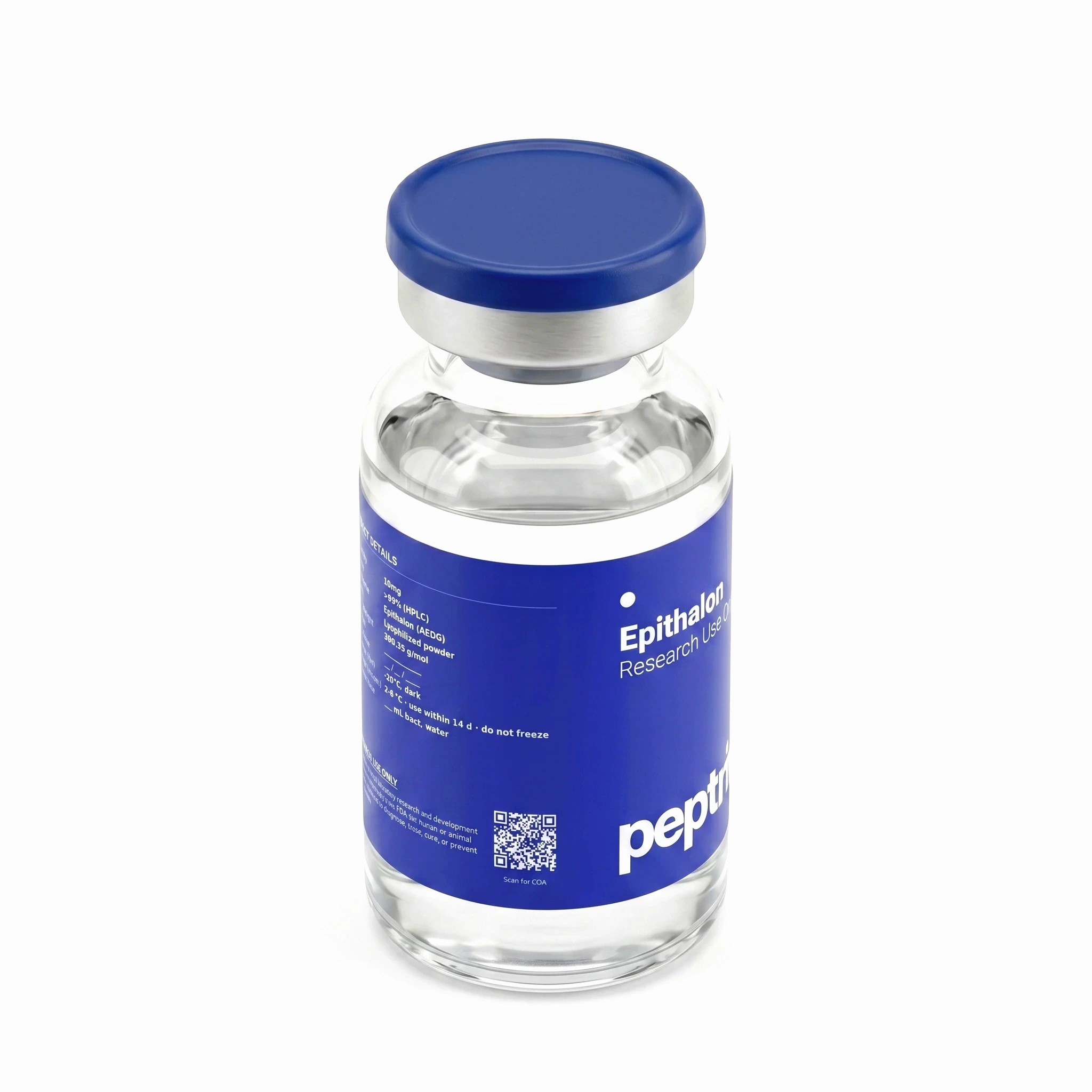
Epithalon
The same compound cited across the Russian and Western trials in this review. Lab-verified identity and purity.
What about the telomerase claim?
The most-cited mechanism story for Epithalon is telomerase upregulation and telomere extension. Telomeres are protective caps on chromosomes that shorten with each cell division. Telomerase is the enzyme that lengthens them. Many longevity researchers think telomere maintenance is part of why some cells age slower than others.
The Khavinson group has published extensively on Epithalon’s telomerase effect in cell culture. The most important recent finding came from an independent Western lab in 2025. Al-Dulaimi at Brunel University London tested Epithalon on breast cancer cell lines (21NT, BT474), normal epithelial cells, and connective-tissue cells.
That study confirmed two things and raised a third. First, Epithalon produces dose-dependent telomere length extension in normal cells through the hTERT pathway. Second, the mechanism replicated in a lab with no Khavinson-group affiliation. That’s the strongest piece of independent Western validation in the Epithalon literature.
The new finding is one the Khavinson literature didn’t address. In cancer cells, Epithalon activated an alternative telomere-lengthening pathway called ALT. That’s a cancer concern. Telomerase activation is one of 10 hallmarks of cancer. Chronic outside telomerase activation in an unselected population is theoretically problematic for cancer cells trying to stay alive longer.
The Brunel finding doesn’t mean Epithalon causes cancer, and the authors are appropriately careful about implications. It does mean the “normal-cell-specific” framing in the Khavinson materials is more complicated than consumer marketing reflects.
What does the modern preclinical literature show?
The 2020–2026 PubMed-indexed Epithalon literature includes several mechanism extensions:
- Bovine egg cells / IVF (2025). A Korean group reported Epithalon-activated telomerase improved bovine egg maturation and post-thaw embryo viability.
- Mouse egg aging (2022). A Chinese group reported Epithalon at 0.1 mM reduced oxidative stress, decreased structural defects, and reduced cell death in aging mouse eggs.
- Diabetic eye disease (2025). An Italian-Russian collaboration (with Khavinson co-authorship) reported Epithalon improved wound healing in high-glucose-injured retinal cells.
- Stem cell differentiation (2020). A Khavinson-group study reported AEDG increased markers of neuron differentiation in human gum stem cells via proposed gene-binding mechanisms.
These studies extend the mechanism story without resolving the central evidence-quality question. When does cell-culture mechanism become validated human therapeutic effect under modern RCT conditions? For Epithalon, that translation hasn’t happened in Western research.
How to read the Epithalon evidence base
The marketing keeps trying to make the evidence picture feel simple. The actual evidence base is more complicated.
The mechanism is plausible. The Russian trials reported positive outcomes. The 2025 Brunel work confirms a piece of the cell-culture mechanism. None of that adds up to the level of evidence a 2026 Western clinician would treat as supporting confident conclusions for “life extension.”
Where this falls short. Human clinical evidence is dominated by one research group’s open-label small-sample work, mostly in Russian, mostly from the 1990s–2000s. Zero Western RCT replications under modern conditions. The cell-culture mechanism is real and partially replicated. The cancer-cell concern from the 2025 Brunel paper is real, and consumer marketing doesn’t address it. Dosing parameters cited on consumer sites are extrapolated from Russian clinical practice, not derived from Western pharmacokinetic studies.
Researchers evaluating Epithalon should weigh these open questions in the literature:
- What evidence base is treated as load-bearing? The Khavinson trials are the primary source, and the methodological caveats are real.
- Cancer-cell ALT activation. The 2025 Brunel finding is the kind of caveat the field should be discussing more openly. Its implications for oncological contexts remain unresolved.
- Validated outcome measures. For telomere length, modern flow-FISH or Southern blot is the standard. That measurement is absent from the grey-market literature.
- Source and chain of custody. Synthetic Epithalon is widely sold by research-chemical vendors with no FDA oversight.
- Timeline for Western validation. No major Western RCT is in the pipeline. The field has been stuck at “cell culture replication” for nearly two decades.
Epithalon
Synthetic Ala-Glu-Asp-Gly tetrapeptide · pineal-derived sequence. The same reference compound used across the cited preclinical and Russian clinical studies. COA available with each lot.
What would change the picture?
A single methodologically rigorous Western RCT of Epithalon in a defined elderly population would change the conversation entirely. It would need validated telomere measurement, mortality follow-up over 5+ years, and a placebo-controlled design.
That trial doesn’t exist and hasn’t been announced. The closest analog is the broader telomerase-modulation literature in human aging, which is itself unsettled.
Until it happens, we read Epithalon as sitting in the category of grey-market longevity peptides where consumer enthusiasm has outpaced Western validation. That doesn’t mean the molecule is fictional or fraudulent. It does mean the evidence-quality conversation hasn’t caught up with the marketing.
What to know now
- Authorship concentration: the vast majority of Epithalon human work comes from one Russian research consortium led by Khavinson.
- Western replication: the 2025 Brunel study confirms telomerase upregulation in cell culture and adds an oncologic ALT-activation caveat in cancer cells.
- Human RCT evidence: no PubMed-indexed Western randomized controlled trials of Epithalon for any indication in the 2020–2026 window.
- Methodological caveats: open-label designs, small samples, Russian-language publication, no validated Western outcome measures for the mortality-reduction claims.
- Regulatory status: not FDA-approved, not EMA-approved. Russian clinical history under different regulatory standards.
- Honest framing: real molecule, real cell-culture mechanism, real preliminary Russian work — consumer marketing claims that significantly outpace Western evidence-based validation.
What we’re watching
Three things over the next 24 months. First, whether any independent Western group registers a formal Epithalon RCT on ClinicalTrials.gov — that would be the most important change in the evidence landscape. Second, whether follow-up work on the Al-Dulaimi 2025 ALT-activation finding clarifies the cancer-cell concern. That’s the kind of mechanistic detail that should drive contraindication-style guidance if it holds up. Third, whether any major Russian-language Epithalon trial gets translated into PubMed-indexed English. That would let the broader scientific community evaluate the foundational claims directly.
References
- Araj, S. K., Brzezik, J., Mądra-Gackowska, K., & Szeleszczuk, Ł. (2025). Overview of Epitalon — Highly bioactive pineal tetrapeptide with promising properties. International Journal of Molecular Sciences, 26(6), 2691. https://doi.org/10.3390/ijms26062691
- Al-Dulaimi, S., Thomas, R., Matta, S., & Roberts, T. (2025). Epitalon increases telomere length in human cell lines through telomerase upregulation or ALT activity. Biogerontology, 26(5), 178. https://doi.org/10.1007/s10522-025-10315-x
- Yue, X., Liu, S. L., Guo, J. N., et al. (2022). Epitalon protects against post-ovulatory aging-related damage of mouse oocytes. Aging (Albany NY), 14(7), 3191–3202. https://doi.org/10.18632/aging.204007
- Gatta, M., Dovizio, M., Milillo, C., et al. (2025). The antioxidant tetrapeptide Epitalon enhances delayed wound healing in an in vitro model of diabetic retinopathy. Stem Cell Reviews and Reports, 21(6), 1822–1834. https://doi.org/10.1007/s12015-025-10911-x
- Ullah, S., Haider, Z., Perera, C. D., et al. (2025). Epitalon-activated telomerase enhance bovine oocyte maturation rate and post-thawed embryo development. Life Sciences, 362, 123381. https://doi.org/10.1016/j.lfs.2025.123381
- Khavinson, V., Diomede, F., Mironova, E., et al. (2020). AEDG peptide (Epitalon) stimulates gene expression and protein synthesis during neurogenesis: Possible epigenetic mechanism. Molecules, 25(3), 609. https://doi.org/10.3390/molecules25030609