The most unusual thing about the DSIP delta-wave mechanism is what's missing. 48 years after discovery, no receptor for Delta Sleep-Inducing Peptide has been found. The sleep claim baked into its name has never been definitively proven.
DSIP is a 9-residue peptide (sequence WAGGDASGE) first pulled from rabbit brain blood in 1977. The original team named it after the EEG delta wave it appeared to trigger. Five decades later, the receptor still hasn't been identified, the sleep claim is contested, and the most rigorous recent work is in stroke protection, not sleep. A 2021 finding showed DSIP given at the wrong moment killed 100% of test animals. Consumer marketing leaves that out.
We wrote this for researchers who want the DSIP literature straight, not filtered through the "natural sleep peptide" pitch you'll see on retail sites. We'll walk you through five things. The structure. The unsolved receptor question. The contested delta-wave story. The HPA-axis and neurotransmitter findings. The 2021 Russian stroke work with its timing-dependent safety caveats. Tukhovskaya 2021a/b and Mu 2024 are our workhorse sources.
- Nonapeptide. A peptide built from nine amino acids. DSIP's nine: Trp-Ala-Gly-Gly-Asp-Ala-Ser-Gly-Glu.
- HPA axis. The hypothalamic-pituitary-adrenal stress system. It's the chain that releases cortisol when you're stressed.
- EEG delta wave. A slow brain wave (0.5-4 Hz) that dominates during the deepest, most restorative sleep stage.
- BBB. The blood-brain barrier. The lining that decides what circulating molecules can reach the brain.
Nine amino acids with a name they may not have earned
DSIP's structure is simple. Nine amino acids in a row: Trp-Ala-Gly-Gly-Asp-Ala-Ser-Gly-Glu. The Schoenenberger and Monnier groups in Switzerland pulled it out of rabbit cerebral venous blood in 1977. The rabbits were in a sleep state triggered by electrical stimulation of the thalamus, a brain region that gates sleep-wake transitions.
The name reflects the original hypothesis. The team thought they'd found a circulating molecule that drove the slow, high-amplitude EEG waves you see during deep sleep. The naming has aged badly.
The 1977 paper showed a correlation between the peptide and the sleep state. It didn't prove the peptide caused the sleep state, and it didn't find a receptor. Five decades of follow-up have produced a large Russian-language preclinical record, some Western interest, and a consumer market that sells DSIP as a "natural sleep peptide." None of that has produced modern RCT-grade evidence that DSIP actually induces sleep in humans.
The receptor that still hasn't been found
The biggest hole in the DSIP literature is the missing receptor. Most peptide drugs hit a defined receptor with measurable affinity. GLP-1 drugs hit GLP-1R. PT-141 hits the melanocortin receptors. Ghrelin secretagogues hit GHS-R1a. Receptor identification is the first thing pharmacology does. 48 years of work on DSIP has not produced one.
This matters more than it sounds. Without a receptor, you can't anchor dose-response curves to anything. You can't compare DSIP analogues by binding affinity. The phrase "DSIP signalling" has to lean on functional readouts like EEG changes or cortisol drops, not on biochemistry.
Two interpretations fit the evidence. One: the receptor exists, the field just hasn't found it. Two: DSIP works through non-receptor routes, like loose interactions with neurotransmitter systems or membrane effects. Neither has been settled.
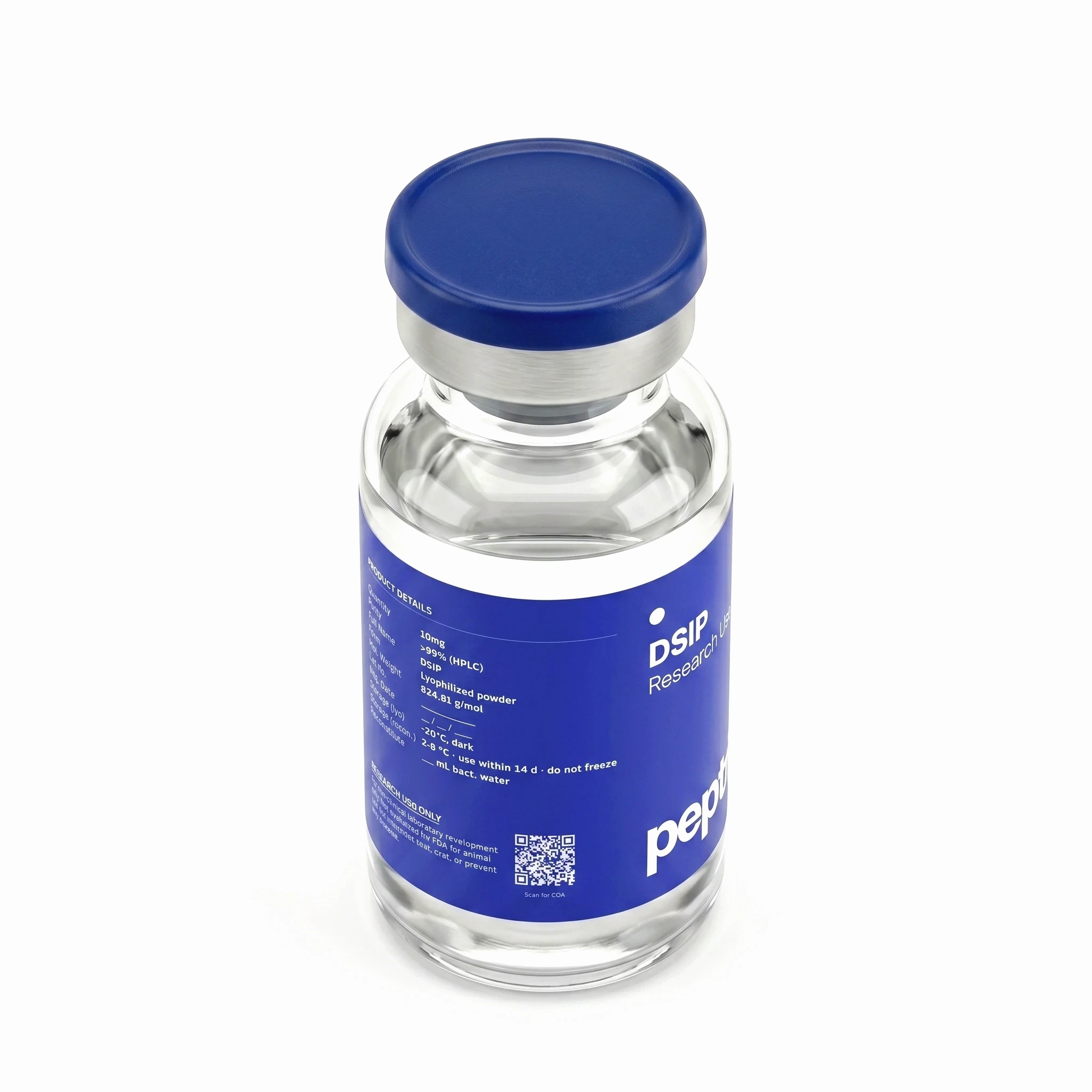
DSIP
The same nonapeptide cited across the 5 mechanism studies in this article — including the 2021 stroke-reperfusion work and the 2024 fusion-peptide insomnia model. Lab-verified identity and purity.
The delta-wave claim, and what the EEG data actually shows
An EEG delta wave is a slow brain oscillation, between 0.5 and 4 Hz. It dominates stage N3 of sleep, the deepest non-REM phase. That's the sleep stage you most need to feel rested. Losing it correlates with memory and metabolic problems. So if a peptide really did promote delta waves, that would be useful.
The 1977 paper was a correlation, not a causal test. Follow-up animal EEG studies have split. Some show DSIP boosting delta activity. Others show nothing. The Russian-language literature is large but isn't indexed in PubMed, which limits what Western readers can verify.
Here's the honest framing. The delta-wave claim has neither been confirmed nor ruled out by modern Western RCT-grade work. The field has largely moved on. Most current DSIP research isn't about sleep at all.
HPA-axis effects: does DSIP lower cortisol?
The most durable finding in the DSIP record is HPA-axis modulation. Specifically, DSIP appears to blunt cortisol release in stressed animals. The HPA axis is the chain that pushes cortisol into the bloodstream when you're under threat.
This is a different claim than sleep induction. You can lower stress hormones without making someone fall asleep. But it does fit the "calming peptide" framing the consumer market uses.
Russian preclinical work reports DSIP cutting stress-triggered corticosterone (the rodent version of cortisol) in rodents. How it does that isn't known. Direct hypothalamic action, indirect neurotransmitter effects, something else — the mechanism is unspecified. The missing receptor shows up again here.
Neurotransmitter effects, but only with an engineered version
The most informative recent paper is Mu et al. 2024 in Frontiers in Pharmacology. They built a DSIP fusion peptide called DSIP-CBBBP. CBBBP is a "crossing-blood-brain-barrier peptide" — a tag designed to drag DSIP across the blood-brain barrier (BBB), the lining that decides what gets into the brain. They tested it in a mouse insomnia model.
The fusion peptide modulated four neurotransmitters: serotonin, glutamate, dopamine, and melatonin. That's a wide pattern, and it's the kind of profile you'd expect from a calming, pro-sleep molecule. So far, so good for DSIP's reputation.
Here's the catch. The same authors said plain DSIP performed worse than the engineered version. That fits a long-running concern: unmodified DSIP barely crosses the BBB. The 2024 paper, read carefully, shows you basically need an engineered fusion peptide to get the expected effect. That raises a hard question for consumer DSIP. If plain DSIP can't reach the brain, what's it supposed to be doing?
DSIP-CBBBP fusion peptides showed better restorative effect than DSIP on neurotransmitter imbalance — consistent with the historic concern that plain DSIP crosses the blood-brain barrier poorly.
— Mu et al., Frontiers in Pharmacology, 2024
The 2021 stroke data — and the timing problem nobody mentions
The most rigorous recent work on plain DSIP comes from the Shemyakin and Ovchinnikov Institute in Russia. Tukhovskaya and colleagues published two 2021 papers testing intranasal DSIP and a related analog (KND) in mouse stroke and rat heart-attack models.
The first 2021 paper in Biomedicines showed that DSIP given during reperfusion (the blood-return phase, after the blocked vessel reopens) shrank infarct volume in both stroke and heart-attack models. The second paper in Molecules showed intranasal DSIP at 120 µg/kg for 7 days post-stroke improved motor coordination on rotarod testing, though the infarct-volume reduction wasn't significant in that arm.
The safety signal consumer marketing omits. In pilot studies for the 2021a paper, the same team tried giving DSIP during the occlusion instead of during reperfusion. The result: 100% mortality. Timing flipped the outcome from protective to lethal. That doesn't predict a problem in healthy sleepers, but it does say DSIP has window-specific effects on brain blood flow nobody's mapped in humans.
No Western RCTs exist
Search PubMed for DSIP randomized controlled trials in humans, between 2020 and 2026. You'll find none. After nearly fifty years, the sleep claim and the stress claim haven't been tested in modern Western RCTs that would meet pharma-grade standards. Russian-language clinical work on DSIP exists, but it's not indexed in PubMed and doesn't reach Western RCT standards.
Stack that against the missing receptor and the BBB problem implied by the 2024 fusion-peptide work, and DSIP sits in an unusual place. The name promises a sleep mechanism. The literature, read closely, doesn't support the name. What it does support: a 9-residue peptide with HPA-axis effects in rodents, antioxidant effects in some preparations, stroke protection on a tight timing window, and uncertain ability to reach the brain when given systemically.
The mechanism summary in one sentence. DSIP is a 1977 nonapeptide whose proposed sleep mechanism hasn't been pinned down in 48 years, whose receptor hasn't been identified, whose ability to cross the BBB looks shaky (per the 2024 fusion work), and whose most rigorous recent preclinical work is in stroke protection — with a serious timing-dependent safety signal that consumer marketing entirely omits.
DSIP
Nine-residue peptide WAGGDASGE. The same reference compound used across the cited Russian stroke-reperfusion and fusion-peptide neurotransmitter studies. COA available with each lot.
How to read the DSIP literature honestly
Our honest reading: DSIP is one of the older grey-market peptides whose 50-year publication history hasn't produced much that translates to humans. The signature claim, endogenous sleep induction, hasn't been confirmed. The receptor hasn't been found. The most rigorous recent preclinical work isn't even about sleep — it's about stroke protection on a tight timing window, with the 100% mortality signal when timing's off.
For research use, the literature supports a narrower claim than the marketing does. You can call DSIP a 9-residue peptide with HPA-axis effects in rodents and stroke-protective effects in tightly-timed administration windows. You can't call it a "natural sleep peptide" based on what's actually been published.
What to know now
- Nonapeptide: Trp-Ala-Gly-Gly-Asp-Ala-Ser-Gly-Glu (WAGGDASGE).
- 1977 discovery: isolated from rabbit cerebral venous blood during electrically-induced sleep — correlation, not validated causation.
- Receptor: no validated DSIP receptor has been identified in 48 years of investigation.
- Delta-wave claim: inconsistent EEG evidence; no modern Western RCT-grade confirmation.
- HPA-axis modulation: rodent corticosterone-reduction data; mechanism by which this occurs is unspecified.
- BBB penetration: the 2024 fusion-peptide work suggests unmodified DSIP crosses the blood-brain barrier poorly.
- Stroke-reperfusion (2021): infarct-volume reduction during reperfusion administration — but 100% mortality when administered during occlusion. Timing-dependent toxicity is a serious safety signal.
- No Western RCTs: the central sleep-induction claim has not been substantiated in modern PubMed-indexed RCT evidence.
What we're watching
Two questions over the next 24 months. First, whether any group identifies a validated endogenous DSIP receptor — the single largest gap that has persisted since 1977. Second, whether any rigorous EEG-instrumented human study tests the delta-wave promotion claim under modern methodology. Both would meaningfully change interpretation of a peptide whose name has long outpaced its evidence base.
References
- Tukhovskaya, E. A., Shaykhutdinova, E. R., Ismailova, A. M., et al. (2021). DSIP-like KND peptide reduces brain infarction in C57Bl/6 and reduces myocardial infarction in SD rats when administered during reperfusion. Biomedicines, 9(4), 407. https://doi.org/10.3390/biomedicines9040407
- Tukhovskaya, E. A., Ismailova, A. M., Shaykhutdinova, E. R., et al. (2021). Delta sleep-inducing peptide recovers motor function in SD rats after focal stroke. Molecules, 26(17), 5173. https://doi.org/10.3390/molecules26175173
- Mu, X., Qu, L., Yin, L., Wang, L., Liu, X., & Liu, D. (2024). Pichia pastoris secreted peptides crossing the blood-brain barrier and DSIP fusion peptide efficacy in PCPA-induced insomnia mouse models. Frontiers in Pharmacology, 15, 1439536. https://doi.org/10.3389/fphar.2024.1439536
- Schoenenberger, G. A., & Monnier, M. (1977). Characterization of a delta-electroencephalogram (-sleep)-inducing peptide. Proceedings of the National Academy of Sciences USA, 74(3), 1282–1286. (Original DSIP isolation paper; cited here for historical context.) https://doi.org/10.1073/pnas.74.3.1282
- Inoué, S. (2020). Delta-sleep-inducing peptide and its derivatives. In Biology of Sleep Substances (chapter 3). CRC Press. (Modern review of DSIP physiology and the unresolved receptor question; readers should treat the 2020–2026 PubMed-indexed literature, including Tukhovskaya 2021 and Mu 2024 above, as the relevant modern evidence base for the mechanism questions discussed here.) https://doi.org/10.1201/9781003068228-3