Tesamorelin is unusual. It's the only GHRH analog that's actually a drug — an FDA approval, two large Phase III trials, and a labeled indication. Where to buy tesamorelin in 2026 splits into three lanes: prescription Egrifta (~$3,500–5,000/month), 503A compounded (narrowed since 2023), and research-grade ($80–160/vial). We'll cover the third lane here.
Tesamorelin is a synthetic 44-amino-acid analog of GHRH (growth hormone-releasing hormone, the hypothalamic signal that stimulates pituitary GH release). It carries an N-terminal trans-3-hexenoyl modification that blocks DPP-4 (the enzyme that normally degrades GHRH in minutes). Modified MW ~5,196 Da; unmodified backbone ~5,135 Da. It's the only FDA-approved GHRH analog — sold as Egrifta® (2010) and Egrifta SV® (2019) for HIV-associated lipodystrophy. Research-grade runs $80–$160 per 5 mg vial versus $3,500–$5,000/month for prescription Egrifta. Tesamorelin is on the WADA Prohibited List (S2).
Quick answer. Research-grade tesamorelin should cost $80–$220 per vial. It should ship lyophilized (freeze-dried). The Certificate of Analysis (a one-page lab report) should come from an ISO 17025–accredited lab. HPLC purity ≥98%. Mass-spec at the expected modified mass of ~5,196 Da. If the mass-spec reads ~5,135 Da instead, the hexenoyl modification is missing — that's not tesamorelin.
What the research compound is
Tesamorelin is human GHRH(1-44) with one extra chemical group. The trans-3-hexenoyl modification on the N-terminus blocks DPP-4 from chewing up the peptide. That extends plasma half-life from ~7 minutes (native GHRH) to roughly 26 minutes. We treat that 19-minute extension as the whole reason tesamorelin works as a daily drug while older unmodified analogs like sermorelin don't (Fourman et al., 2020).
Here's how the mechanism works. Tesamorelin binds the GHRH receptor on pituitary somatotrophs (the cells that store and release GH). The pituitary fires off a GH pulse. The liver responds by making IGF-1 (insulin-like growth factor-1, the main downstream mediator of GH's effects). It's the same pathway native GHRH uses. The difference: tesamorelin lasts long enough to actually trigger a pulse before DPP-4 destroys it.
Pulsatility matters here. Recombinant GH produces a flat, non-pulsatile rise. Research has shown that physiological tissues respond less favorably to flat exposure than to discrete pulses. That's part of why studies have reported that tesamorelin produces metabolic effects at physiological GH levels — not the supraphysiological exposures observed with recombinant GH dosing in research models.
The FDA approval rests on two large Phase III trials in HIV-associated lipodystrophy. They showed 15–18% visceral adipose tissue reduction at 26 weeks. A 12-month double-blind RCT in HIV-associated NAFLD has produced secondary analyses on hepatic transcriptomics (Fourman et al., 2020), plasma proteomics (Fourman et al., 2021), and immune-activation markers (Stanley et al., 2021). A 2024 sub-analysis extends this to study participants on integrase-inhibitor regimens (Russo et al., 2024).
Three sourcing channels — what we cover
Tesamorelin exists in three distinct U.S. supply chains:
- Prescription Egrifta® / Egrifta SV®. The FDA-approved finished drug, made by Theratechnologies under cGMP. Dispensed by licensed pharmacies against a prescription. Labeled for HIV-associated lipodystrophy. Retail price: $3,500–$5,000 per month without insurance. Coverage outside the HIV indication is usually absent.
- 503A compounded tesamorelin. 503A is the section of federal law that lets compounding pharmacies prepare custom drugs for individual patients. The FDA's 2023 categorization decisions on bulk peptide substances narrowed this channel sharply. Most pharmacies that prepared tesamorelin no longer do.
- Research-grade tesamorelin (RUO). Lyophilized powder sold as a lab reference compound under Research Use Only labeling (21 CFR § 809.10(b)(9)). Not for human or animal use. 2026 pricing: $80–$220 per vial.
We focus on the third channel here. If you have an HIV-lipodystrophy diagnosis and insurance coverage, the first channel is the right one — see your physician.
How to verify research-grade tesamorelin
The standard eight vendor criteria apply. Four are sharper for tesamorelin.
1. Mass-spec must show the modification
Tesamorelin's modified mass is ~5,196 Da. The unmodified backbone is ~5,135 Da. That 61 Da gap is small but unambiguous on any decent mass spectrometer. If a CoA reports observed mass at ~5,135 Da, the hexenoyl coupling step failed. The vial contains plain GHRH(1-44). It has roughly the same binding affinity in cell assays but the ~10-minute DPP-4-susceptible half-life of sermorelin. That's not tesamorelin. The mass-spec line is the single most informative number on the CoA.
2. The CoA should name the hexenoyl modification
A real tesamorelin CoA names the modification. Some labs write "N-terminal trans-3-hexenoic acid modification." Others write "hexenoyl-GHRH(1-44)." A CoA that just says "GHRH(1-44)" with nothing else is selling either the unmodified peptide or one the supplier didn't bother to characterize. Either way, that's not what you're paying for.
3. Lyophilized — no oral, no sublingual
Tesamorelin ships as a lyophilized powder. That is the form FDA-approved as Egrifta and the form used in every published clinical trial. Pre-reconstituted liquid has a much shorter shelf life (weeks vs years). Oral or sublingual formulations have no validation in controlled studies. Lyophilized powder is the only form with published research support.
4. Cold chain still matters
The hexenoyl modification gives tesamorelin better storage stability than unmodified GHRH. Same DPP-4 resistance that extends plasma half-life also slows shelf degradation. Lyophilized tesamorelin at −20°C is stable for years. Reconstituted material refrigerated at 2–8°C lasts 2–4 weeks — longer than the 1–2 weeks typical for unmodified GHRH analogs. Vendors who ship with no cold-chain documentation are cutting a corner the pharmacology doesn't justify.
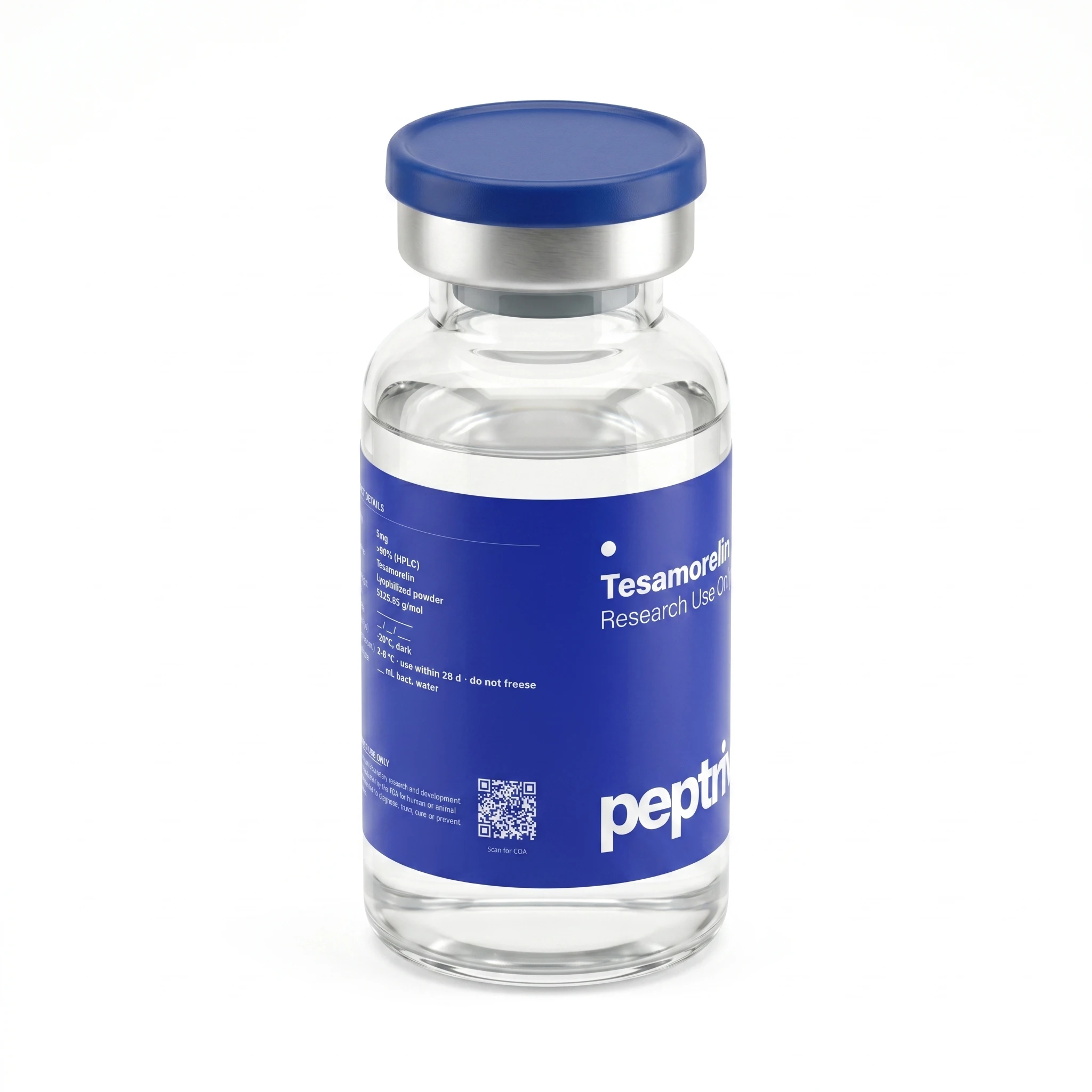
Tesamorelin
The same 44-residue stabilized GHRH peptide cited across the 2024 Russo INSTI sub-analysis and the Massachusetts General Hospital HIV-NAFLD trial program. Same molecule as FDA-approved Egrifta. Lab-verified identity confirms the trans-3-hexenoyl modification; mass-spec at ~5,196 Da on every lot.
What research-grade tesamorelin costs in 2026
Tesamorelin is one of the longer peptides in the GH-axis category. Forty-four residues. Every residue is another coupling step in solid-phase synthesis. Plus the hexenoyl modification adds specialized chemistry. That puts synthesis cost above shorter analogs (sermorelin at 29 residues, ipamorelin at 5) but well below tirzepatide (39 residues plus a C20 fatty acid chain). Here's what we see in the 2026 market:
- 5 mg vial: $80–$160 ($16–$32/mg). The most common research-grade size.
- 10 mg vial: $120–$220 ($12–$22/mg). Better per-mg value.
- Multi-vial discounts: 10–25% off for 3- or 6-packs at most vendors.
- Reference point: prescription Egrifta runs $3,500–$5,000/month at U.S. retail without insurance. The labeled 2 mg daily dose adds up. The 20–30x price gap is FDA approval, cGMP oversight, finished drug-product formulation, and a narrow labeled population — not retail markup.
Below $60 per 5 mg vial? Ask questions. The trans-3-hexenoyl coupling step is one of the more failure-prone parts of the synthesis. A vendor offering tesamorelin at sermorelin prices is probably shipping the unmodified GHRH(1-44) backbone or a partial mixture. Above $35 per mg, you're paying retail markup, not synthesis cost.
Where this falls short. The FDA approval is narrow. It covers HIV-associated lipodystrophy. Two big Phase III trials anchor it, plus a decade of post-marketing research. Uses outside the labeled HIV-lipodystrophy indication have not been validated in RCTs; the 2014 Stanley meta-analysis demonstrated visceral fat reduction specifically in HIV-affected study participants, and equivalent controlled data in healthy adults is not available. Tesamorelin also lost EMA approval in 2020 — Theratechnologies withdrew it from the EU market for commercial reasons (low patient volume), not safety, but it represents a narrowing commercial footprint.
Legal status — FDA-approved drug, RUO, and WADA
Tesamorelin's regulatory picture is genuinely different from every other peptide in this category. The molecule sits in five overlapping buckets at once:
- FDA-approved as Egrifta® (2010) and Egrifta SV® (2019). Theratechnologies holds the approval for "reduction of excess abdominal fat in HIV-infected patients with lipodystrophy." A real labeled indication backed by Phase III RCTs. Use outside the HIV-lipodystrophy indication does not have RCT-level validation.
- Sold as a Research Use Only compound. 21 CFR § 809.10(b)(9) covers RUO-labeled chemical substances. Selling tesamorelin for lab research is legal in the U.S. Selling it for human consumption isn't.
- Subject to 503A restrictions. The FDA's 2023 decisions on bulk peptide substances narrowed the 503A channel sharply. Most pharmacies that prepared tesamorelin for off-label clinical use no longer do.
- WADA-prohibited under S2. Peptide Hormones, Growth Factors, Related Substances and Mimetics — banned year-round. Detection methods for tesamorelin are published. WADA-accredited labs identify it routinely.
- EMA-withdrawn (2020). Theratechnologies withdrew Egrifta from the EU for commercial reasons (low patient volume), not safety. Health Canada approval remains.
For research buyers, here's what matters. RUO-labeled tesamorelin is legal to buy, sell, and use in laboratory research. Administering it to humans or animals outside the FDA approval framework isn't.
Red flags to watch for
- Mass-spec at ~5,135 Da instead of ~5,196 Da. The hexenoyl coupling failed. You don't have tesamorelin.
- Vendors calling tesamorelin a "sermorelin alternative" without explaining the difference. These are different molecules: 29 vs 44 residues, unmodified vs hexenoyl-modified, ~10 min vs ~26 min half-life. Conflating them means either confusion or a sales pitch.
- Pre-reconstituted liquid without cold chain. Lyophilized survives shipping. Reconstituted at room temperature has a much shorter shelf life.
- Oral capsules, sublingual sprays, or transdermal patches. Zero validation in published research. Subcutaneous lyophilized is the form used in every trial.
- "Equivalent to Egrifta" without explaining the RUO framework. Same molecule, different products, different oversight. A research-grade supplier should make that distinction explicit.
- Clinical claims on the product page. "Tesamorelin reduces belly fat." "Tesamorelin for body recomposition." That's FDA enforcement territory.
- Internal-QC-only documentation. You want third-party ISO 17025 verification.
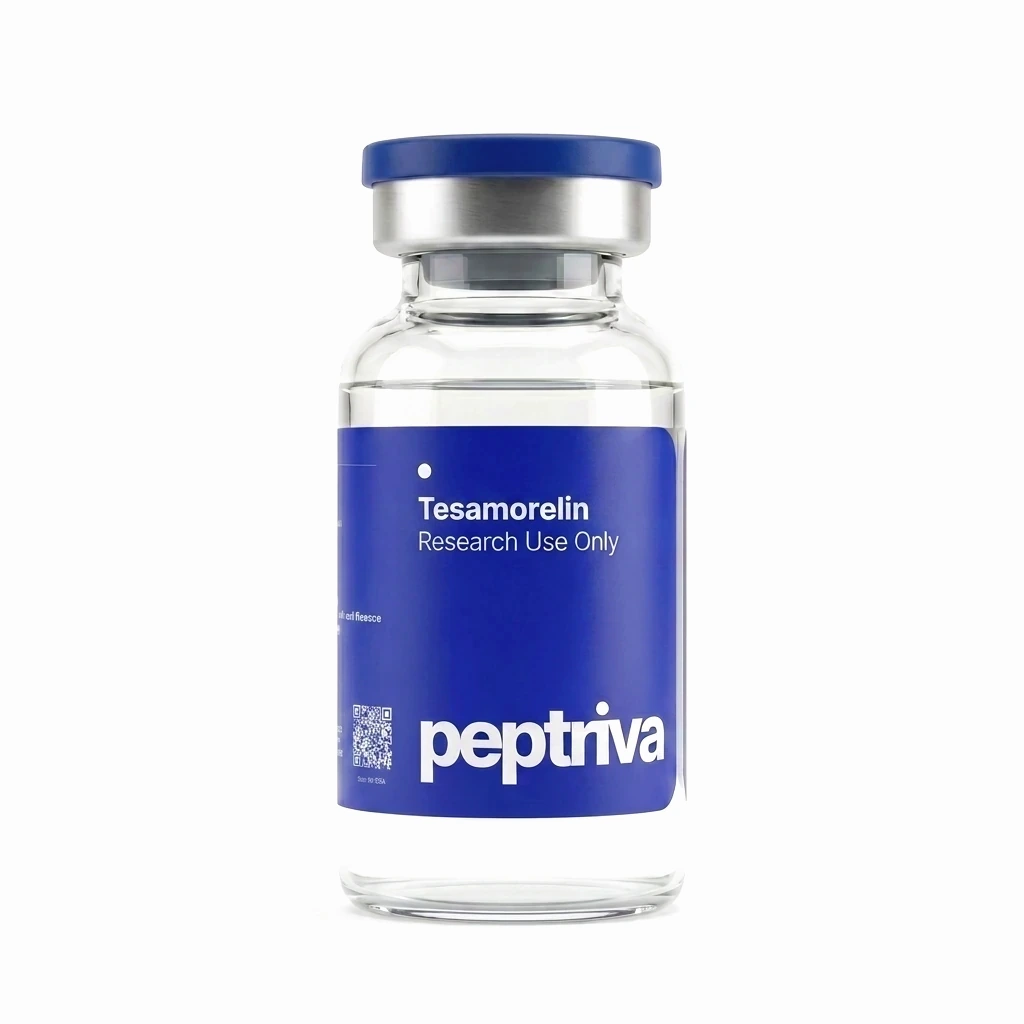
Tesamorelin
44-residue GHRH(1-44) with the N-terminal trans-3-hexenoyl modification — the same molecule as FDA-approved Egrifta. CoA confirms HPLC purity, mass-spec at ~5,196 Da (modification verified), and ISO 17025 third-party testing. The reference compound used across the cited Phase III and MGH HIV-NAFLD trial program.
Tesamorelin reduced visceral adipose tissue by 15–18% at 26 weeks in two Phase III trials of HIV-associated lipodystrophy — the basis for the 2010 FDA approval. The trans-3-hexenoyl modification is what made daily subcutaneous dosing viable.
— Fourman et al., JCI Insight, 2020
Frequently asked questions
Is research-grade tesamorelin the same as Egrifta?
Chemically, yes. Both are the same 44-amino-acid GHRH(1-44) peptide with the N-terminal trans-3-hexenoic acid modification. What differs: regulatory framing, supply chain, manufacturing quality system, dosage form. Egrifta and Egrifta SV are FDA-approved finished drug products made under cGMP by Theratechnologies. They're dispensed by licensed pharmacies against a prescription. Research-grade tesamorelin is lyophilized powder sold under Research Use Only labeling. Not for human or animal use.
How much should research-grade tesamorelin cost vs Egrifta?
Roughly $80–$160 per 5 mg vial and $120–$220 per 10 mg vial in 2026. Prescription Egrifta runs $3,500–$5,000/month at U.S. retail without insurance. The labeled dose is 2 mg daily subcutaneous — a meaningful monthly quantity. The 20–30x gap is FDA approval, cGMP oversight, finished drug-product formulation, and a narrow labeled population. Same molecule, different supply chains.
How is tesamorelin different from sermorelin?
Both are GHRH analogs that activate the GHRH receptor on pituitary somatotrophs. The difference is half-life. Sermorelin is GHRH(1-29) with no stabilizing modification. DPP-4 degrades it in plasma within minutes (~10 min half-life). That's why sermorelin's clinical role is mostly diagnostic — testing pituitary GH-secretion capacity, not therapy. Tesamorelin is the full GHRH(1-44) sequence with an N-terminal trans-3-hexenoyl modification that blocks DPP-4 cleavage. Half-life extends to ~26 min. That extension is what makes daily dosing viable. It's why tesamorelin has an FDA approval and sermorelin doesn't.
Tesamorelin vs CJC-1295 — which one for research?
Both bind the same target — the GHRH receptor on pituitary somatotrophs. Tesamorelin is the 44-residue full GHRH(1-44) with the trans-3-hexenoyl modification, FDA-approved as Egrifta in 2010. CJC-1295 is a shorter 30-residue modified GHRH(1-29), sometimes paired with a DAC (Drug Affinity Complex) linker that covalently binds albumin and extends half-life to days. CJC-1295 clinical development was discontinued. It persists as a grey-market research peptide. Same receptor, same mechanism — only tesamorelin has the FDA approval and the Phase III evidence. See CJC-1295 vs tesamorelin.
Is tesamorelin banned by WADA?
Yes. Tesamorelin is on the WADA Prohibited List under S2 (Peptide Hormones, Growth Factors, Related Substances and Mimetics). Banned year-round. Detection methods are published. WADA-accredited labs can identify it. The prohibition applies to athletic use, not lab research.
What should a tesamorelin CoA show?
HPLC purity ≥98% with chromatogram. Mass-spec at the expected modified mass of ~5,196 Da (the 44-residue GHRH backbone plus the trans-3-hexenoyl modification). Karl Fischer water content 2–8% for lyophilized material. Counterion content (usually trifluoroacetate or acetate). The mass-spec line specifically should confirm the modified peptide — not the unmodified GHRH(1-44) backbone. If the mass is missing the hexenoyl group, the synthesis is incomplete. The lab should be ISO/IEC 17025 accredited and named on the report.
What to know now
- Expected mass ~5,196 Da, not ~5,135 Da. That 61 Da gap is the hexenoyl modification — the feature that makes tesamorelin a drug instead of a sermorelin variant.
- $80–$220 per vial vs $3,500–$5,000/month. The 20–30x gap is regulatory framing, not chemistry.
- Only FDA-approved GHRH analog (2010). Phase III RCTs in HIV lipodystrophy. Ongoing post-marketing research in HIV-NAFLD.
- Three U.S. channels. Egrifta prescription, 503A compounded (narrowed since 2023), research-grade RUO. We cover the third.
- Lyophilized powder is the research-validated form. Oral, sublingual, and transdermal formulations have no published validation in controlled studies.
- WADA S2 banned. Detectable by accredited labs. Research-only use isn't affected.
What we’re watching
Two developments to track. First, the tesamorelin pipeline expansion into non-HIV NASH (a liver disease where excess fat causes inflammation). Phase III trials are anticipated. A positive readout would extend the labeled indication well beyond HIV-associated metabolic disease (Fraile et al., 2021). Second, the FDA's ongoing review of bulk peptide substances under 503A. The compounding channel for tesamorelin has narrowed since 2023, but the picture is still evolving. For research buyers, our framing stays stable: research-grade tesamorelin labeled RUO is legal to buy, sell, and use in lab research. What changes around it is the compounding channel for clinical use, not the research-compound supply.
References
- Russo, S. C., Ockene, M. W., Arpante, A. K., et al. (2024). Efficacy and safety of tesamorelin in people with HIV on integrase inhibitors. AIDS, 38(12), 1758–1764. https://doi.org/10.1097/QAD.0000000000003965
- Fourman, L. T., Billingsley, J. M., Agyapong, G., et al. (2020). Effects of tesamorelin on hepatic transcriptomic signatures in HIV-associated NAFLD. JCI Insight, 5(16). https://doi.org/10.1172/jci.insight.140134
- Stanley, T. L., Fourman, L. T., Wong, L. P., et al. (2021). Growth hormone releasing hormone reduces circulating markers of immune activation in parallel with effects on hepatic immune pathways in individuals with HIV-infection and nonalcoholic fatty liver disease. Clinical Infectious Diseases, 73(4), 621–630. https://doi.org/10.1093/cid/ciab019
- Fourman, L. T., Stanley, T. L., Billingsley, J. M., et al. (2021). Delineating tesamorelin response pathways in HIV-associated NAFLD using a targeted proteomic and transcriptomic approach. Scientific Reports, 11(1), 10485. https://doi.org/10.1038/s41598-021-89966-y
- Lake, J. E., La, K., Erlandson, K. M., et al. (2021). Tesamorelin improves fat quality independent of changes in fat quantity. AIDS, 35(9), 1395–1402. https://doi.org/10.1097/QAD.0000000000002897
- Ellis, R. J., Vaida, F., Hu, K., et al. (2025). Effects of tesamorelin on neurocognitive impairment in persons with HIV and abdominal obesity. Journal of Infectious Diseases, 231(5), 1230–1238. https://doi.org/10.1093/infdis/jiaf012
- Fourman, L. T., & Grinspoon, S. K. (2022). Approach to the patient with lipodystrophy. Journal of Clinical Endocrinology and Metabolism, 107(6), 1714–1726. https://doi.org/10.1210/clinem/dgac079
- Fraile, J. M., Palliyil, S., Barelle, C., Porter, A. J., & Kovaleva, M. (2021). Non-alcoholic steatohepatitis (NASH) - a review of a crowded clinical landscape. Drug Design, Development and Therapy, 15, 3997–4009. https://doi.org/10.2147/DDDT.S315724
- U.S. Food and Drug Administration. (2023). Section 503A of the Federal Food, Drug, and Cosmetic Act. https://www.fda.gov/drugs/human-drug-compounding/section-503a-federal-food-drug-and-cosmetic-act
- World Anti-Doping Agency. (2024). The 2024 Prohibited List. https://www.wada-ama.org/en/prohibited-list
- International Organization for Standardization. (2017). ISO/IEC 17025:2017 — General requirements for the competence of testing and calibration laboratories. https://www.iso.org/standard/66912.html