SS-31 became the third FDA-approved peptide in this Library when the agency green-lit Forzinity™ (elamipretide) for Barth syndrome in September 2025. The question of where to buy SS-31 now depends on the intended use — prescription, compounded, or research-grade. Three channels exist, and they are not interchangeable.
SS-31 (also called elamipretide, brand name Forzinity™) is a synthetic four-residue mitochondria-targeted peptide. The sequence is D-Arg-Dmt-Lys-Phe-NH2, MW ~639.79 g/mol. The FDA approved Forzinity in September 2025 for Barth syndrome patients ≥30 kg. Three channels exist today: prescription Forzinity ($300,000–$750,000/year), 503A compounded (now sharply limited), and research-grade SS-31 at $80–$150 per 10 mg vial. Verification criteria for each channel are described below.
Channel summary. Prescription Forzinity is dispensed through specialty pharmacy for confirmed Barth syndrome diagnoses. Research-grade SS-31 is available as an RUO reference compound for laboratory use at $80–$220 per vial, shipped lyophilized. The Certificate of Analysis must show HPLC purity ≥98%, mass-spec at [M+H]+ 640.8, and chiral-HPLC confirmation of D-arginine. The only FDA-supported indication is Barth syndrome; longevity and anti-aging applications are not supported by clinical evidence.
What the molecule actually is
SS-31 is a four-amino-acid peptide. The sequence is D-Arg-Dmt-Lys-Phe-NH2. "Dmt" is 2',6'-dimethyltyrosine, an unusual residue we'll define in a moment. Two features make this molecule weird. It uses D-amino acids (the mirror-image form of normal amino acids), and it includes a non-standard residue most peptide suppliers can't synthesize cleanly.
The 2025 Tung et al. review describes elamipretide as a cell-permeable peptide that "selectively concentrates in the inner mitochondrial membrane, where it binds cardiolipin." Cardiolipin is the signature lipid of healthy mitochondria. SS-31 stabilizes cristae structure and supports the cardiolipin–cytochrome c supercomplex (Tung et al., 2025).
Stealth BioTherapeutics developed it through a real Phase III clinical-development program. In September 2025, the FDA granted accelerated approval to elamipretide under the brand name Forzinity. The approval is for adult and pediatric Barth syndrome patients weighing ≥30 kg. That makes elamipretide the third FDA-approved peptide in this encyclopedia, behind tesamorelin and bremelanotide (Shirley, 2025).
For a buyer, here's what matters. There are now three legal channels for "SS-31," and they're not the same product.
The three SS-31 channels in 2026
1. Prescription Forzinity (FDA-approved, September 2025)
Forzinity is the FDA-approved version of elamipretide. Stealth manufactures it under cGMP (current Good Manufacturing Practice, the FDA's quality standard for drugs). It's dispensed by prescription only, through specialty pharmacy, to Barth syndrome patients weighing ≥30 kg.
The approval rests on the TAZPOWER trial: 28 weeks of randomized testing, plus a 168-week open-label extension, with 8 of 10 patients reaching the extension endpoint (TAZPOWER OLE, 2024). The FDA requires post-marketing confirmatory trials. Pricing is orphan-drug territory: roughly $300,000 to $750,000 per patient per year. Insurance pre-authorization and patient-assistance programs run through Stealth and the specialty pharmacy.
2. 503A compounded elamipretide (now sharply limited)
503A is the section of federal law that lets compounding pharmacies make custom drug formulations for individual patients. Before September 2025, some 503A pharmacies prepared elamipretide for off-label use. The FDA approval changed that.
When a drug is FDA-approved as a finished product, 503A generally prohibits compounding pharmacies from making "essentially a copy" of it. The compounded-elamipretide channel that existed before approval is now largely closed, except under narrow shortage exceptions (FDA, Section 503A).
3. Research-grade SS-31 (Research Use Only)
Research-grade SS-31 is sold by chemical suppliers under Research Use Only labeling (21 CFR § 809.10(b)(9)) for laboratory use only. It's nominally the same tetrapeptide as Forzinity. But the manufacturing controls, quality assurance, and intended use are different.
Research-grade SS-31 is appropriate for in-vitro and animal-model work that matches the published literature. It's not equivalent to prescription Forzinity. Selling it for human consumption is illegal. This is the channel we cover for the rest of this guide.
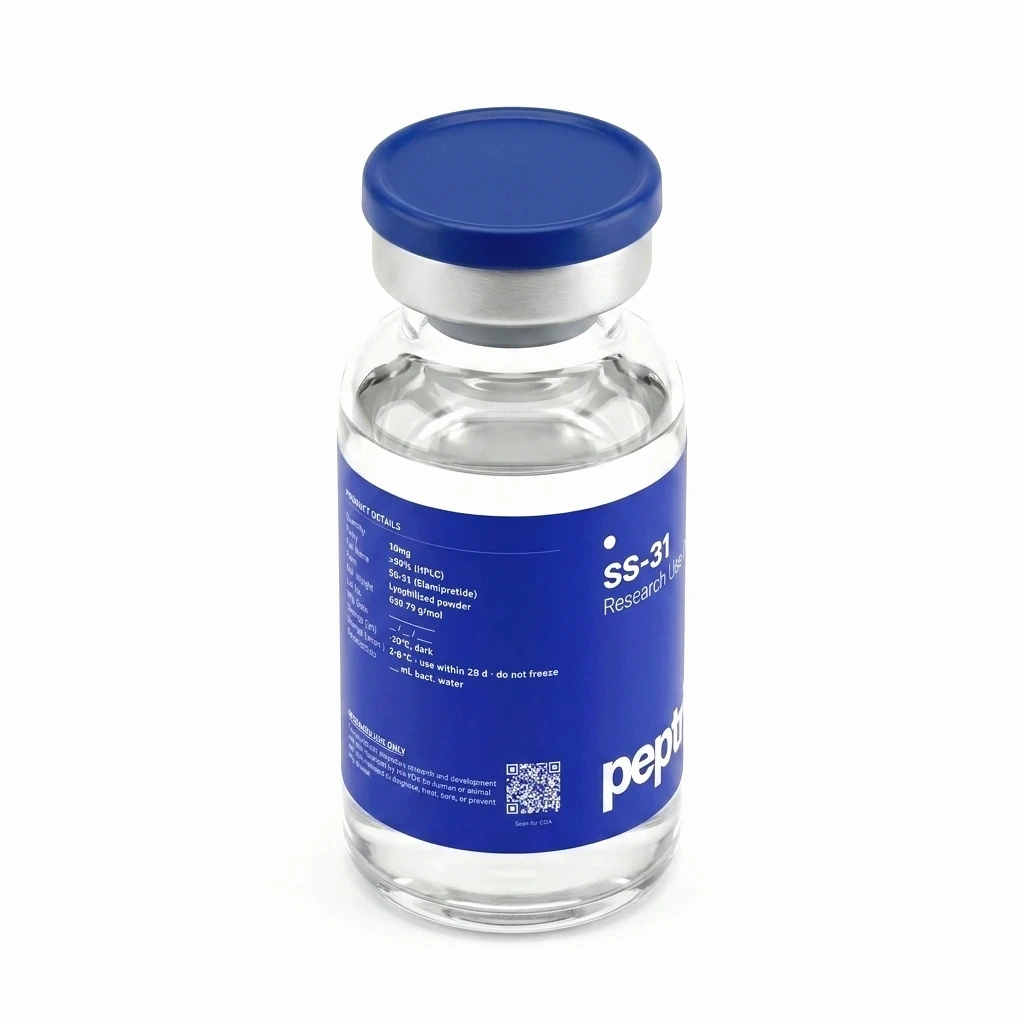
SS-31 (Elamipretide)
The same D-Arg-Dmt-Lys-Phe-NH2 tetrapeptide cited across the 2025 Tung et al. mechanism review and the TAZPOWER + MMPOWER-3 Phase III program. Chiral-HPLC verified D-arginine, observed mass [M+H]+ 640.8, ≥99% HPLC purity, ISO 17025 third-party CoA on every lot. Research Use Only — not the same product as prescription Forzinity.
How to verify research-grade SS-31
The standard eight criteria for any peptide vendor apply here. Four of them are sharper for SS-31, because this molecule has structural quirks most vendors aren't equipped to verify.
1. Confirm the D-arginine
The first residue is D-arginine. That's the mirror-image form of normal L-arginine. The D-form is what gives elamipretide two of its key properties: it resists breakdown by enzymes (proteolytic resistance), and it can cross cell membranes to reach mitochondria. If the synthesis used L-arginine instead, the material is not SS-31 — it is a related but inactive peptide.
The lab confirms D-arginine three ways: chiral HPLC, optical-rotation measurement, or amino-acid analysis after acid hydrolysis. If the CoA doesn't mention any of these, it's missing the most distinctive identity check for this peptide.
2. Confirm the Dmt residue
The second residue is 2',6'-dimethyltyrosine. That's a non-canonical amino acid: it's tyrosine with two extra methyl groups on the aromatic ring. It isn't sold as a standard building block. Suppliers either synthesize it themselves or source it from a specialty vendor.
Vendors who quietly substitute regular tyrosine (which is cheaper and off-the-shelf) aren't producing SS-31. The check: mass-spec at the expected mass, plus NMR or amino-acid analysis confirming Dmt specifically.
3. Mass-spec the molecule
The theoretical mass of SS-31 is ~639.79 g/mol. A research-grade CoA should report observed mass at [M+H]+ 640.8, within 0.3 Da of theoretical. If the observed mass is meaningfully different, the material is not SS-31. The likely substitution is regular tyrosine instead of Dmt, which produces a mass near 612 Da — a 28 Da gap representing the two missing methyl groups.
4. Lyophilized only — no sprays, no patches
Every Phase III trial (MMPOWER-3, TAZPOWER, PROGRESS-HF) used reconstituted lyophilized powder as the study formulation. Research-grade SS-31 should ship as a freeze-dried powder for reconstitution. Capsules, sublingual sprays, and transdermal patches have not been studied in any published trial. Pre-reconstituted liquid shipped without cold chain has already started degrading by the time it is received.
What research-grade SS-31 costs in 2026
SS-31 is one of the more expensive peptides per milligram in this Library. Not because it's long (it's only four residues). It's because two of those four are non-standard. The D-arginine must be sourced as the D-isomer specifically. The Dmt must be synthesized or bought from a specialty supplier. Both add real cost.
Representative 2026 pricing benchmarks for research-grade SS-31:
- 10 mg vial: $80–$150 ($8–$15/mg). The most common retail size.
- 20 mg vial: $130–$220 ($6.50–$11/mg). Better per-mg value for animal-model work.
- 50–100 mg lots: $300–$700 ($6–$8/mg). For academic and industry research groups.
- Prescription Forzinity: $300,000–$750,000 per patient-year. That's orphan-drug pricing, not retail markup.
Pricing below $50 per 10 mg vial is a quality signal worth investigating. The D-arginine and Dmt residues are genuine synthesis costs, and HPLC purification that separates crude material from research-grade product adds further cost. The low end of the SS-31 market frequently reflects substitution: L-arginine instead of D-arginine, regular tyrosine instead of Dmt, or both — producing a related peptide that is not SS-31. Pricing above $30/mg typically reflects retail margin rather than synthesis cost.
Where this falls short. The 2025 Mitchell Aging Cell paper found functional improvements in aged mice but no detectable changes in epigenetic or transcriptomic age (Mitchell et al., 2025). MMPOWER-3 in primary mitochondrial myopathy missed its primary endpoint. The TAZPOWER trial that got Forzinity approved had just 10 patients — a real Phase III, but a small one for an ultra-rare disease. Accelerated approval also means post-marketing trials still have to confirm benefit. Translation: this is the cleanest evidence base for any mitochondria-targeted peptide, and it's still narrow.
Legal status — what changed in September 2025
Before September 2025, elamipretide was a Phase III investigational drug. It was available only through clinical trials or through limited 503A compounding. Research-grade SS-31 was sold under Research Use Only labeling. That channel hasn't changed.
The FDA approval changed three things:
- Created the prescription Forzinity channel. Patients with confirmed Barth syndrome can now get elamipretide as a finished pharmaceutical product through specialty pharmacy, with insurance, post-marketing surveillance, and the rest of the drug infrastructure (Shirley, 2025).
- Closed most of the 503A compounded channel. 503A pharmacies generally can't produce "essentially a copy" of an FDA-approved drug. The compounded-elamipretide route that operated before approval is now largely unavailable.
- Didn't change research-grade. Research Use Only labeling under 21 CFR § 809.10(b)(9) still applies to chemical suppliers selling SS-31 for lab work. Approval of one finished product doesn't criminalize research-chemical synthesis of the underlying molecule.
For deeper context on the September 2025 approval, see our Forzinity FDA approval article.
Red flags to watch for
- No chirality verification on the CoA. If the lab didn't confirm D-arginine, they didn't check the most distinctive feature of this peptide.
- Mass-spec near 612 [M+H]+ instead of 640.8. That 28 Da gap is two missing methyl groups — the Dmt was substituted with regular tyrosine.
- "SS-31 for longevity" or "anti-aging." The only FDA-supported indication is Barth syndrome. Mouse functional data doesn't extrapolate to healthy adults.
- "Equivalent to Forzinity." Same molecule, different products, different oversight. Equivalence claims cross FDA jurisdiction.
- Capsules, sprays, or transdermal patches. Every Phase III trial used reconstituted lyophilized powder as the study formulation. Other delivery routes have not been studied in any published trial.
- Pre-reconstituted liquid without cold chain. Reconstituted SS-31 at room temperature has a much shorter shelf life than the dry powder.
- Internal-QC-only documentation. You want third-party ISO 17025 verification, not the vendor's own paperwork.
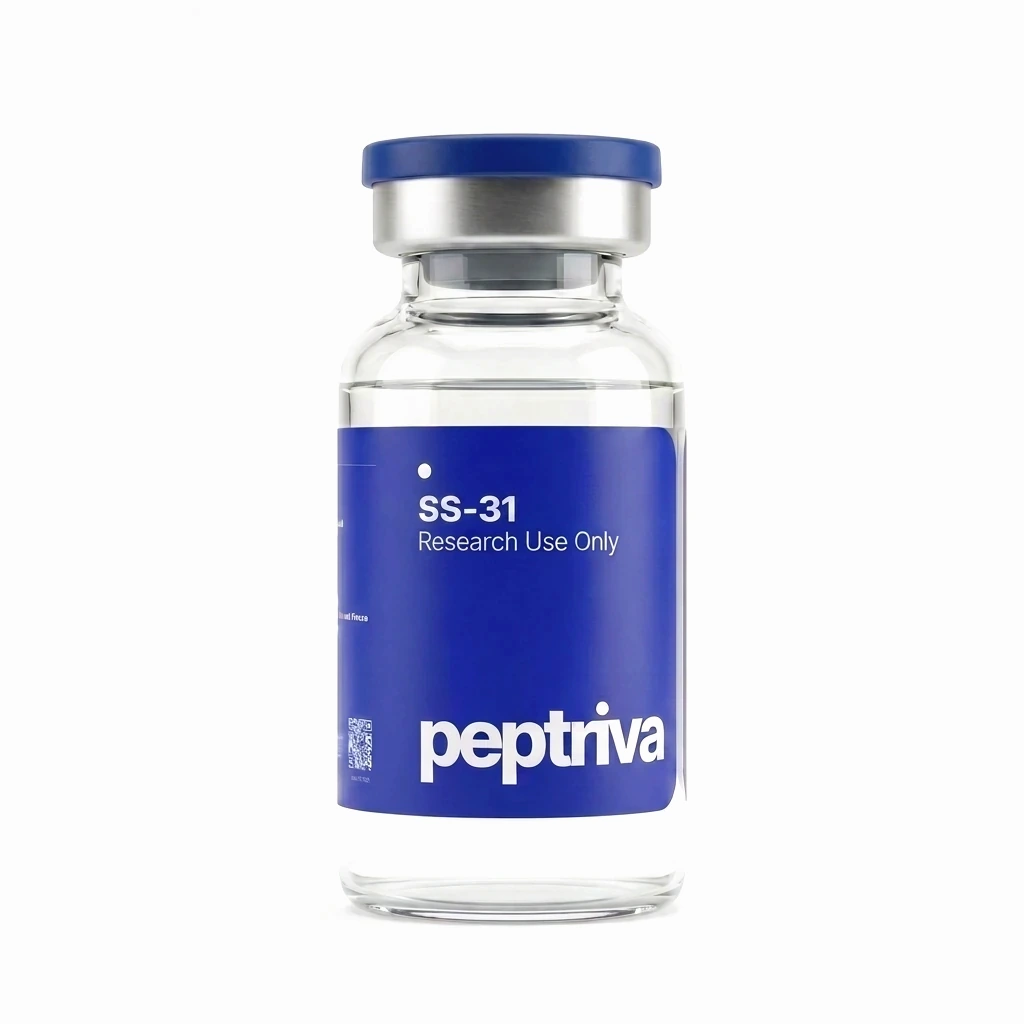
SS-31 (Elamipretide)
D-Arg-Dmt-Lys-Phe-NH2 tetrapeptide, theoretical MW ~639.79. The same reference compound studied across the MMPOWER-3, TAZPOWER + 168-week OLE, and ongoing NuPOWER / ReCLAIM / PROGRESS-HF Phase III programs. COA with HPLC trace, mass-spec, and chiral verification ships with every order. Research Use Only.
Elamipretide selectively concentrates in the inner mitochondrial membrane, where it binds cardiolipin — the signature lipid of healthy cristae — and stabilizes the cardiolipin–cytochrome c supercomplex.
— Tung et al., International Journal of Molecular Sciences, 2025
Frequently asked questions
Is SS-31 legal to buy in the USA?
Two channels, two answers. Prescription Forzinity is legal only with a Barth syndrome diagnosis, dispensed through specialty pharmacy with a physician prescription. Research-grade SS-31 from chemical suppliers is legal as a Research Use Only compound for laboratory work under 21 CFR § 809.10(b)(9). It is not the same product as Forzinity. Selling it for human consumption is illegal.
What's the difference between Forzinity and research-grade SS-31?
Forzinity is the FDA-approved version, made by Stealth under cGMP. It ships through specialty pharmacy with prescribing info, post-marketing surveillance, and insurance coverage. Research-grade SS-31 is the same tetrapeptide, made by chemical suppliers under Research Use Only labeling. The molecules are nominally identical. The manufacturing controls, quality systems, and intended use aren't.
How much should research-grade SS-31 cost?
Roughly $80–$150 per 10 mg vial, $130–$220 per 20 mg vial, and $300–$700 for 50–100 mg lots. SS-31 is short (four residues) but expensive to make because of the D-arginine and Dmt. Prescription Forzinity sits in the $300,000–$750,000 per patient-year orphan-drug range and isn't directly comparable.
What is Forzinity approved for?
The FDA granted accelerated approval in September 2025 for improvement of muscle strength in Barth syndrome patients ≥30 kg. The basis was the TAZPOWER 28-week RCT plus its 168-week open-label extension. Accelerated approval requires confirmatory trials after launch. Forzinity isn't approved for primary mitochondrial myopathy, dry AMD, heart failure, sarcopenia, or anti-aging.
What should an SS-31 Certificate of Analysis show?
HPLC purity ≥98% with the chromatogram. Mass-spec at observed [M+H]+ 640.8 (theoretical MW 639.79). Chiral-HPLC confirming D-arginine. NMR or amino-acid analysis confirming Dmt. Karl Fischer water content 2–8% for lyophilized material. Counterion content (usually acetate or trifluoroacetate). The testing lab should be ISO/IEC 17025 accredited and named on the report.
SS-31 vs MOTS-c — which one for research?
Different mechanisms, different evidence tiers. SS-31 is a synthetic tetrapeptide that binds cardiolipin in the inner mitochondrial membrane. It now holds FDA accelerated approval. MOTS-c is a 16-residue peptide encoded by mitochondrial DNA, with proposed AMPK-related metabolic effects. It has no FDA approval and stays an early-stage research target. SS-31's clinical program is an order of magnitude more mature. See SS-31 vs MOTS-c.
How should research-grade SS-31 be stored?
Lyophilized material should be stored at −20°C, protected from light, with a multi-year shelf life when properly handled. Once reconstituted, the solution should be stored at 2–8°C and used within 30 days. The D-amino acid residue confers proteolytic resistance in biological systems, but does not protect against hydrolysis or oxidation in solution.
What to know now
- Three channels. Prescription Forzinity, 503A compounded (now sharply limited), research-grade RUO. September 2025 changed the map.
- Mass-spec line: [M+H]+ 640.8. Theoretical MW 639.79. That's what a credible CoA should show.
- D-Arg + Dmt verification is non-negotiable. Chiral HPLC for D-Arg, NMR or amino-acid analysis for Dmt.
- $80–$220 per vial. Non-standard residues drive per-mg cost above what four residues should imply.
- FDA-approved indication is Barth syndrome only. ≥30 kg patients with a confirmed diagnosis. Longevity and anti-aging marketing extrapolates well past the trial evidence.
- Lyophilized formulation only. Capsules, sprays, and transdermal patches have not been studied in any Phase III trial.
- Research-grade isn't Forzinity. Same nominal molecule, different products, different oversight.
What we’re watching
Over 2026–2027, we're watching the FDA post-marketing confirmatory trials that Forzinity's accelerated approval requires. We're also watching three Phase III readouts: NuPOWER in primary mitochondrial myopathy (which tests the MMPOWER-3 responder hypothesis), ReCLAIM in dry AMD, and PROGRESS-HF in heart failure with reduced ejection fraction. Any of these could expand the approved-indication footprint. Any could also narrow the clinical-benefit story if the data don't hold up. Separately, the 503A compounded channel is still settling out as pharmacies and the FDA work through what the approval means for off-label compounding.
References
- Shirley, M. (2025). Elamipretide: First approval. Drugs, 86(3), 377–383. https://doi.org/10.1007/s40265-025-02269-8
- Karaa, A., Haas, R., Goldstein, A., Vockley, J., & Cohen, B. (2023). Efficacy and safety of elamipretide in individuals with primary mitochondrial myopathy: The MMPOWER-3 randomized clinical trial. Neurology. https://doi.org/10.1212/WNL.0000000000207402
- Karaa, A., Bertini, E., Carelli, V., et al. (2024). Genotype-specific effects of elamipretide in patients with primary mitochondrial myopathy: A post hoc analysis of the MMPOWER-3 trial. Orphanet Journal of Rare Diseases, 19(1), 431. https://doi.org/10.1186/s13023-024-03421-5
- TAZPOWER OLE Investigators. (2024). Long-term efficacy and safety of elamipretide in patients with Barth syndrome: 168-week open-label extension results of TAZPOWER. Genetics in Medicine. https://doi.org/10.1016/j.gim.2024.101138
- Tung, C., Varzideh, F., Farroni, E., et al. (2025). Elamipretide: A review of its structure, mechanism of action, and therapeutic potential. International Journal of Molecular Sciences, 26(3), 944. https://doi.org/10.3390/ijms26030944
- Mitchell, W., Pharaoh, G., Tyshkovskiy, A., et al. (2025). The mitochondria-targeted peptide therapeutic elamipretide improves cardiac and skeletal muscle function during aging without detectable changes in tissue epigenetic or transcriptomic age. Aging Cell, 24(6), e70026. https://doi.org/10.1111/acel.70026
- Obi, C., Smith, A. T., Hughes, G. J., & Adeboye, A. A. (2022). Targeting mitochondrial dysfunction with elamipretide. Heart Failure Reviews, 27(5), 1925–1932. https://doi.org/10.1007/s10741-021-10199-2
- U.S. Food and Drug Administration. (2023). Section 503A of the Federal Food, Drug, and Cosmetic Act. https://www.fda.gov/drugs/human-drug-compounding/section-503a-federal-food-drug-and-cosmetic-act
- U.S. Government Publishing Office. 21 CFR § 809.10 — Labeling for in vitro diagnostic products. https://www.ecfr.gov/current/title-21/chapter-I/subchapter-H/part-809/section-809.10
- International Organization for Standardization. (2017). ISO/IEC 17025:2017 — General requirements for the competence of testing and calibration laboratories. https://www.iso.org/standard/66912.html